

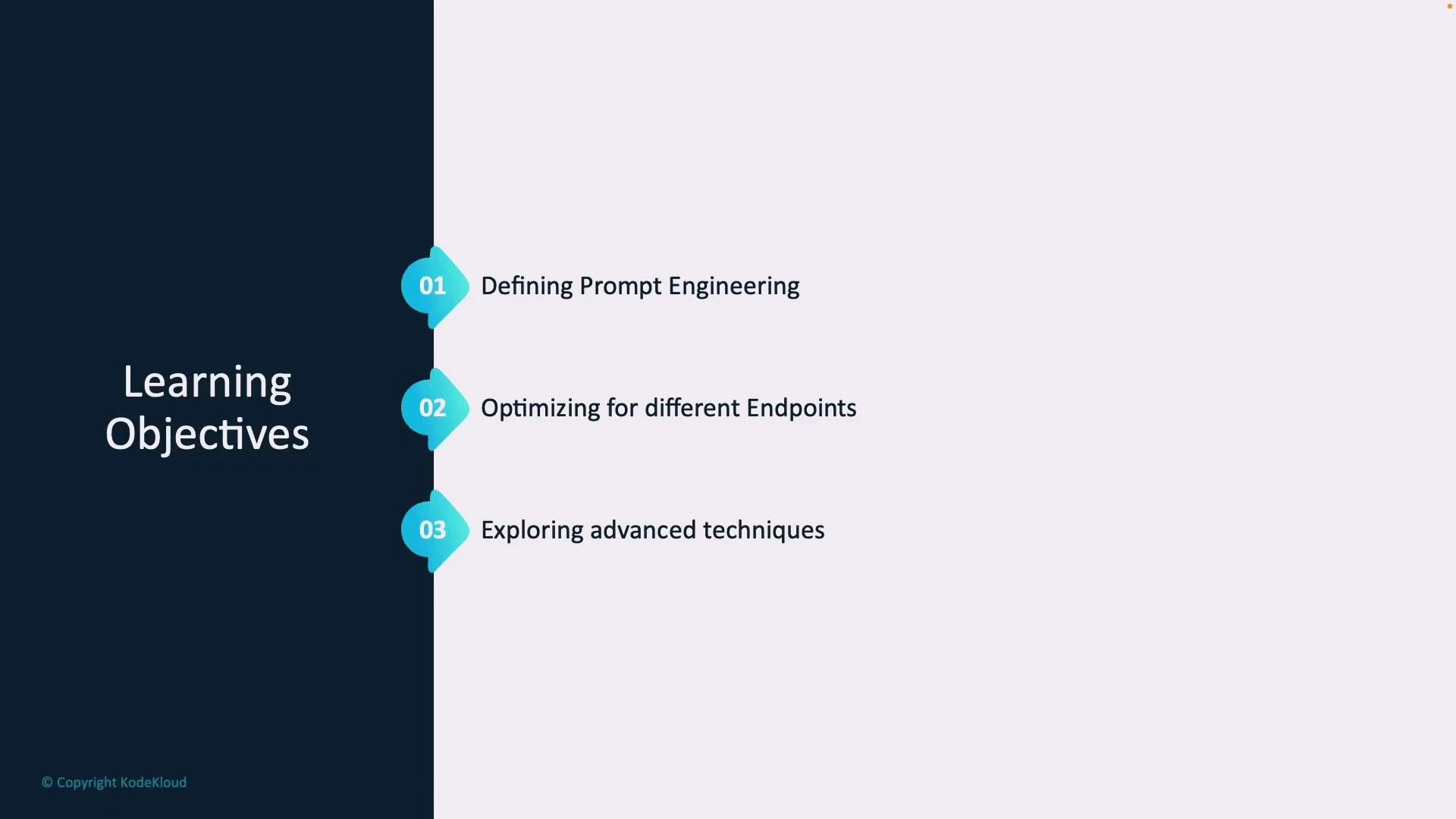
- Define prompt engineering and explain its importance for production systems.
- Show how to design prompts tailored to different endpoints (for example, completions vs. chat).
- Explore advanced techniques to improve consistency, accuracy, and safety of model responses and how to apply them in real applications.
- Practical strategies to convert user intent into structured prompts.
- How to select and adapt prompts depending on whether you call completion, chat, or function-calling endpoints.
- Methods to increase output determinism (temperature & sampling strategies), enforce format constraints, and apply guardrails for safety and compliance.
Prompt engineering is both art and engineering: iterate with small, measurable changes (e.g., tweak temperature, add examples, constrain formats) and validate outputs with automated tests before deploying.
- Prompt structure and components: system instructions, user instructions, examples, and constraints.
- Endpoint considerations: completions vs. chat — when to use each and how to format prompts.
- Advanced prompt patterns: few-shot examples, chain-of-thought prompting, step-by-step decomposition, and output validation.
- Safety and control: using instructions, post-processing, and automated checks to reduce harmful or incorrect outputs.
- Testing & monitoring: QA approaches to ensure prompt changes don’t degrade performance in production.
- Azure OpenAI Service documentation — official guidance on endpoints, SDKs, and deployment.
- Prompting best practices — OpenAI — general prompt design techniques.
- Responsible AI and safety guidelines — principles for building safe AI applications.
Always validate generation outputs against concrete requirements (format, factuality, safety). Small prompt changes can substantially alter model behavior — use automated tests and monitoring before pushing updates to production.