

- Google Translate — translate pasted text, spoken words, or text captured from images.
- Microsoft Copilot — helps write emails, summarize documents, and generate Excel formulas from plain-English instructions.
- GitHub Copilot — suggests code while developers type.
- ChatGPT — generates ideas, drafts content, and explains complex topics.
- Google Lens — recognizes objects and extracts or translates text from images.
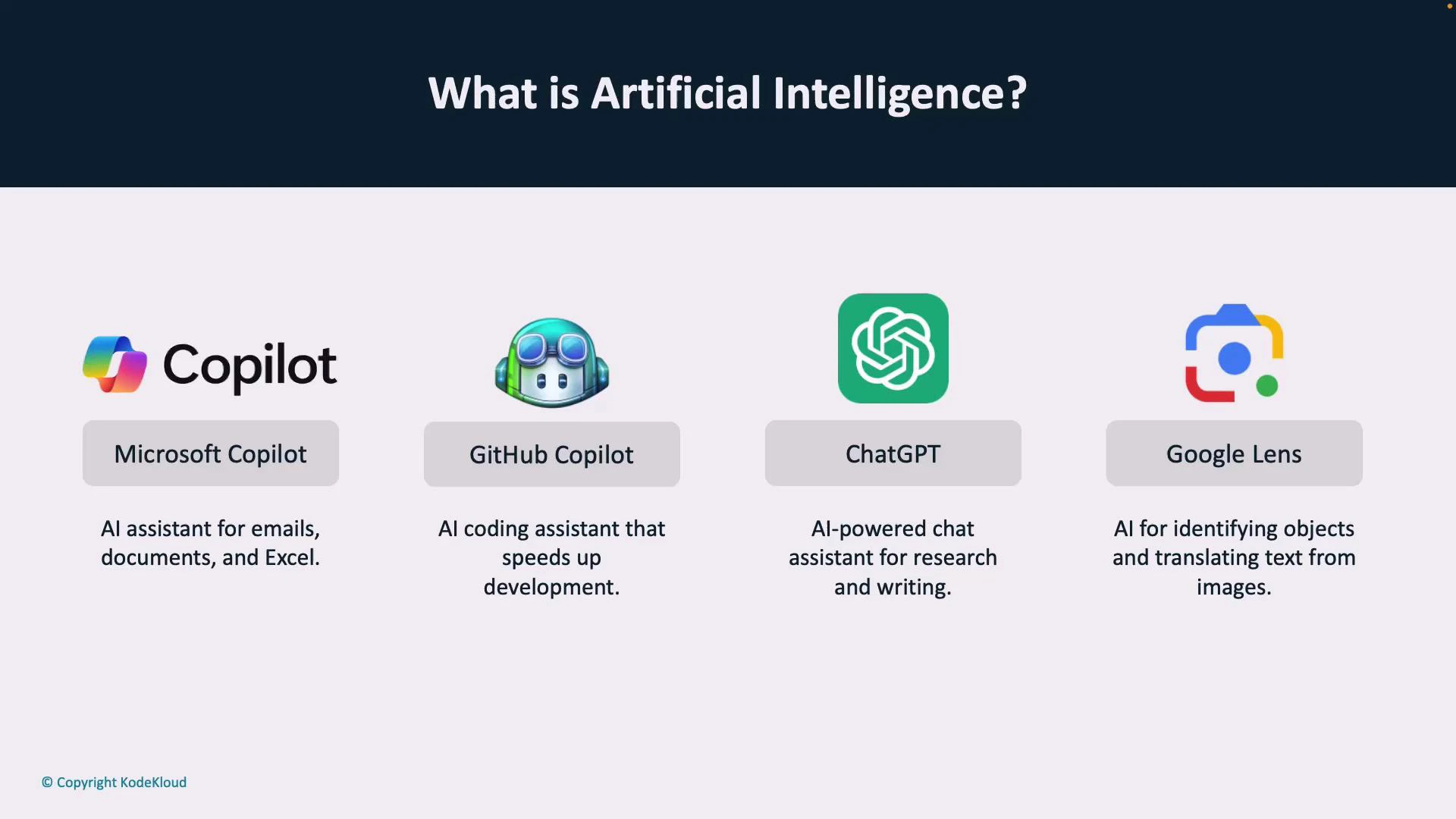
AI enables faster, more accessible communication and automation—reducing manual effort for translation, transcription, image understanding, and conversational assistance.
Core AI capability areas
AI systems typically focus on one or more capability areas. The table below summarizes common capability categories, their purpose, and example uses.
Note: some applications combine multiple capabilities (for example, an app that recognizes a product from an image and then answers user questions about it).
Some inferences—such as attempting to read emotions from facial expressions—are unreliable and ethically contentious. Design AI systems with care to avoid harm, bias, or false confidence.
Skills software engineers need to work with AI
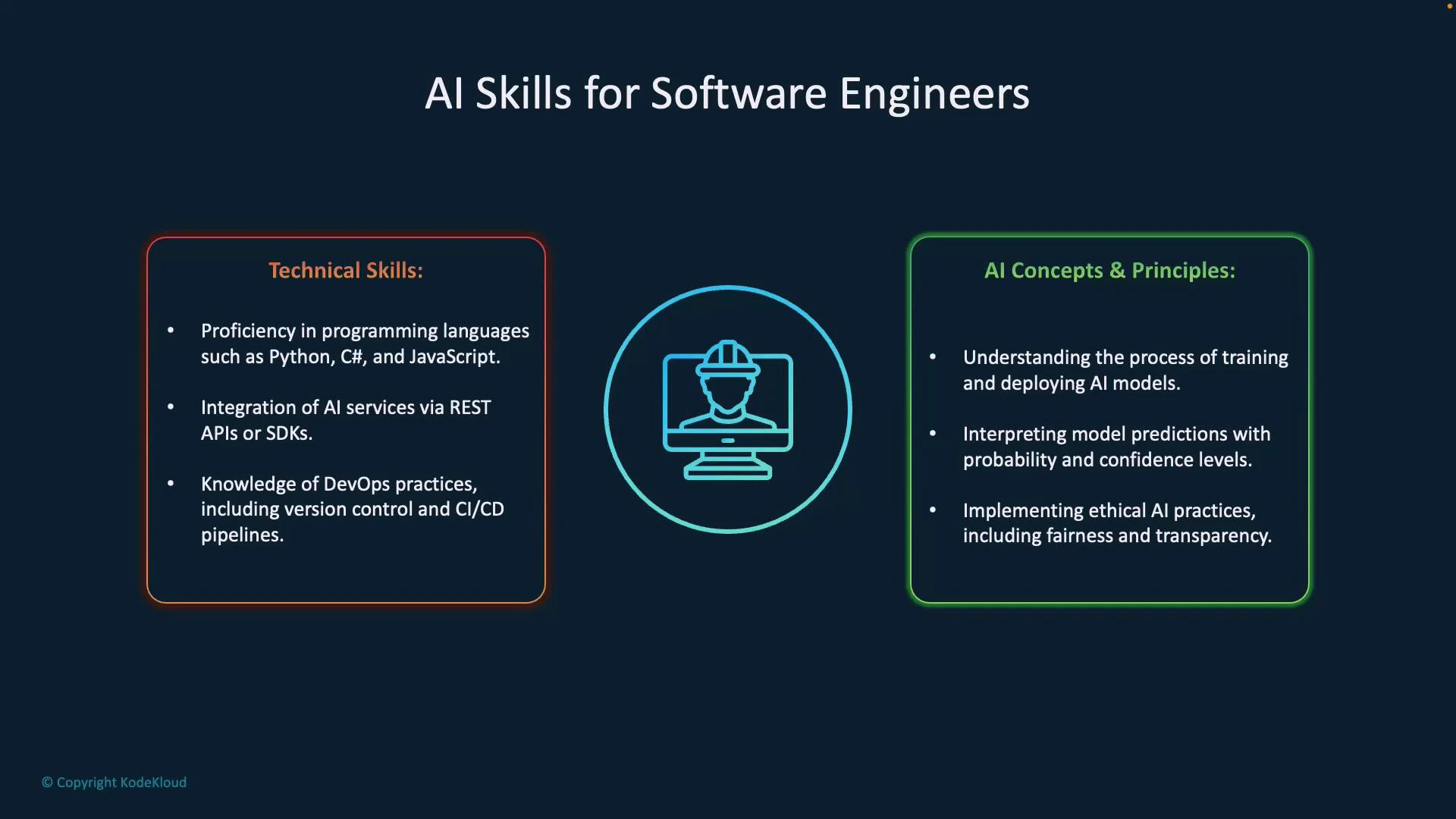
Working with AI in production requires both software engineering practices and conceptual understanding of models. Below is a practical breakdown you can use to evaluate or plan skill development.
For example, practical learning paths cover how to start from a base model, deploy it, integrate it with an application via APIs or SDKs, and manage it in production. These are hands-on skills you’ll use to integrate AI responsibly into real systems.
Responsible AI & governance
Responsible AI is a cross-cutting requirement for production systems. Consider fairness, transparency, privacy, and accountability from design through deployment:- Evaluate datasets for bias and representativeness.
- Expose confidence and limitations of model outputs to users.
- Log model decisions and monitor performance in production.
- Apply privacy-preserving techniques when handling sensitive data.
Always test AI systems for failure modes and biased behavior before deployment. Ethical reviews and governance policies should be part of your release checklist.
Links and references
- Google Translate — translation and image text recognition
- Microsoft Copilot — productivity assistant
- GitHub Copilot — code completion and suggestions
- ChatGPT — conversational AI and content generation
- Google Lens — image recognition and text extraction