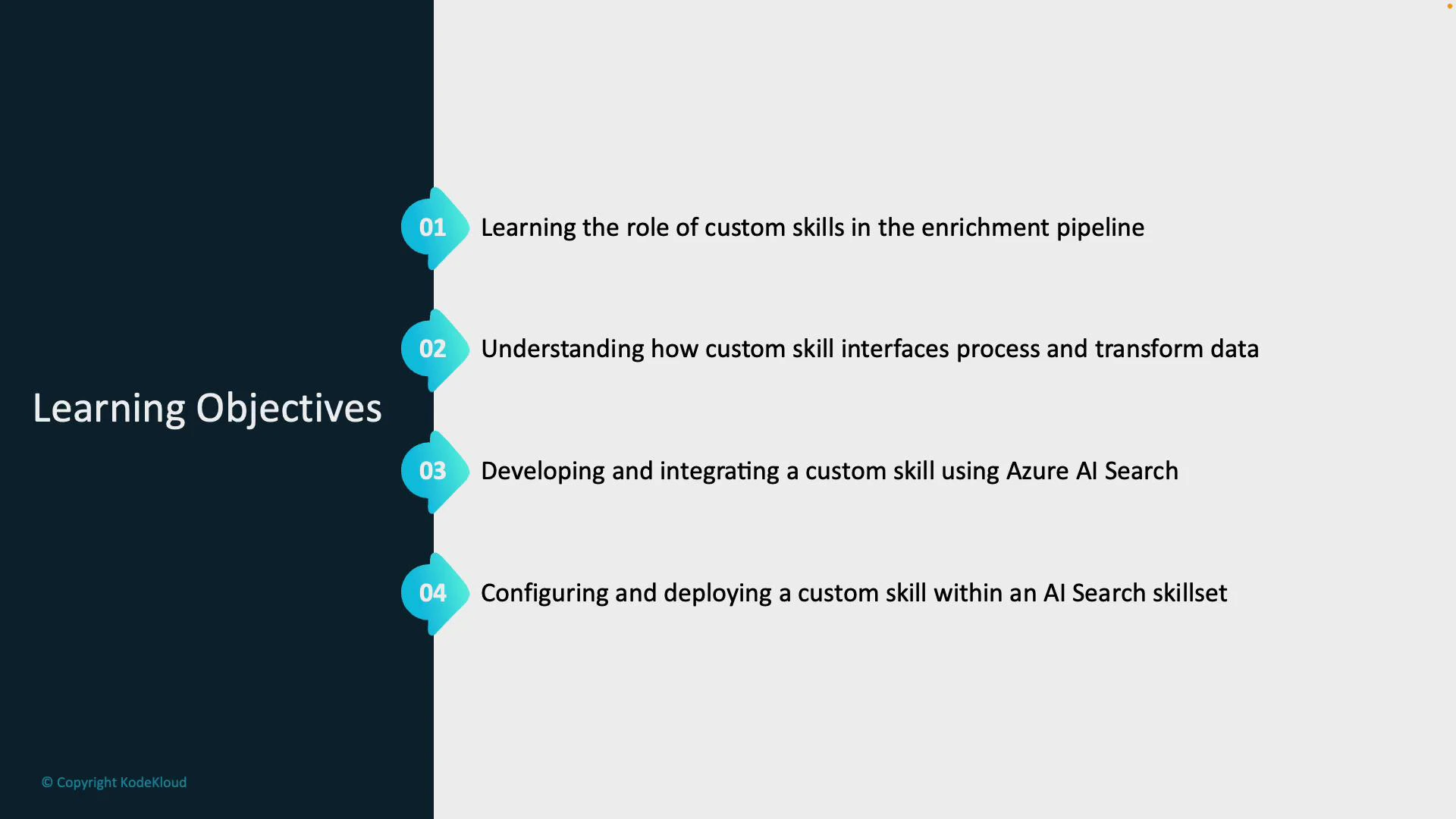
| Learning objective | What you’ll learn | Example outcome |
|---|---|---|
| Role of custom skills in the enrichment pipeline | How custom skills complement built-in skills to perform specialized content processing during indexing | Enrich documents with domain-specific metadata that built-in skills cannot extract |
| Custom skill interface design | Input/output JSON contract, required fields, and shape of the request/response for Azure AI Search | Create an HTTP endpoint that accepts Azure enrichment JSON and returns transformed values |
| Develop, host, and register a custom skill | Implement skill logic, host as a secure web API, and register the endpoint in Azure AI Search | Deploy a Dockerized API and add it to a skillset using the Azure portal or REST API |
| Configure and deploy in a skillset | Add the custom skill to a skillset and ensure it runs as part of the indexer pipeline | Index enriched content automatically with the configured skillset and indexer |

Custom skills are HTTP endpoints that accept and return JSON payloads following Azure AI Search’s enrichment contract. When building a custom skill, pay attention to the API contract (input/output schema), authentication (API key, Azure AD), performance (minimize latency), error handling (graceful failures and retry semantics), and secure hosting. These considerations ensure the custom skill integrates reliably into the enrichment pipeline and scales with your indexing workload.
Links and references
- Azure Cognitive Search documentation
- Create a custom skill for Azure Cognitive Search — guidance and examples
- Designing HTTP APIs: best practices for reliability and performance