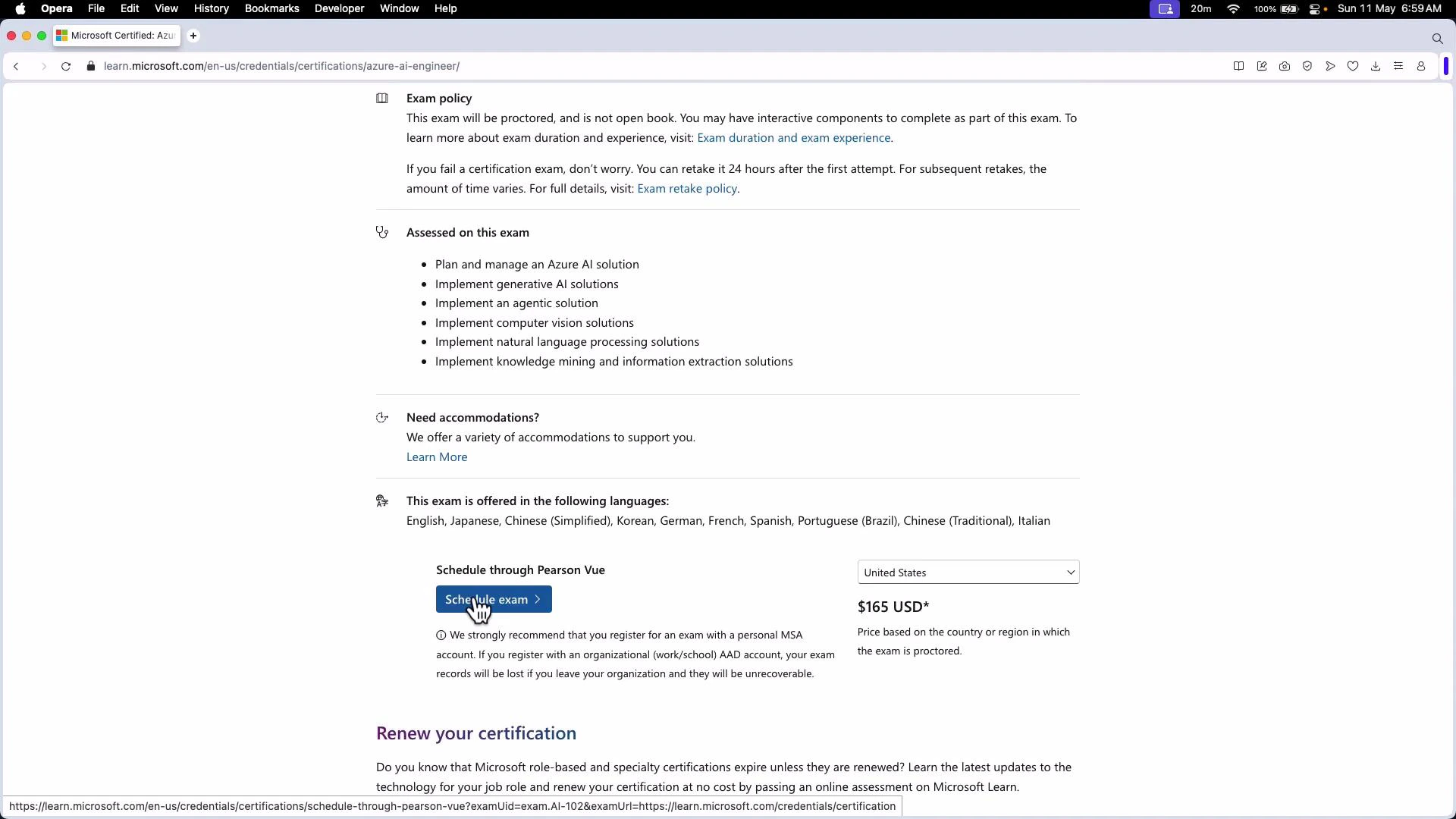
Below we expand each area with focused takeaways so you know what to study and which hands‑on skills to practice.
Plan and manage AI solutions (20–25%)
- Understand core AI concepts and how Azure AI Services map to solution requirements.
- Choose the right Azure AI components (Vision, Language, Speech, OpenAI, Cognitive Search) and integrate them with enterprise-grade security, monitoring, and cost controls.
- Apply governance and lifecycle practices: authentication (managed identities), role-based access, logging, and responsible AI considerations.
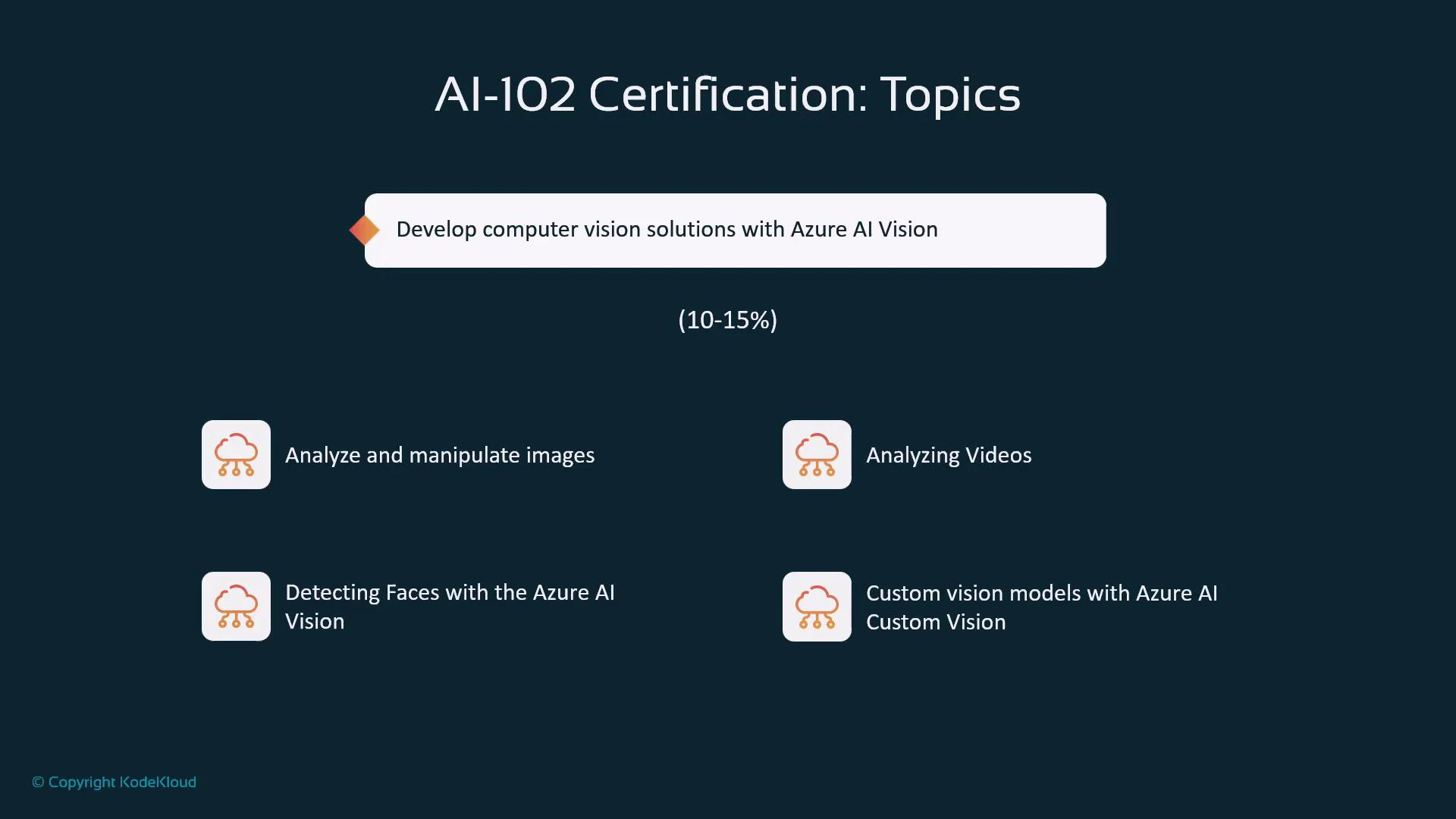
- Use prebuilt vision APIs for image analysis, OCR, and face detection.
- Extract searchable metadata from video content and generate frame-level insights.
- Train and evaluate custom models (Azure Custom Vision) to detect domain-specific objects and visual patterns.
- Optimize deployment options for latency and cost (edge vs cloud).
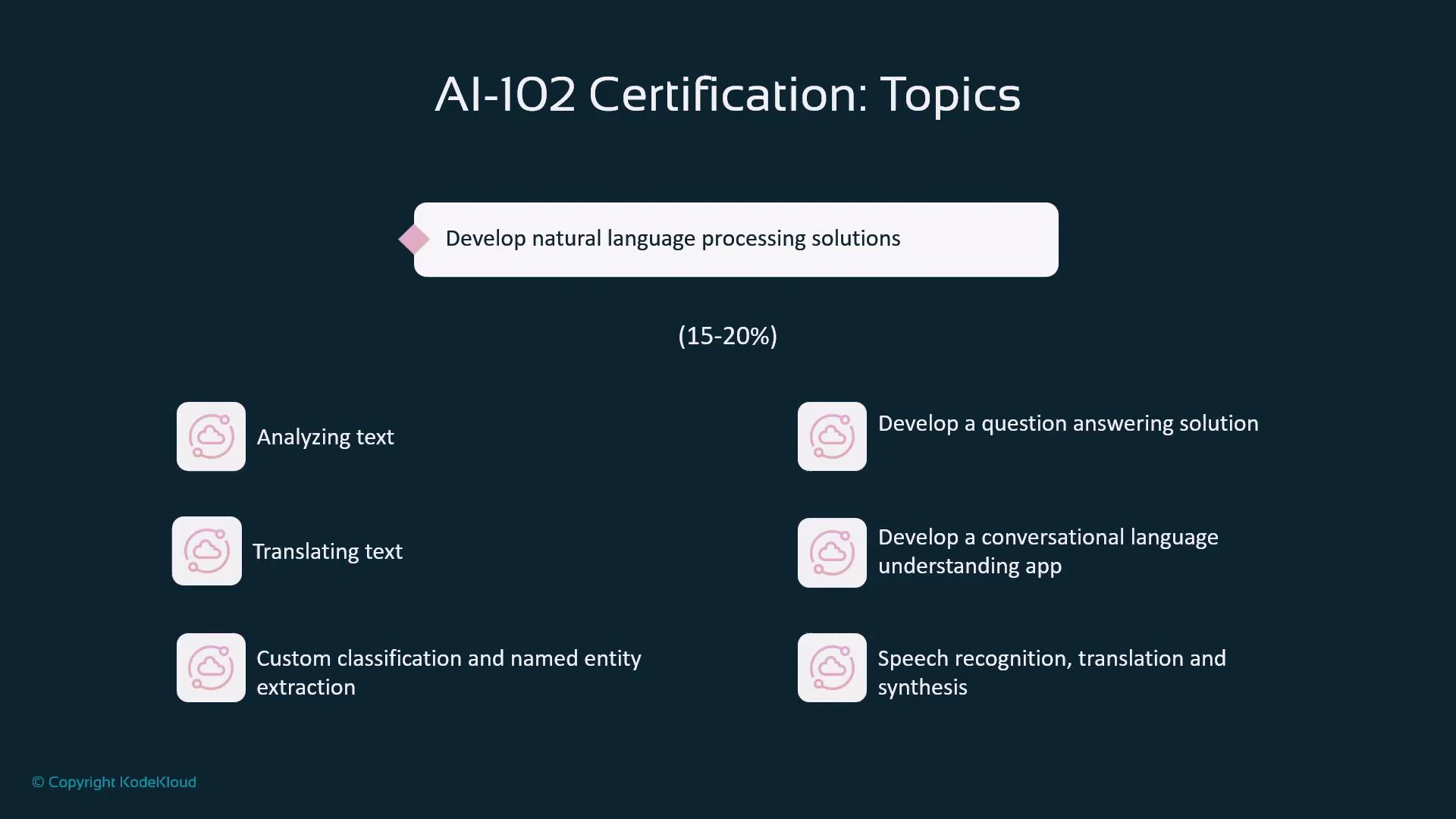
- Perform text analytics: sentiment analysis, key-phrase extraction, language detection, and topic modeling.
- Build question-answering systems and retrieval-backed conversational layers.
- Implement translation and multilingual pipelines with high accuracy.
- Create conversational language understanding solutions: intent recognition, entity extraction, and dialog management.
- Use Document Intelligence to extract structure from documents; implement custom classification and NER for domain-specific labeling.
- Work with speech technologies: speech-to-text, translation, and text-to-speech.
- Connect to Azure OpenAI Service to integrate large language models (LLMs) into applications.
- Use SDKs and REST APIs to call models for text generation, summarization, and code generation.
- Improve factuality and relevance using retrieval-augmented generation (RAG) to ground outputs in your documents and databases.
- Apply prompt engineering best practices to design prompts that produce consistent, safe, and useful responses.
- Build search and indexing solutions with Azure Cognitive Search to surface insights from unstructured data.
- Use Document Intelligence (formerly Form Recognizer) to extract structured fields from invoices, forms, receipts, and contracts.
- Extend enrichment pipelines with Custom Skills for specialized processing.
- Persist enriched, structured data into a Knowledge Store for analytics and queryable outputs.
- Module-level recap questions reinforce core concepts and check practical knowledge.
- Mock exams simulate the certification environment and highlight knowledge gaps to prioritize study.
- Hands-on labs demonstrate integrations with the Azure SDKs (Python and C#), REST APIs, and Azure Portal workflows.
- Direct links to official Microsoft resources let you review exam objectives and practice with vendor-provided materials.
Before scheduling the exam: ensure you have practical experience with at least one programming language (Python or C#). Most labs and real-world tasks require writing code to call Azure SDKs, manage resources, and integrate services.
- Official exam page: AI-102 exam details — Microsoft Learn
- Certification learning path: Azure AI Engineer — Microsoft Learn
- Practice assessments and scheduling: check the official exam page for links to practice tests and Pearson VUE scheduling.