

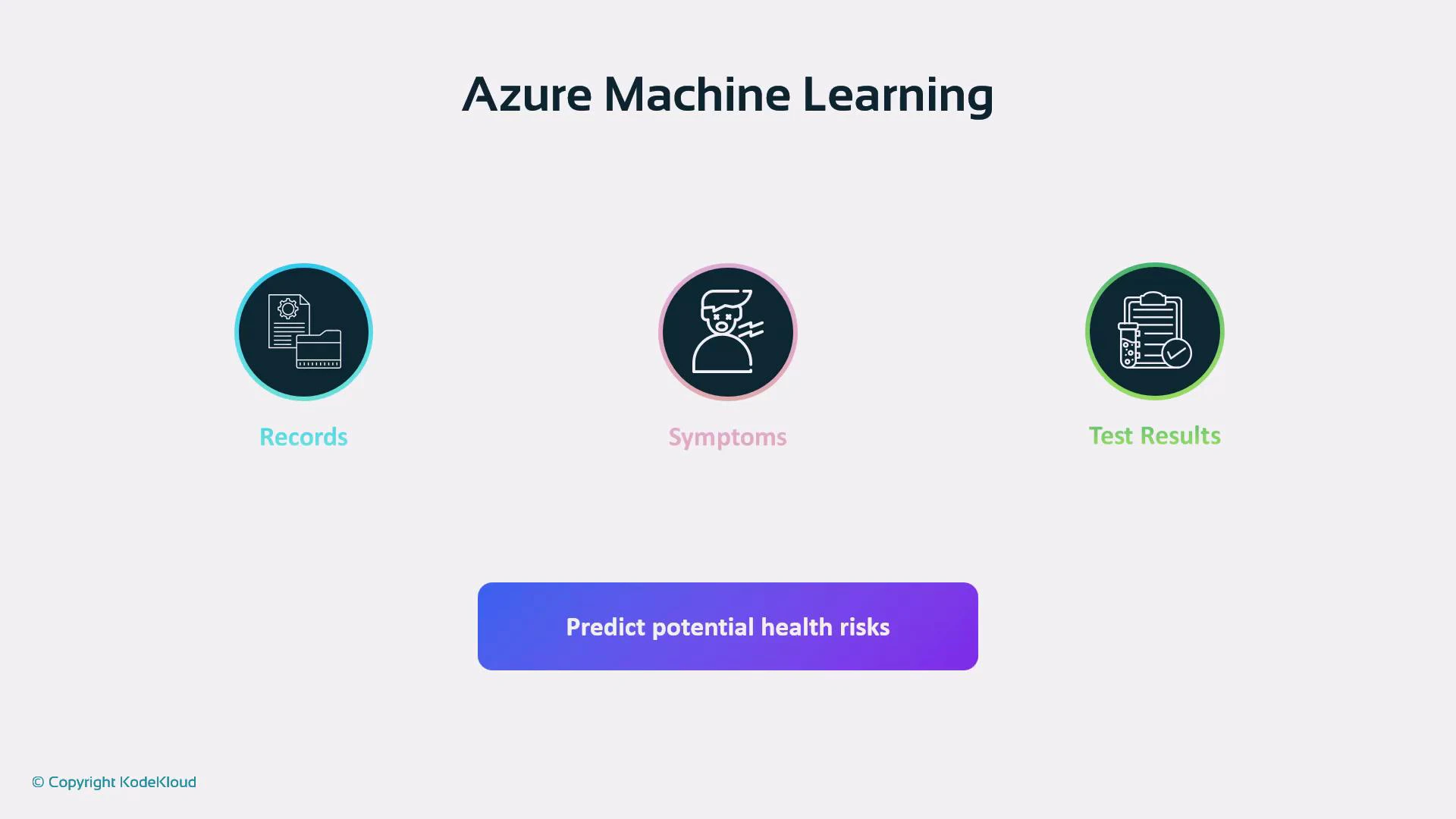
What is Azure Machine Learning?
Azure Machine Learning is Microsoft’s cloud service designed for data scientists and developers to manage the end-to-end machine learning lifecycle. It provides managed compute, scalable storage, experiment tracking, model registries, and deployment endpoints—so teams can focus on building models and delivering predictions rather than operating infrastructure. Key capabilities include:- Managed compute: interactive compute instances, training clusters, and inference targets.
- Experimentation and reproducibility: tracking runs, logs, and metrics.
- Model registry and versioning: store and manage production-ready models.
- Flexible deployment: real-time (online) endpoints and batch scoring pipelines.
- Integrations: AutoML, Azure ML Studio, Python SDK, and Azure CLI.
- MLOps support: CI/CD, repeatable pipelines, and governance for production ML.
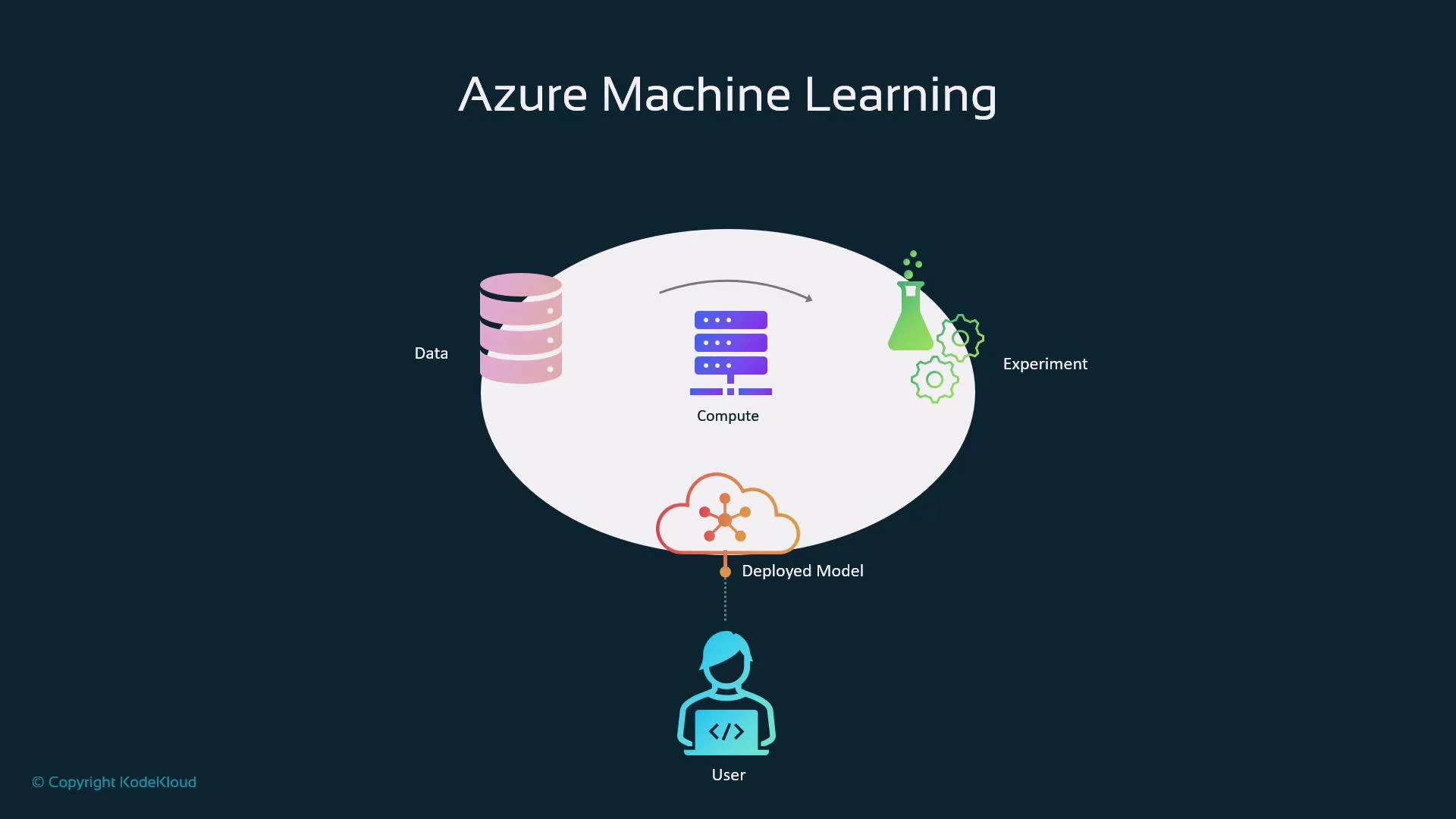
Simplified Azure ML workflow
Below is a streamlined view of the typical Azure ML lifecycle—useful for planning ML projects, regulatory compliance, and operationalizing models.
A typical lifecycle maps to Azure ML services (Datasets, Jobs/Experiments, Model Registry, Endpoints) and integrates with CI/CD for production deployments.
Integrations and best practices
Azure ML supports the full lifecycle: data preparation (Datasets), training (Jobs/Experiments), orchestration and CI/CD for models (MLOps), model registry, and deployments (real-time and batch). It also integrates with AutoML for common tasks and provides SDKs and studio interfaces for reproducible workflows. For production-grade ML, consider:- Automating training and deployment with pipelines and CI/CD.
- Monitoring model performance and data drift to trigger retraining.
- Using model explainability tools to increase transparency.
- Enforcing role-based access and audit trails for governance.
When working with healthcare or sensitive data, ensure compliance with regulations such as HIPAA and GDPR. Use Azure security features—private networks (VNet), role-based access control (RBAC), encryption at rest and in transit, and audit logging—to protect patient information.
Links and references
- Azure Machine Learning documentation: https://learn.microsoft.com/azure/machine-learning/
- Azure AI services overview: https://learn.microsoft.com/azure/ai-services/
- Fundamentals of MLOps course: https://learn.kodekloud.com/user/courses/fundamentals-of-mlops
- HIPAA overview: https://www.hhs.gov/hipaa/index.html
- GDPR overview: https://gdpr.eu/