

-
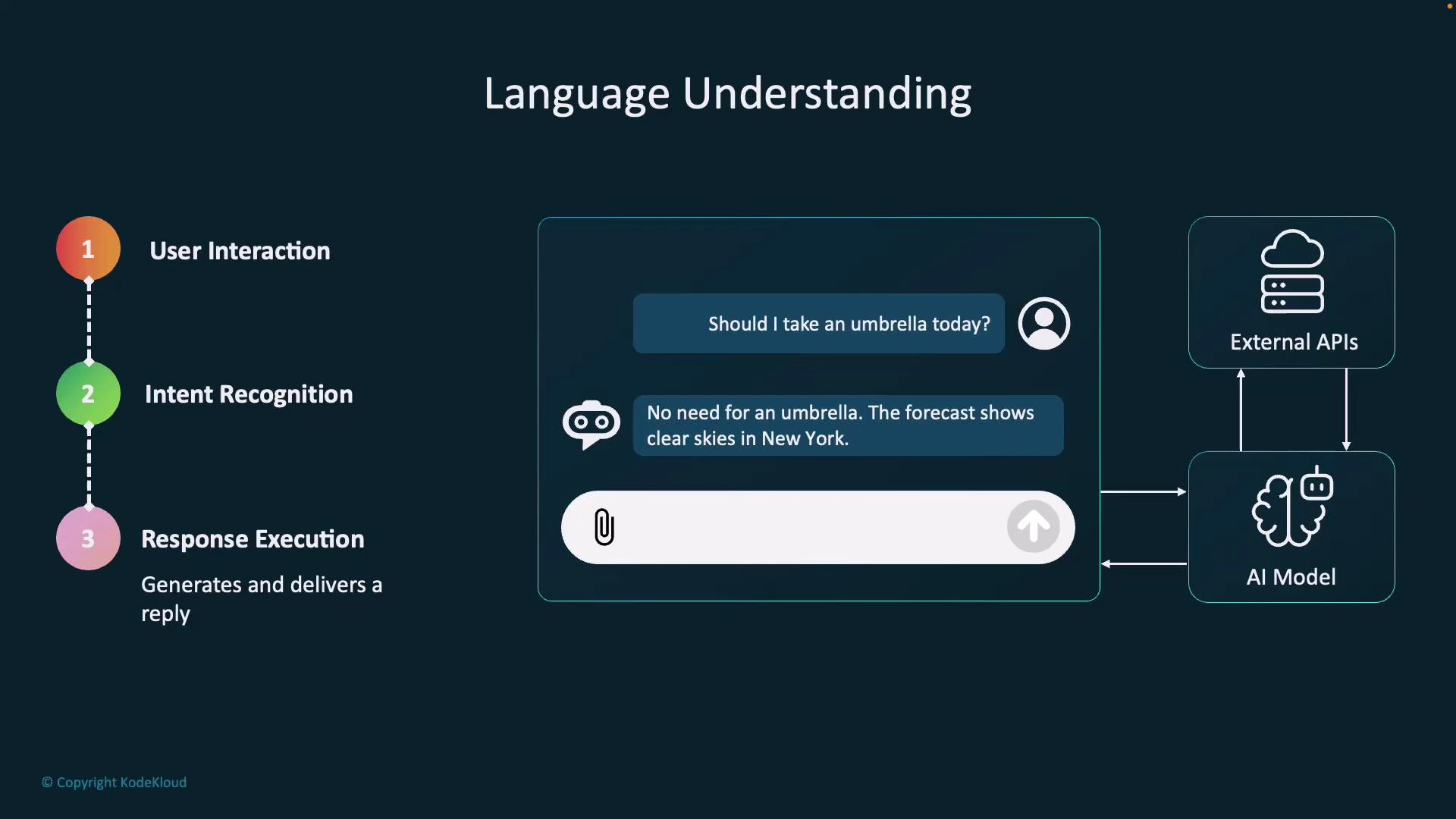
User interaction
- A person provides input via a conversational interface such as a chatbot, voice assistant, or messaging app. Example: “Should I take an umbrella today?”
-
Intent recognition and entity extraction
- The system analyzes the text or speech to determine the user’s intent (what they want to achieve) and extracts entities (relevant values like location, date, or time). Context from previous turns or user profile helps disambiguate meaning—e.g., “today” or the referenced location.
-
Response execution
- The application performs required actions: calling external APIs (weather service), applying business logic, updating state, and composing a natural-language reply. Example reply: “No need for an umbrella. The forecast shows clear skies.”
-
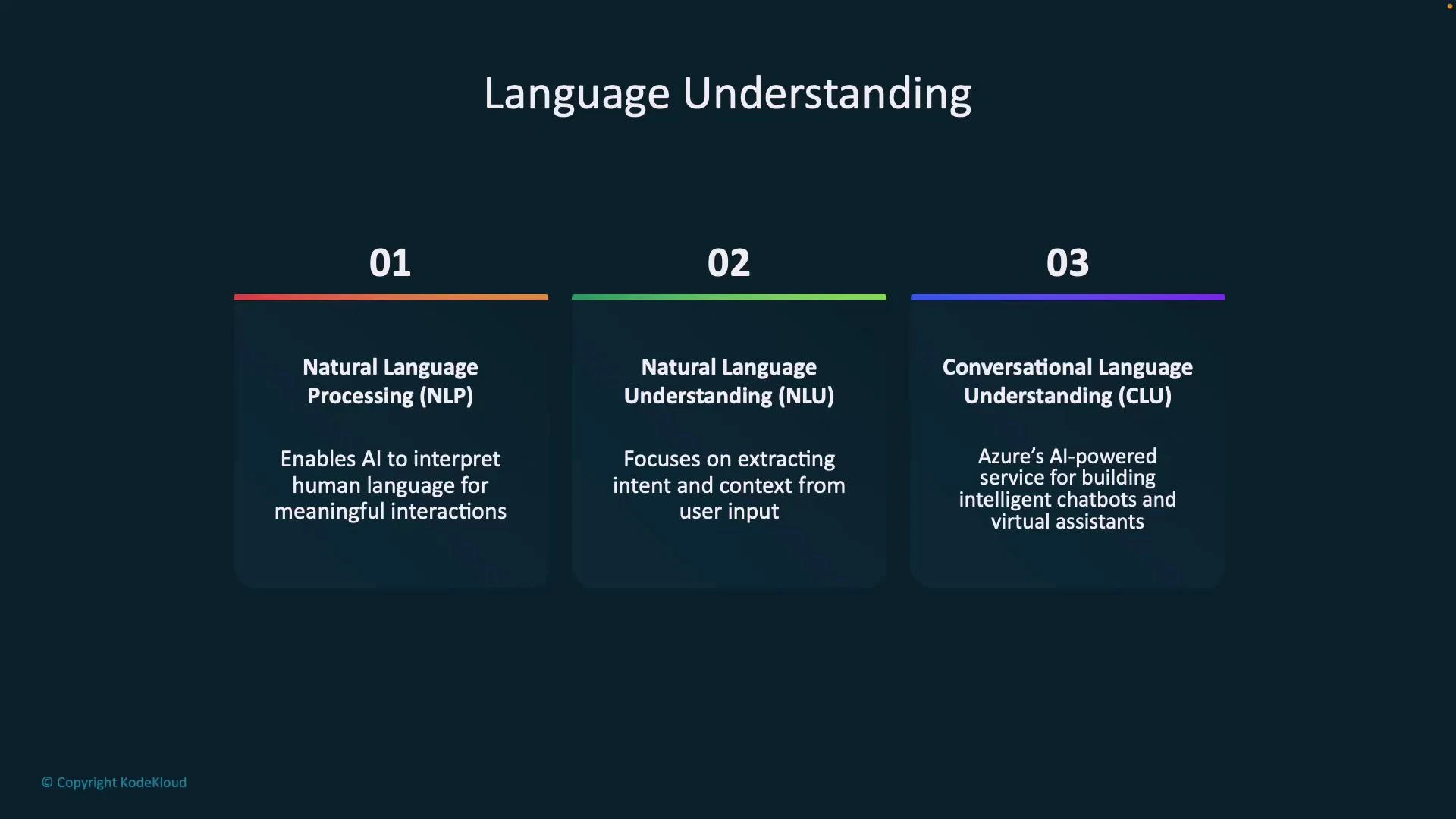
Natural Language Processing (NLP)
- Broad field that enables machines to interpret, analyze, and generate human language. Common NLP tasks include language detection, tokenization, part-of-speech tagging, parsing, and sentiment analysis. Use cases: text classification, language detection, named-entity recognition, and text summarization.
-
Natural Language Understanding (NLU)
- A subfield focused on extracting structured meaning from text: identifying user intents, entities (sometimes called slots), and contextual cues. NLU converts unstructured input into actionable data. Example: From “Book a flight tomorrow morning,” NLU extracts intent (book_flight) and entities such as date (tomorrow) and time_of_day (morning).
-
Conversational Language Understanding (CLU)
- Combines NLP and NLU with dialogue/state management, turn-taking, and orchestration of downstream calls (APIs, database queries, workflows). CLU is typically a managed service for building chatbots and virtual assistants that maintain context across turns and handle interruptions gracefully.
Design tips for reliable conversational apps
- Always capture and persist relevant context (user location, preferences, last intent) to resolve ambiguous queries.
- Validate and normalize entities (dates, numbers, locations) before calling downstream services.
- Use explicit confirmation for high-risk actions (purchases, cancellations).
- Log user interactions and model decisions to improve training data and diagnose failures.
NLP supplies language tools, NLU extracts intents/entities into structured data, and CLU adds dialog/state management to build robust conversational experiences—especially when integrating with cloud services and external APIs.
- Azure Conversational Language Understanding (CLU): https://learn.microsoft.com/azure/cognitive-services/language-service/
- Introduction to Natural Language Processing: https://en.wikipedia.org/wiki/Natural_language_processing
- Practical NLU concepts and intent/entity design: https://developer.ibm.com/articles/nlu-design/