

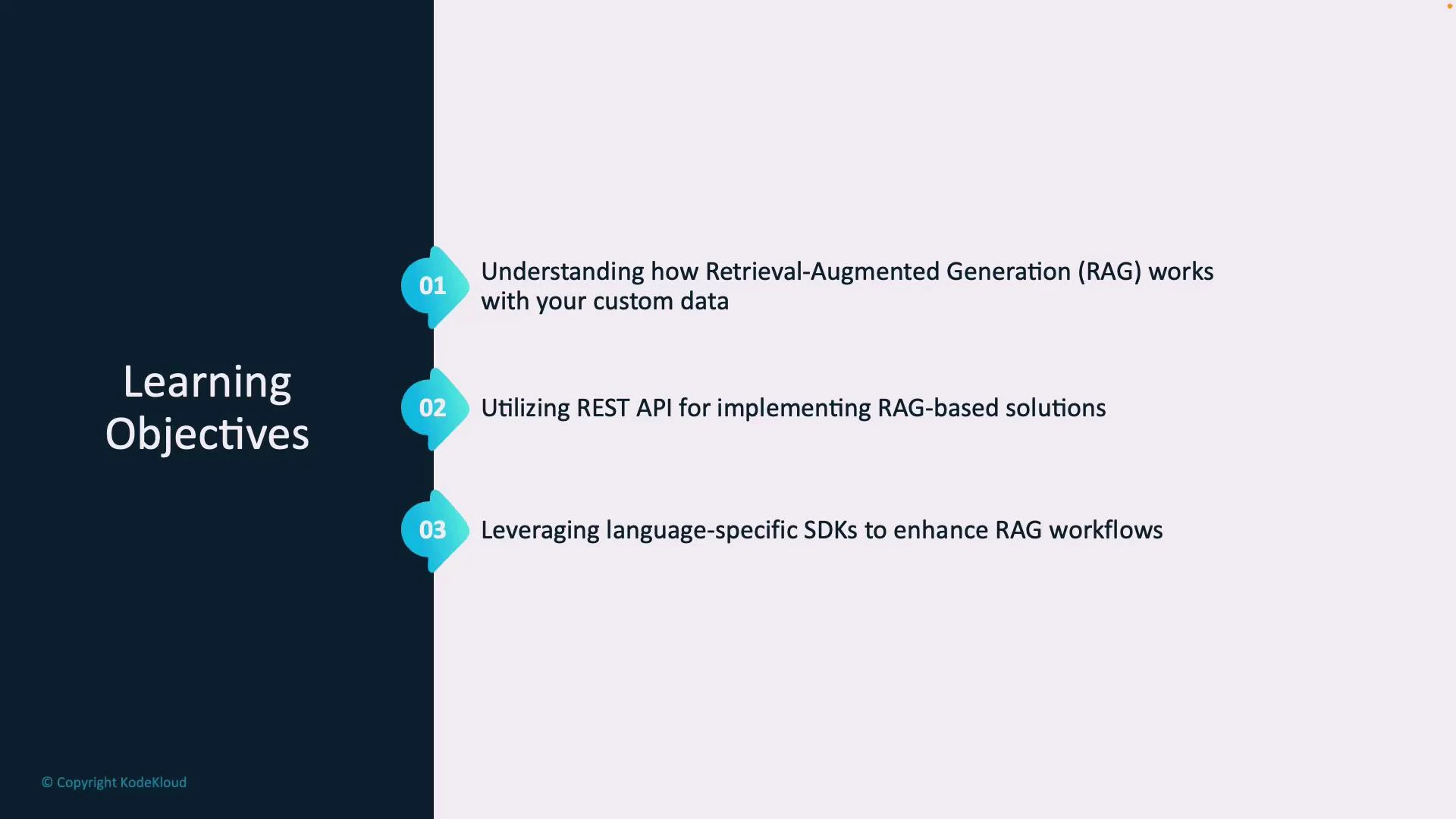
By the end of this module you’ll be able to design and implement RAG solutions that augment Azure OpenAI model outputs with relevant data from your own sources—documents, knowledge bases, databases, and more.
Before you begin, make sure you have access to Azure OpenAI resources and a dataset (documents or structured data) to index. Familiarity with embeddings and vector search concepts will accelerate your progress.
- Overview of RAG architectures and when to use them (hybrid vs. pure retrieval).
- How to create embeddings for your data and store them in a vector store or search service.
- How to retrieve relevant context and construct prompts that safely and effectively condition model outputs.
- Implementing RAG via the Azure OpenAI REST API and leveraging language-specific SDKs to streamline the workflow.
- Best practices for relevance, latency, hallucinatory behavior mitigation, and production deployment.
- Azure OpenAI Service documentation
- Retrieval-augmented generation overview (concepts)
- Azure Cognitive Search (vector search & integration)
- Embeddings and vector databases — concepts and options