

-
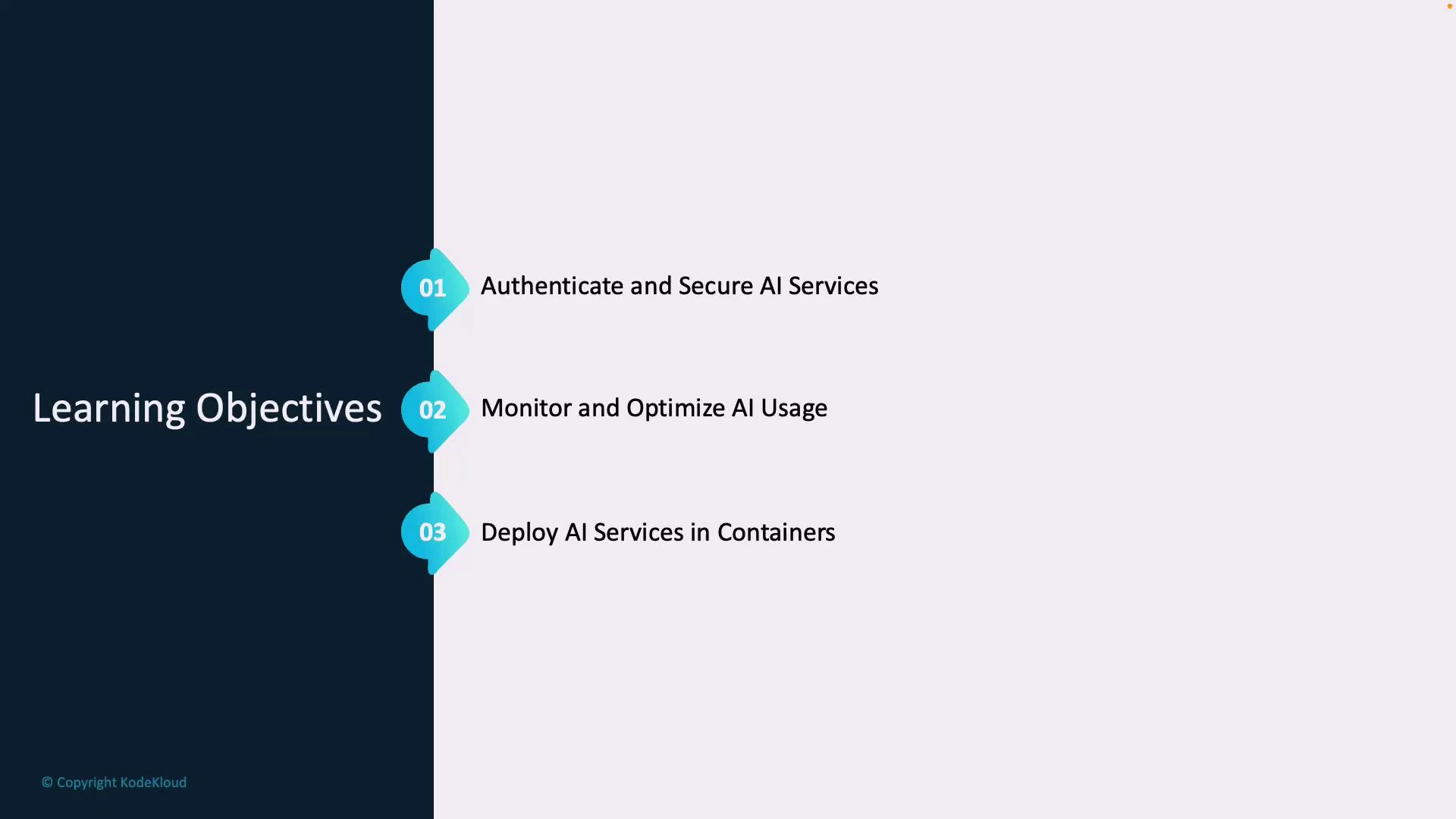
Authenticate and secure AI services
- Manage API keys and secrets safely
- Store secrets centrally with Azure Key Vault
- Use Azure Active Directory and managed identities to enforce least‑privilege access
- Implement role‑based access control (RBAC) and network isolation via private endpoints and VNETs
-
Monitor and optimize AI usage
- Track metrics and usage to understand cost and performance drivers
- Collect logs and traces with Azure Monitor, Log Analytics, and Application Insights
- Analyze latency, error rates, and throughput to guide autoscaling and cost optimization
-
Deploy AI services in containers
- Containerize models and inference components using Docker best practices
- Run containers locally, in Azure Container Instances (ACI), or on Azure Kubernetes Service (AKS)
- Use Azure Container Registry (ACR) or private registries for controlled image distribution
- Plan for edge deployments and air‑gapped or private‑network scenarios where public endpoints are not available
Security and monitoring are foundational. Prefer managed identities and Key Vault over long-lived keys, and instrument your services early so you can measure and optimize before traffic grows.
- Azure Key Vault overview
- Azure Active Directory fundamentals
- Azure Monitor overview
- Log Analytics overview
- Application Insights overview
- Azure Container Instances overview
- Azure Kubernetes Service (AKS) introduction
- Azure Container Registry introduction