

- marking objects in images,
- tagging sentiment or entities in text, and
- transcribing and timestamping audio.
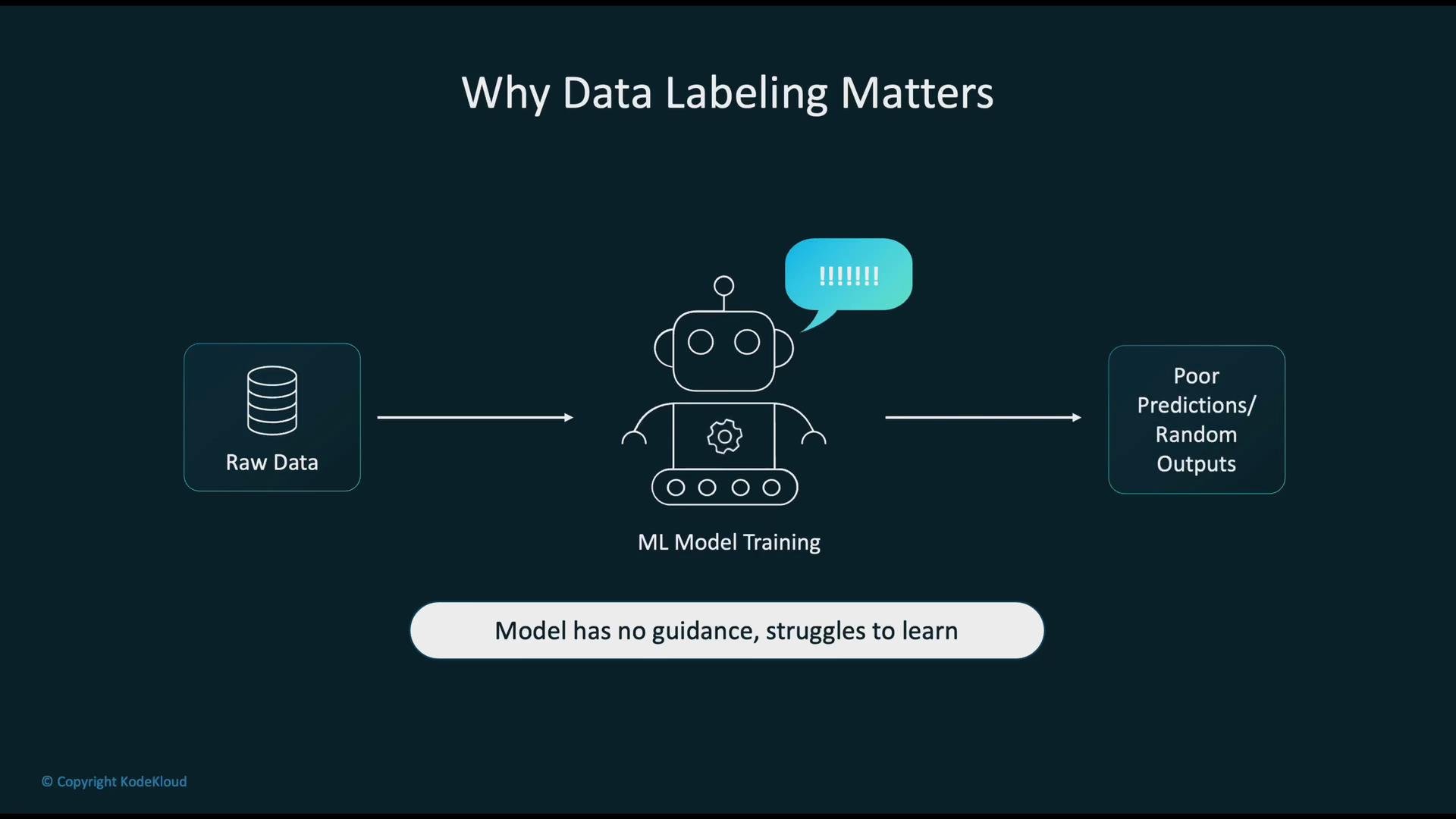
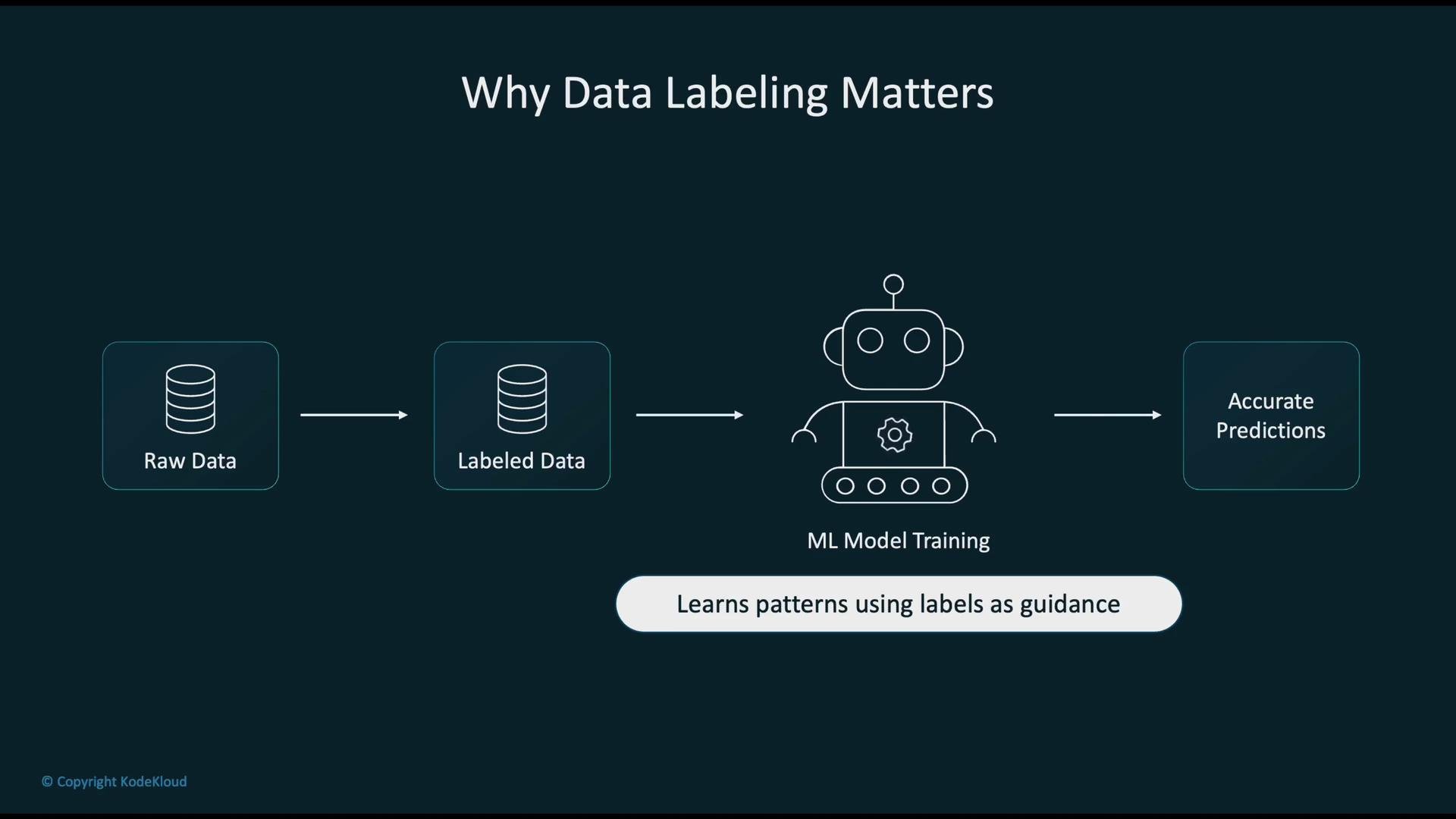
What is SageMaker Ground Truth?
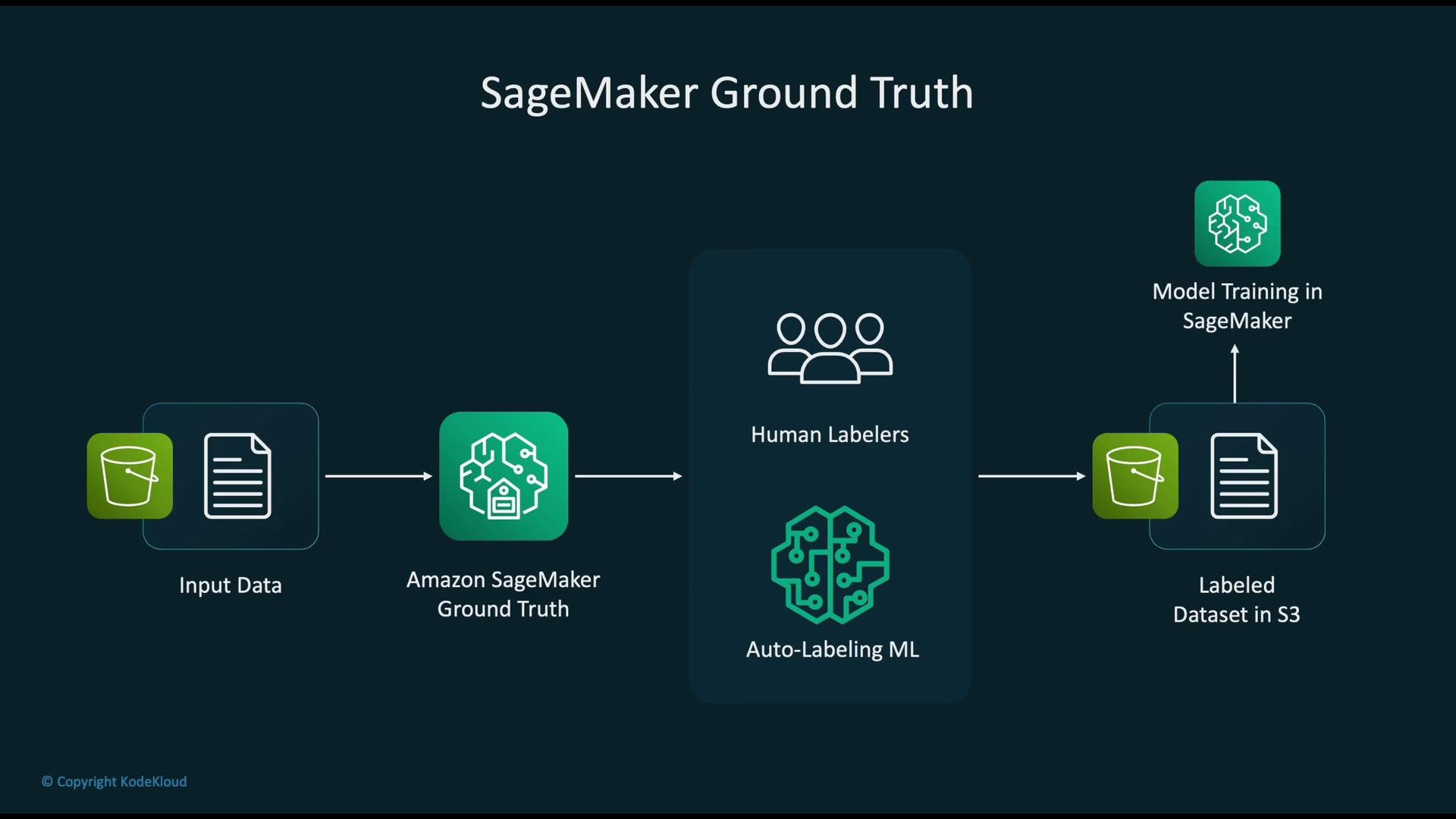
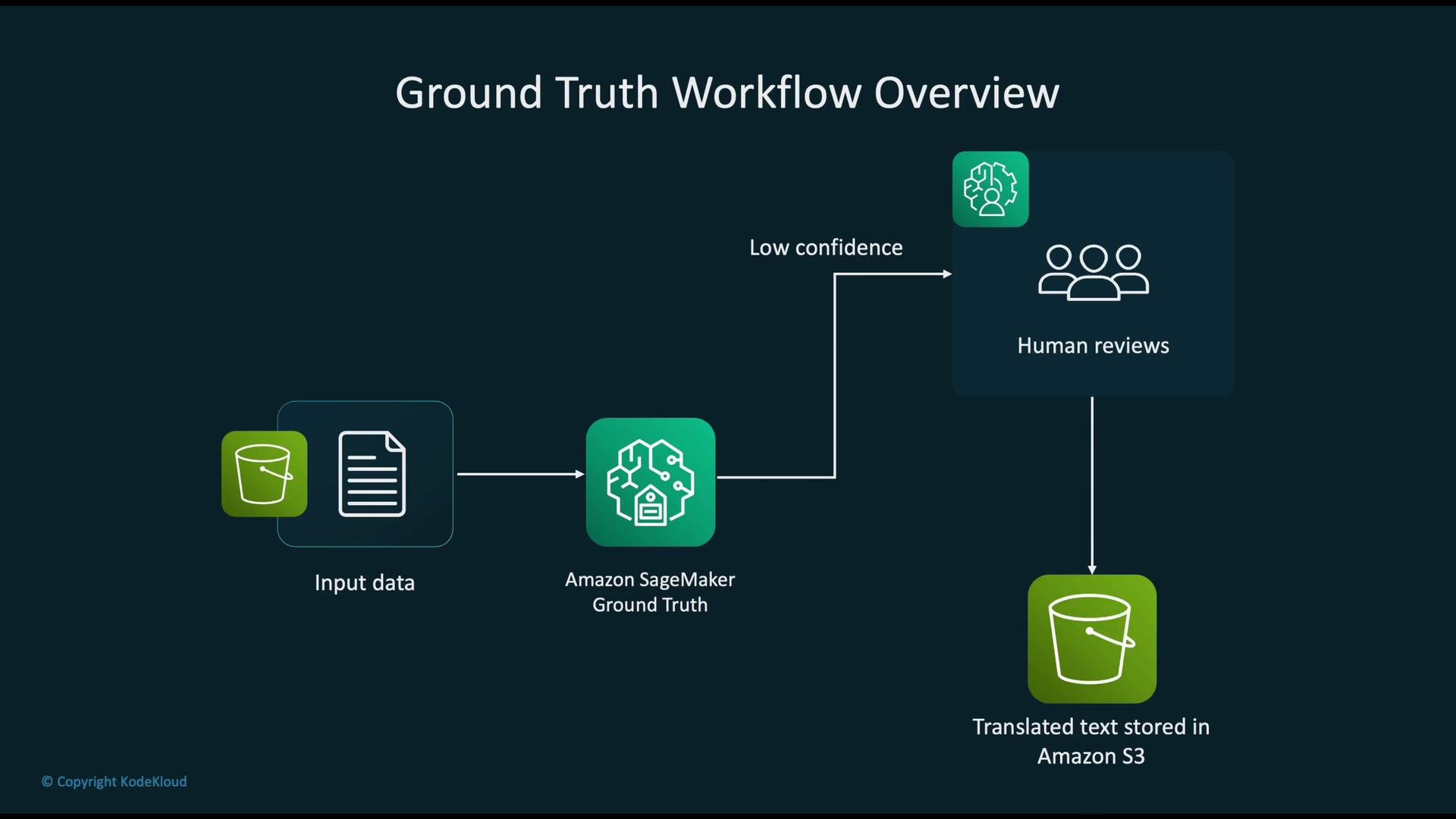
Amazon SageMaker Ground Truth is a managed data-labeling service that accelerates dataset creation by combining machine learning–assisted auto-labeling with human review workflows. Ground Truth stores both inputs and labeled outputs in Amazon S3 and provides mechanisms to reduce cost and improve labeling quality through automation and built-in quality controls. Typical Ground Truth flow:- Raw data is ingested from Amazon S3.
- Auto-labeling (model-in-the-loop) labels high-confidence items.
- Low-confidence or ambiguous items are routed to human workers for review.
- Consolidated, quality-checked labels are written back to S3 for model training.
Human workforces: options and when to use them
Choose the appropriate workforce based on scale, sensitivity, and label quality requirements. Ground Truth supports three workforce types: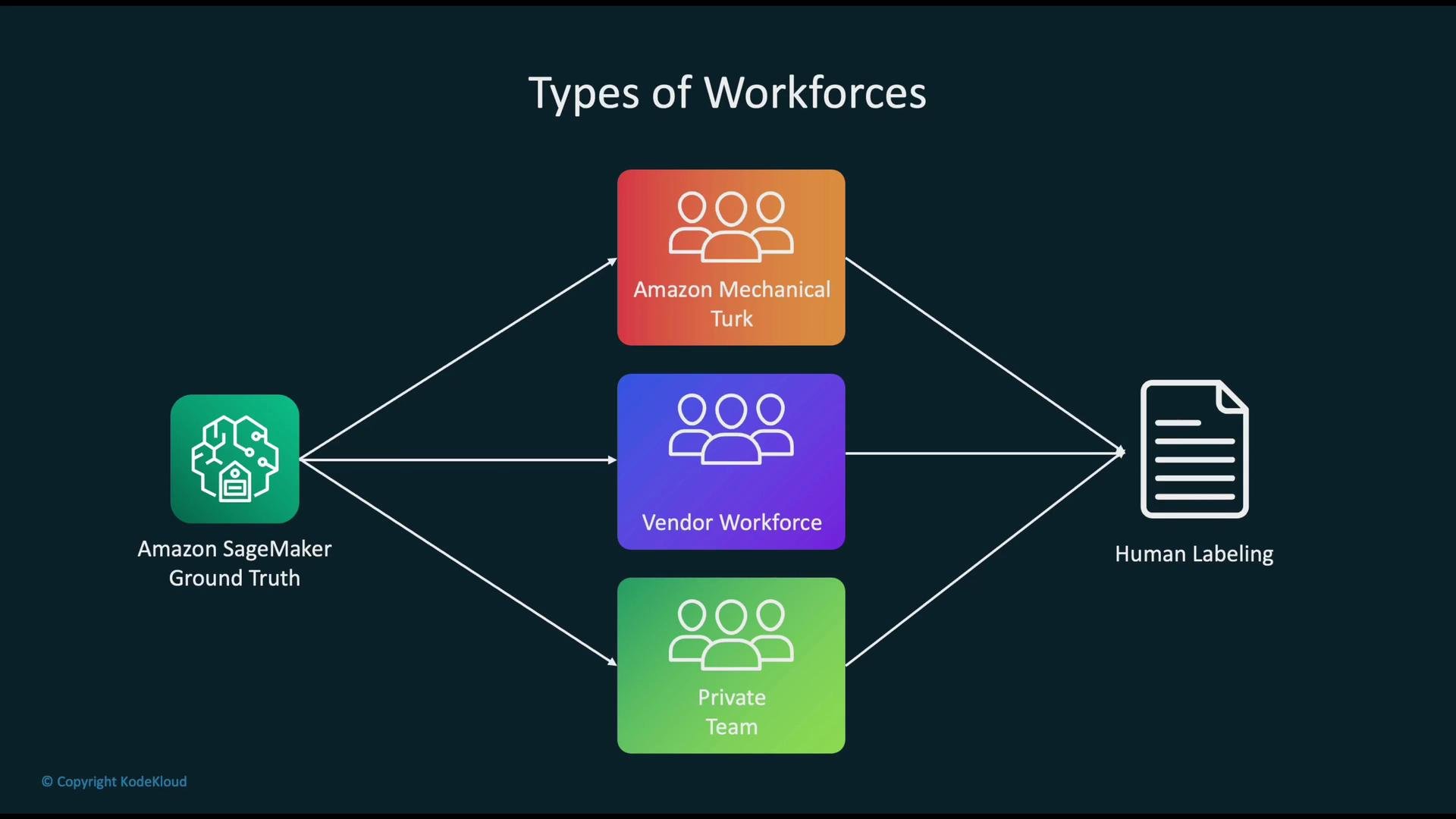
Key features and capabilities
Ground Truth provides a suite of features to scale labeling and maintain high quality:- Active learning and model-in-the-loop auto-labeling to reduce manual effort.
- Multiple workforce options to balance cost, scale, and data sensitivity.
- Secure integration with Amazon S3 for storage, access control, and auditability.
- Scalability to handle datasets with millions of records.
- Built-in quality controls and metrics (annotation consolidation, worker performance tracking, and consensus algorithms).
Supported labeling tasks
Ground Truth supports common labeling modalities across image, text, and video. Use this table to quickly identify task types and examples.
The end-to-end workflow ingests raw data, applies automated labeling where possible, routes uncertain items to humans, performs quality consolidation, and exports the final labels back to Amazon S3 for downstream training.
Active learning and cost reduction
Ground Truth’s active learning loop is a practical way to reduce manual labeling overhead:- The system trains or uses an existing model (auto-labeler) to label examples it is confident about.
- Low-confidence or ambiguous examples are routed to human labelers.
- Human-reviewed labels are fed back to improve the auto-labeler, increasing automation and lowering costs over time.
Ground Truth’s active learning and auto-labeling significantly reduce labeling costs and accelerate dataset creation by prioritizing human effort for the most uncertain examples.
Integrations and downstream use
Ground Truth integrates with core AWS ML services to complete the labeling-to-training pipeline:- Amazon SageMaker — train and deploy models using the labeled datasets.
- Amazon Rekognition — leverage prebuilt vision capabilities or seed auto-labelers.
- Amazon Comprehend — use NLP services for preprocessing or transfer learning for text tasks.
- Amazon Translate — assist multilingual labeling workflows.
- Amazon S3 — secure storage for raw inputs, annotations, and outputs.
Summary
SageMaker Ground Truth streamlines the labeling pipeline by combining automation, active learning, and human-in-the-loop reviews. It supports multiple workforce options, a broad set of labeling tasks, and tight AWS integrations—helping teams produce accurate, scalable, and cost-effective labeled datasets for training robust ML models. Further reading and references:- Amazon SageMaker Ground Truth
- Amazon S3
- Amazon Mechanical Turk
- Amazon Rekognition
- Amazon Comprehend
- Amazon Translate