- Fundamentals of ML deployment strategies
- How rollback mechanisms work
- AWS deployment types: blue-green, canary, linear, and A/B testing
- How rollbacks resolve production issues
- Key concepts related to ML workflow orchestration
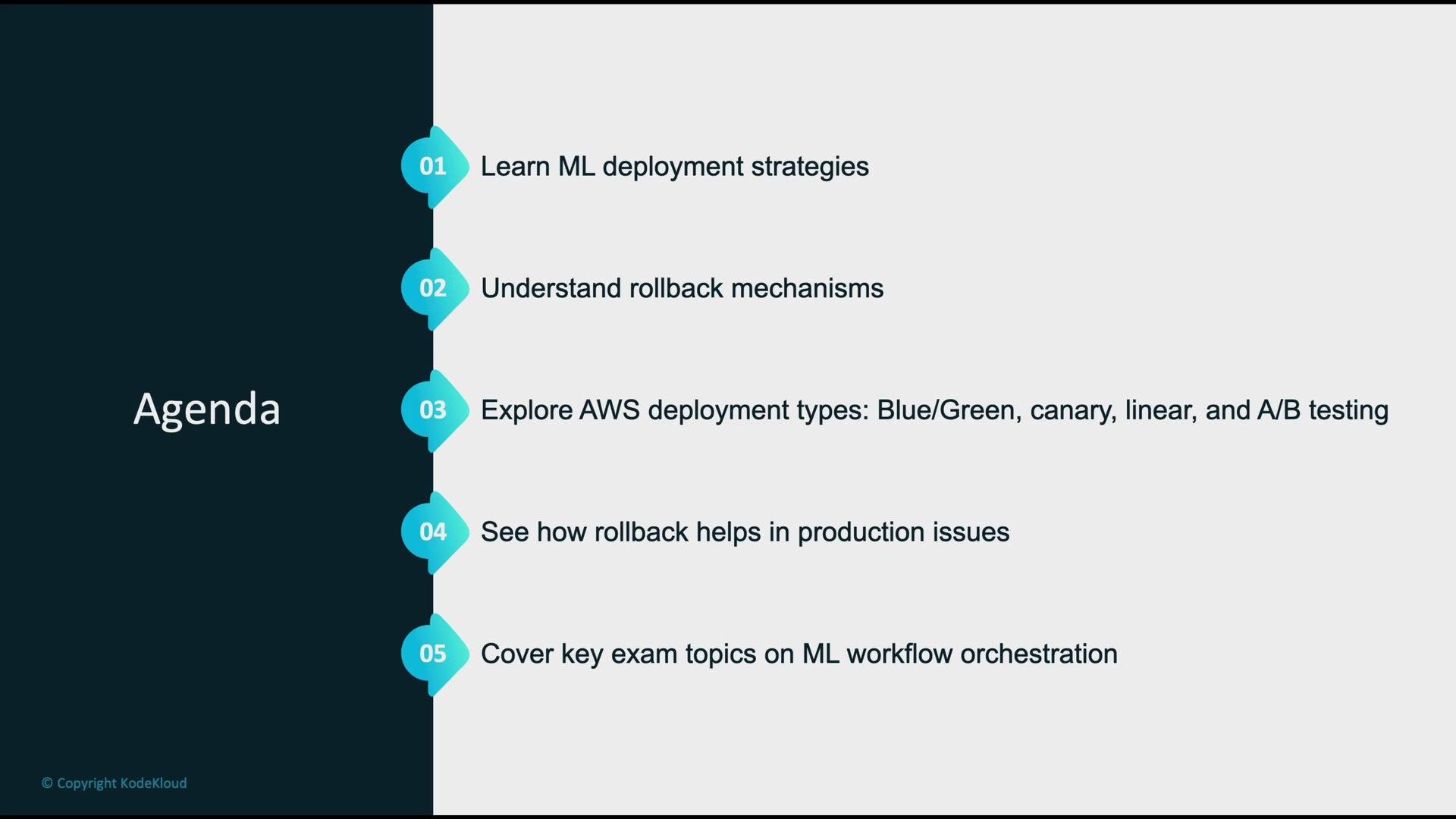
Four-step process for safe ML deployments
To reduce downtime and customer impact, use a consistent, four-step deployment approach:- Validate the model: run tests and compare metrics against production-like datasets to verify accuracy and performance.
- Controlled release: expose the new model incrementally rather than switching traffic all at once.
- Continuous monitoring: collect metrics and logs in real time to detect regressions and drift.
- Instant rollback: automate the ability to revert to the last known-good version when thresholds are breached.
Example AWS-based deployment pipeline
A typical automated pipeline for ML on AWS:- Source control: store model code, infra-as-code, and configs in a VCS such as AWS CodeCommit, GitHub, or GitLab.
- Orchestration: trigger CI/CD with AWS CodePipeline, GitHub Actions, or similar to run builds, tests, and deployments.
- Artifact: produce a trained model package or container image (ECR or model package in SageMaker).
- Hosting: serve the artifact with SageMaker real-time endpoints, batch transform jobs, or ECS/EKS containers.
- Observability: use CloudWatch, X-Ray, and SageMaker Model Monitor for metrics, traces, and drift detection.
Deployment strategies
Below are common deployment patterns used in MLOps. Each strategy balances risk, complexity, and speed differently.Blue–green deployment
Blue–green deploys a new version into an isolated environment (green), validates it, and then switches production traffic from blue to green for near-zero downtime.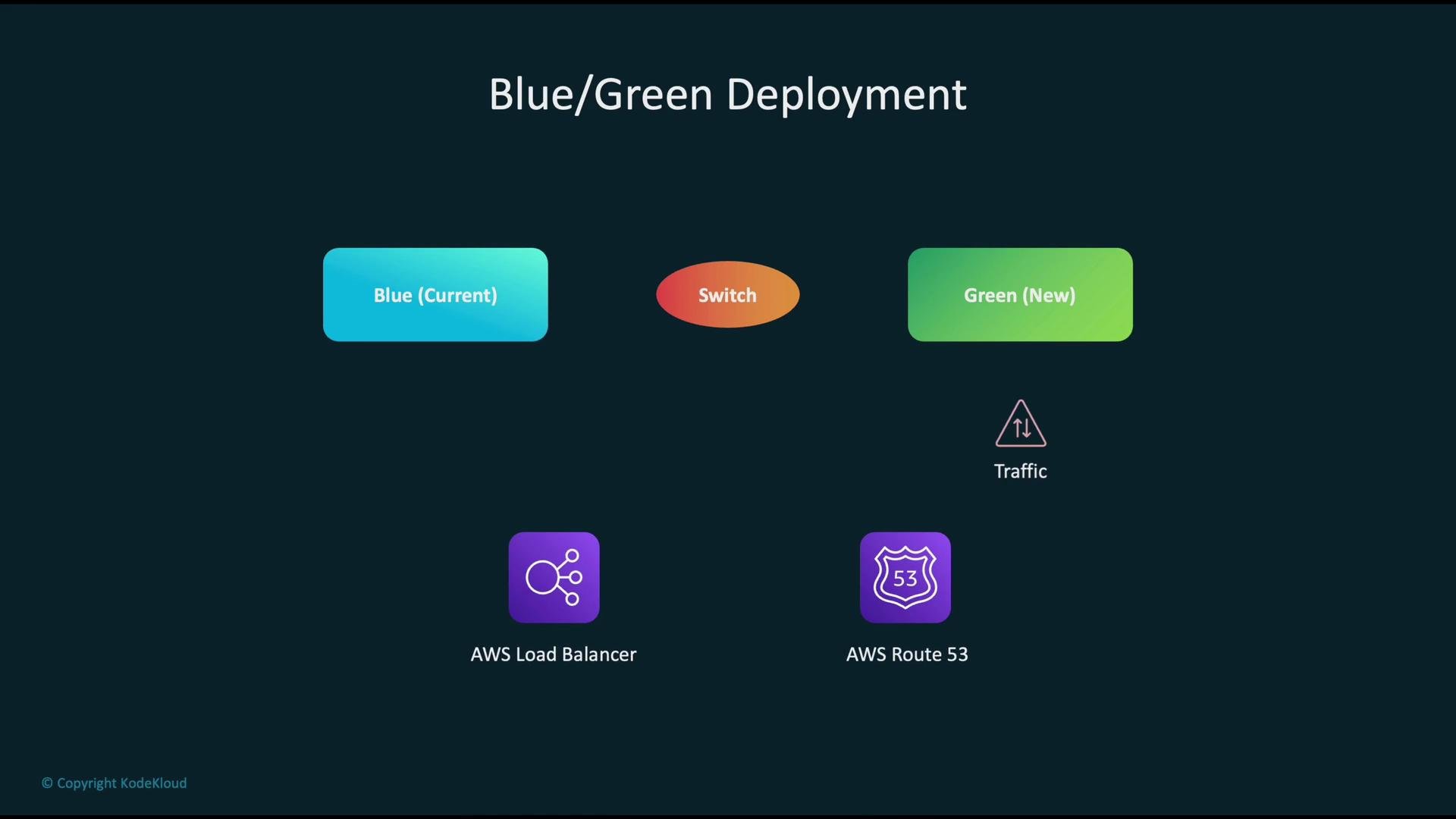
- Route traffic with an Application Load Balancer or
Route 53. - Test the green environment in isolation before switching DNS or ALB target groups.
- Rollback is simple: direct traffic back to blue if problems appear.
Canary deployment
Canary releases route a small fraction of production traffic to the new model to validate behavior under real load.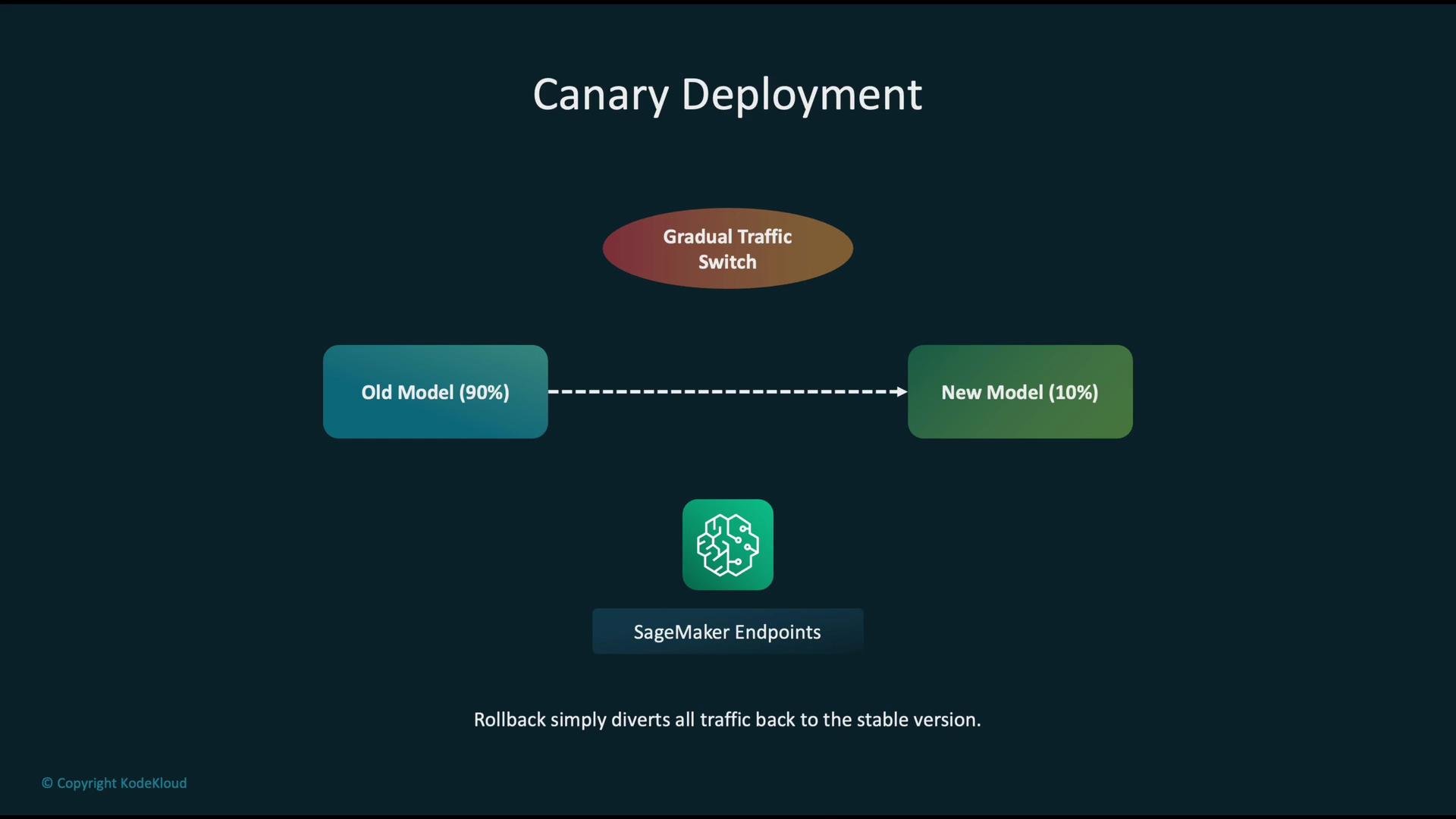
- Start with a small percentage (e.g.,
5–10%) of traffic to the canary. - Monitor latency, error rate, and business KPIs.
- Gradually increase traffic when metrics remain within thresholds, or revert immediately on regressions.
Linear (incremental) deployment
Linear deployments shift traffic in fixed increments (e.g., 0 → 20 → 50 → 100), validating at each step.- Increase traffic in controlled steps and validate at each stage.
- If any step shows regressions, rollback to the previous stable percentage or to 0% immediately.
A/B testing
A/B testing runs two or more model variants in parallel and compares their real-world performance using predefined metrics.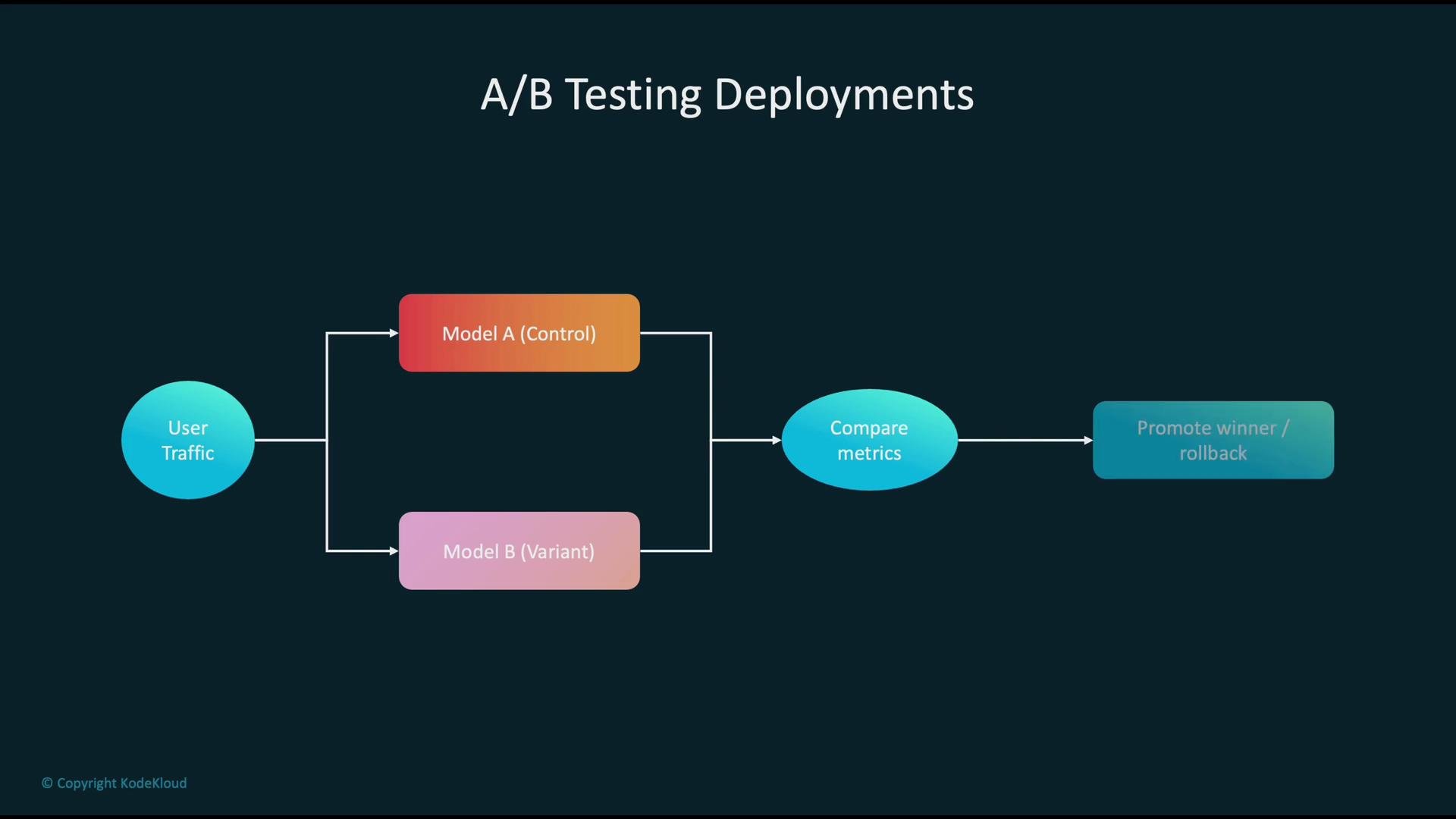
- Define evaluation metrics and statistical significance thresholds before launching.
- Use consistent traffic splits (e.g.,
50/50) or business-driven ratios. - Promote the winning model automatically or manually after validation.
Rollback mechanisms
A robust rollback reverts to a known-good state automatically when failures are detected.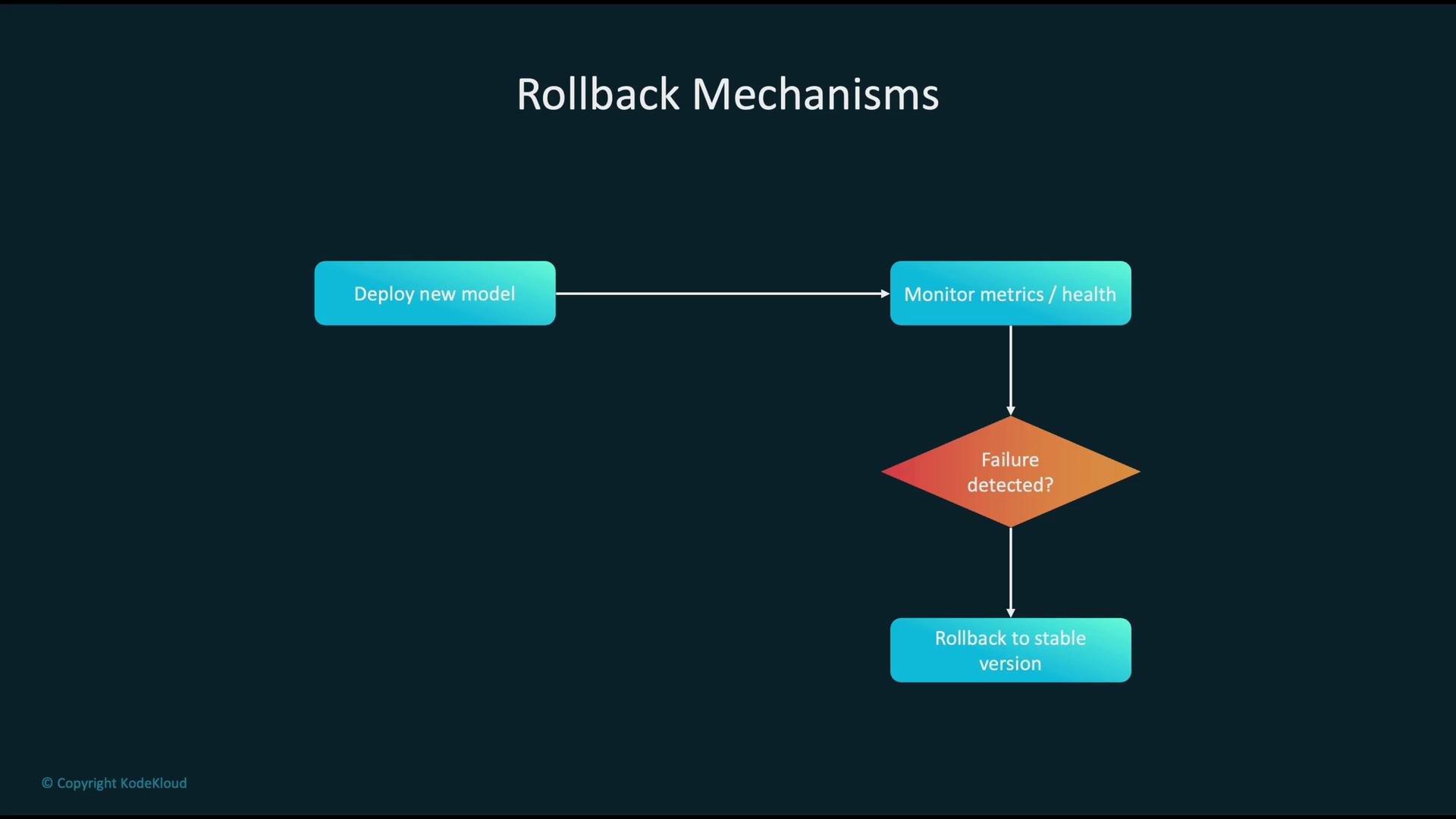
- Deploy new version and enable active monitoring.
- Continuously evaluate health and metric thresholds (latency, errors, KPI deltas).
- If thresholds are breached, trigger an automated rollback to the last stable version.
- Log events and analyze root causes to prevent recurrence.
- Use
CloudWatch Alarms+EventBridgeto trigger Lambda/Runbook for rollback. - Integrate alarms into CI/CD (CodePipeline) to stop promotions on failures.
Security pillars for safe deployments
Combine access controls, encryption, and network isolation to harden your deployment platform.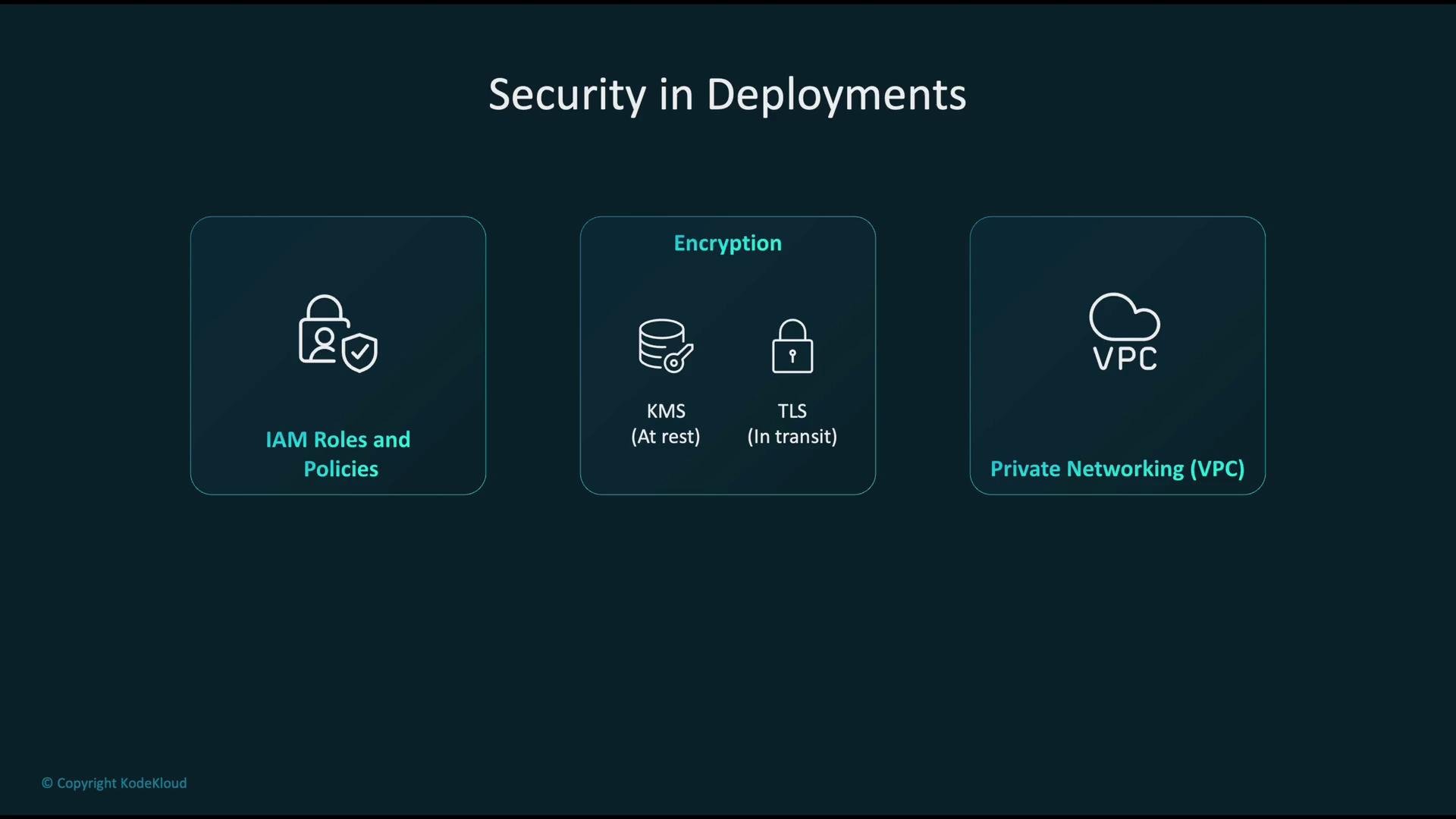
- IAM roles and least-privilege policies to control access to model artifacts and endpoints.
- Encrypt data at rest with
AWS KMSand in transit with TLS. - Use VPCs, private subnets, and security groups to restrict access to inference endpoints and data stores.
Always apply the principle of least privilege for service roles and encrypt secrets and model artifacts at rest. Use private networking to reduce attack surface for inference endpoints.
Monitoring and observability
Effective monitoring detects regressions, performance issues, and model drift early.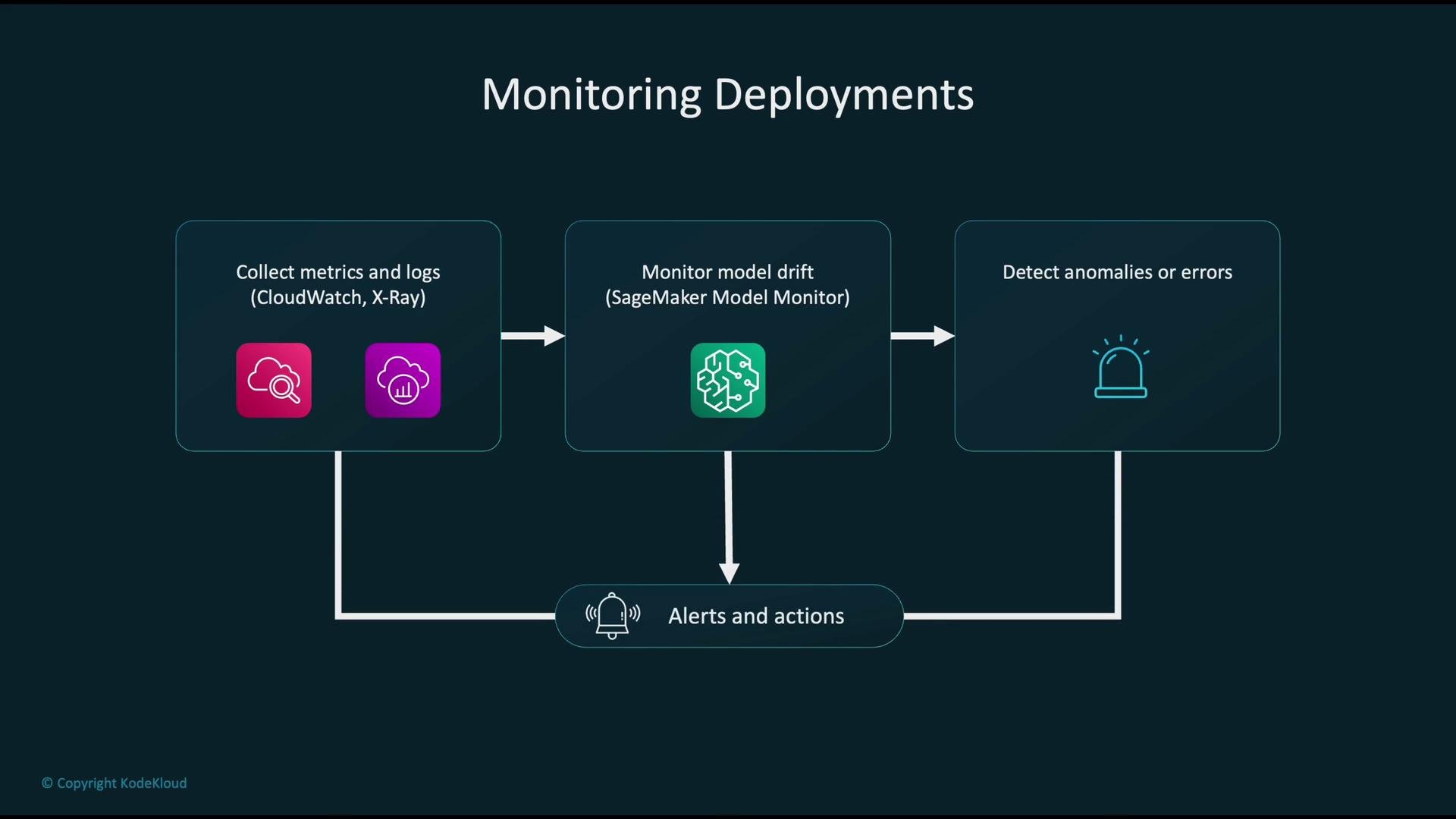
- Capture logs, metrics, and traces with
CloudWatchandX-Ray. - Detect model quality degradation and data drift with
SageMaker Model Monitor. - Implement automated alerts and runbooks for critical thresholds to trigger rollback or mitigation steps.
- Store historical metrics for trend analysis and postmortems.
Disaster recovery fundamentals
Plan for catastrophic failures via backups, replication, and tested restore procedures.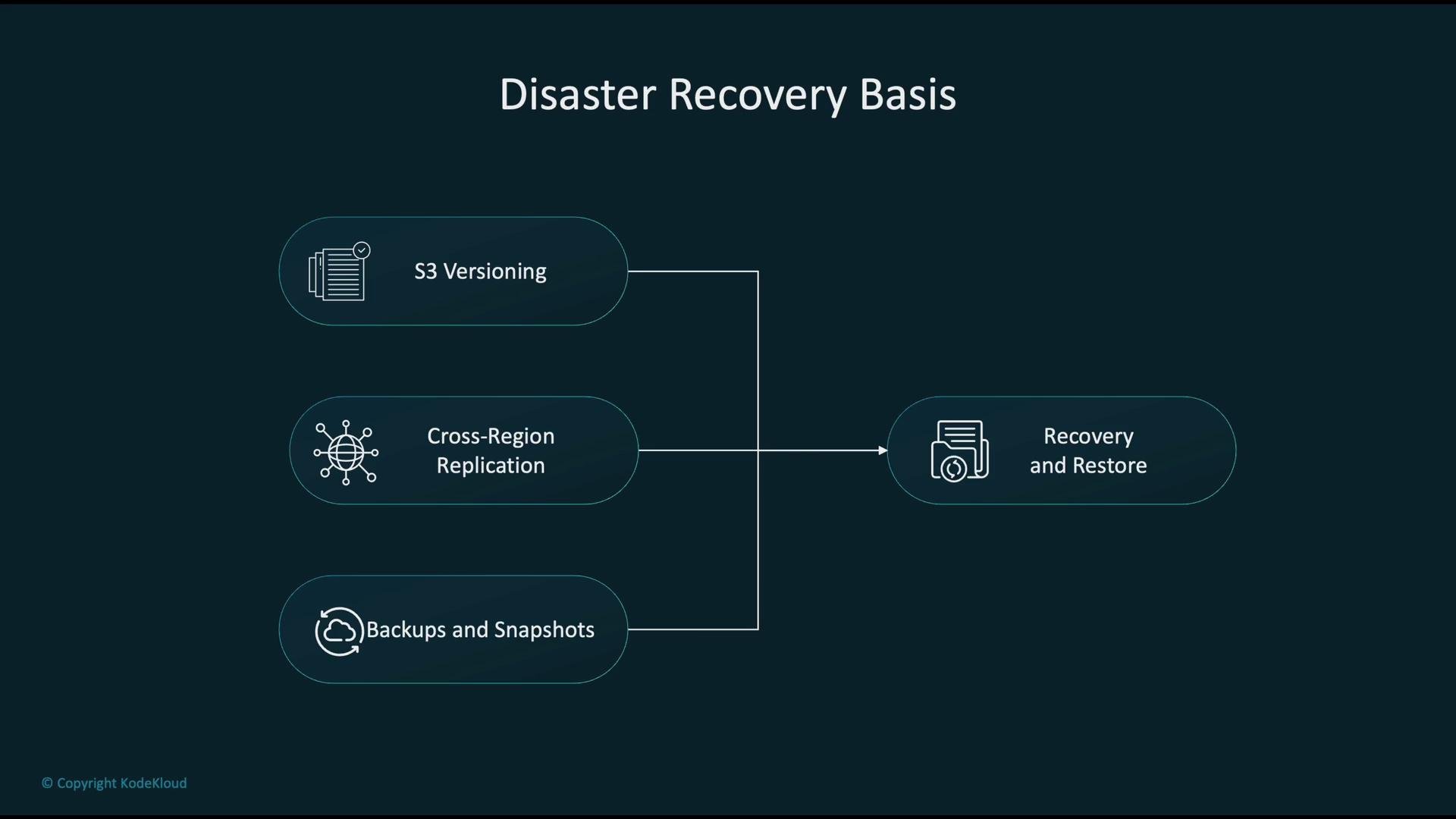
- Enable S3 versioning to protect model artifacts from accidental deletion or overwrite.
- Use Cross-Region Replication (CRR) to protect against regional outages.
- Take regular backups and snapshots (EBS, RDS) for point-in-time recovery.
- Regularly test restore procedures and document recovery time objectives (RTO) and recovery point objectives (RPO).
Anti-patterns to avoid
Avoid practices that increase production risk and reduce reproducibility.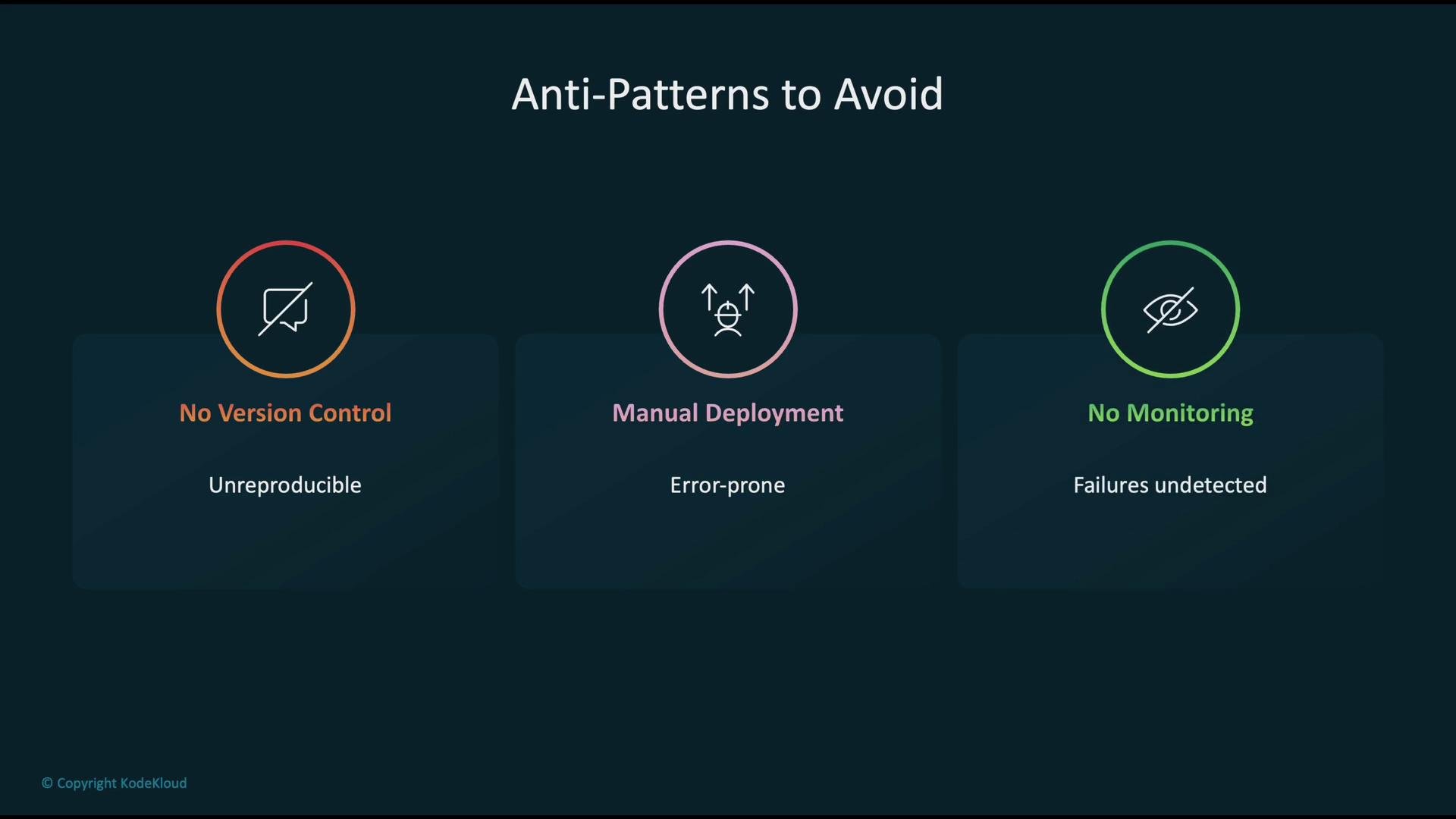
- No version control: experiments and production changes become unreproducible and hard to audit.
- Manual deployments: increase the chance of human error and inconsistent rollouts — prefer automated CI/CD.
- No monitoring: issues remain undetected until they cause business impact.
Key takeaways
- Leverage blue–green, canary, linear, and A/B testing to stage and validate model releases.
- Secure deployments with least-privilege IAM, encryption (KMS/TLS), and VPC isolation.
- Instrument robust monitoring and automated rollback to recover quickly from regressions.
- Build backups, versioning, and cross-region replication into your disaster recovery plan.