

- Automating retraining when new data arrives
- Validating models with automated gates
- Promoting validated model artifacts to production with traceability
For reproducibility, treat code, datasets, and model artifacts as first-class versioned assets. This enables automated pipelines to rebuild, validate, and compare models consistently.
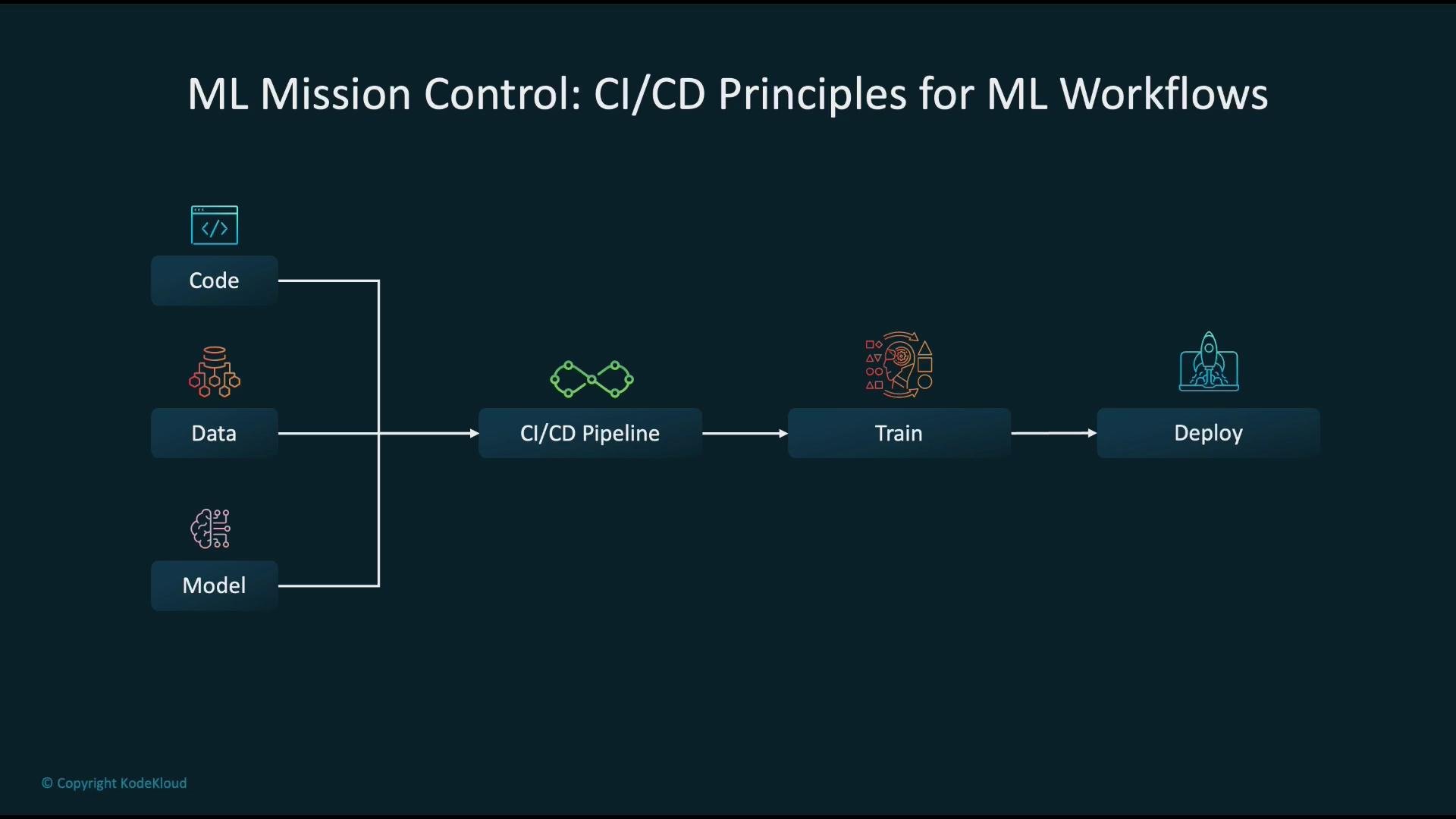
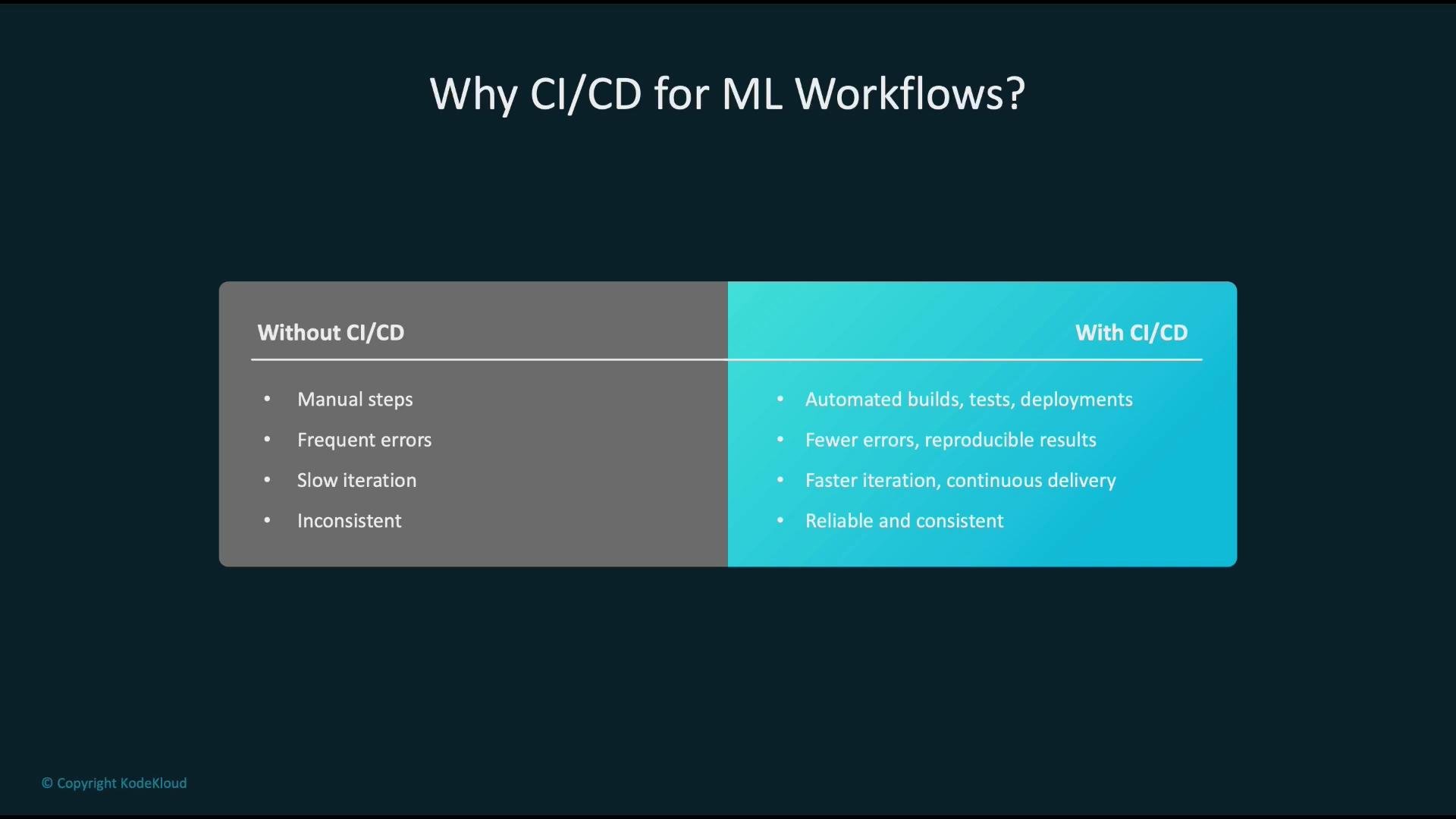
Why CI/CD matters for ML
Without CI/CD, ML development relies on manual handoffs and ad-hoc scripts, which causes slower delivery, poor reproducibility, and higher operational risk. With CI/CD you get:- Automated builds, tests, and deployments
- Reproducible experiments and model artifacts
- Faster feedback loops between data scientists and production systems
- Reduced human error during promotions and rollouts
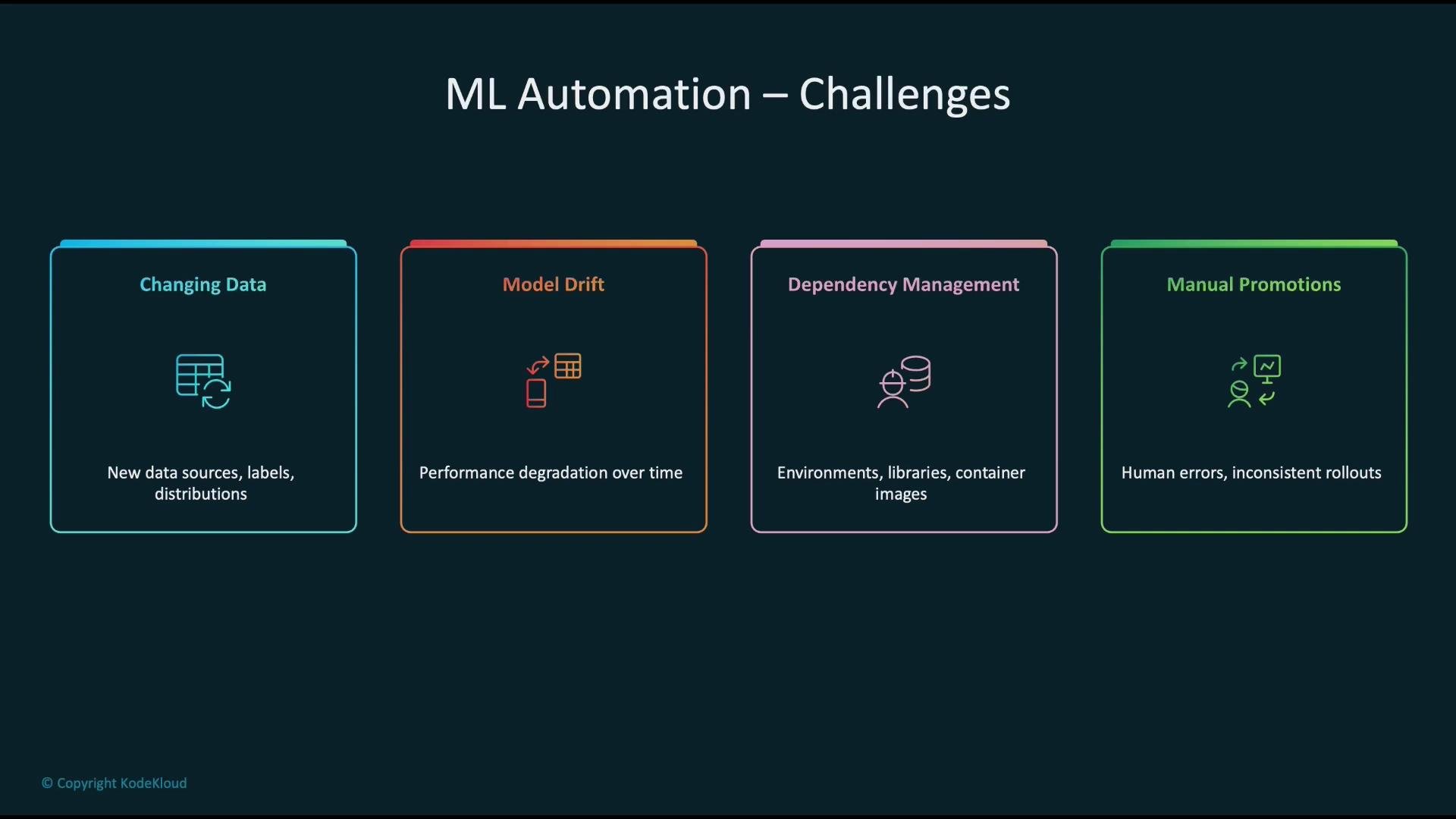
ML automation: key challenges
ML pipelines introduce unique operational challenges compared to typical software CI/CD:- Changing data: new data sources, updated labels, and distribution shifts can affect model performance.
- Model drift: performance can degrade over time as production data diverges from training data.
- Dependency management: libraries, runtimes, and container images must be reproducible.
- Manual promotions: human-driven rollouts increase inconsistency and risk.
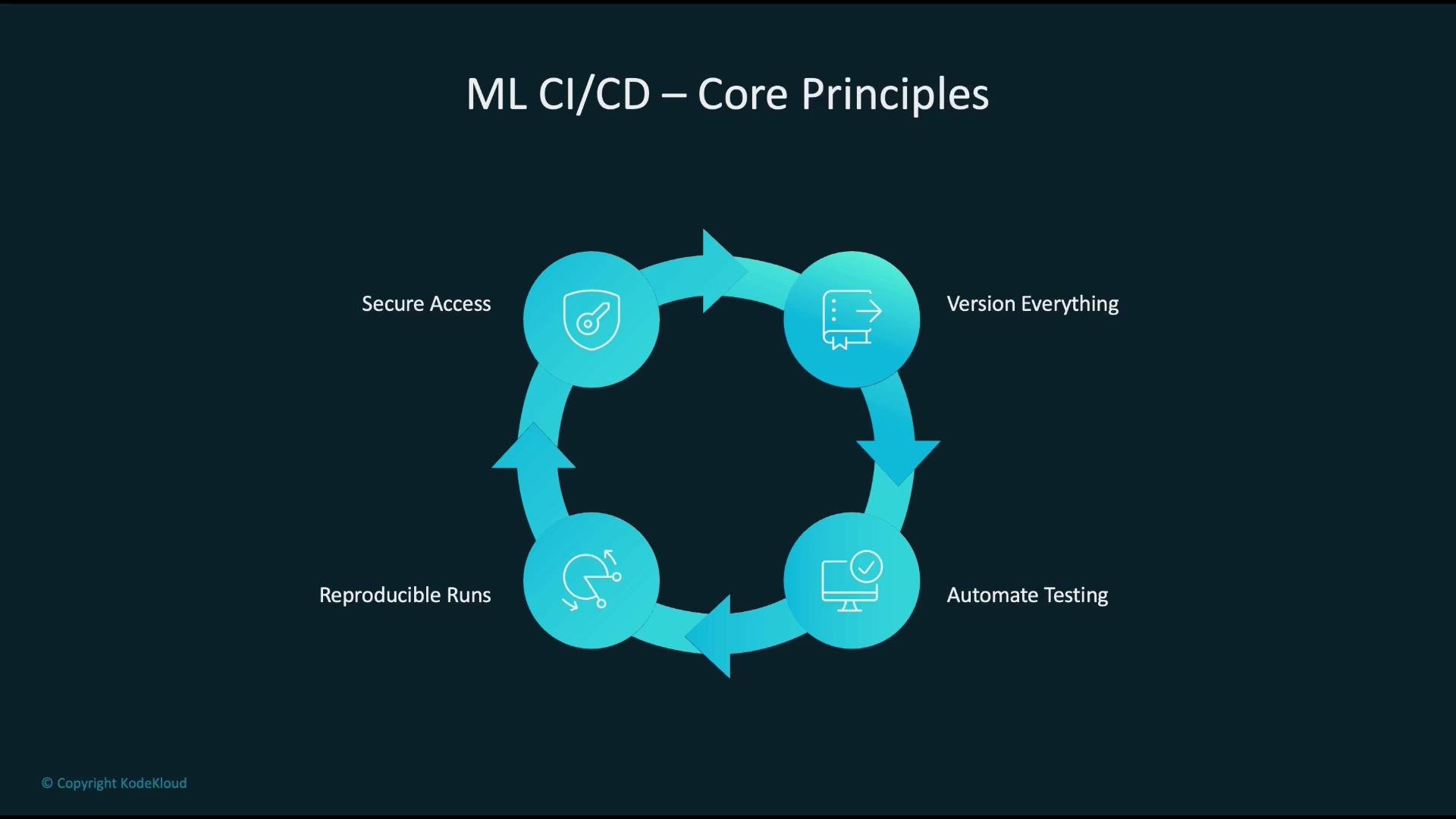
Core principles for robust ML CI/CD
These principles form a continuous cycle to keep ML systems reliable, auditable, and maintainable:- Secure access: grant least privilege to users and services for code, data, and models.
- Version everything: track code, datasets, and model artifacts so runs are reproducible.
- Automate testing: validate code, data schema, and model performance continuously.
- Reproducible runs: ensure training and experiments can be rerun to reproduce results.
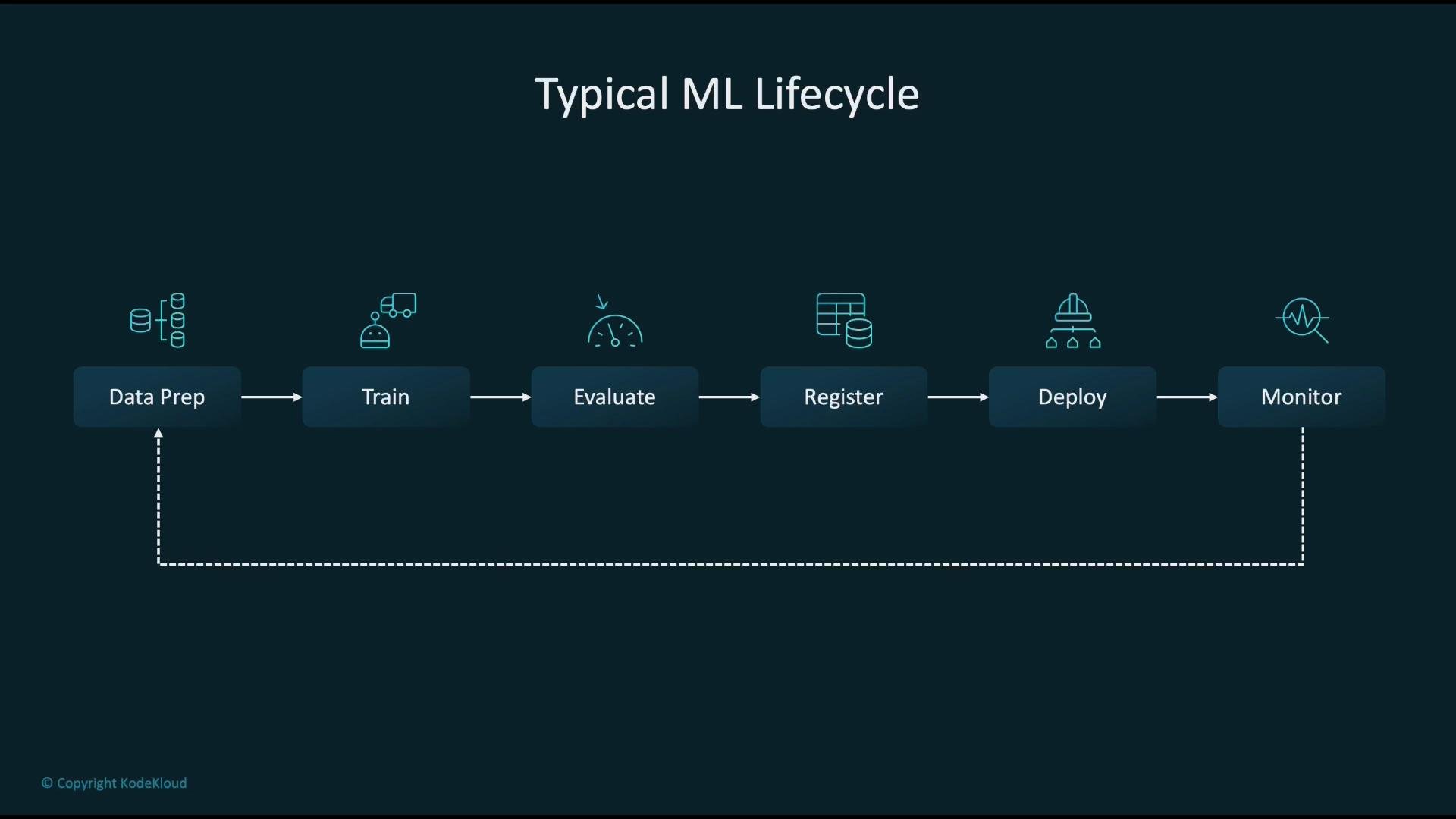
Typical ML project lifecycle
A production-oriented ML lifecycle cycles between data and models. Below is a concise mapping of stages, objectives, and example tasks:
Monitoring and feedback close the loop: runtime metrics and newly labeled data trigger data prep and retraining when needed.
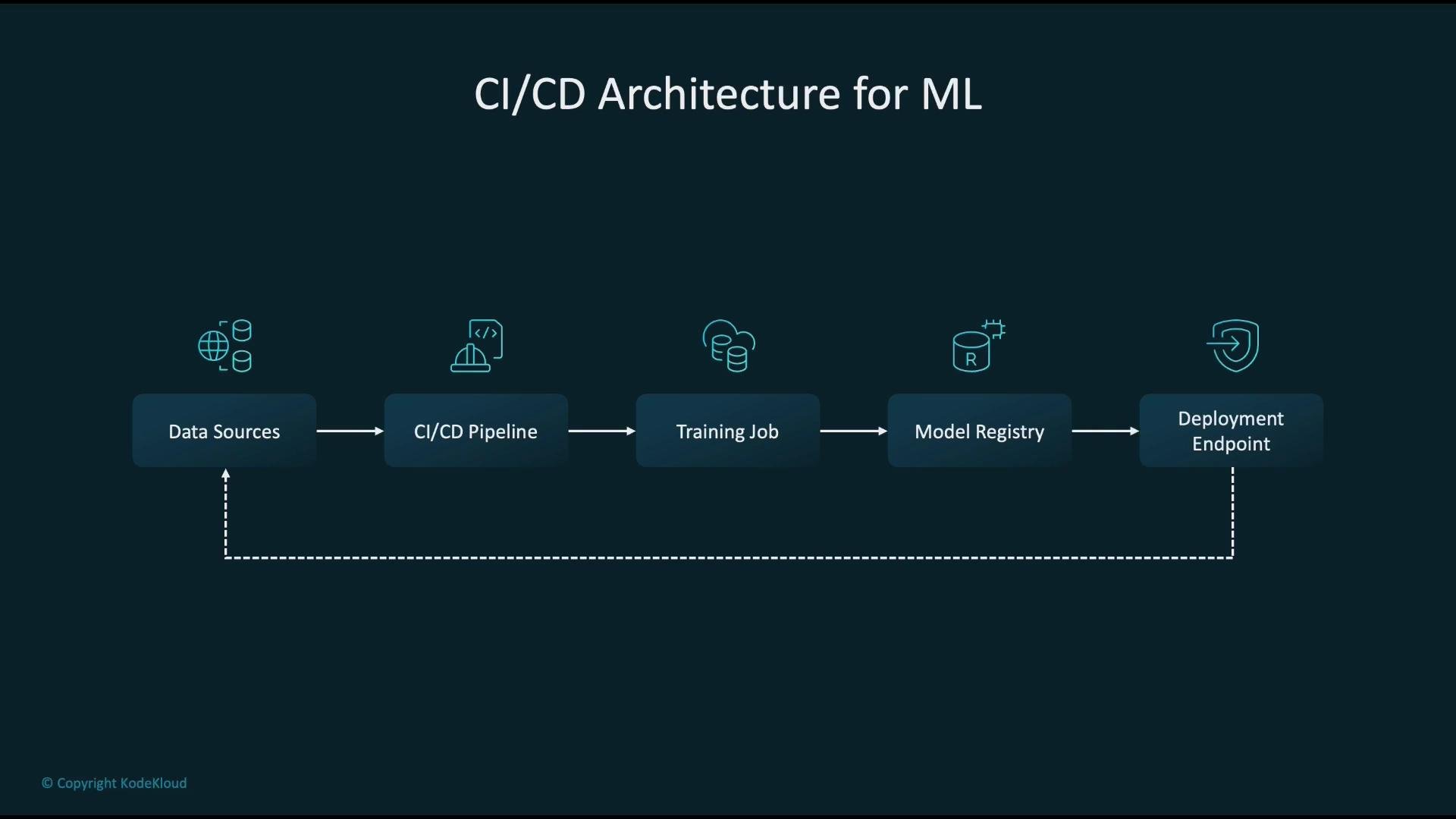
Standard MLOps architecture
A production MLOps architecture typically includes the following components:- Data sources (batch and streaming)
- CI/CD pipeline that automates data validation, training, and tests
- Training jobs that produce artifacts and metrics
- Model registry to store versioned models and metadata
- Serving endpoints for predictions
- Feedback loop to collect runtime metrics and labeled data for retraining
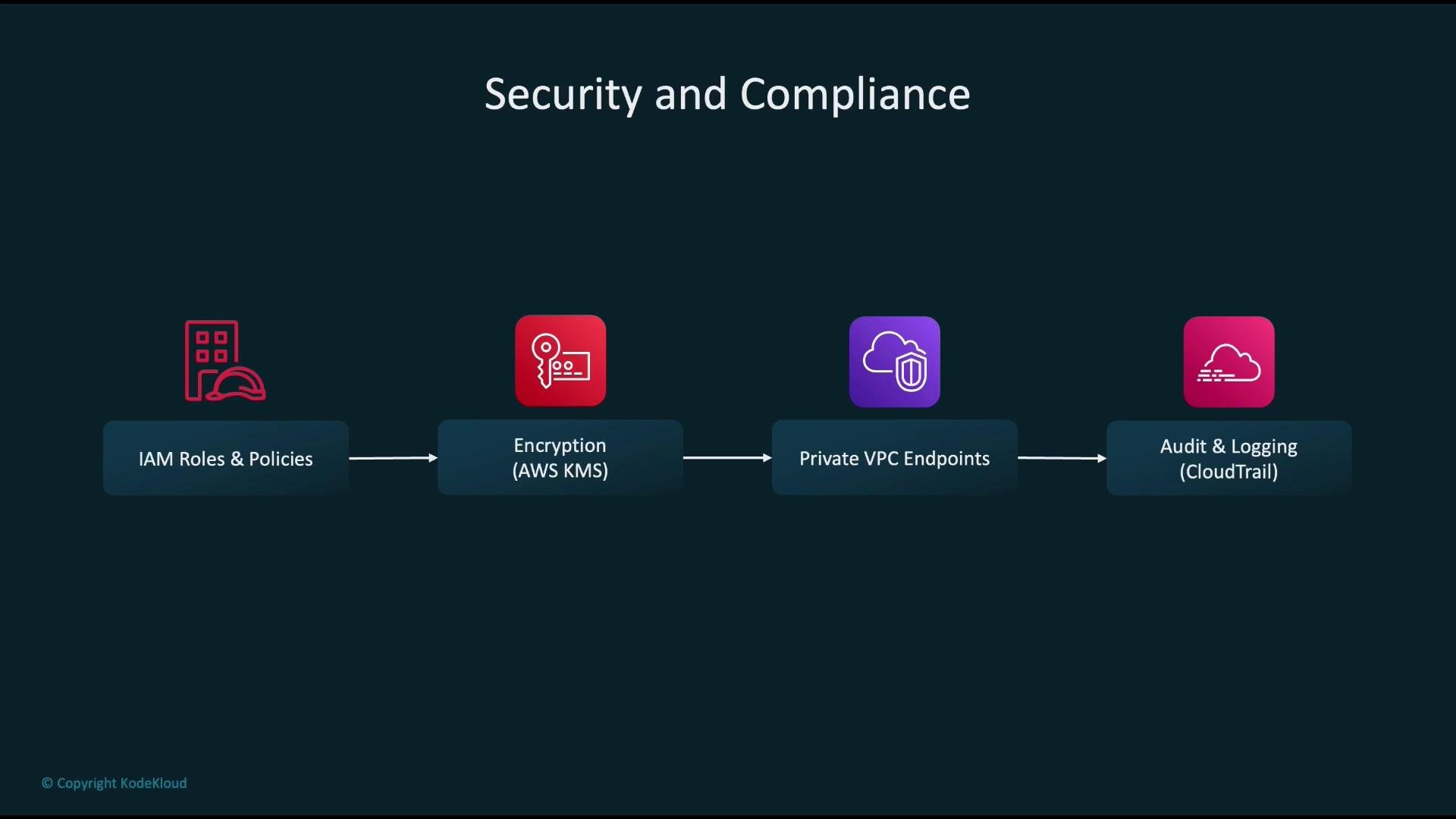
Security and compliance: layered controls
Protecting models, data, and pipelines requires multilayered controls:- Granular access control: use IAM roles and policies to restrict access.
- Encryption: enforce encryption in transit and at rest via a KMS (e.g., AWS KMS).
- Network isolation: use private VPC endpoints and secure communication channels.
- Audit trails and logging: capture actions for accountability and forensics (e.g., CloudTrail).
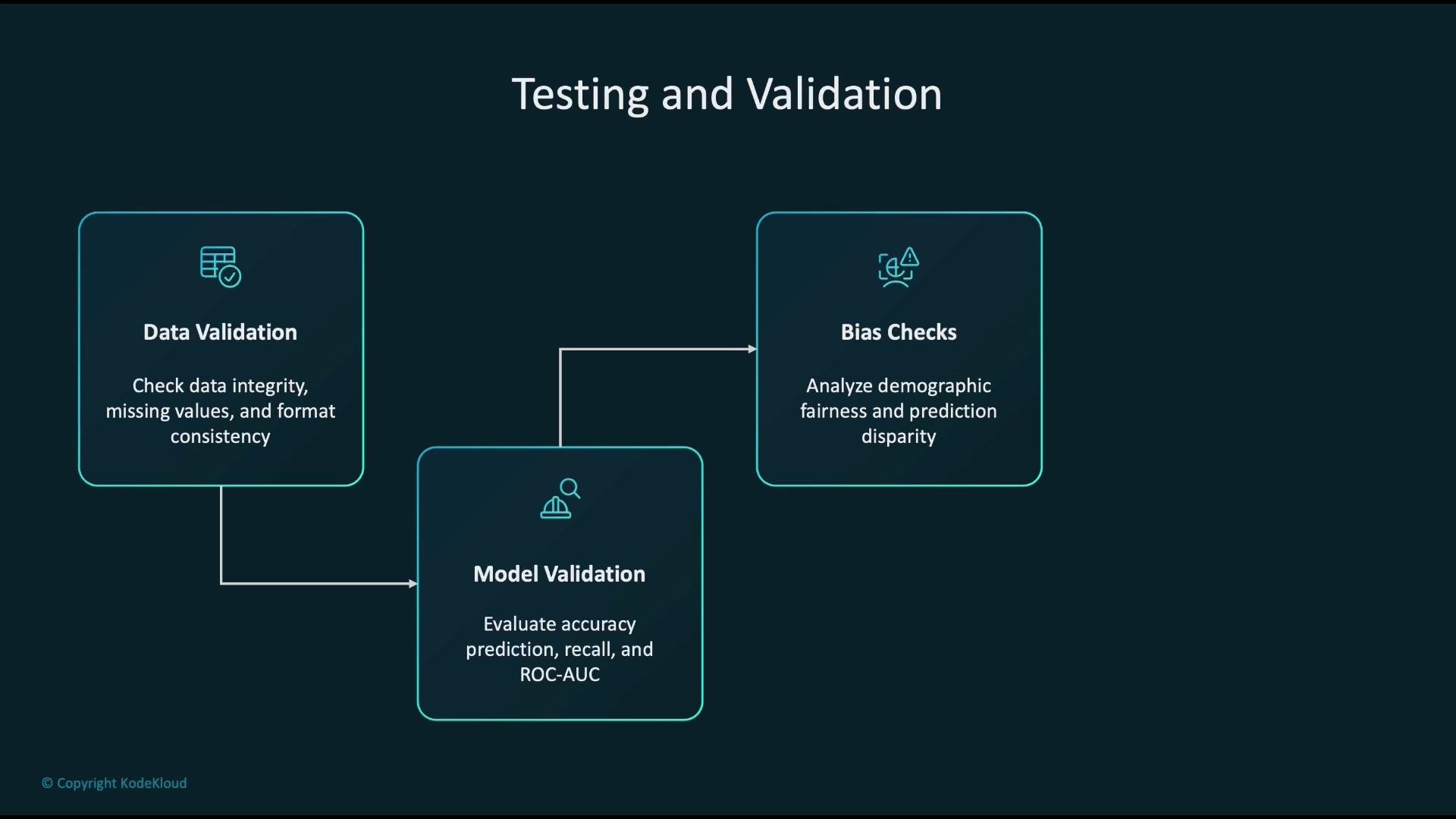
Testing and validation workflow
Automated validation is central to safe ML deployment. Typical checks include:- Data validation: schema checks, missing values, feature ranges, and distribution tests before training.
- Model validation: evaluate metrics (accuracy, precision/recall, AUC-ROC), confidence calibration, and thresholding.
- Bias and fairness checks: analyze model behavior across demographic and other important subgroups.
- Deployment gating: require automated checks (and human review where needed) before promotion.
Anti-patterns to avoid
Common pitfalls that undermine automation, reliability, or auditability:- Manual model promotion: prevents consistent rollouts and scaling.
- No artifact versioning: losing datasets and model versions breaks reproducibility.
- Skipping data validation: data issues quickly lead to degraded or incorrect models.
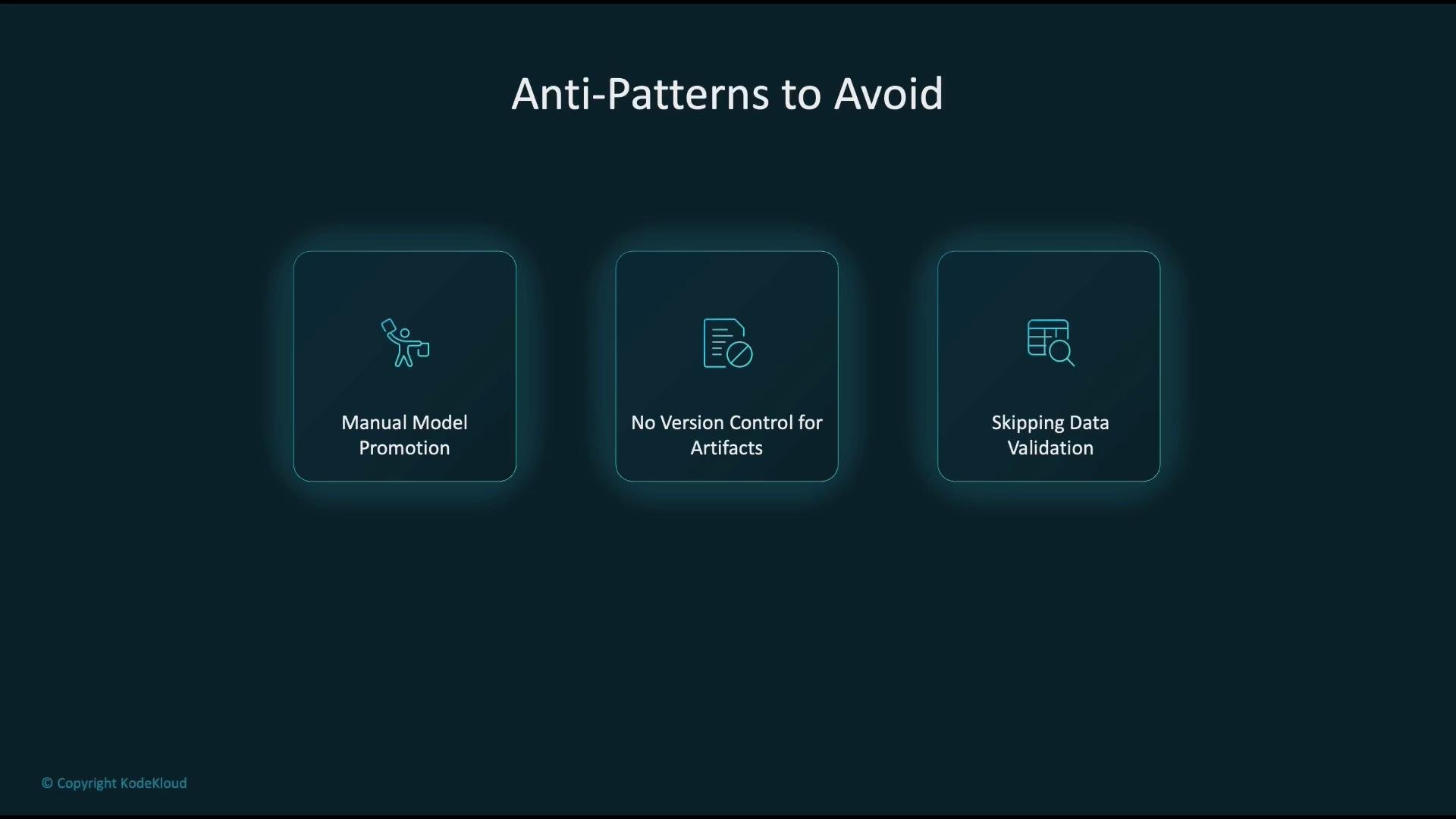
Avoid these anti-patterns by automating promotion gates, enforcing artifact versioning, and running data validation checks early in the pipeline.
Further reading and references
- CI/CD fundamentals for ML workflows — overview course
- MLOps fundamentals and best practices
- AWS IAM documentation on roles and policies
- AWS KMS developer guide
- AWS CloudTrail documentation