

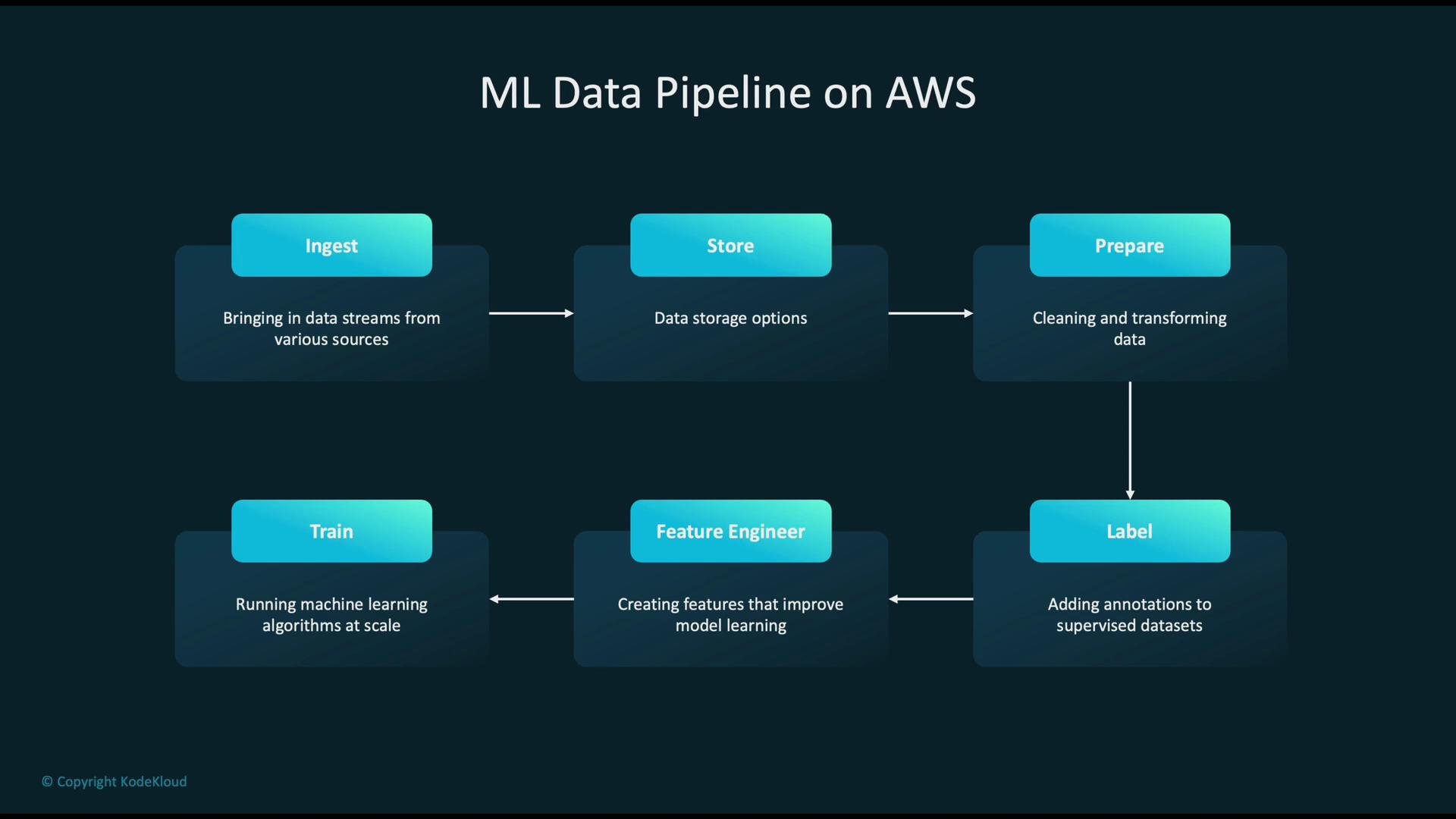
- Ingestion — bringing data into AWS from devices, applications, or other systems.
- Storage — persisting raw and processed data in an appropriate store.
- Preparation — cleaning, transforming, and enriching data for ML.
- Labeling — annotating data for supervised learning.
- Feature engineering — creating and storing features for training and inference.
- Training and orchestration — running model training at scale and managing the ML workflow.
Data ingestion on AWS
Choose ingestion services based on latency/throughput needs and destination targets (S3, Redshift, Feature Store, etc.):
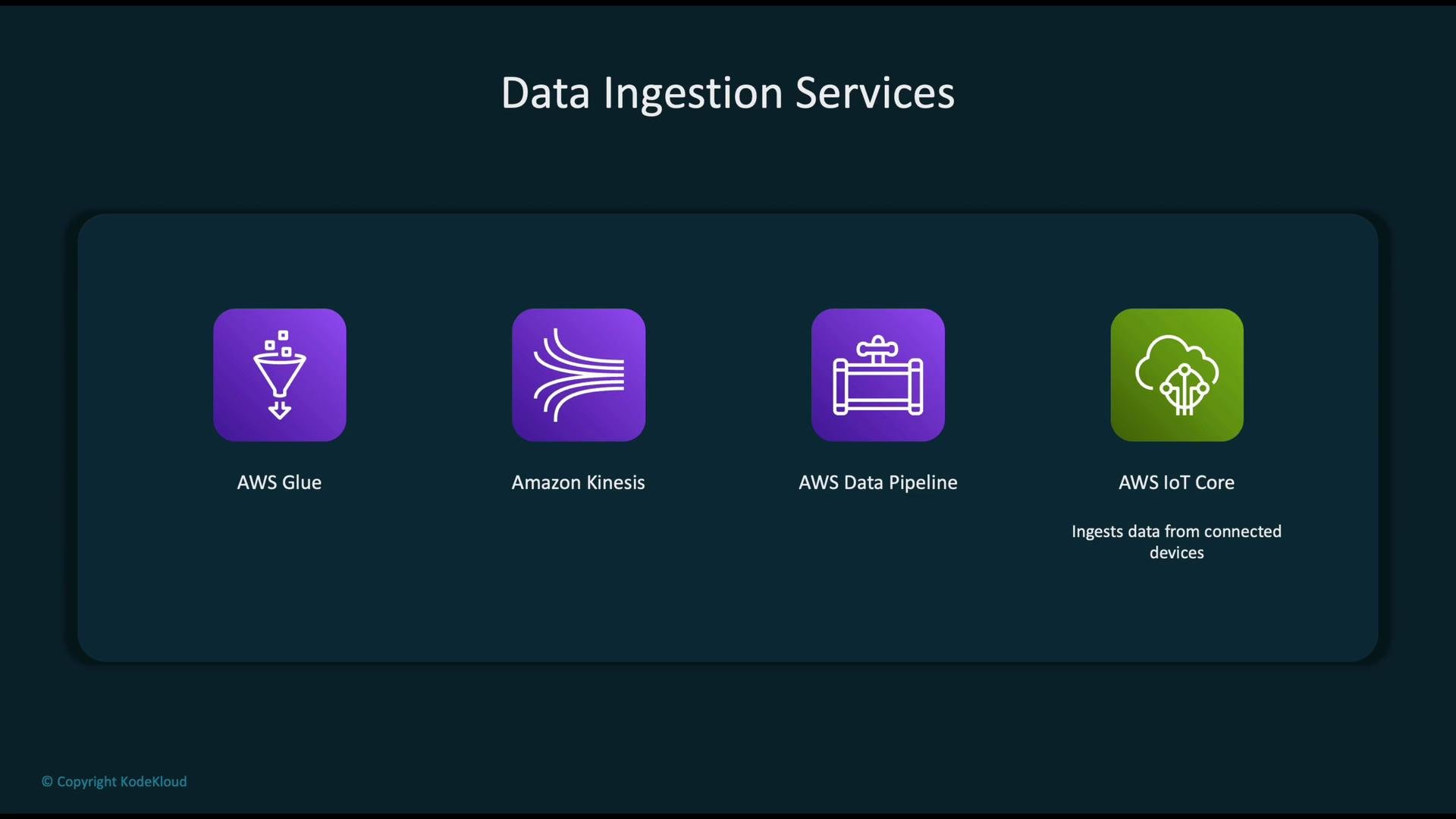
- Amazon Kinesis (Data Streams and Data Firehose) — real-time streaming ingestion and delivery to targets such as
Amazon S3, Redshift, or Elasticsearch. - AWS Glue — ETL movement and transformation between stores when building batch pipelines.
- AWS Data Pipeline — orchestration for scheduled data movement and long-running or legacy workflows.
- AWS IoT Core — secure ingestion of telemetry and messages from connected devices.
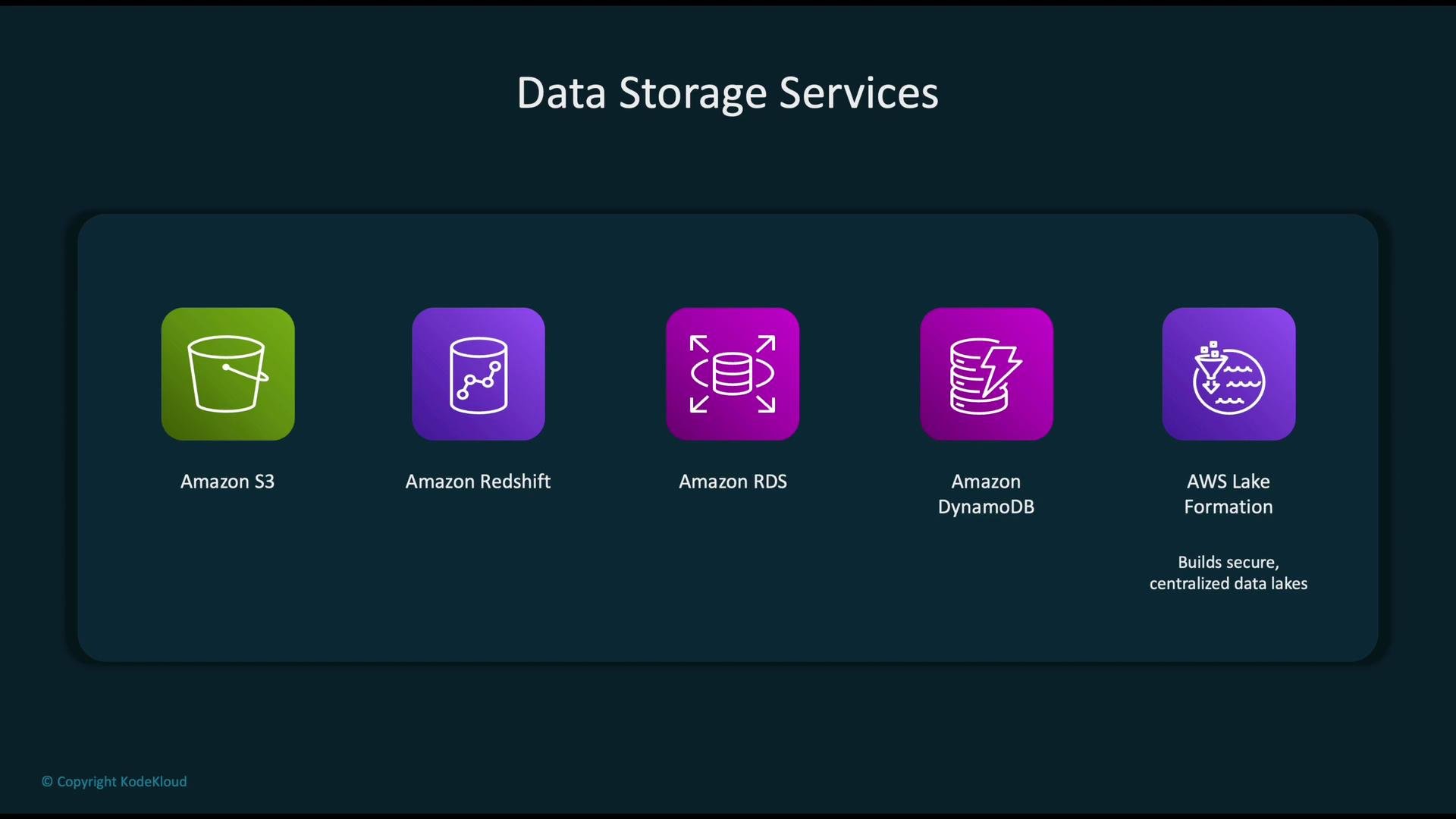
Amazon S3— scalable object storage and the de facto data lake for raw and processed datasets, model artifacts, and feature export.- Amazon Redshift — columnar data warehouse for analytical queries and BI workloads at scale.
- Amazon RDS — managed relational databases for structured OLTP workloads.
- Amazon DynamoDB — fully managed NoSQL key-value and document store for low-latency, high-scale access patterns.
- AWS Lake Formation — simplifies building, securing, and managing a centralized data lake on
S3with fine-grained access control.
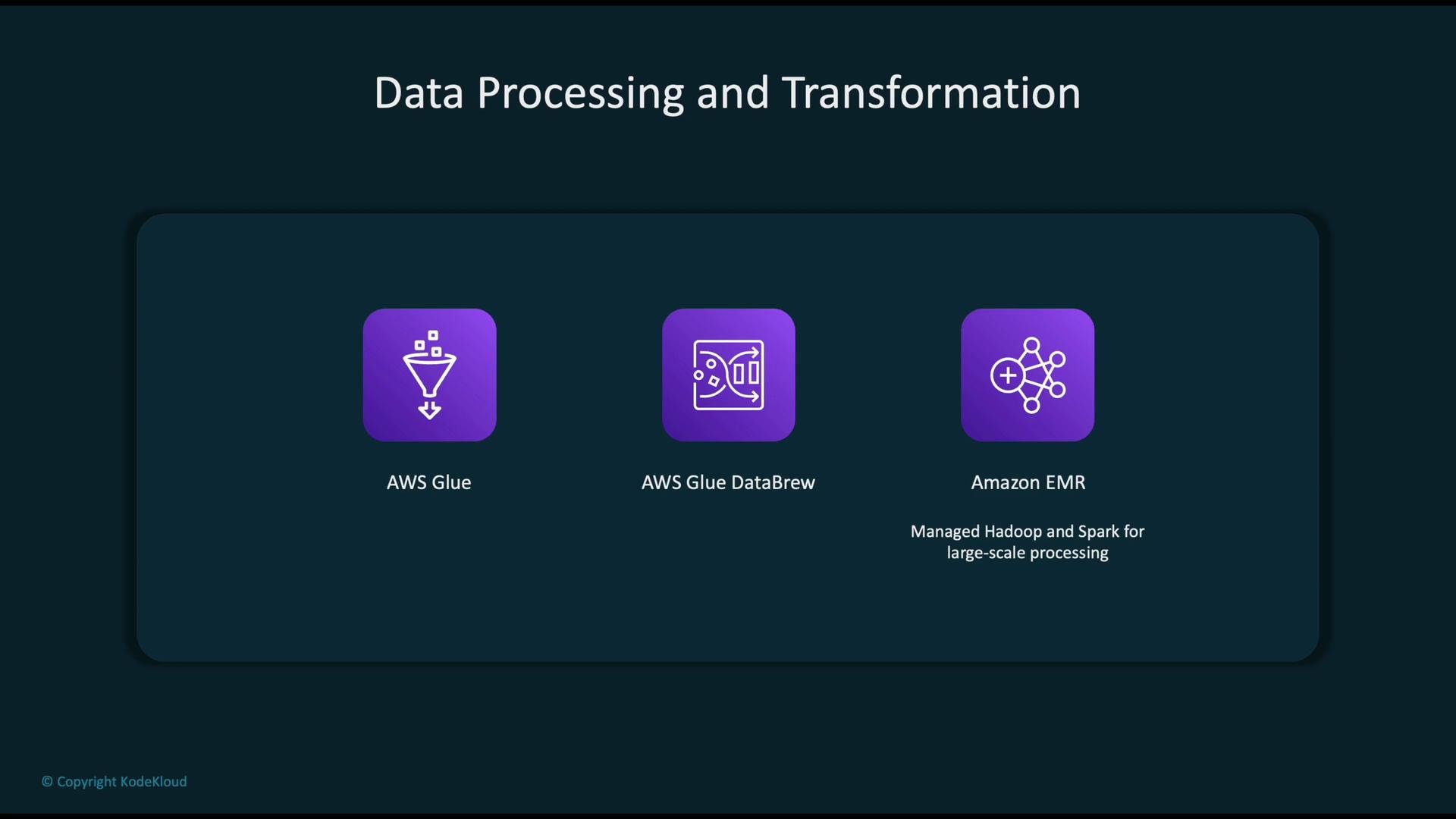
- AWS Glue — serverless ETL that discovers schemas, generates PySpark or Scala code, runs ETL jobs, and catalogs metadata in AWS Glue Data Catalog.
- AWS Glue DataBrew — a no-code/low-code visual tool for data cleaning, profiling, and exploration; great for analysts and data scientists collaborating on data prep.
- Amazon EMR — managed Hadoop/Spark cluster platform for large-scale distributed processing and custom Spark jobs where fine control and ecosystem tools are required.
- Amazon SageMaker Ground Truth — scalable labeling with human labelers, private workforces, and automated/ML-assisted labeling (active learning) to reduce cost and improve label quality.
- Amazon SageMaker Feature Store — centralized feature repository with both offline (batch) and low-latency online stores; supports consistent feature retrieval for training and inference.
- Amazon SageMaker Pipelines — orchestrate, automate, and version end-to-end ML workflows: data processing, training jobs, evaluation, and deployment. Pipelines integrates tightly with SageMaker components and other AWS services.
- Ingest streaming events with Kinesis or batch files into
Amazon S3. - Catalog and transform data with AWS Glue (or run Spark jobs on EMR for large-scale processing).
- Use SageMaker Ground Truth to label a representative subset of data.
- Store engineered features in SageMaker Feature Store for reuse and consistent serving.
- Orchestrate data processing, training, and deployment with SageMaker Pipelines and run managed SageMaker training jobs.
Select services based on data velocity, scale, and required SLAs: use streaming services (Kinesis) for real-time pipelines, EMR for heavy custom distributed processing, and serverless Glue/DataBrew for most ETL and interactive cleaning tasks.
- Amazon S3 — Object Storage
- Amazon SageMaker — Managed ML Platform
- AWS Glue — Serverless ETL
- Amazon Kinesis — Real-time Data Streaming
- Amazon EMR — Managed Hadoop/Spark
- AWS Lake Formation — Data Lake Management
- Amazon RDS & DynamoDB — Managed Databases