

Feature engineering is both art and science: start with domain knowledge, iterate with experiments, and automate or store reliable features for reuse. Use simple features first—well-crafted features often beat higher model complexity.
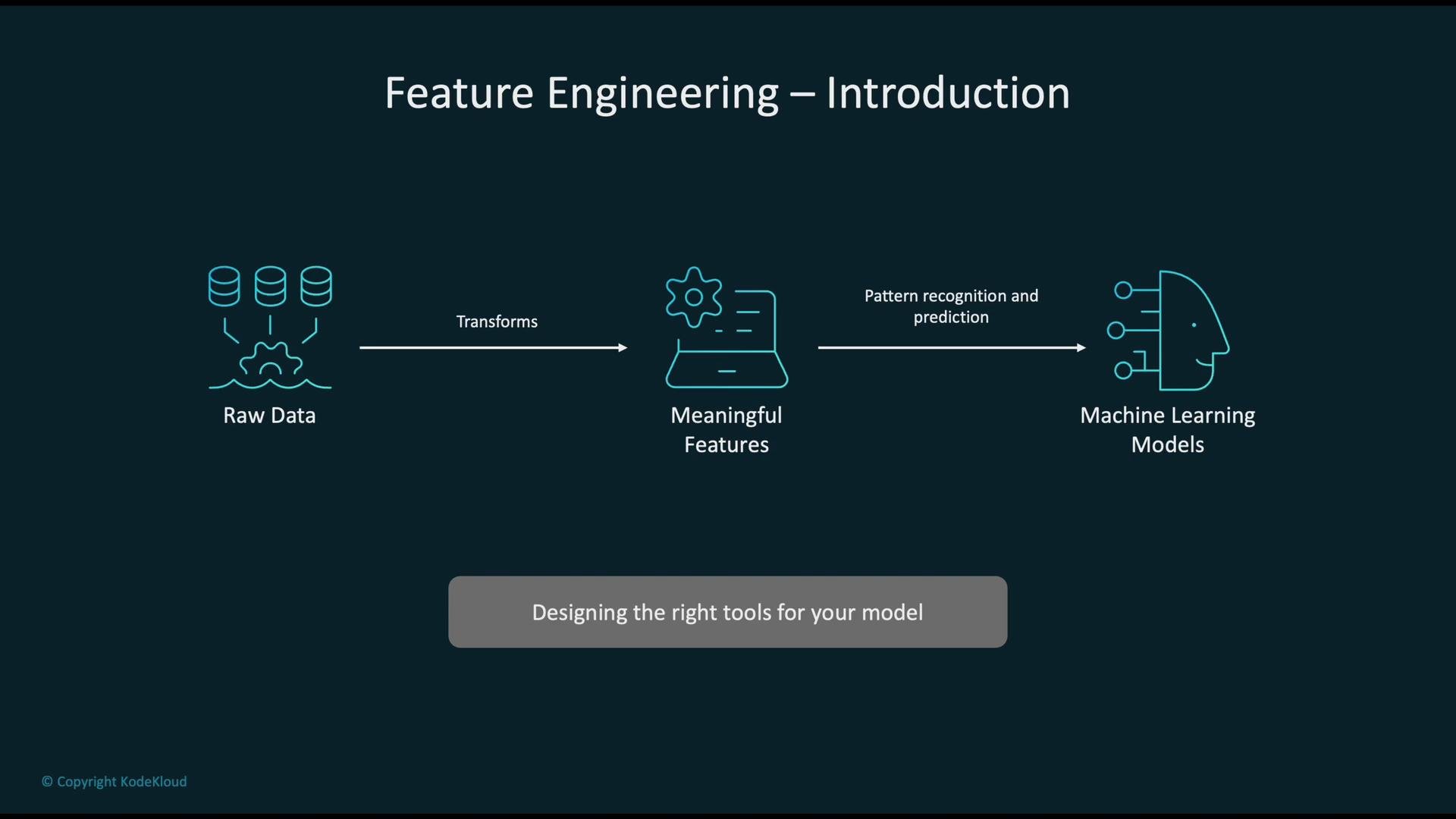
- Imagine you work at a space agency and must predict whether a rocket launch will succeed. Raw sensor readings (temperature, humidity, wind, fuel levels, mass, radius, etc.) are useful but often insufficient by themselves.
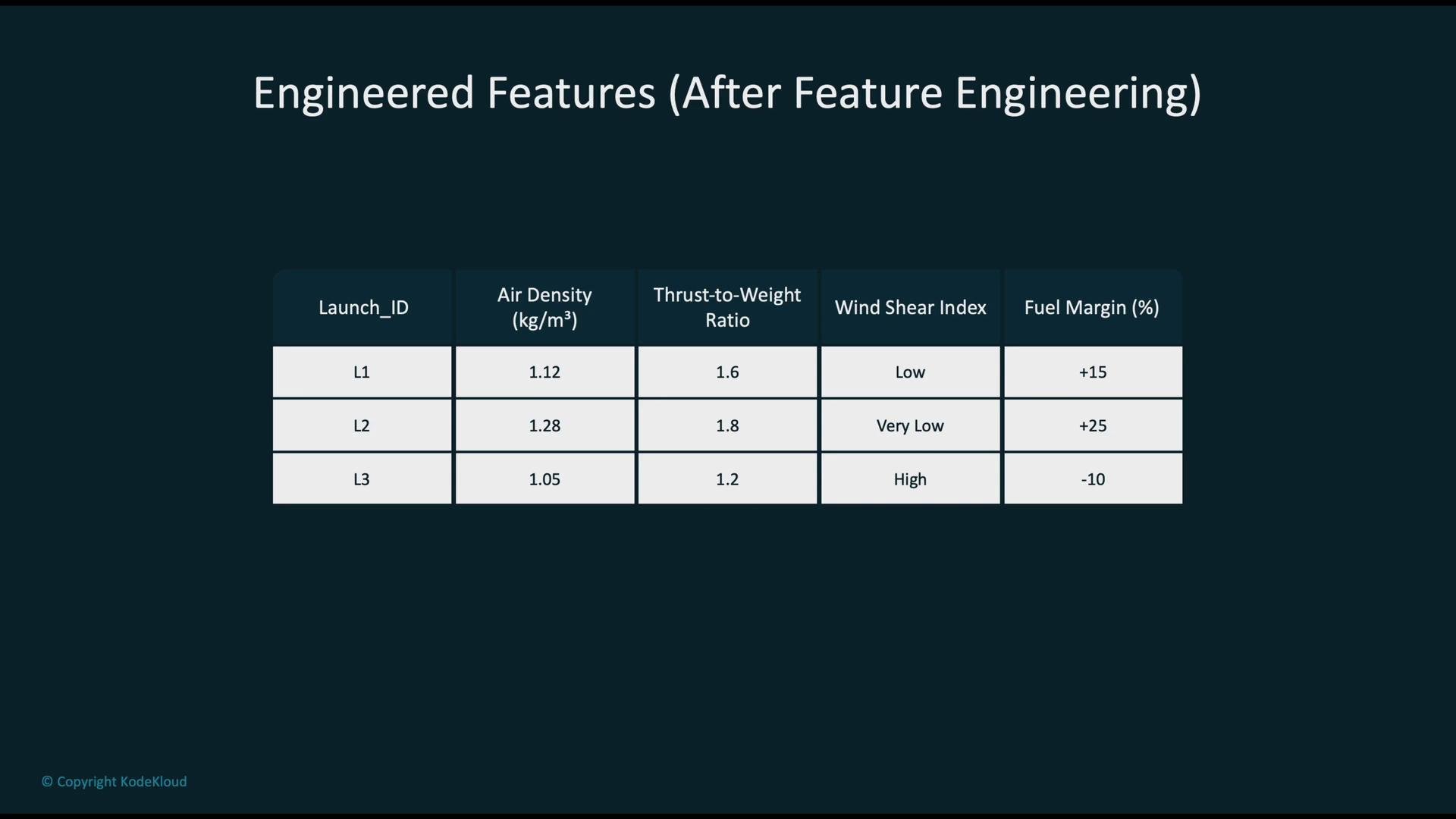
- Feature engineering turns those raw signals into features that capture domain-relevant patterns—e.g., air density, thrust-to-weight ratio, wind shear index, and fuel margin—so a model can better assess risk.
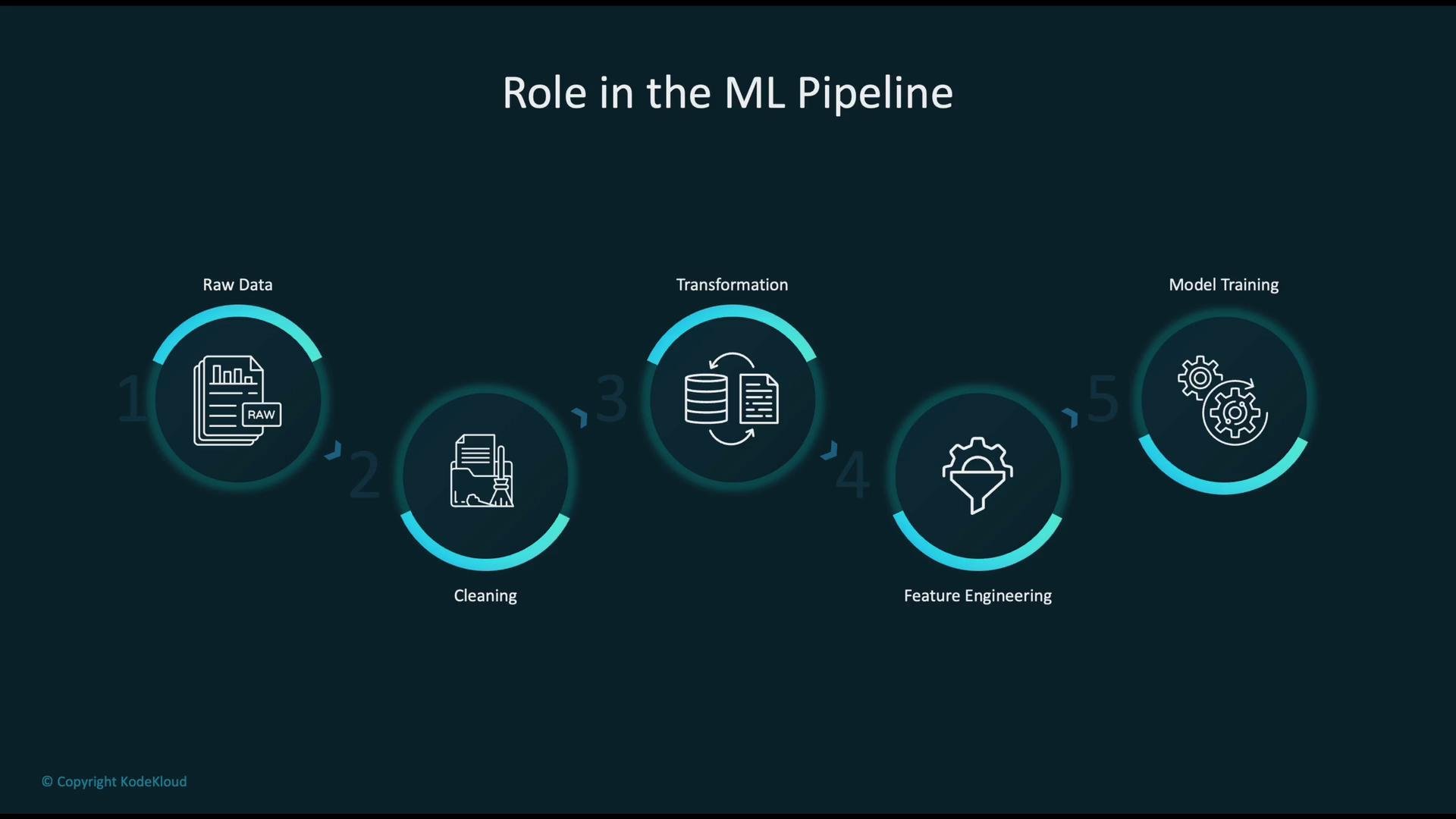
- Raw data (often messy and unstructured) → Cleaning (fix missing values, remove errors) → Transformation (convert to structured, machine-readable form) → Feature engineering (derive meaningful features) → Model training & evaluation.
- Higher accuracy: Features that encode signal make patterns easier to learn.
- Faster training: Compact, relevant features reduce computation.
- Lower overfitting: Removing noisy or irrelevant inputs improves generalization.
- Better transfer: Robust features often generalize better to new data.
Transform raw signals into domain-aware features
- Raw sensors: temperature, humidity, wind speed, fuel level, mass, radius.
- Derived features that capture risk:
- Temperature + humidity (+pressure) → air density
- Thrust and mass → thrust-to-weight ratio
- Wind speed profile → wind shear index
- Fuel level → fuel margin
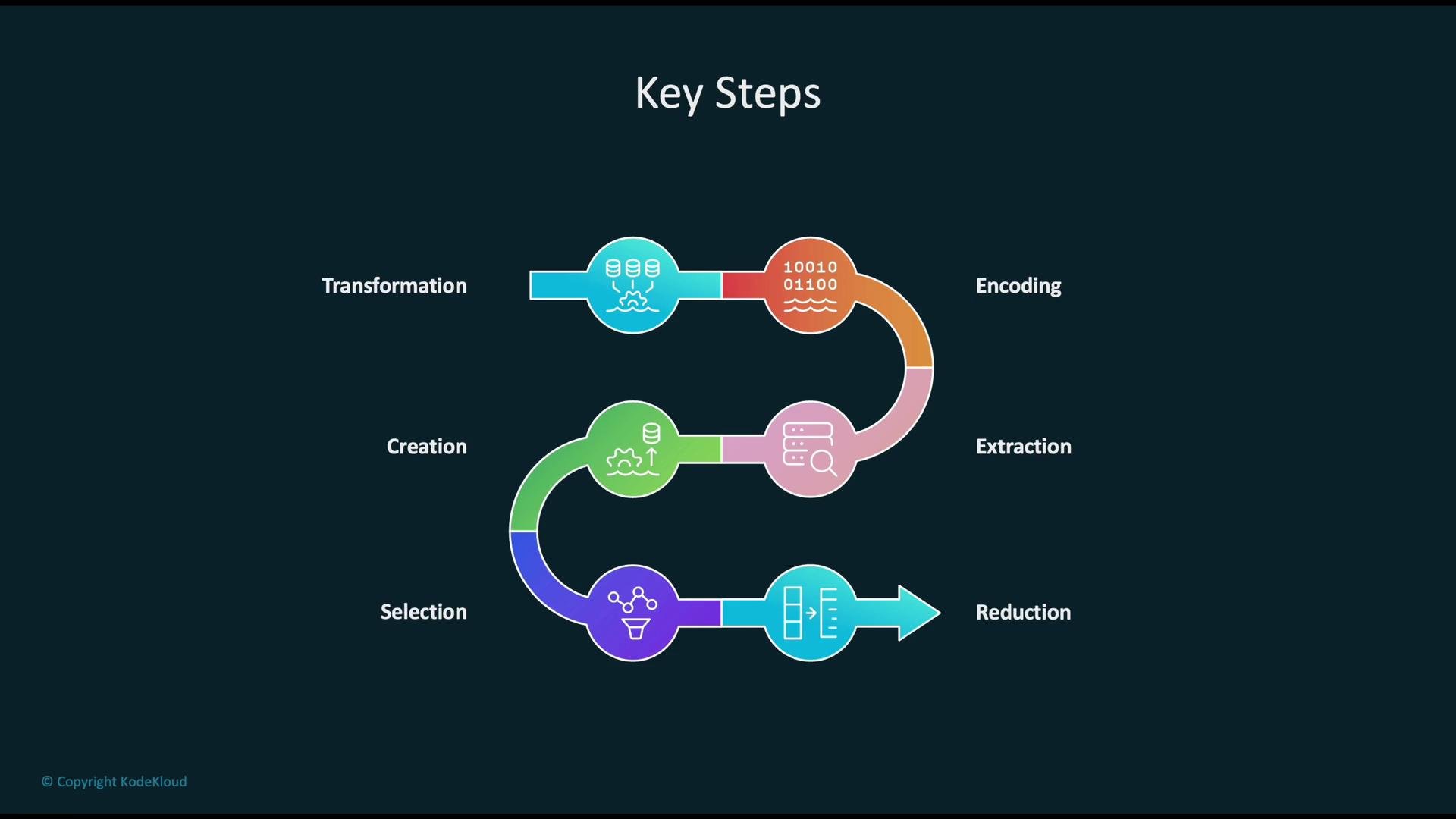
- Transformation — rescaling or normalizing values so features are comparable.
- Encoding — converting categorical/textual data into numeric form (one-hot, ordinal).
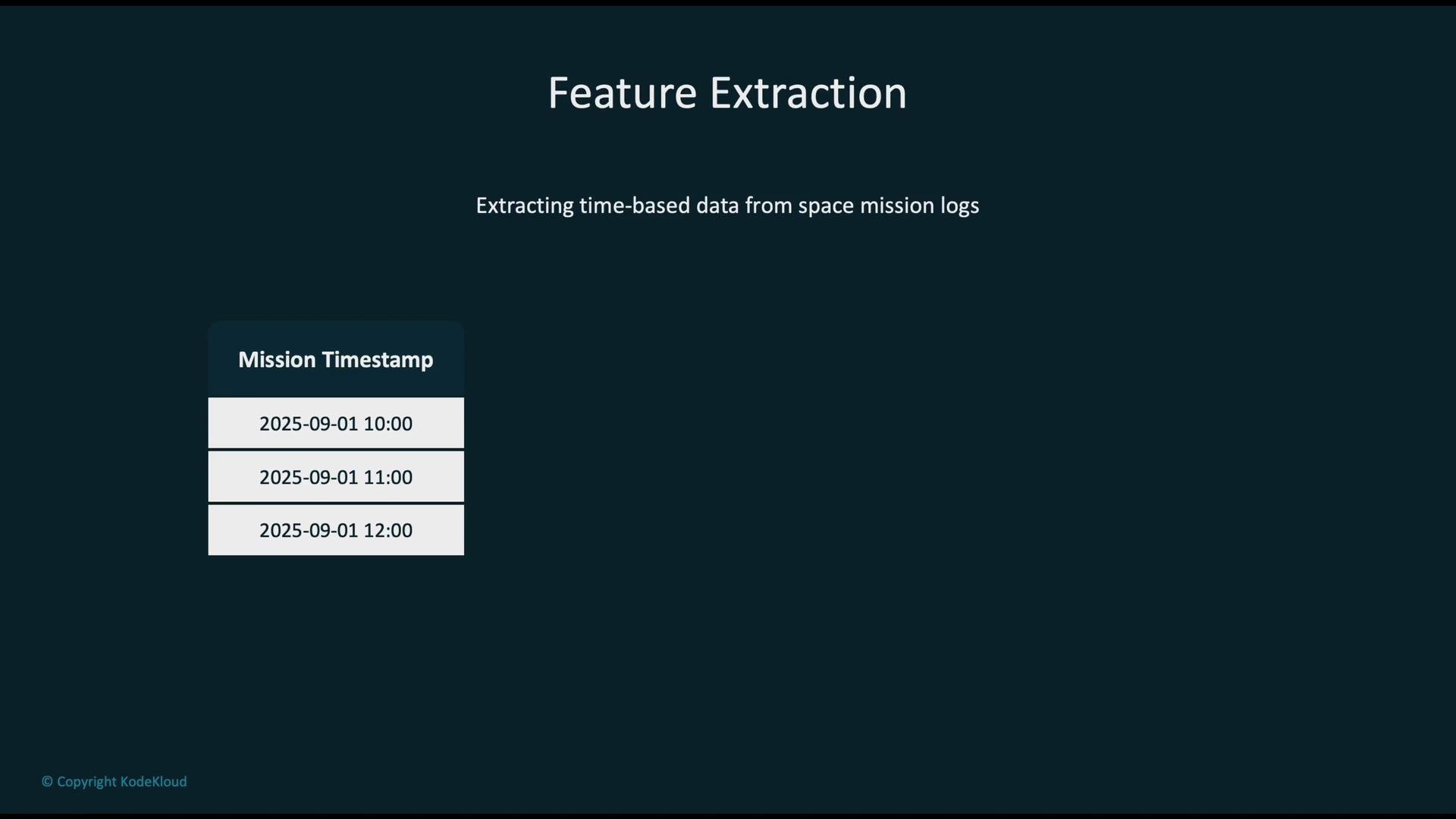
- Extraction — deriving signals from raw fields (timestamps → hour/day).
- Creation — combining variables using domain knowledge (mass & radius → gravity).
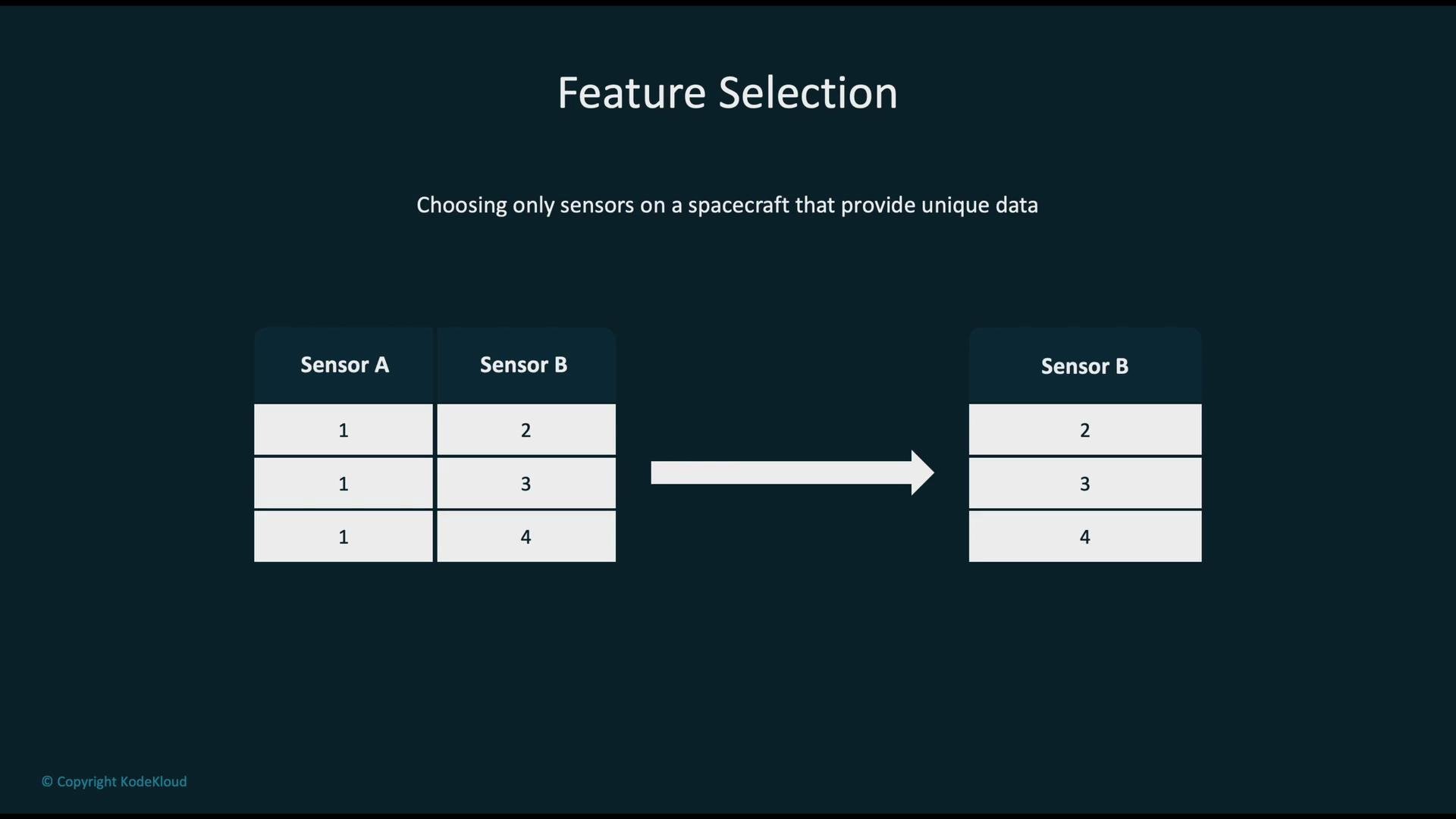
- Selection — removing redundant/noisy features to reduce variance.
- Dimensionality reduction — compressing features with PCA, SVD, etc.
-
Transformation
- Min-max scaling to [0,1] or z-score standardization to center/scale features.
- Use scaling consistently between training and inference (save scalers).
-
Encoding
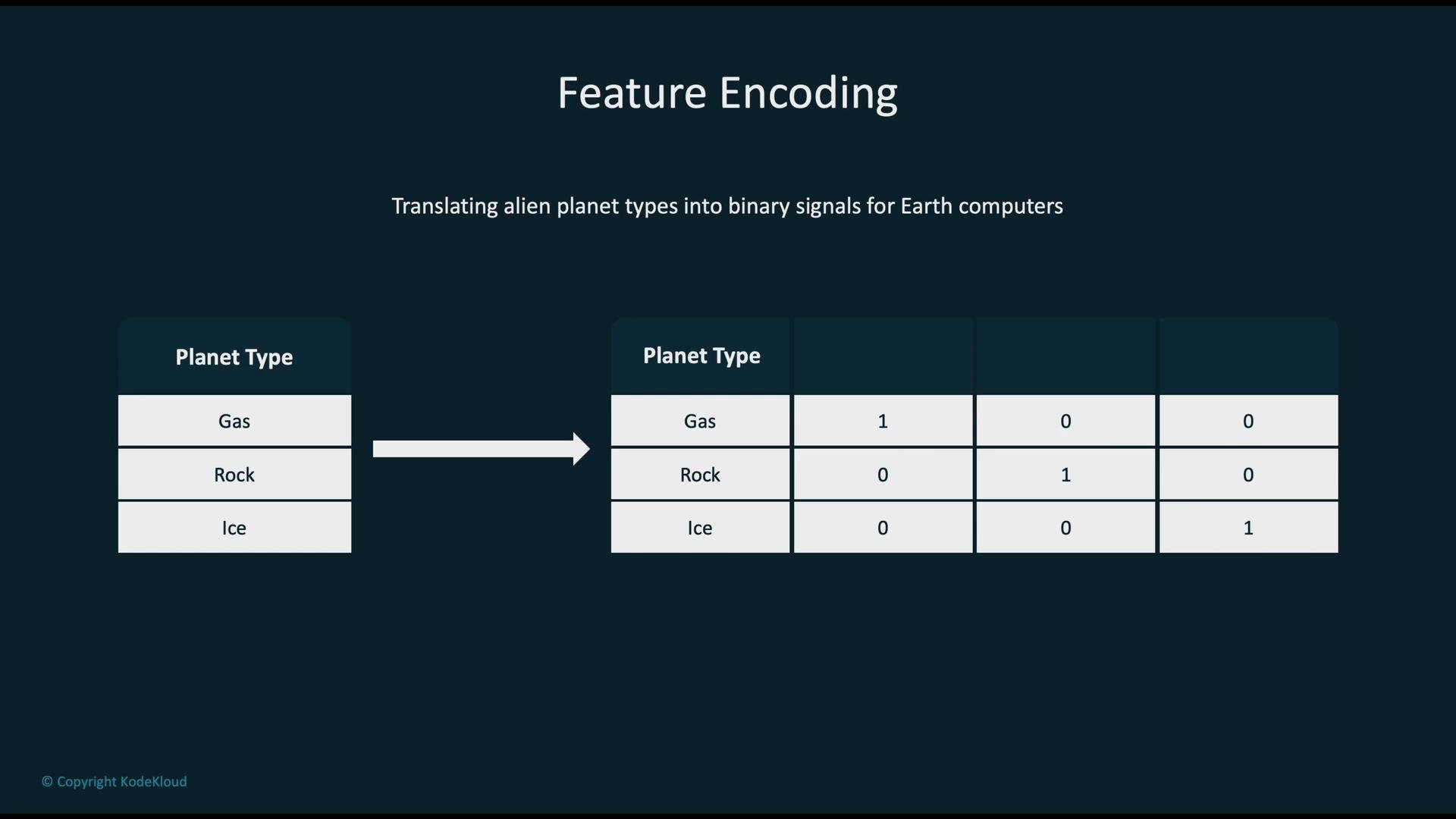
- One-hot encoding turns categories into binary vectors so models can use them.
- Example: Planet types (Gas, Rock, Ice) → binary features for each category.
- Extraction
- From timestamps extract components such as hour-of-day, day-of-week, elapsed time, or cyclical encodings (sin/cos for time-of-day) to capture periodicity.
-
Creation
- Build domain-specific features (e.g., compute gravity from mass and radius) to surface relationships not obvious from raw inputs.
-
Selection
- Filter out redundant or faulty sensors. If Sensor A is faulty and highly correlated with other sensors, remove it and keep unique signals like Sensor B.
- Dimensionality reduction
- Use PCA or similar methods when many features are correlated. This reduces noise and model complexity while preserving variance (analogous to converting RGB to grayscale when color adds little value).
- Amazon SageMaker Data Wrangler — visual/no-code data cleaning, transformation, and feature engineering.
- Amazon SageMaker Feature Store — centralized, consistent feature repository for sharing and reusing features across teams and models.
- Amazon SageMaker Processing — scalable, code-based preprocessing and transformation jobs.
- AWS Glue / Amazon EMR — managed ETL and big-data processing for large-scale feature pipelines.
- Amazon SageMaker Data Wrangler
- Amazon SageMaker Feature Store
- Amazon SageMaker Processing
- AWS Glue
- Amazon EMR
Beware of data leakage: create features using only training-period information. Using future labels or post-event data leaks can inflate validation metrics and produce poor real-world performance.
- Start with domain knowledge and simple features.
- Validate each feature with holdout/temporal validation.
- Persist proven features in a feature store for reproducibility.
- Automate pipelines for consistent preprocessing at training and inference.
- Monitor feature drift and data quality in production.