

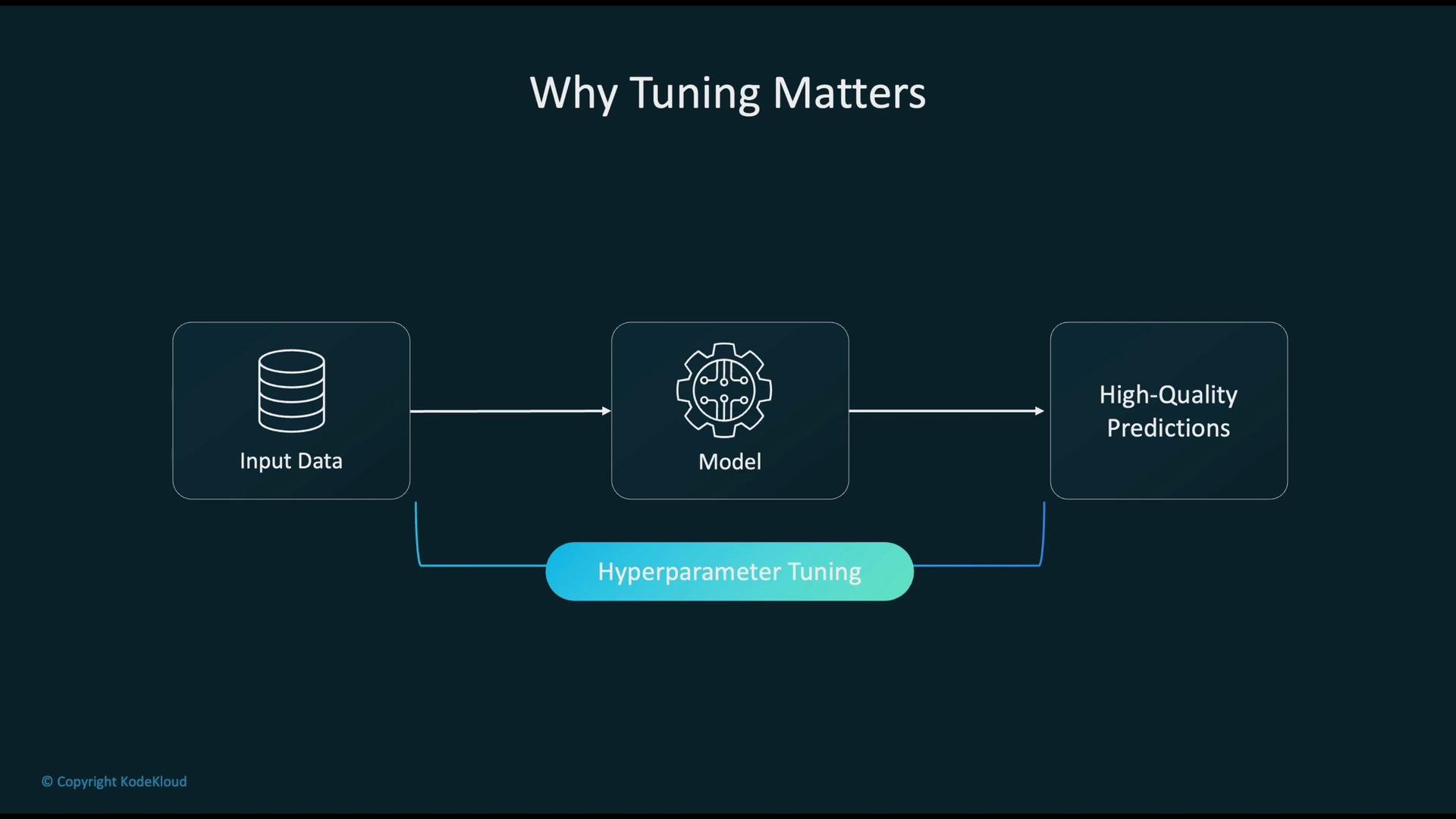
- Correct hyperparameters control the trade-off between underfitting and overfitting.
- They influence convergence speed, final accuracy, and resource usage (compute and time).
- Effective tuning can reduce cost by lowering the number of expensive training runs needed to reach target performance.
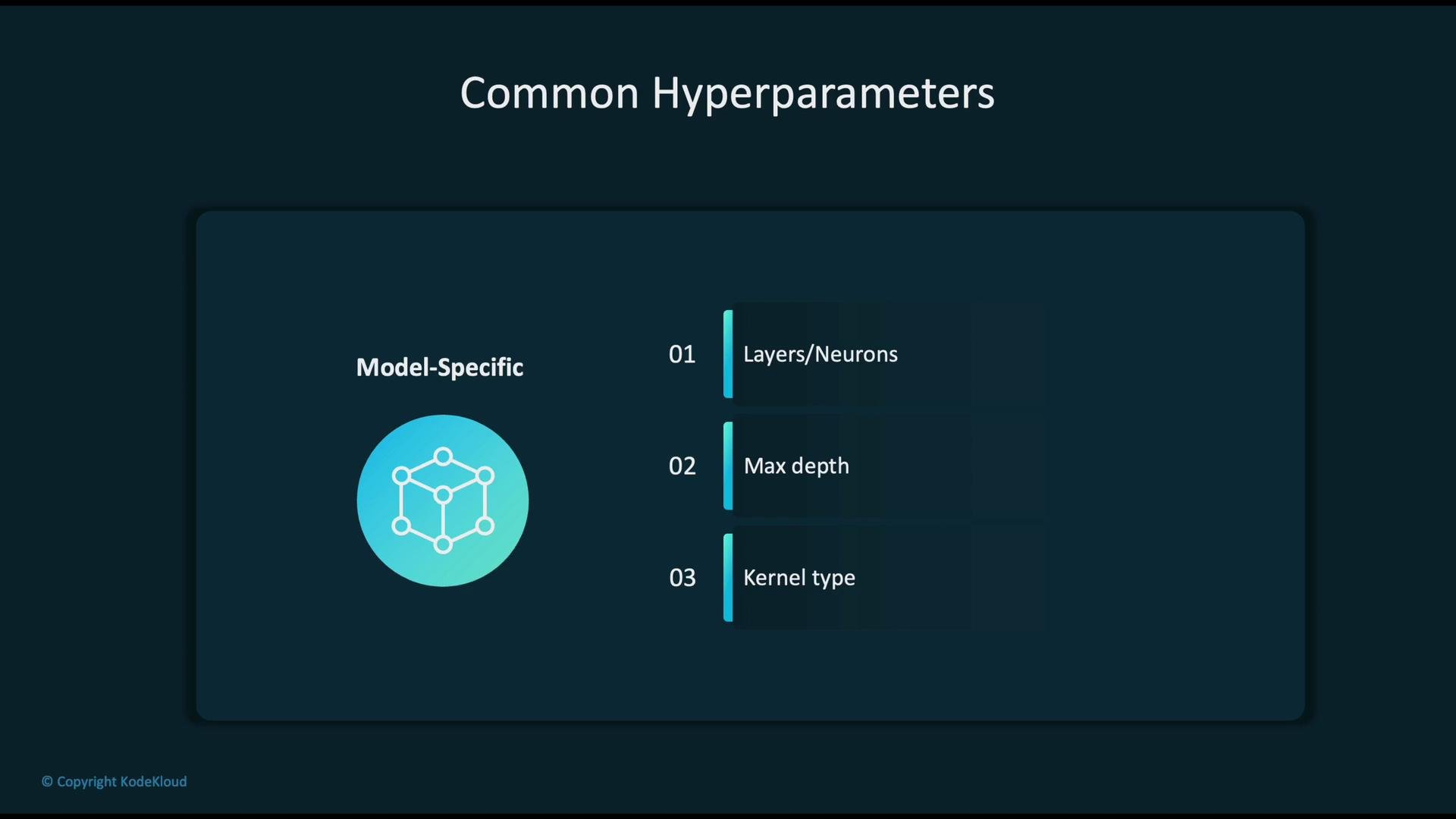
- Model-specific: number of layers, number of neurons, max depth (decision trees), kernel type (SVM).
- Regularization: L1/L2 penalties, dropout rate, weight decay.
- Training process: learning rate, batch size, optimizer, number of epochs.
- Evaluation / early stopping: validation split, early-stopping patience, checkpoint frequency.
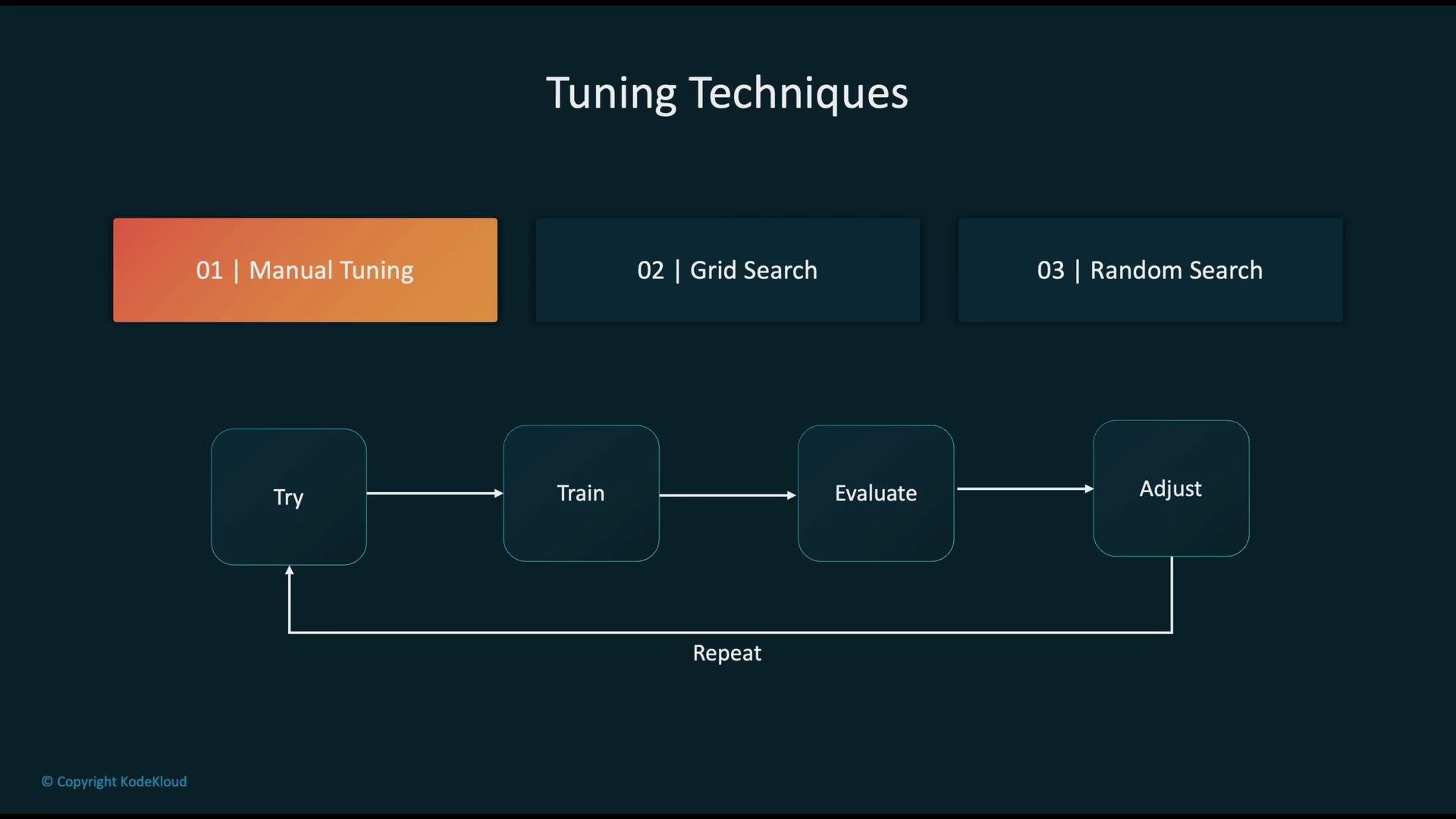
Manual tuning
- Pros: Simple, increases practitioner intuition about which hyperparameters matter.
- Cons: Time-consuming, not scalable, often yields suboptimal configurations.
- When to use: Exploratory experiments, small models, or educational settings.
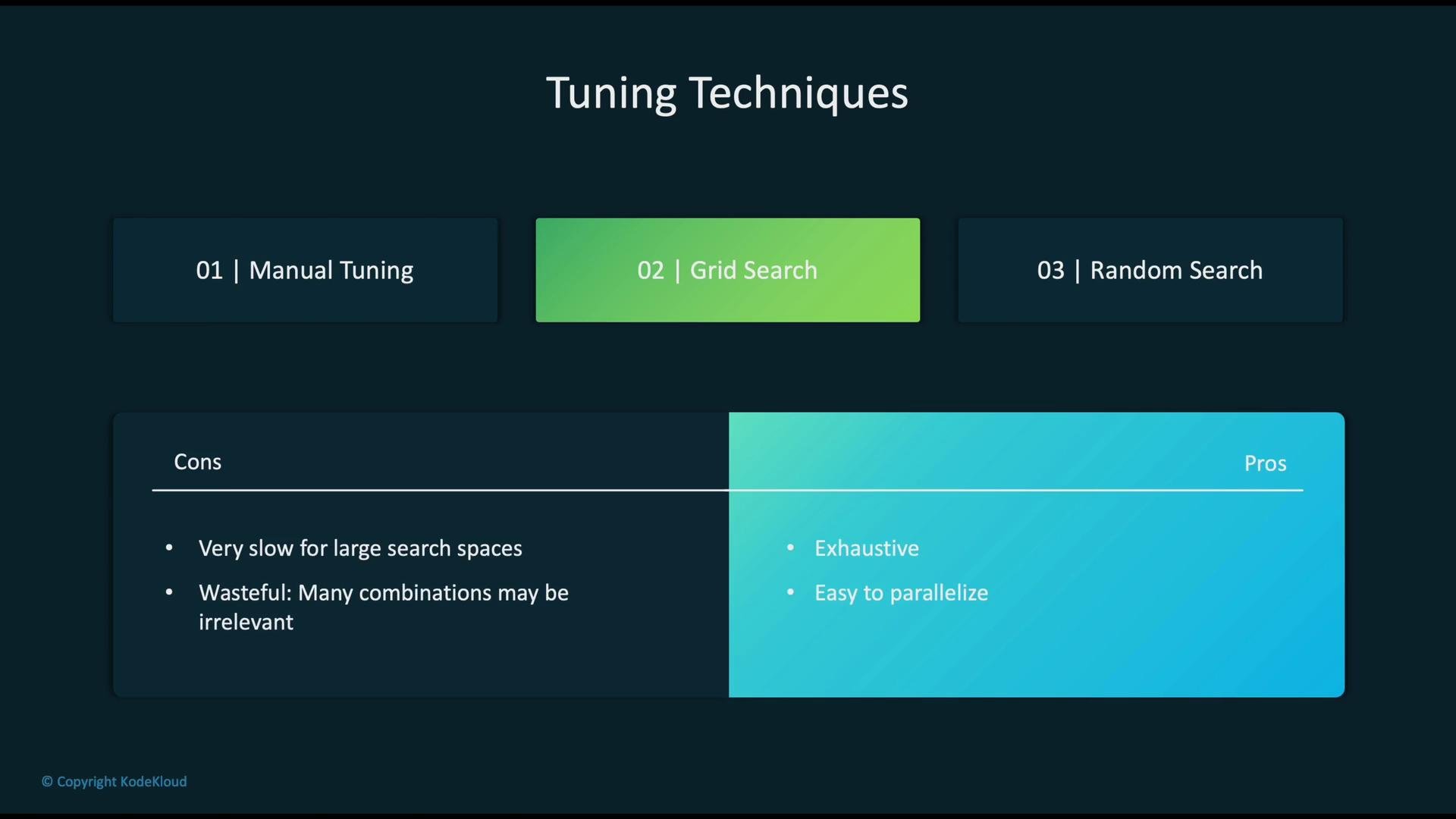
- Pros: Exhaustive within the grid and easy to parallelize.
- Cons: Infeasible for large or continuous search spaces; wastes trials on unimportant parameters.
- When to use: Low-dimensional, discrete search spaces where guaranteed grid coverage is desired.
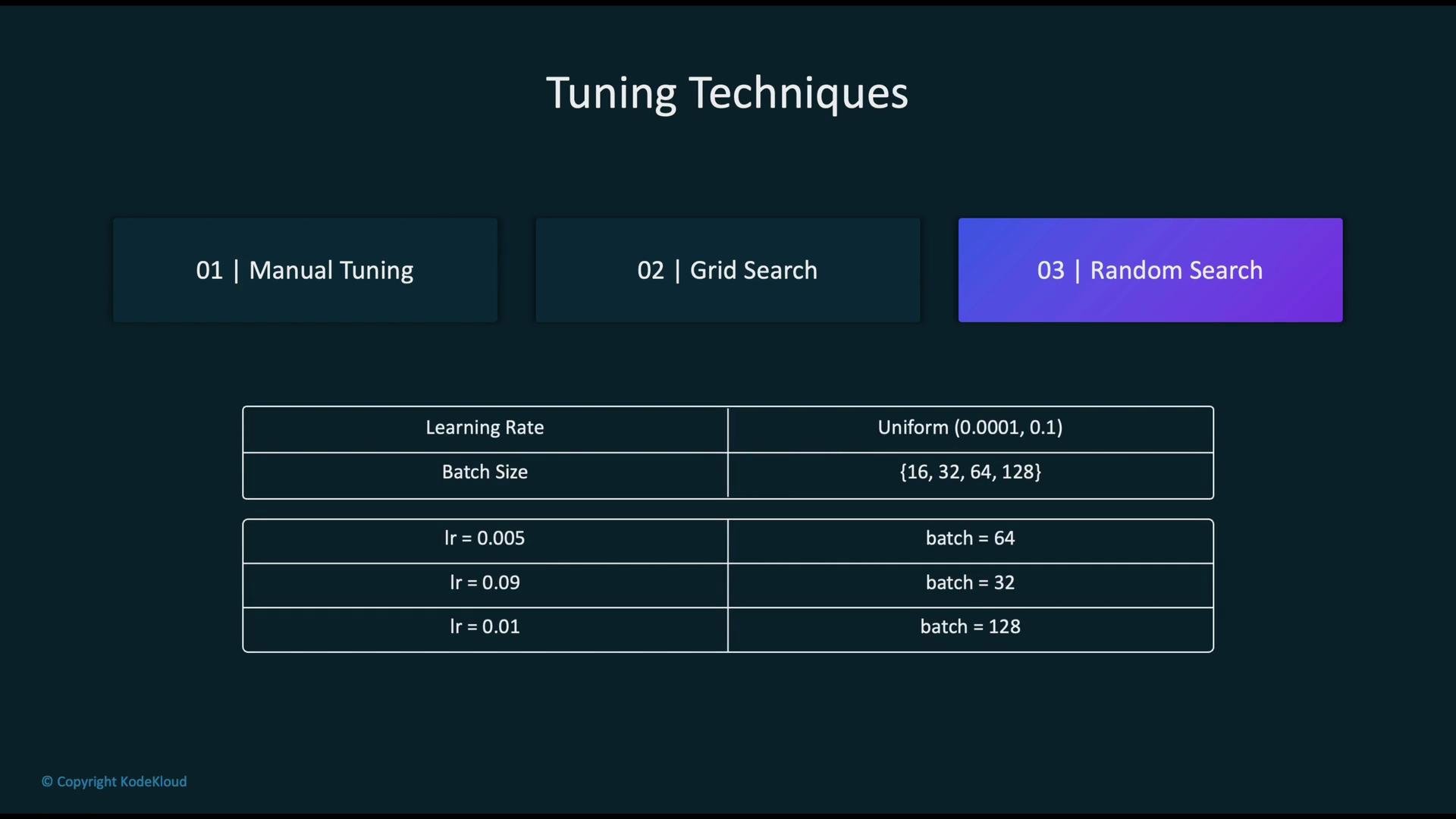
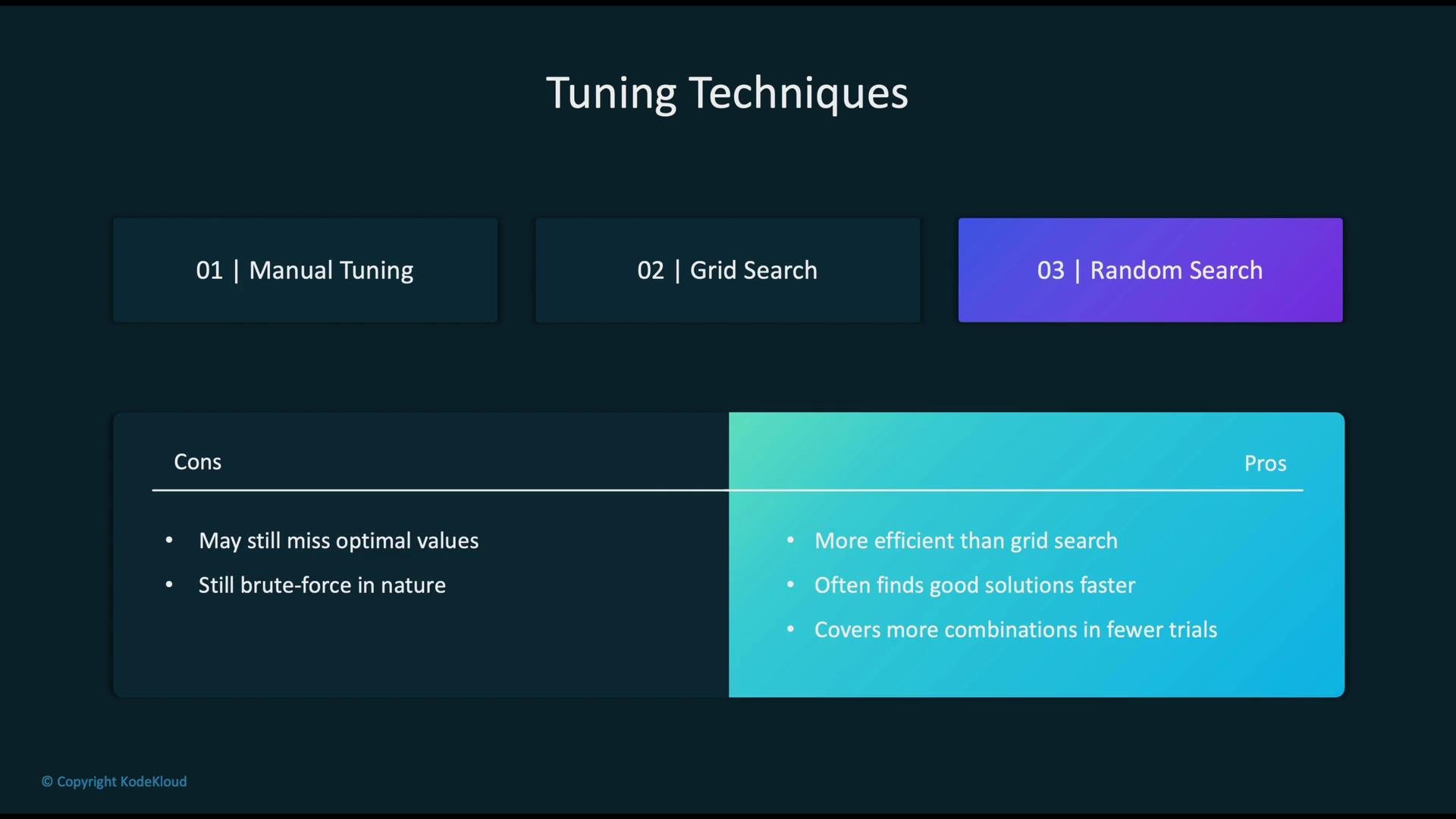
- Pros: More efficient than grid search in many practical high-dimensional problems; tends to find good configurations with fewer trials.
- Cons: Still random and can miss narrow optimal regions.
- When to use: Medium-to-large search spaces where budget is limited and you want broader coverage than a grid.
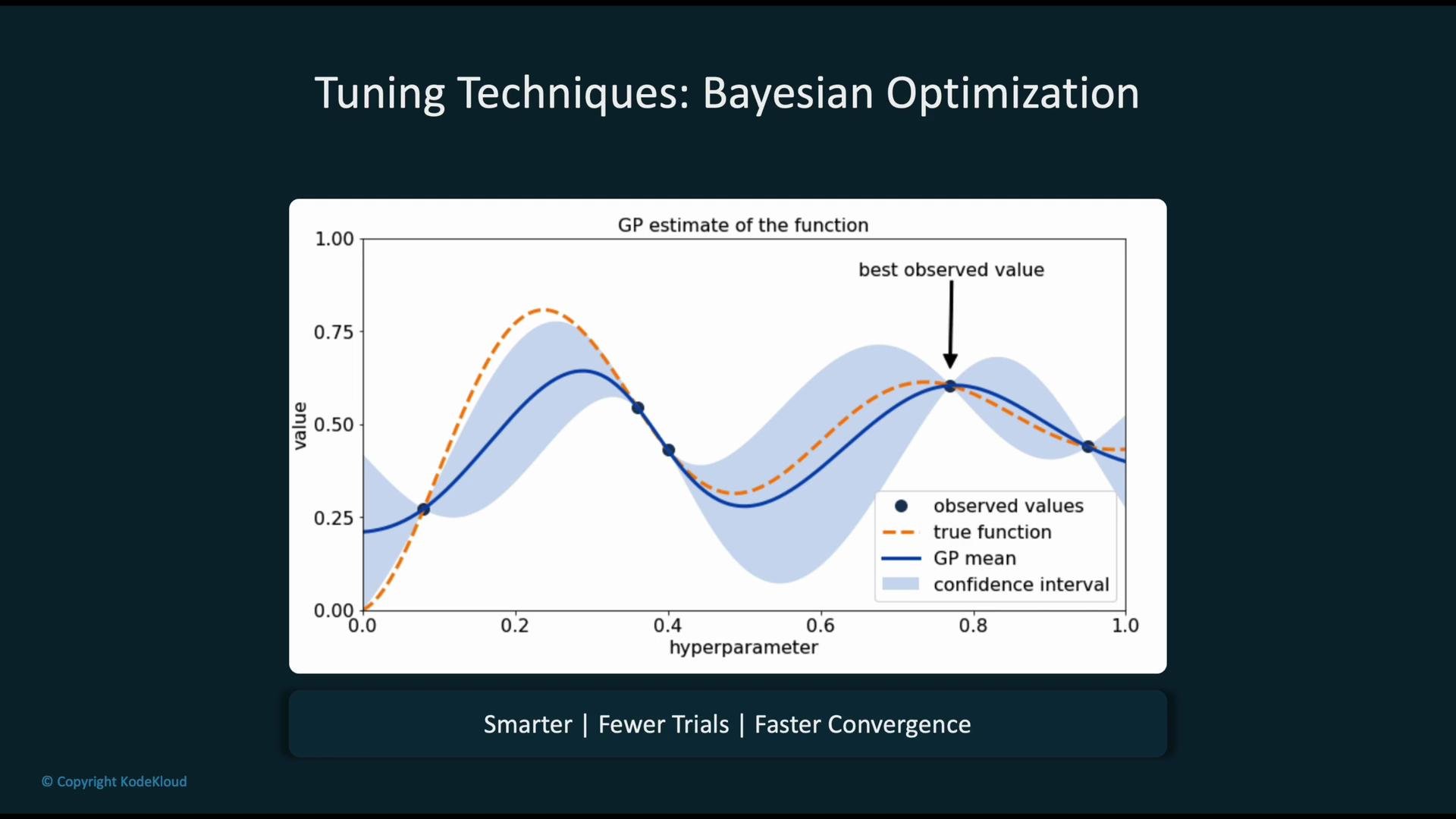
- Pros: Great for expensive-to-evaluate objectives; reduces number of required trials.
- Cons: Additional implementation complexity; surrogate model overhead for many parallel experiments.
- When to use: Long training runs, costly compute (GPU/TPU), or when each trial is expensive in time or money.
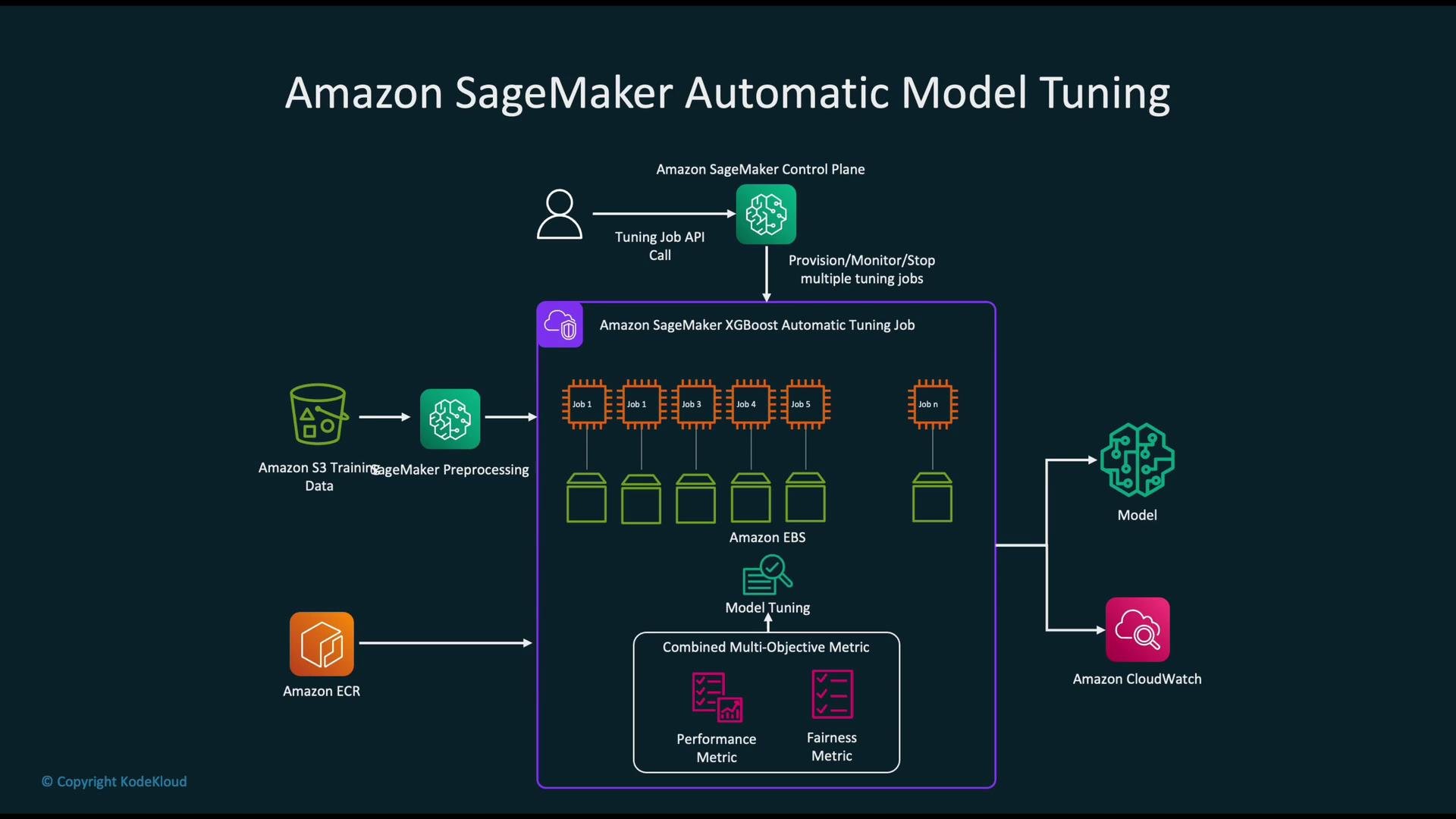
- Key features:
- Define hyperparameter ranges and distributions.
- Choose optimization strategies (random or Bayesian/SMBO).
- Run many training jobs in parallel with resource management.
- Aggregate results, log metrics, and automatically select the best model.
- Use Bayesian optimization or a managed HPO service (like SageMaker HPO) when training is expensive or each trial takes hours/days.
- Use random search for a balance of simplicity and efficiency on larger search spaces.
- Reserve grid search for small, discrete, and well-bounded parameter grids.
When training is expensive (long training times or high compute cost), prefer Bayesian optimization or managed tuning services that reduce the number of trials needed to find a good configuration.
- Kubernetes Documentation (deployment patterns for training clusters)
- Amazon SageMaker (managed model training and HPO)
- Research on Bayesian optimization and SMBO for hyperparameter tuning