

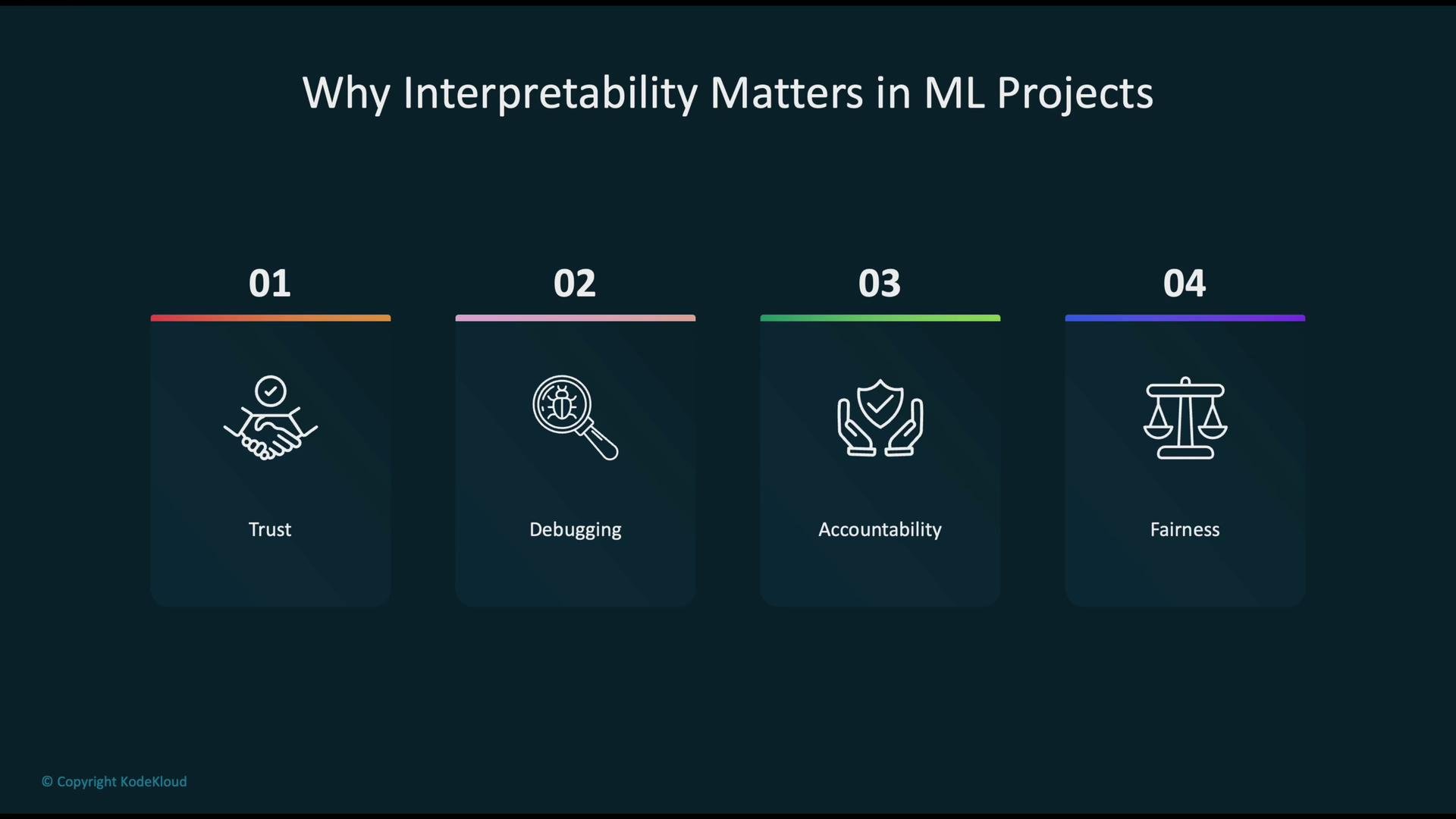
- Trust: Users and stakeholders are more likely to adopt AI systems when they understand the reasoning behind predictions.
- Debugging: Interpretability helps data scientists surface data-quality issues, preprocessing mistakes, or model weaknesses.
- Accountability & compliance: In regulated domains (healthcare, finance, legal), explainability is often required to justify automated decisions.
- Fairness: Explanations make it easier to detect whether a model systematically disadvantages specific groups.
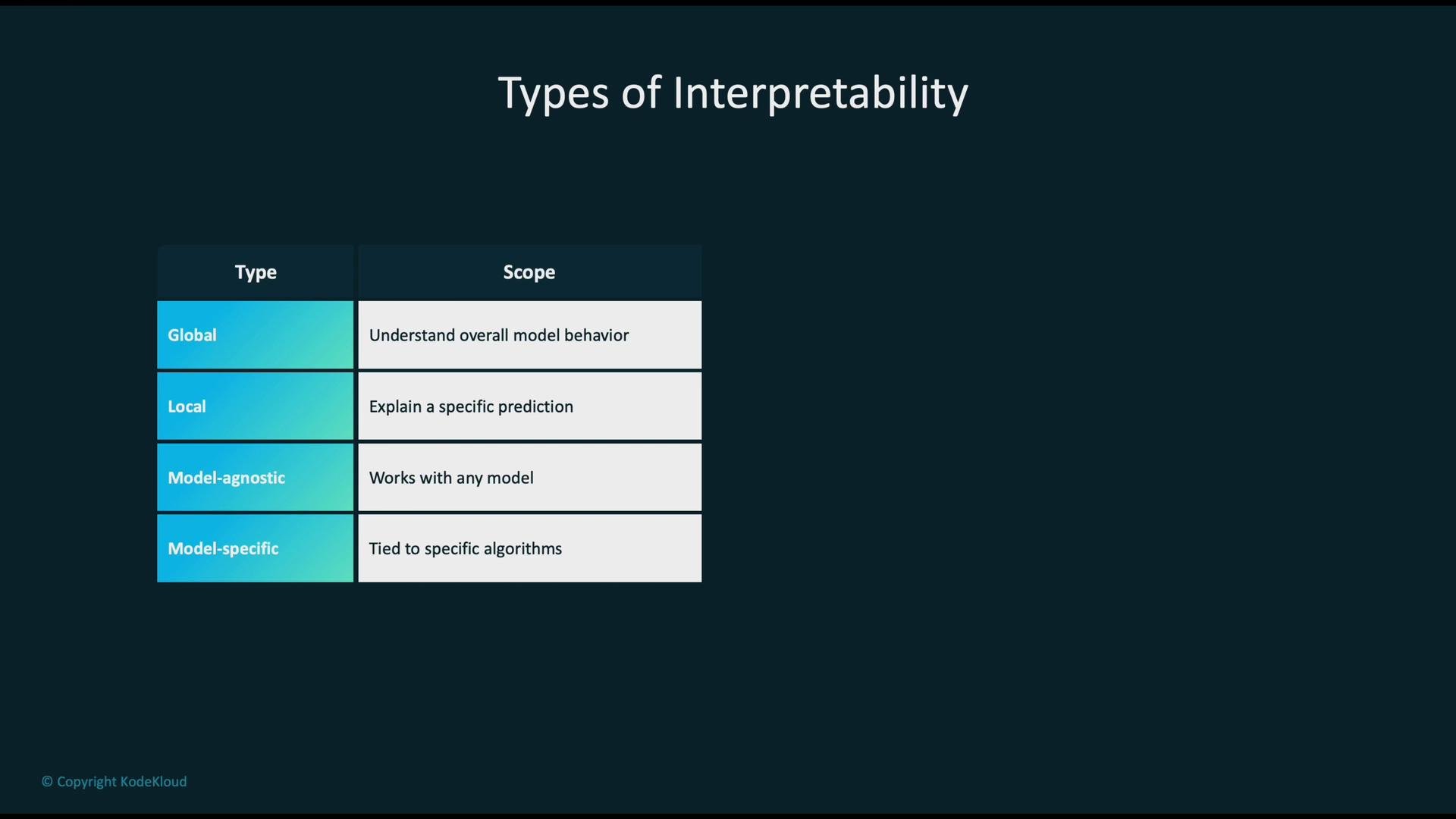
- Global interpretability explains overall model behavior across the dataset (e.g., which features are most influential on average).
- Local interpretability explains an individual prediction (e.g., why was this loan application denied).
- Model-agnostic methods operate by probing inputs and outputs and can be applied to any model type.
- Model-specific methods leverage internal structure of particular algorithms (e.g., feature gain in tree ensembles, coefficients in linear models).
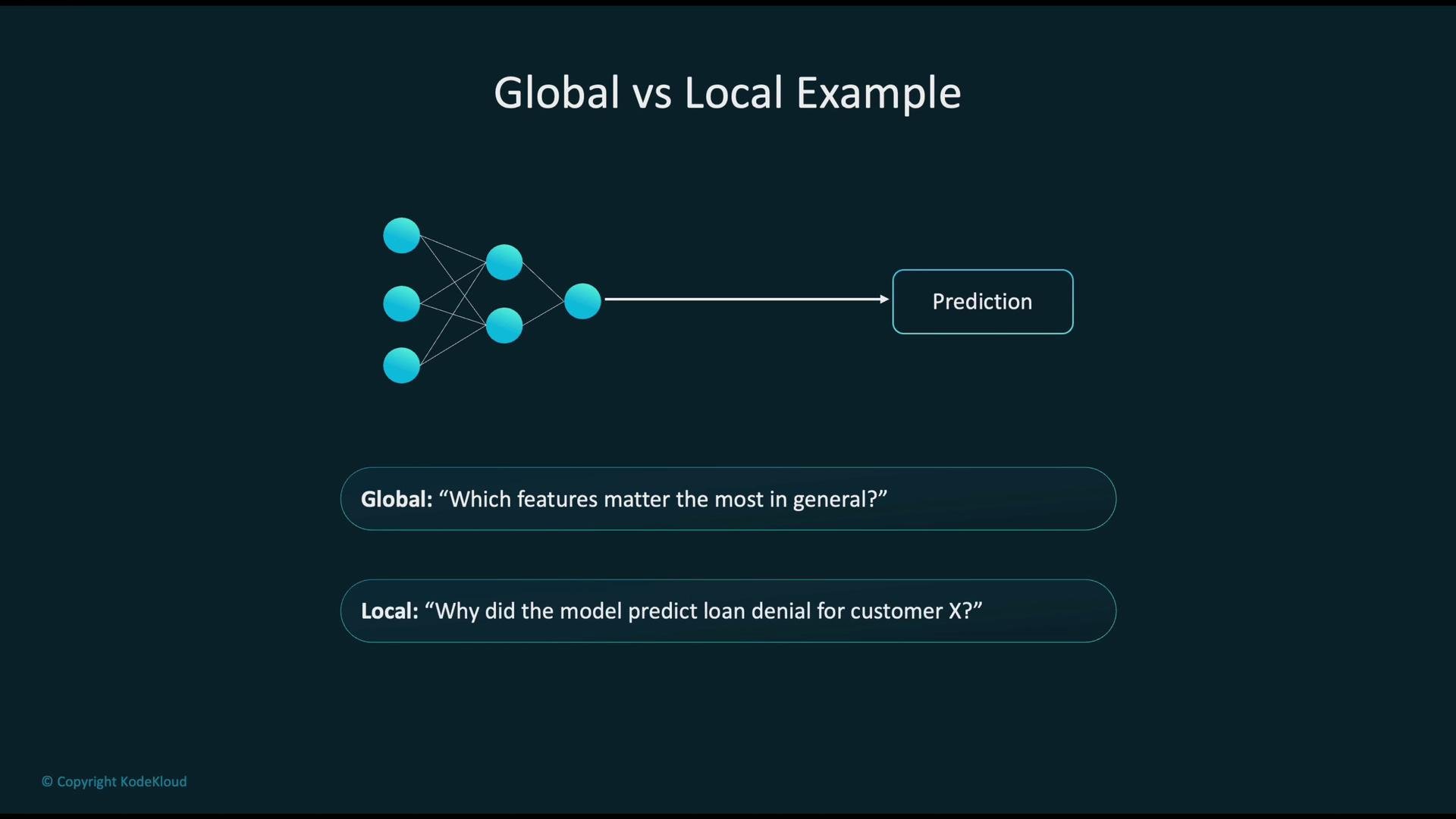
- Global explanations answer: “Which features generally influence predictions the most?” They provide a high-level view of model behavior across the data distribution and are useful for model validation and fairness audits.
- Local explanations answer: “Why did the model make this specific prediction?” They are used for case-level investigations (for example, explaining a single loan denial) and for user-facing justification or appeals.
- Purpose: Quantify how much each feature contributes to predictions (typically aggregated across the dataset).
- Typical sources: built-in gains/split counts in tree-based models (Random Forest, XGBoost, LightGBM, CatBoost) or permutation importance for model-agnostic estimates.
- Best use: Global interpretability to identify dominant predictors or suspicious feature influence.
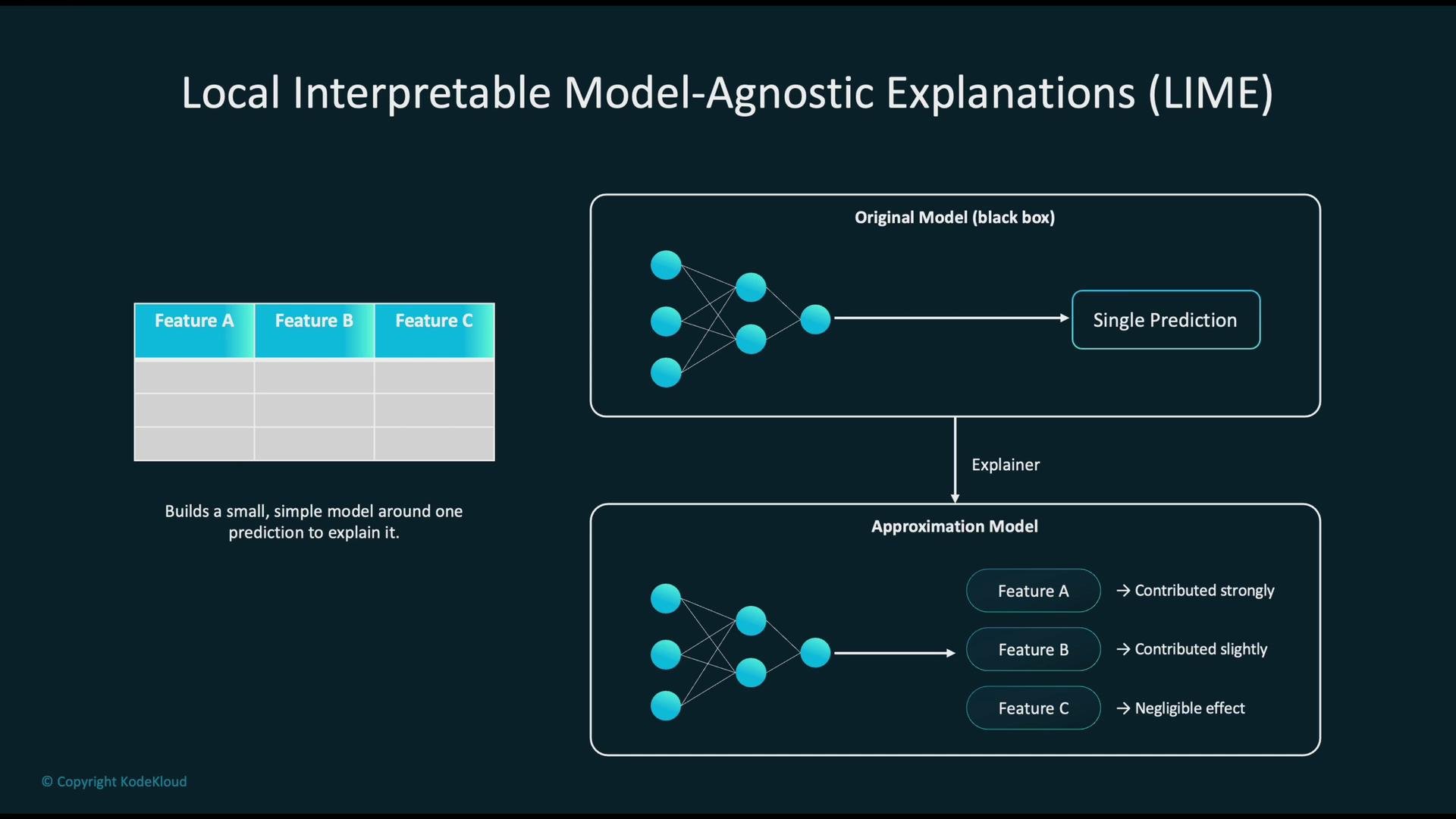
- Overview: LIME approximates a complex model locally (around a single prediction) using a simple surrogate model (often linear). It identifies which features most influenced that specific prediction.
- Use cases: Explaining a single decision to an end user, debugging unexpected predictions, or generating human-readable explanations for case reviews.
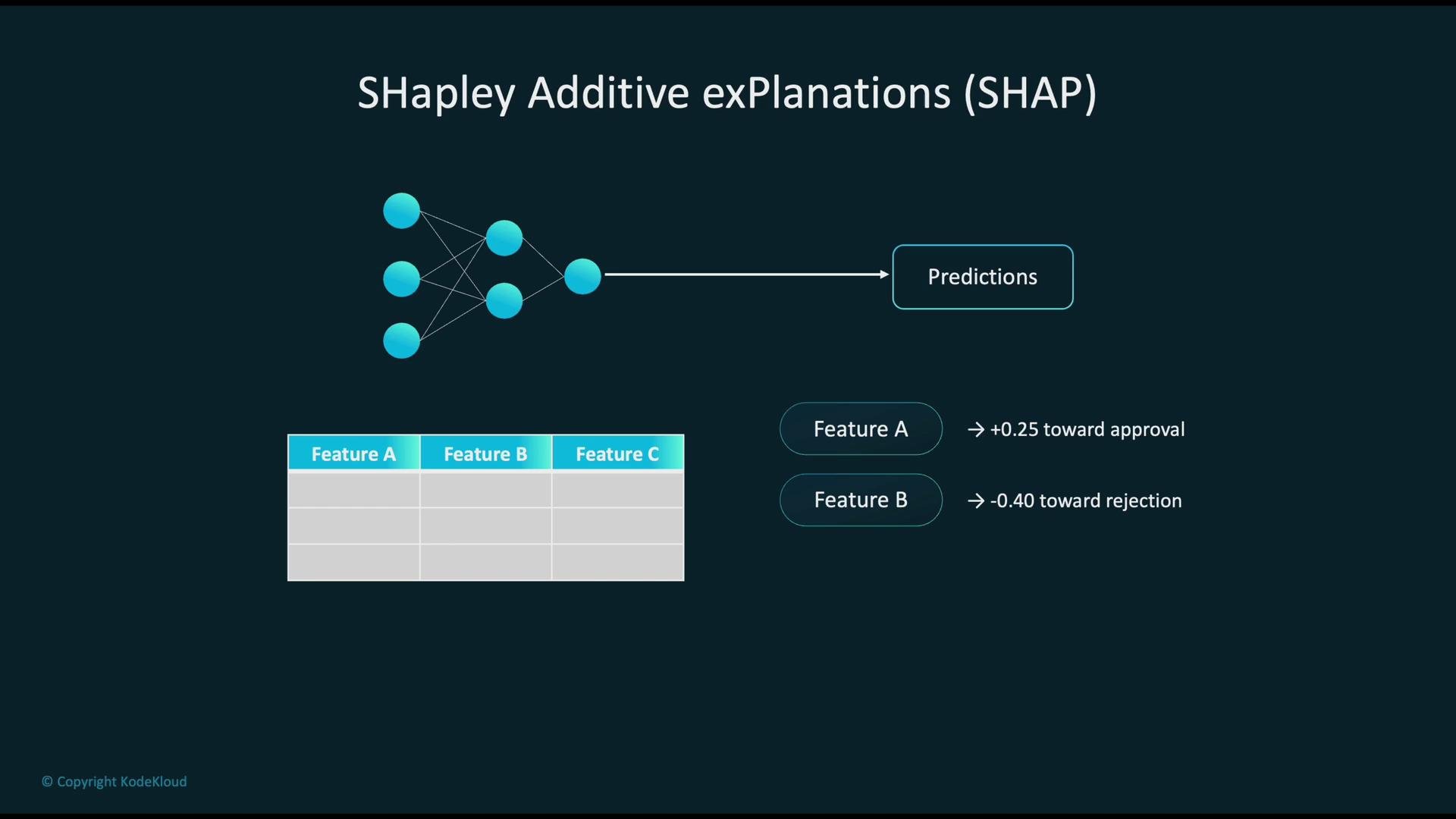
- Overview: SHAP uses Shapley values from cooperative game theory to attribute a contribution value to each feature for a given prediction.
- Strengths: Provides consistent, theoretically grounded attributions; supports both local and global explanations through aggregation.
- Implementations: TreeSHAP (optimized for tree ensembles), DeepSHAP (for neural networks), KernelSHAP (model-agnostic but computationally heavier).
- Purpose: Visualize how a feature affects the model’s predicted outcome on average, marginalizing over other features.
- Use case: Understand nonlinear relationships and the marginal effect of a feature (e.g., how predicted default probability changes with income).
- Applicability: Any model that can be queried for predictions.
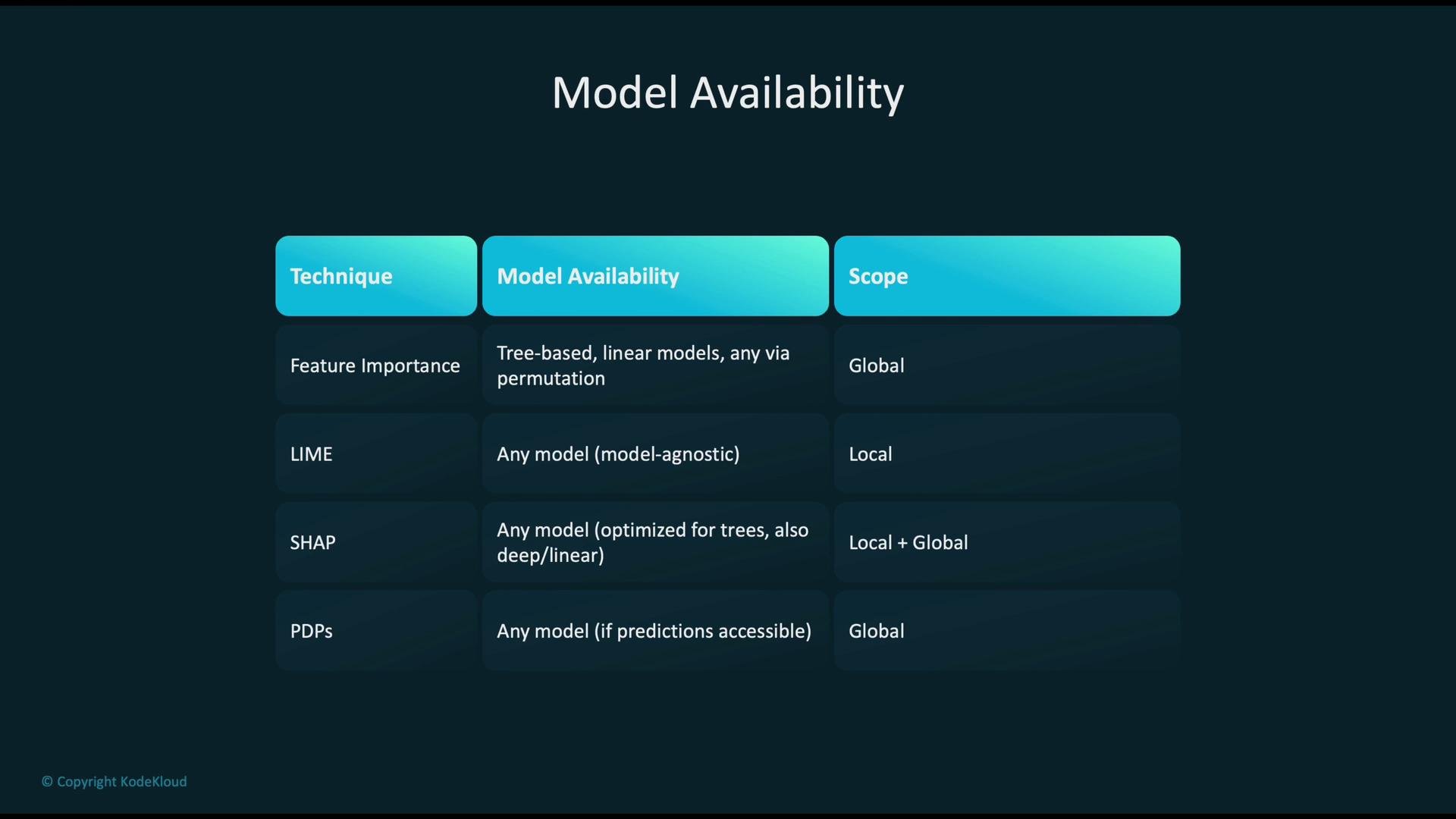
- Use local methods (LIME, SHAP) when you need case-level explanations for users, appeals, or detailed debugging.
- Use global methods (feature importance, PDPs, aggregated SHAP) to assess model-wide behavior, bias, or to prioritize feature engineering.
- For production monitoring and compliance, prefer explanations that are reproducible and computationally feasible at scale (e.g., TreeSHAP for tree ensembles).
- Always align the explanation format with the audience: simple visual summaries for non-technical stakeholders, detailed attribution scores for auditors and engineers.
- Interpretability builds trust, aids debugging, and supports fairness, accountability, and regulatory compliance.
- Key techniques include SHAP, LIME, feature importance, and PDPs—each addresses different needs (local vs. global).
- Choose methods based on your use case, model type, computational constraints, and stakeholder requirements.
- Tools such as Amazon SageMaker Clarify provide integrated capabilities for bias detection and explainability within deployment pipelines—use them when operational governance and automation are required.
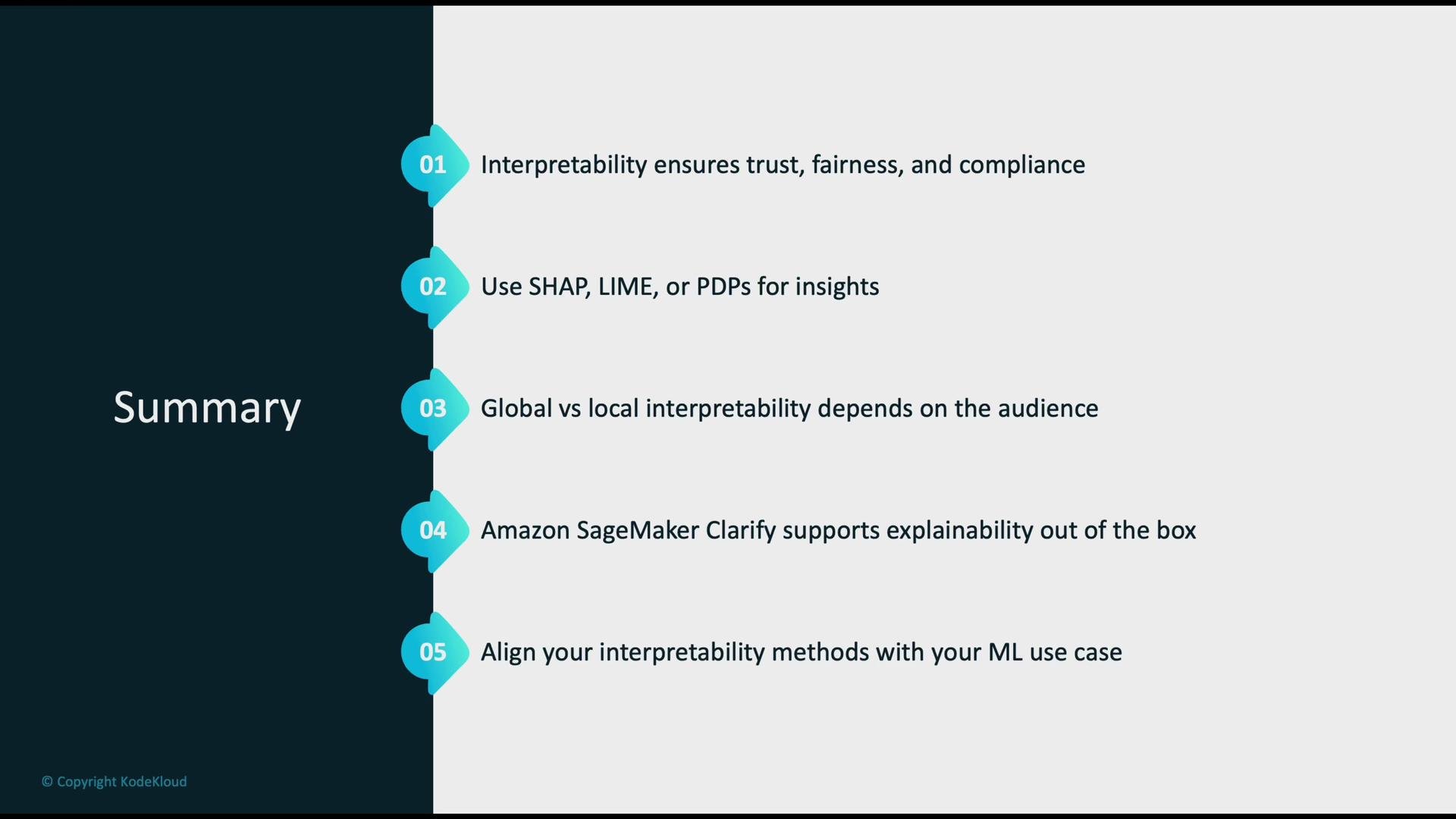
Match technique to goal: use local methods (LIME, SHAP) for case-level explanations and audits; use global methods (feature importance, PDPs) to understand overall model behavior and uncover systemic bias. Prioritize reproducibility and scalability when deploying explanations in production.
- LIME: https://lime-ml.readthedocs.io/en/latest/
- SHAP: https://shap.readthedocs.io/
- scikit-learn inspection (permutation importance, PDPs): https://scikit-learn.org/stable/modules/inspection.html
- Amazon SageMaker Clarify: https://aws.amazon.com/sagemaker/clarify/