

SageMaker deployment patterns
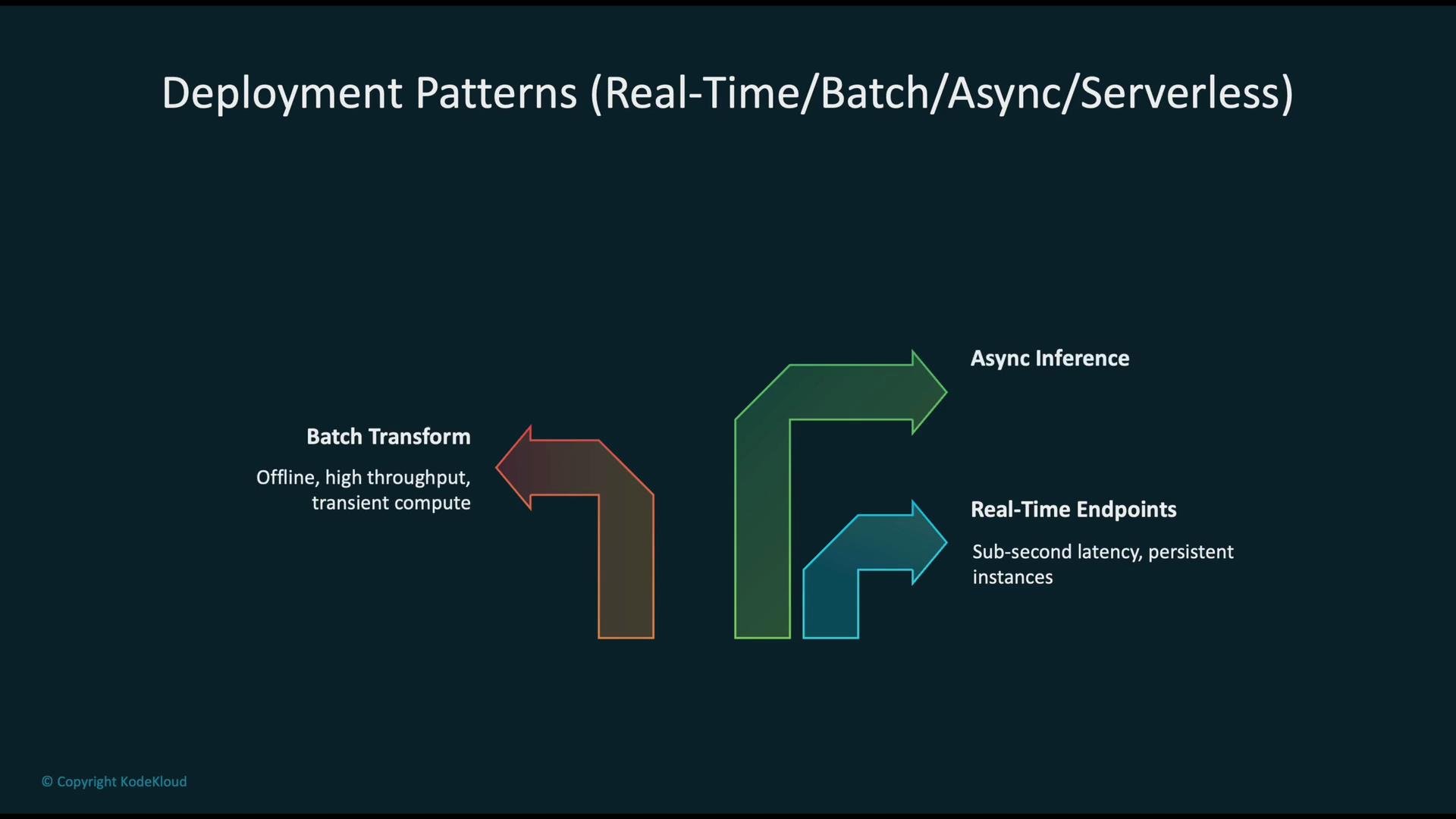
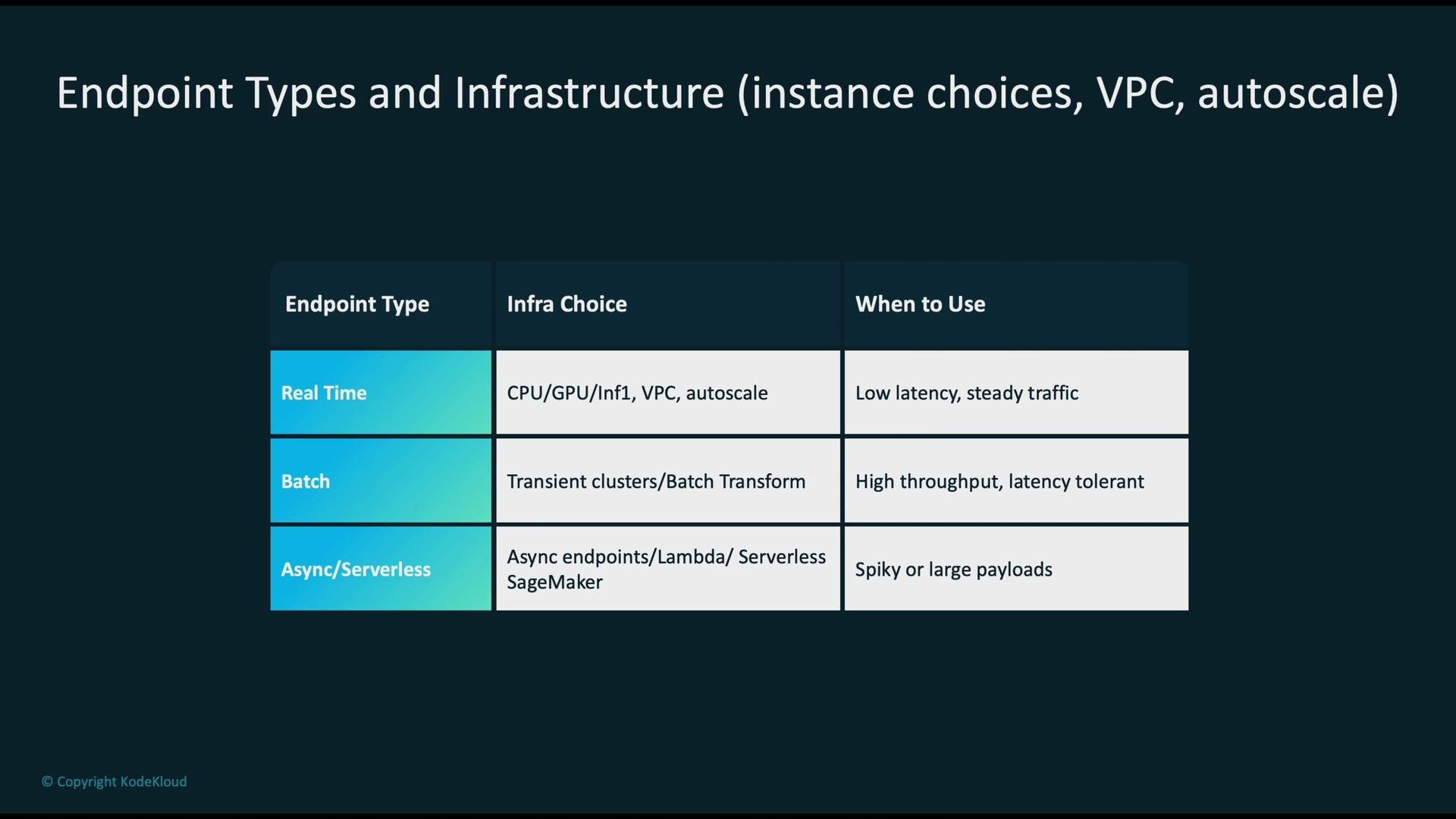
Choose the deployment pattern that matches your SLA, payload, throughput and cost constraints:- Real-time endpoints: low-latency, always-on serving using CPU/GPU instances (often in a VPC) with autoscaling for steady traffic.
- Asynchronous inference: for large payloads or long-running inference tasks where responses are returned later.
- Batch transform: high-throughput, offline processing where latency is not critical.
- Serverless inference: handles spiky workloads without provisioning instances; good for unpredictable traffic and lower management overhead.
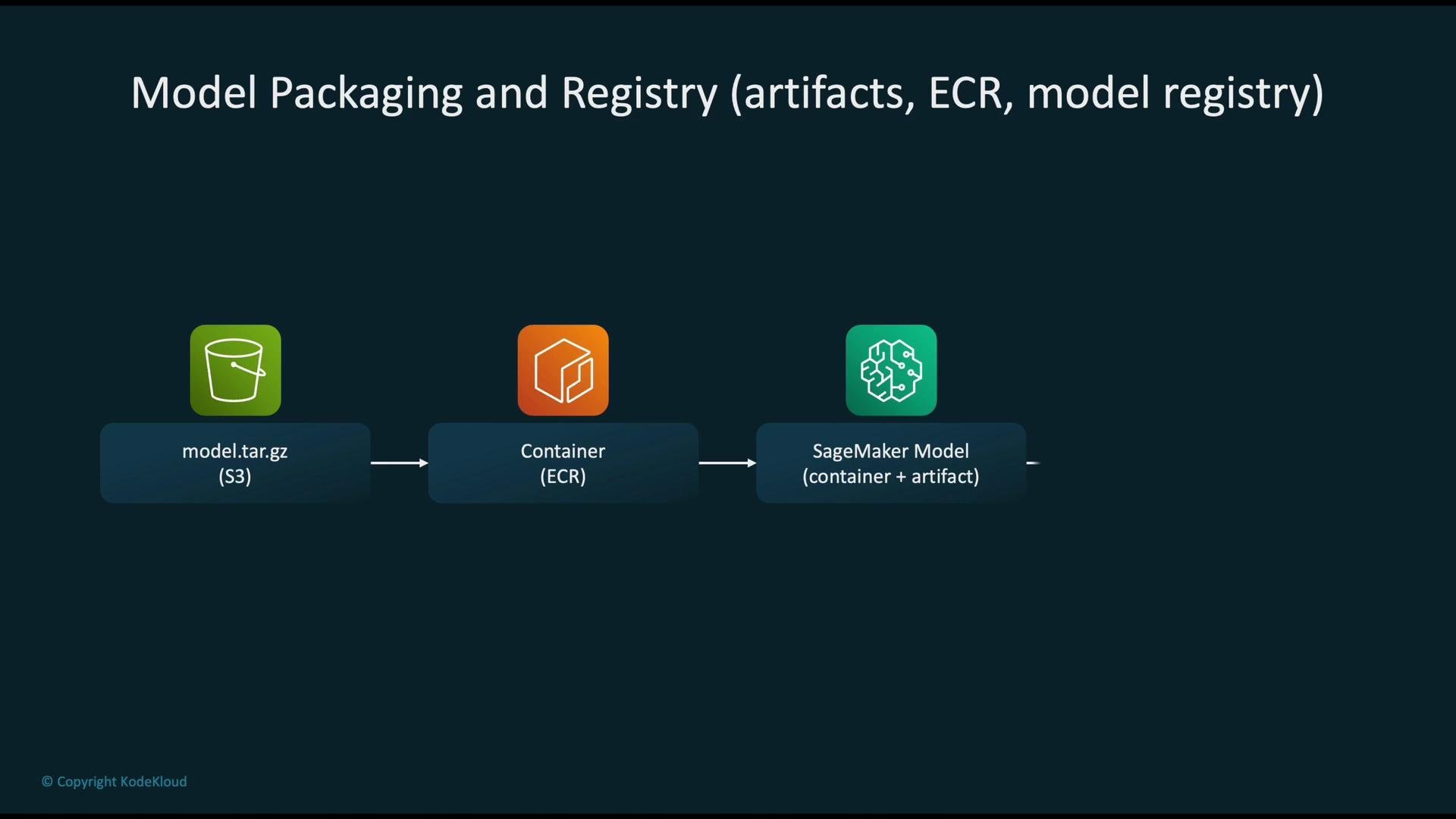
Model packaging and registry flow
Standard packaging and registry steps ensure reproducibility and traceability:- Upload the trained model artifact (for example,
model.tar.gz) to Amazon S3. - Build the container image (inference runtime) and push it to Amazon ECR.
- Create a SageMaker Model object that references the S3 model artifact and the ECR image.
- Register the Model in the SageMaker Model Registry for versioning, approval workflows, and lifecycle management.
Endpoint types and infrastructure choices
Match endpoint type to latency, payload size, and scaling requirements.
Links for deeper reading:
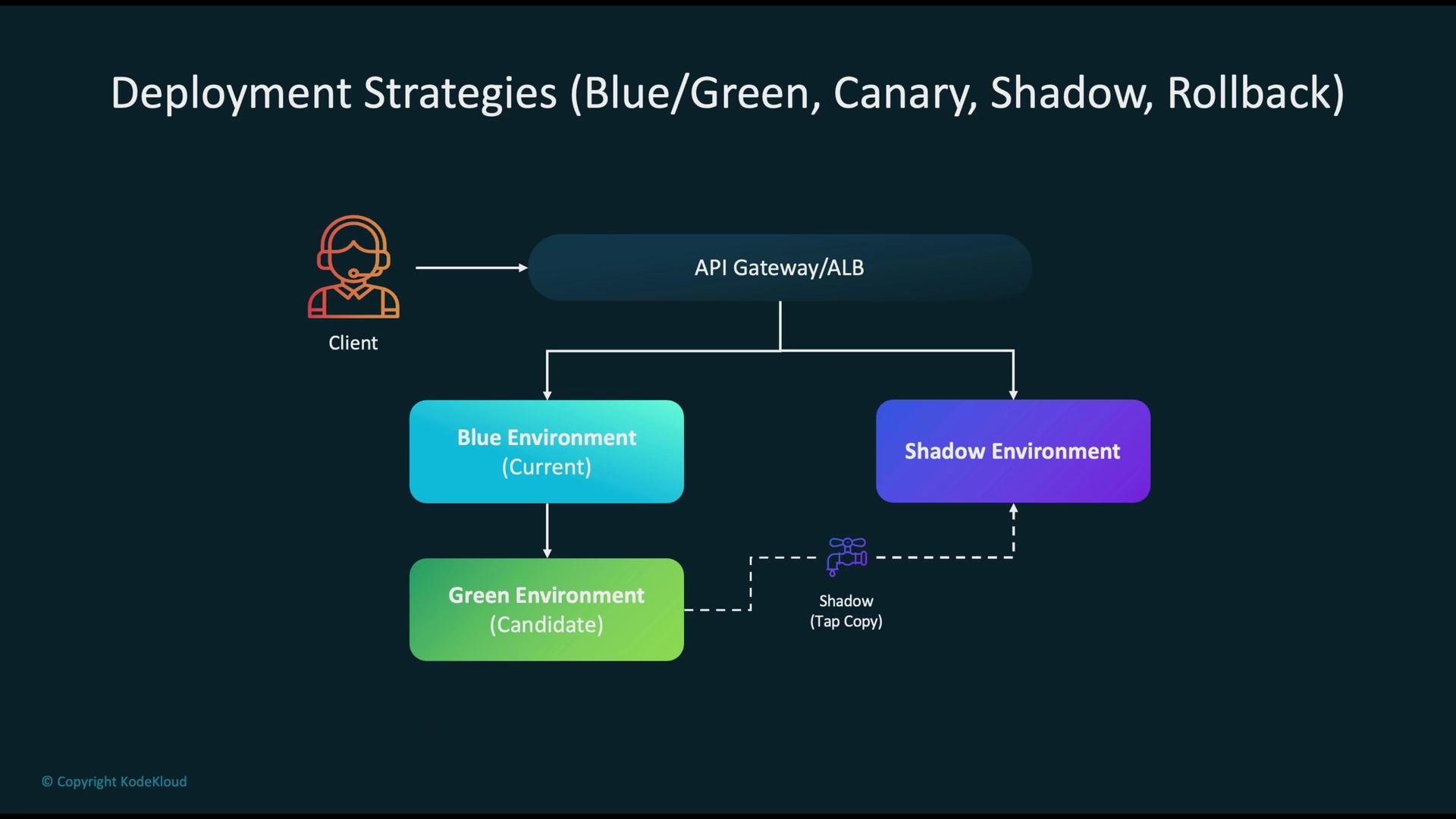
Deployment strategies
Traffic is typically routed via an API Gateway or an Application Load Balancer to the active environment (blue). New model versions are deployed as candidates (green). Common strategies:- Blue/Green: run a fully provisioned stable (blue) environment while validating a candidate (green) environment before switching traffic.
- Canary: gradually shift a small percentage of traffic to the new version (e.g., 5% → 25% → 100%), monitor metrics, then promote or rollback.
- Shadow: mirror production traffic to the new model without returning its responses to users—useful for validating behavior on real traffic.
- Rollback: define automated or manual rollback paths if metrics or alarms indicate regressions.
CI/CD and MLOps
A robust MLOps pipeline ties source control, testing, orchestration, and deployment together:- Source: push code and model artifacts to a Git provider (CodeCommit, GitHub, etc.).
- Build & test: run unit tests, integration tests, and data checks using CodeBuild or other CI runners.
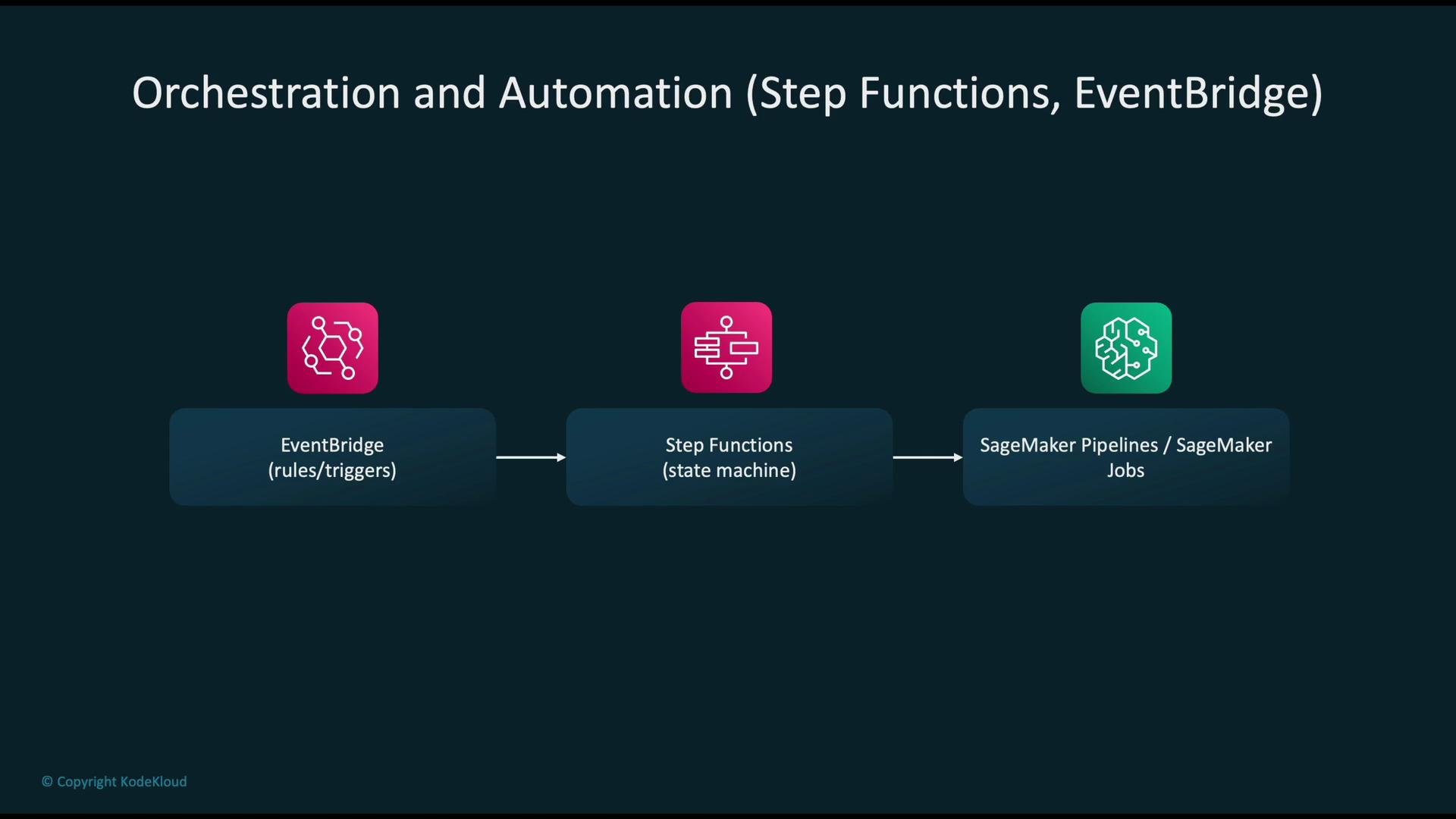
- Orchestration: use CodePipeline to organize CI/CD stages; use SageMaker Pipelines for ML-specific workflows (training, evaluation, registration, deployment).
- Model Registry: after passing validations, register models in the SageMaker Model Registry to control approvals and deployments.
- EventBridge: trigger workflows on events such as “model registered”, job failures, or scheduled tasks.
- Step Functions: orchestrate complex stateful workflows — e.g., preprocessing → training → evaluation → registration → deployment.
- SageMaker Pipelines / Jobs: execute training, processing, and deployment tasks as discrete, auditable steps.
Monitoring, alerts, and anti-patterns
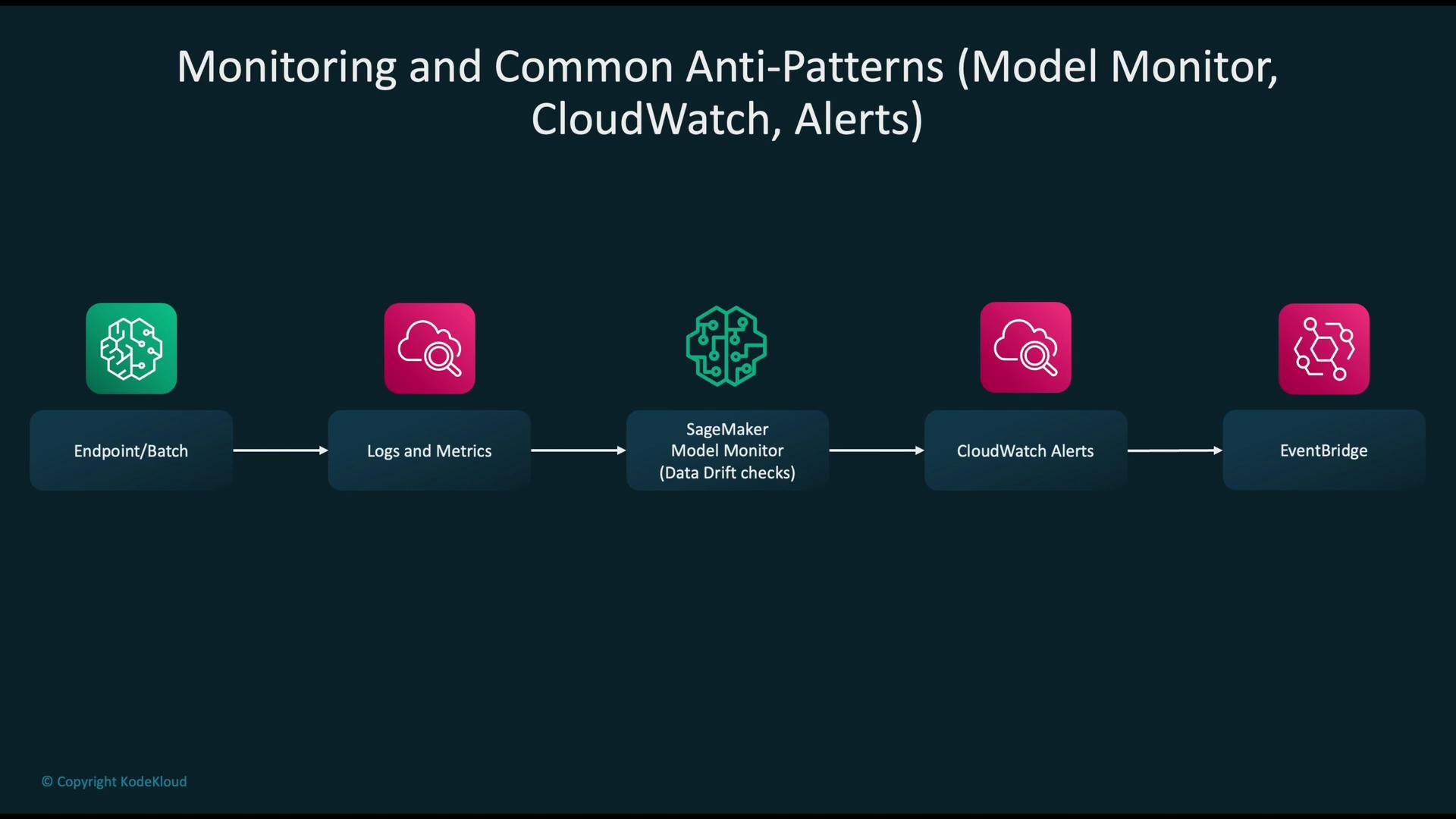
Collect logs and metrics from endpoints, batch jobs, and containers, then surface anomalies with alarms:- Use CloudWatch logs/metrics and container logs for observability.
- Use SageMaker Model Monitor to detect data drift, changes in feature distributions, and prediction-quality issues.
- Wire CloudWatch alarms and EventBridge to trigger automated responses (retraining, rollback, paging on-call).
- Monolithic endpoints that prevent independent updates and increase the blast radius.
- Overly permissive IAM policies that create security and compliance risks.
- Using long-lived, provisioned real-time endpoints for highly spiky traffic when serverless or async inference would be more cost-effective.
Do not rely solely on periodic manual checks. Lack of automated monitoring and alerts creates blind spots where regressions or data quality issues can go undetected. Ensure Model Monitor and CloudWatch alarms are part of your deployment gates.
Decision guide (summary)
Start by defining SLA and non-functional requirements: latency, throughput, payload size, cost budget, and security constraints.- Low latency & steady traffic: SageMaker real-time endpoints or a managed Amazon EKS serving solution.
- Offline, high-throughput jobs: Batch Transform or AWS Batch.
- Large payloads or long-running inference: SageMaker Asynchronous Inference.
- Unpredictable, spiky traffic with minimal infra ops: choose serverless (SageMaker Serverless Inference or AWS Lambda for simple functions).
Consider automating validation and monitoring in your CI/CD pipeline: register models only after automated evaluation, use canary or shadow deployments for validation, and wire Model Monitor and alarms into your deployment decision gates.
Links and references
- Amazon SageMaker
- SageMaker Model Registry
- SageMaker Pipelines
- SageMaker Batch Transform
- SageMaker Asynchronous Inference
- SageMaker Serverless Inference
- Amazon ECR
- Amazon S3
- Amazon CloudWatch
- Amazon EventBridge
- AWS Step Functions
- AWS Lambda
- Amazon EKS