

- Amazon Translate — neural machine translation for converting text between languages.
- Amazon Rekognition — image and video analysis for object, scene, face, text, and activity detection.
- Amazon Transcribe — automatic speech recognition (ASR) to convert audio into text.
- Amazon Polly — text-to-speech (TTS) to generate natural-sounding audio from text.
Links and references
- Amazon Translate documentation
- Amazon Rekognition documentation
- Amazon Transcribe documentation
- Amazon Polly documentation
Amazon Translate
Amazon Translate is a neural machine translation (NMT) service that delivers fast, natural-sounding translations and supports customization for domain-specific terminology. It processes UTF-8 input and returns UTF-8 output — translated text length may vary depending on language differences.
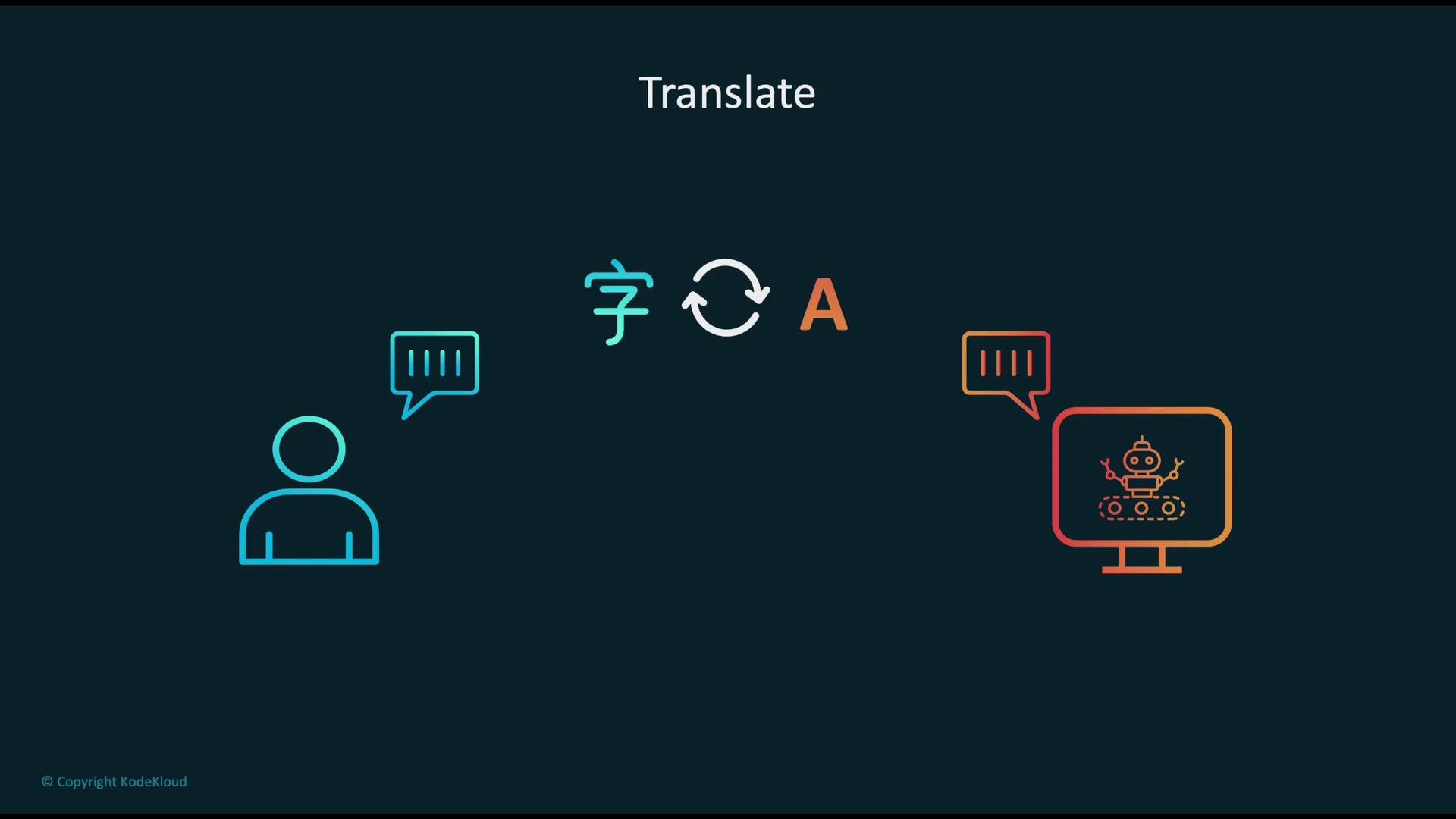
- The encoder ingests the source sentence and produces a semantic representation that captures meaning and context.
- The decoder generates the translated sentence in the target language one token at a time using that representation.
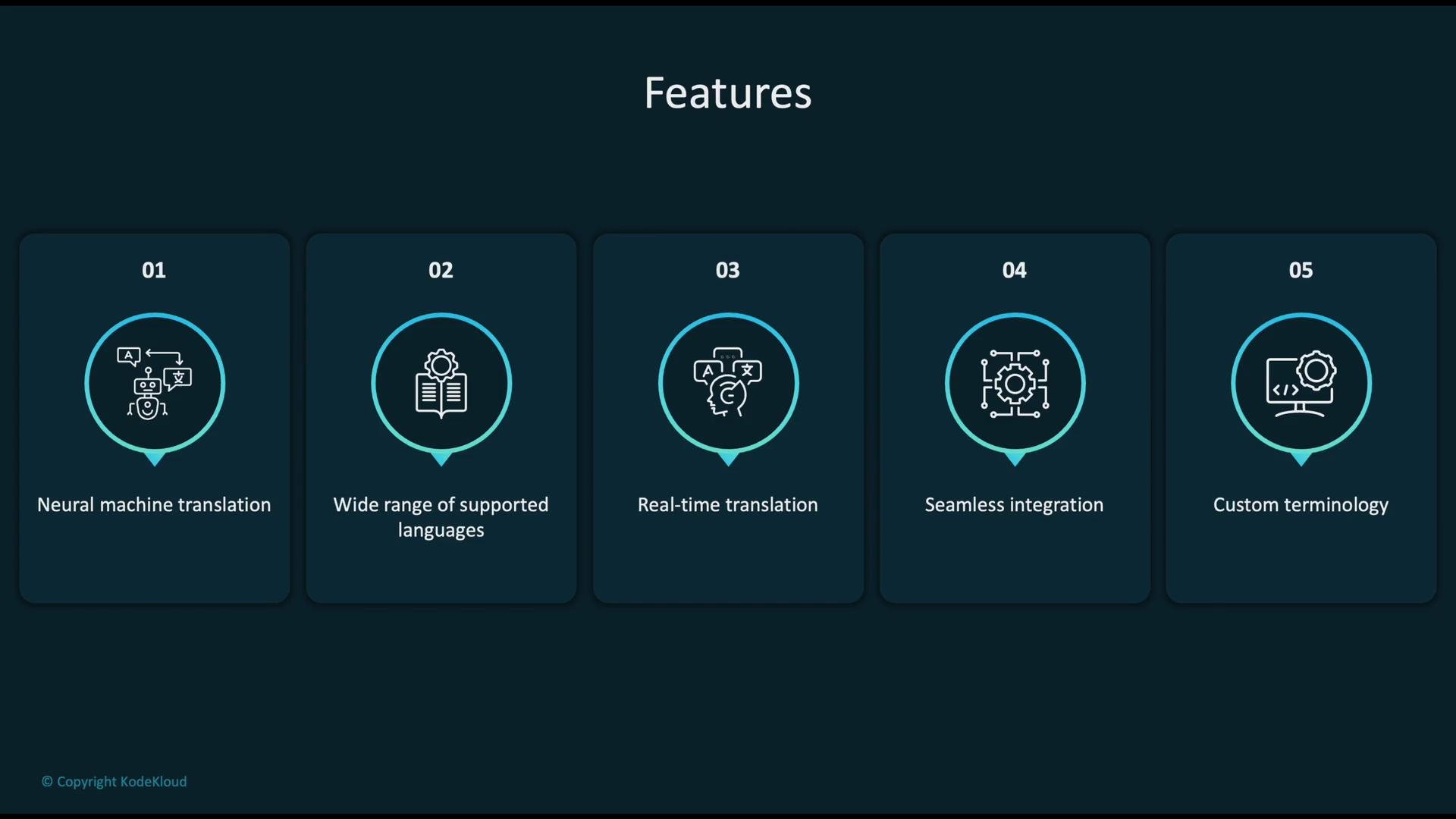
- Neural Machine Translation (NMT) for more accurate, fluent output.
- Wide language and language-pair coverage for global applications.
- Real-time (low-latency) translation for live chat and support scenarios.
- Seamless integration with S3, Lambda, Polly, and other AWS services for end-to-end pipelines.
- Custom terminology to preserve brand names, product names, and domain-specific vocabulary.
- A customer calls a voice system and Amazon Transcribe performs real-time speech-to-text.
- The system auto-detects the spoken language or uses a preconfigured language setting.
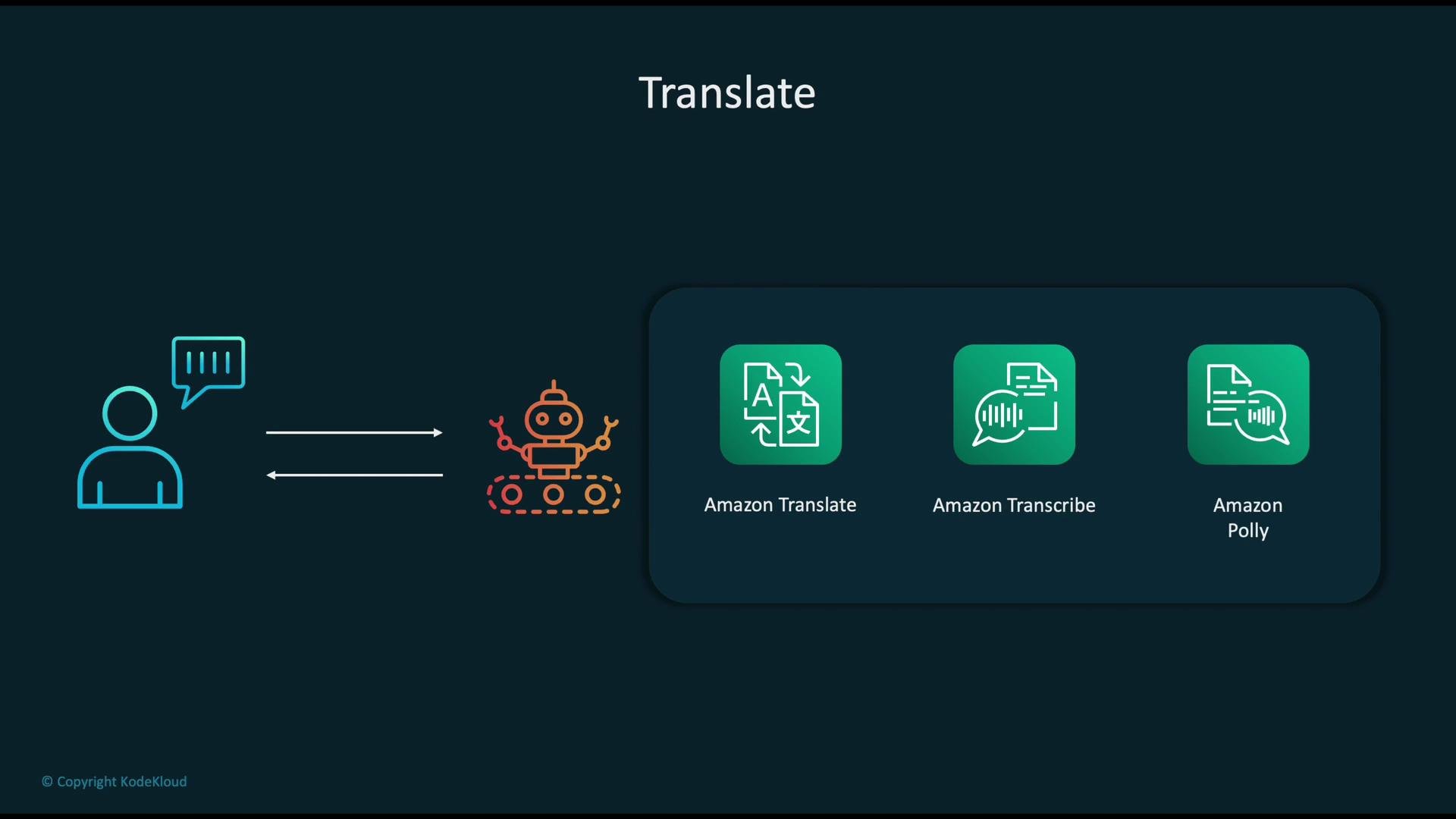
- The transcript is translated with Amazon Translate.
- If needed, Amazon Polly converts the translated text back to speech for the caller.
Amazon Translate provides a free tier for new customers and supports UTF-8. If precise translations of specialized terms are required, apply custom terminology or pre-process input to standardize domain language.
Amazon Rekognition
Amazon Rekognition is a fully managed service for image and video analysis using pre-trained models and optional custom label training. Submit an image or video and Rekognition returns labels, face metadata, OCR text, and activity detections.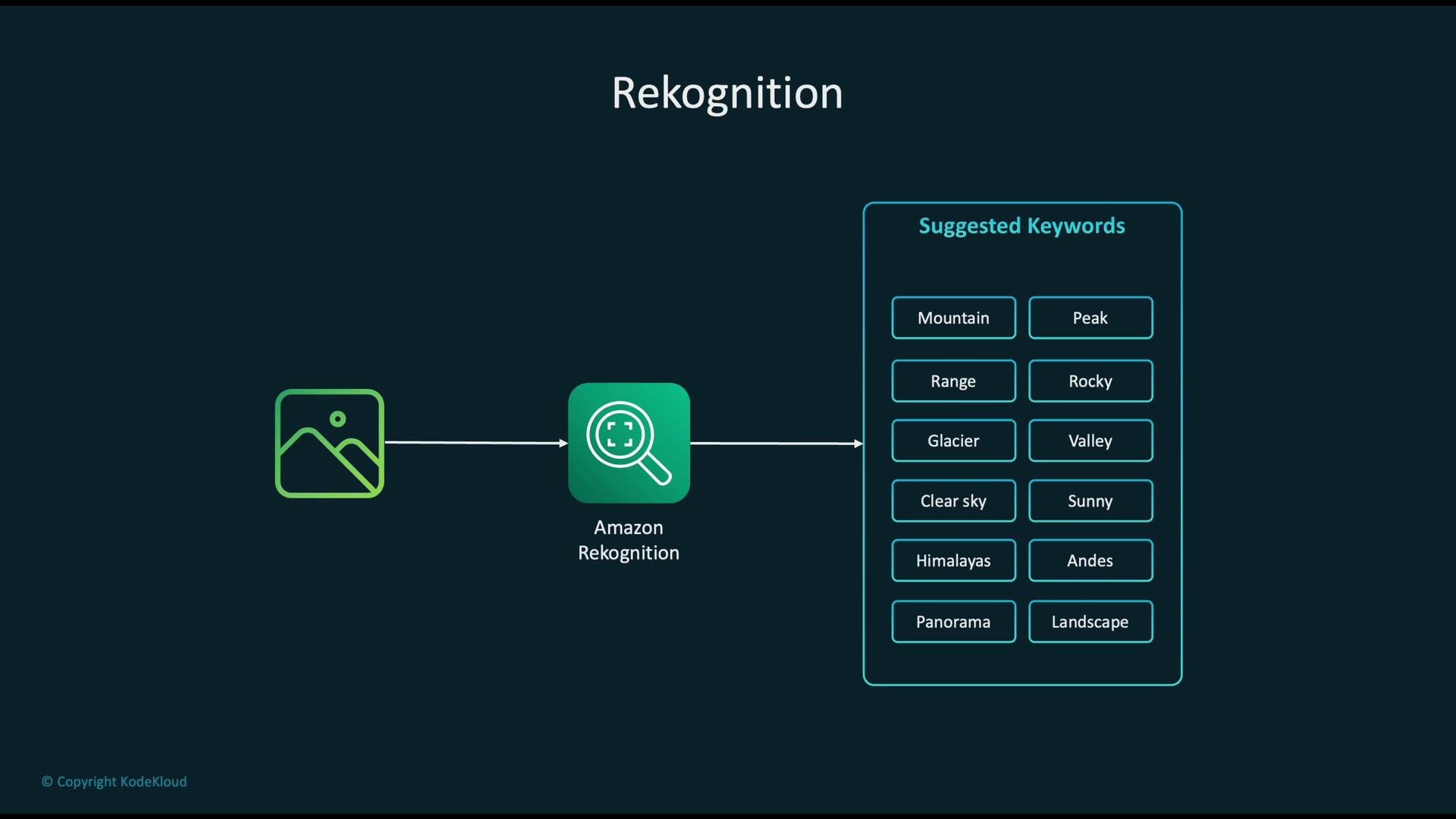
- Content moderation to detect unsafe or policy-violating imagery.
- Face analysis (attributes, orientation, face comparison).
- Text detection (OCR) for reading labels, signs, or license plates.
- Activity detection and person tracking across video frames.
- Training Custom Labels to support domain-specific object detection.
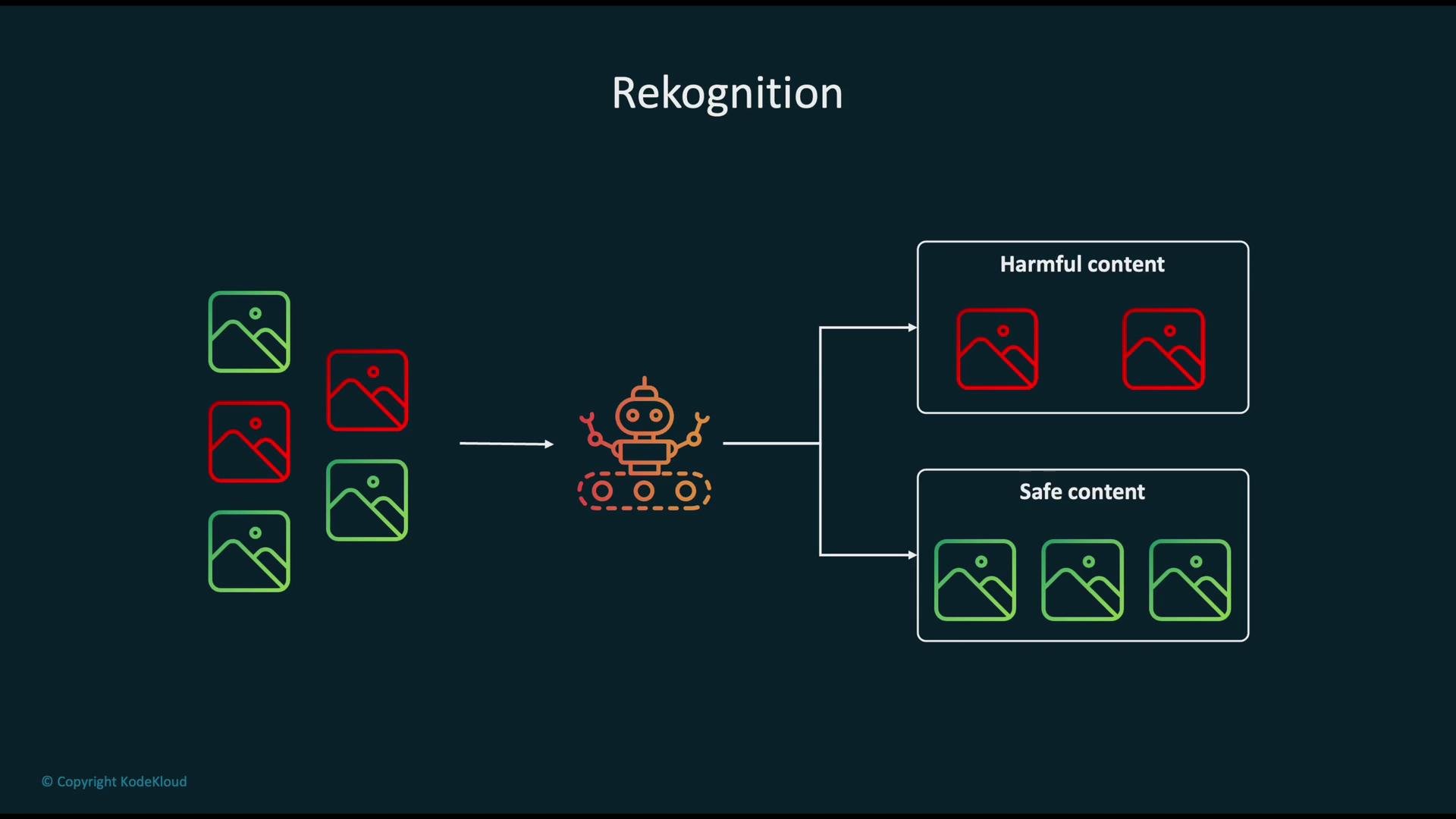
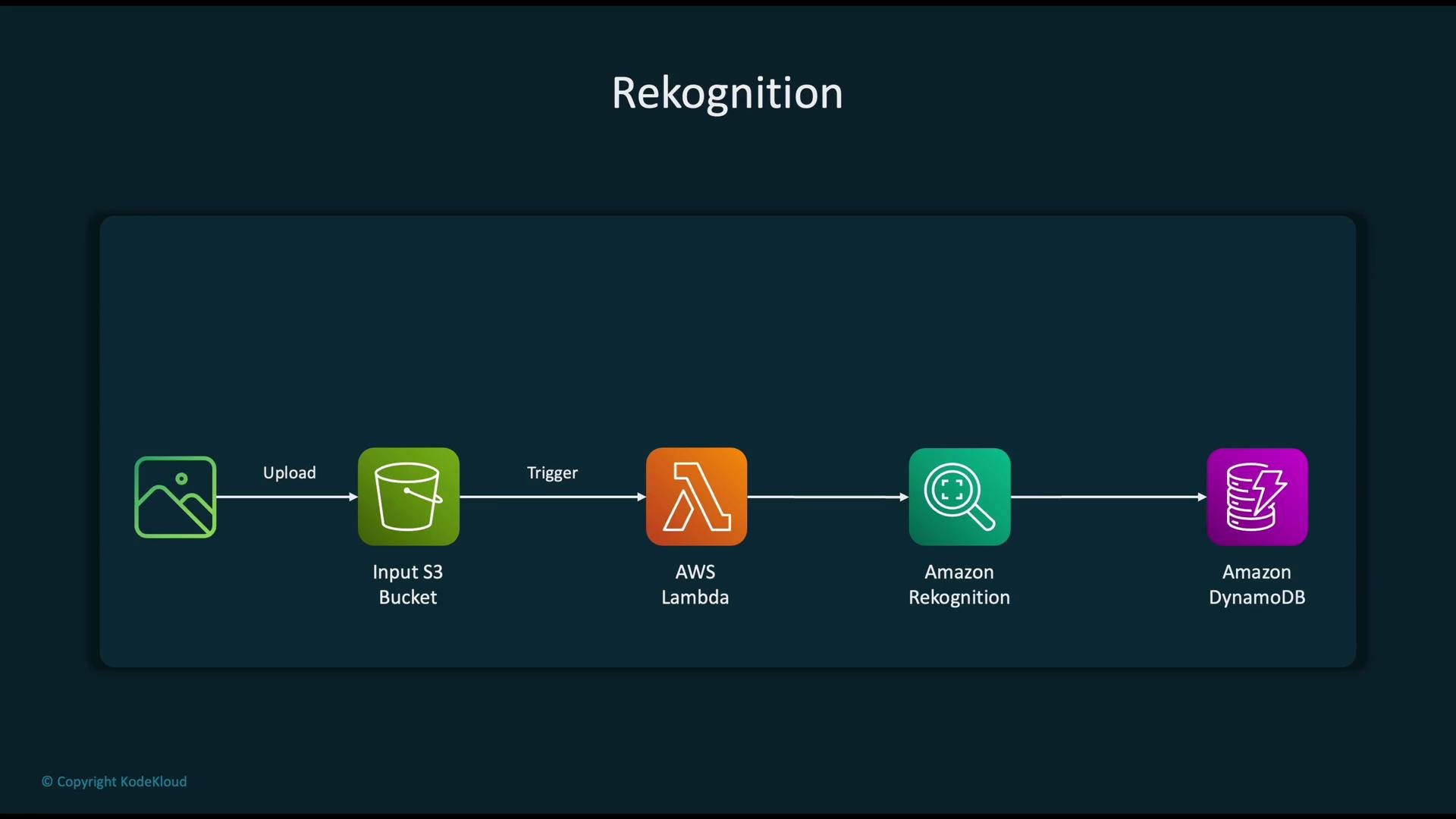
- Store images/videos in Amazon S3.
- Use S3 event notifications to invoke AWS Lambda when new media is uploaded.
- Lambda calls Rekognition to analyze media and returns labels, text, timestamps, or face metadata.
- Save results to a database such as Amazon DynamoDB for search, auditing, or downstream workflows.
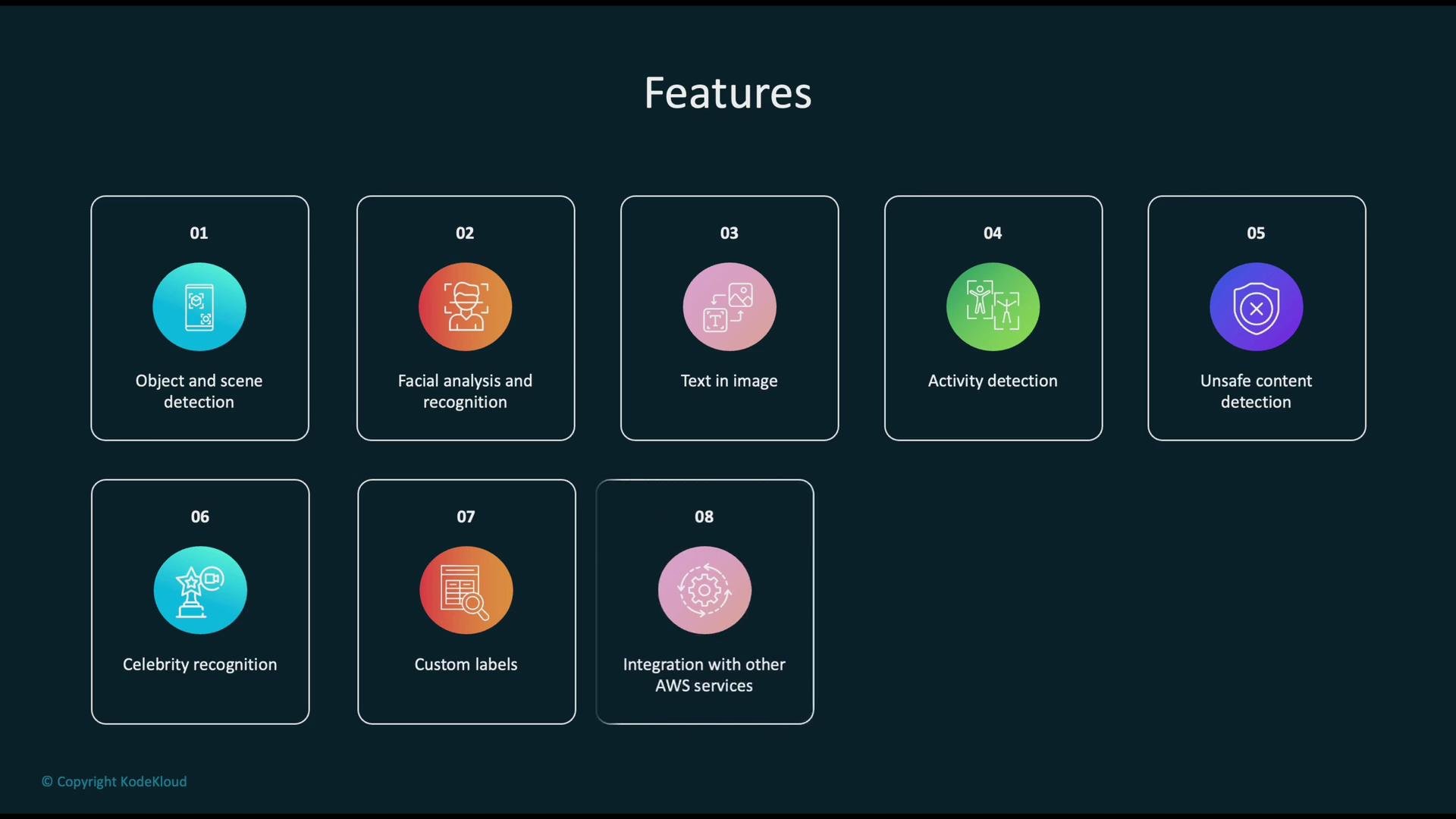
- Object and scene detection.
- Facial analysis and face comparison.
- Text-in-image detection (OCR).
- Activity and motion detection across video.
- Unsafe content detection for moderation.
- Celebrity recognition and person tracking.
- Custom Labels to train models for domain-specific objects.
- Real-time analysis for streams and emotion detection in faces.
- Keep media in S3 and process asynchronously for scalability.
- Use IAM roles and KMS to protect sensitive images and metadata.
- Combine Rekognition results with manual review (A2I) for high-stakes moderation.
Amazon Transcribe
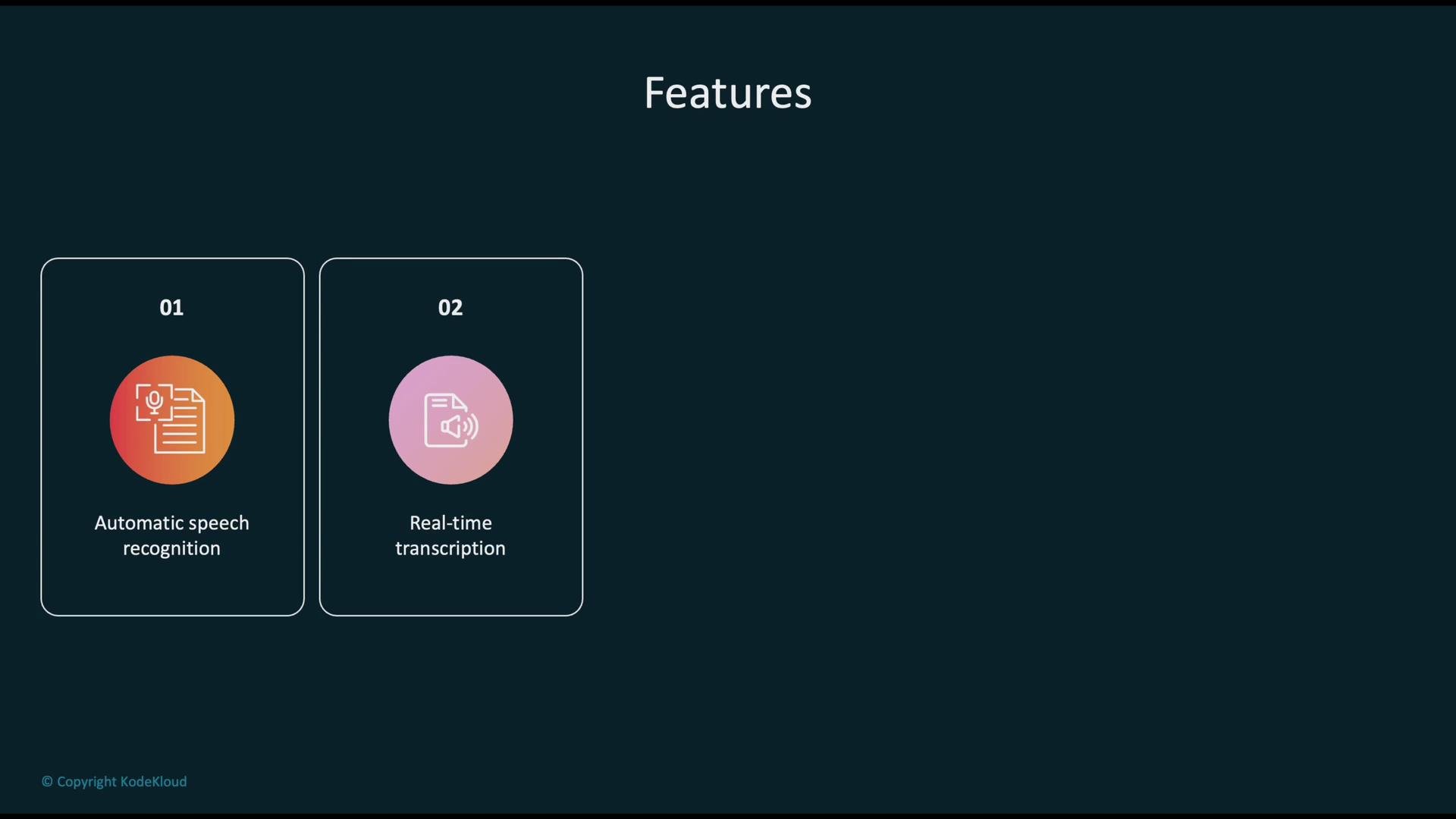
Amazon Transcribe automatically converts spoken audio into text using deep learning ASR models. It supports both batch and streaming modes and is commonly used for call transcription, subtitles, and meeting notes. At a glance- Real-time streaming transcription for live captioning and contact center use.
- Batch transcription for processing recorded media.
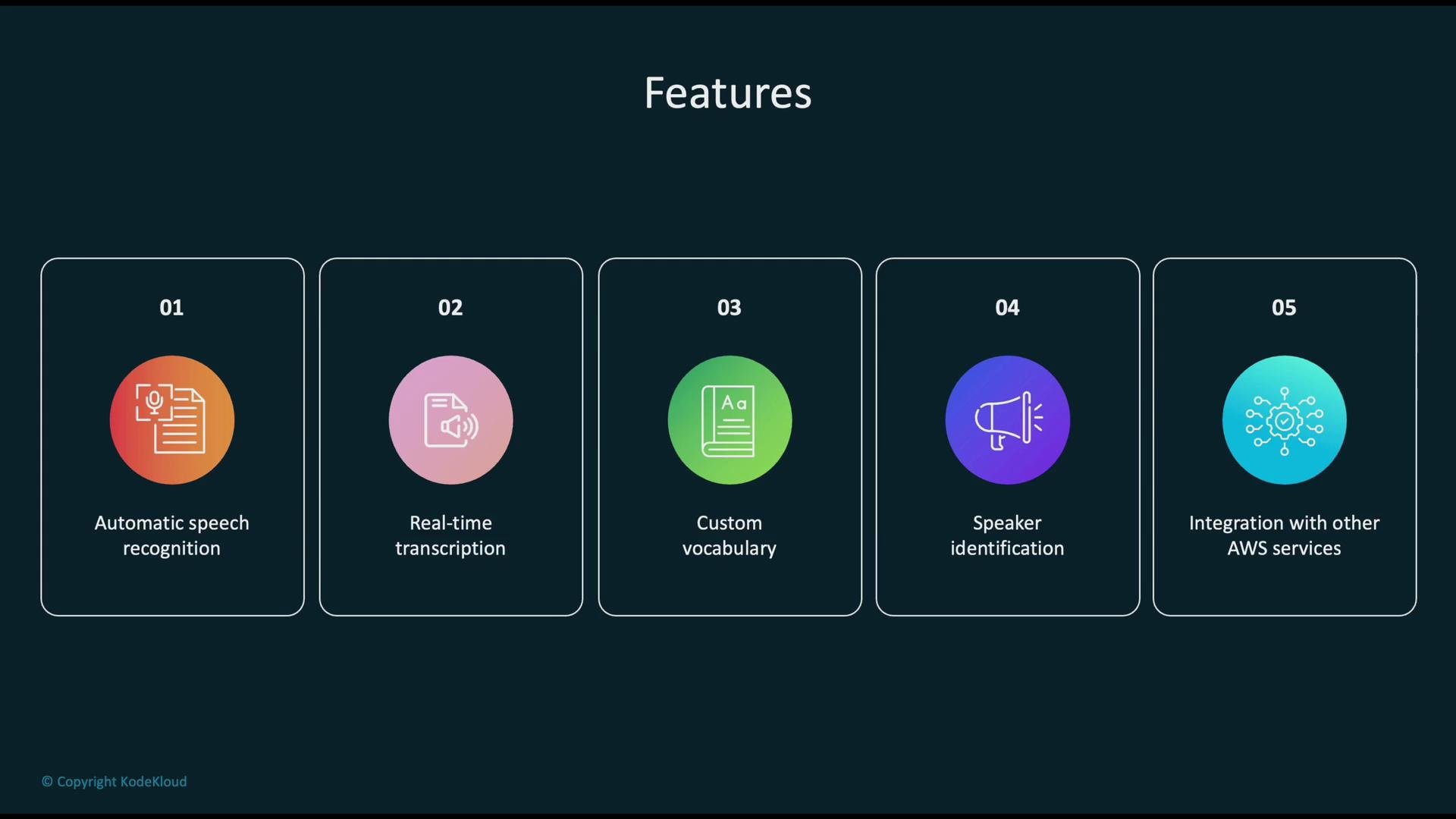
- Custom vocabulary to improve recognition of product names and jargon.
- Speaker diarization to attribute parts of a conversation to different speakers.
- Integration with S3, Lambda, and downstream analytics pipelines.
- Automatic Speech Recognition (ASR) for multiple languages and dialects.
- Real-time streaming for low-latency captioning and voice interfaces.
- Speaker identification and timestamps for transcript indexing.
- Easy integration: store audio in S3, trigger Lambda for post-processing, or push transcripts into analytics systems.
- Contact center analytics: transcribe customer calls, then run sentiment analysis on transcripts.
- Media captioning: generate subtitles for video content.
- Meeting automation: produce searchable meeting transcripts and action-item detection.
Amazon Polly
Amazon Polly synthesizes text into lifelike speech using neural voices. Use Polly to create audio for IVR systems, notifications, accessibility features, and more. Polly supports SSML for granular control over pronunciation, pauses, emphasis, pitch, and speaking rate.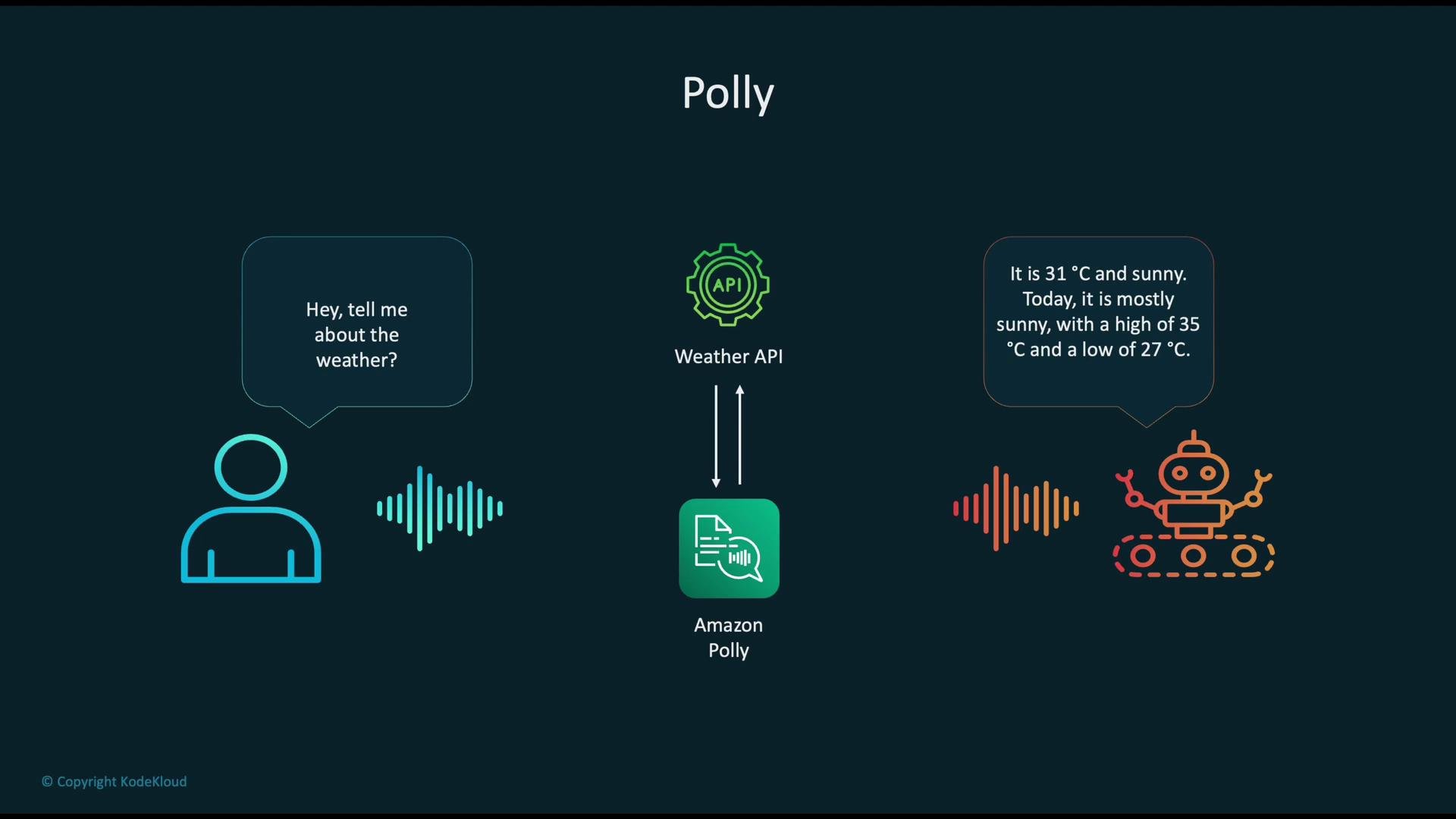
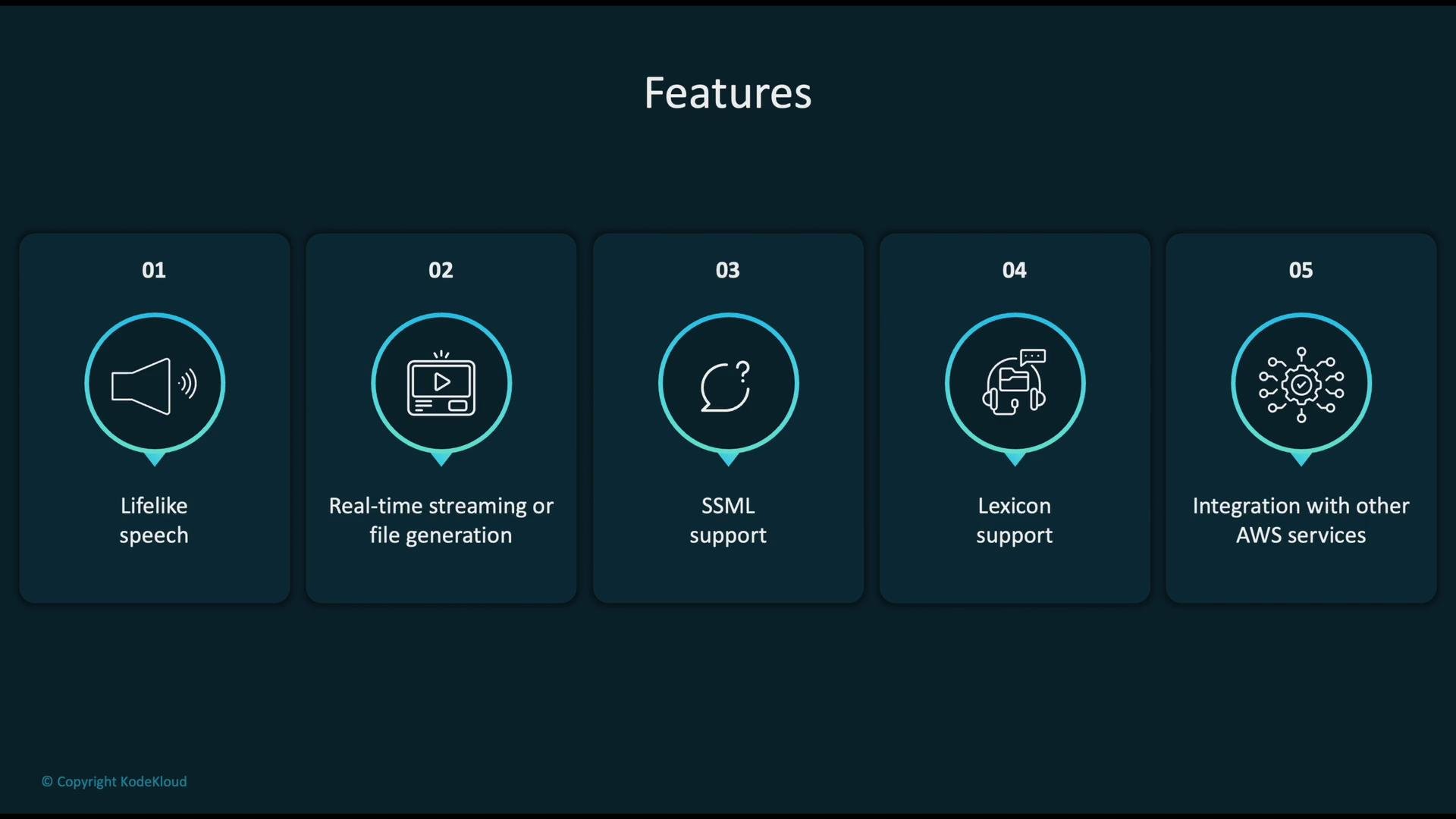
- Neural voices for natural-sounding speech.
- Real-time streaming or generation of audio files for playback or storage.
- SSML support to control pronunciation and expressive speech.
- Custom lexicons to adjust pronunciation of specialized terms.
- Integrates with Amazon Lex for conversational bots and Lambda/S3 for serverless workflows.
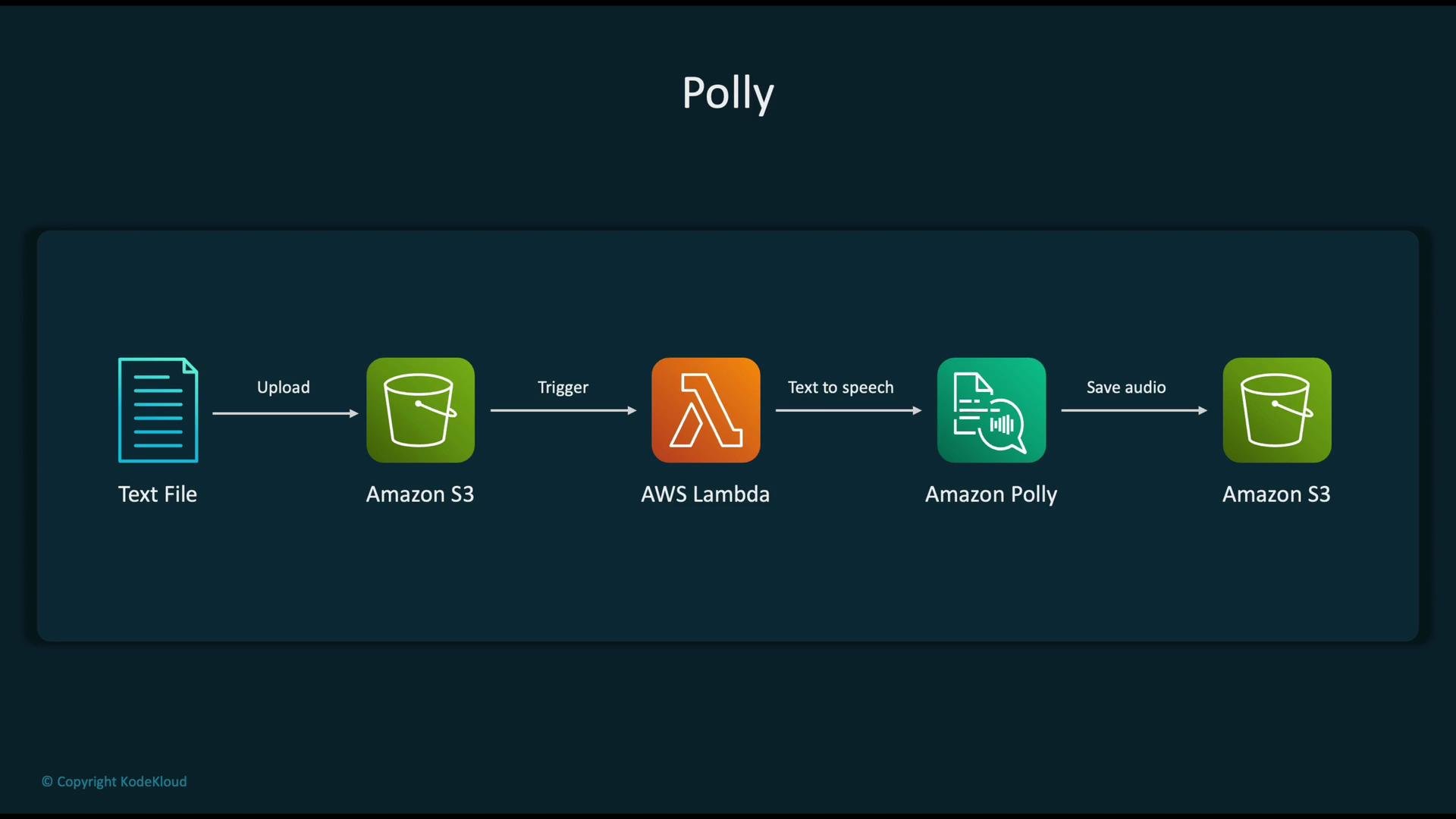
- Upload a text file to S3.
- An S3 event triggers a Lambda function.
- Lambda reads the text and calls Amazon Polly to synthesize speech.
- Store the resulting audio file back in S3 for playback or distribution.
Putting it all together
These AWS AI services can be combined to build robust multilingual and multimodal applications:- Translation pipelines: Transcribe → Translate → Polly for live multilingual voice interactions.
- Vision moderation and analytics: S3 upload → Rekognition → DynamoDB/A2I → downstream review or automation.
- Automated captioning and search: S3 audio/video → Transcribe → Store transcripts in a search index for discovery and analytics.
- TTS distribution: Text sources → Polly → S3 → CDN for audio delivery.