

- Multiple ML teams consume the same core dataset (e.g., customer demographics, transactions, website activity) but build different models:
- Team A: churn prediction
- Team B: personalized product recommendations
- Team C: suspicious login detection
- Duplicate feature-engineering logic across teams
- Training-serving skew (features used in training differ from those retrieved at serving)
- Inconsistent experiment and production results
- Increased maintenance costs for duplicated ETL/transformation code
- Reduced feature reuse and slower collaboration

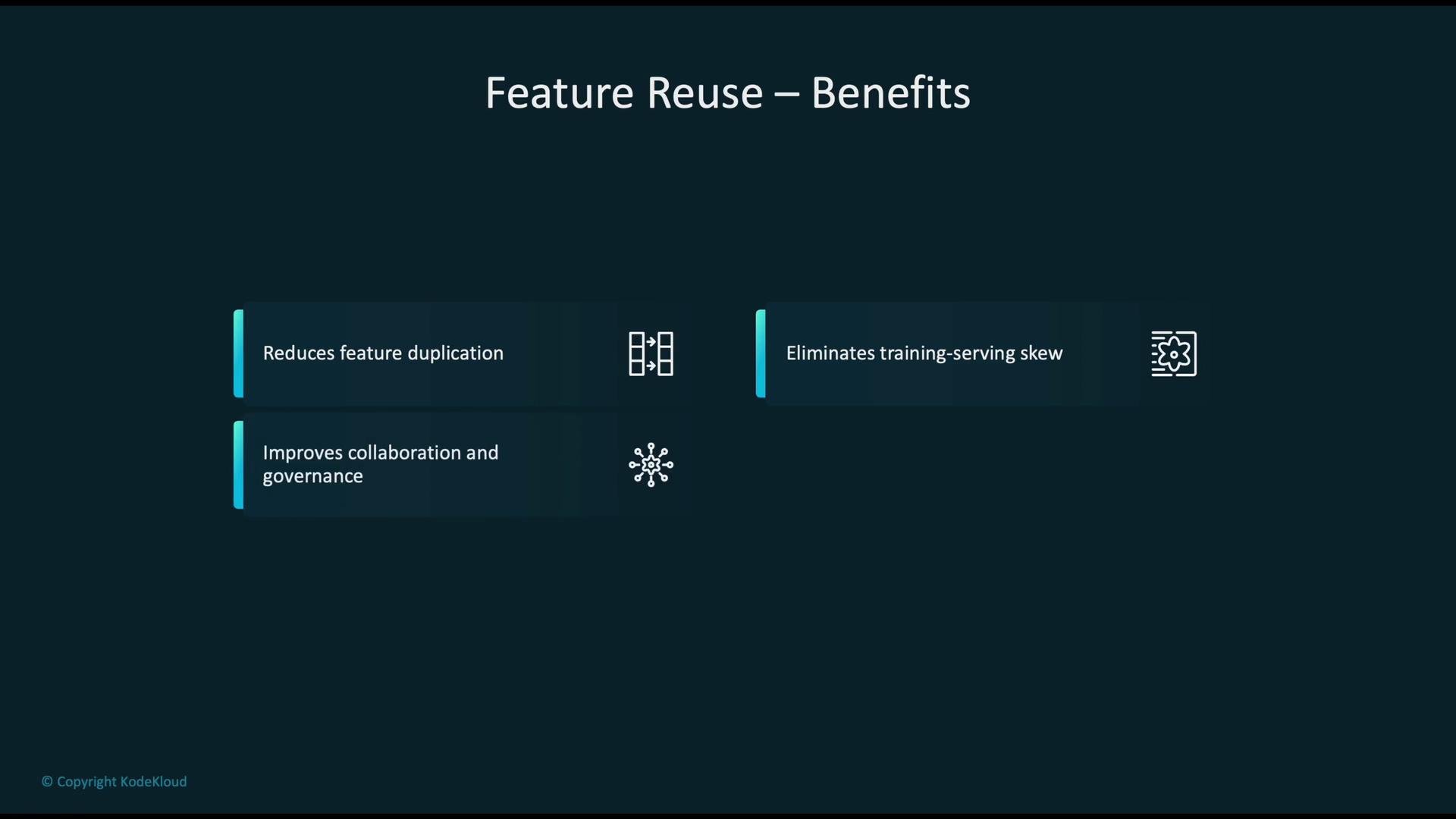
- Define features once and reuse them across teams and projects
- Eliminate training-serving skew through identical retrieval logic
- Improve collaboration and governance with a centralized catalog
- Reduce duplicated ETL and transformation maintenance
- A feature group is a logical collection of related features for a specific use case (for example: churn prediction).
- Each record in a feature group represents an entity (e.g., a customer or transaction) and must include:
- An entity identifier (primary key)
- An event time or timestamp (for point-in-time correctness)
- Feature columns with associated metadata (data types, descriptions, and transformation provenance)
- Raw data sources: databases, APIs, application logs, and streaming systems
- Ingestion/processing: ETL jobs, stream processors, or serverless functions that clean, transform, and compute features
- Feature Store: dual-storage system—an online store for low-latency serving and an offline store for large-scale batch access
- Consumers: live inference endpoints (real-time) and batch training/analytics jobs (historical / backfills)
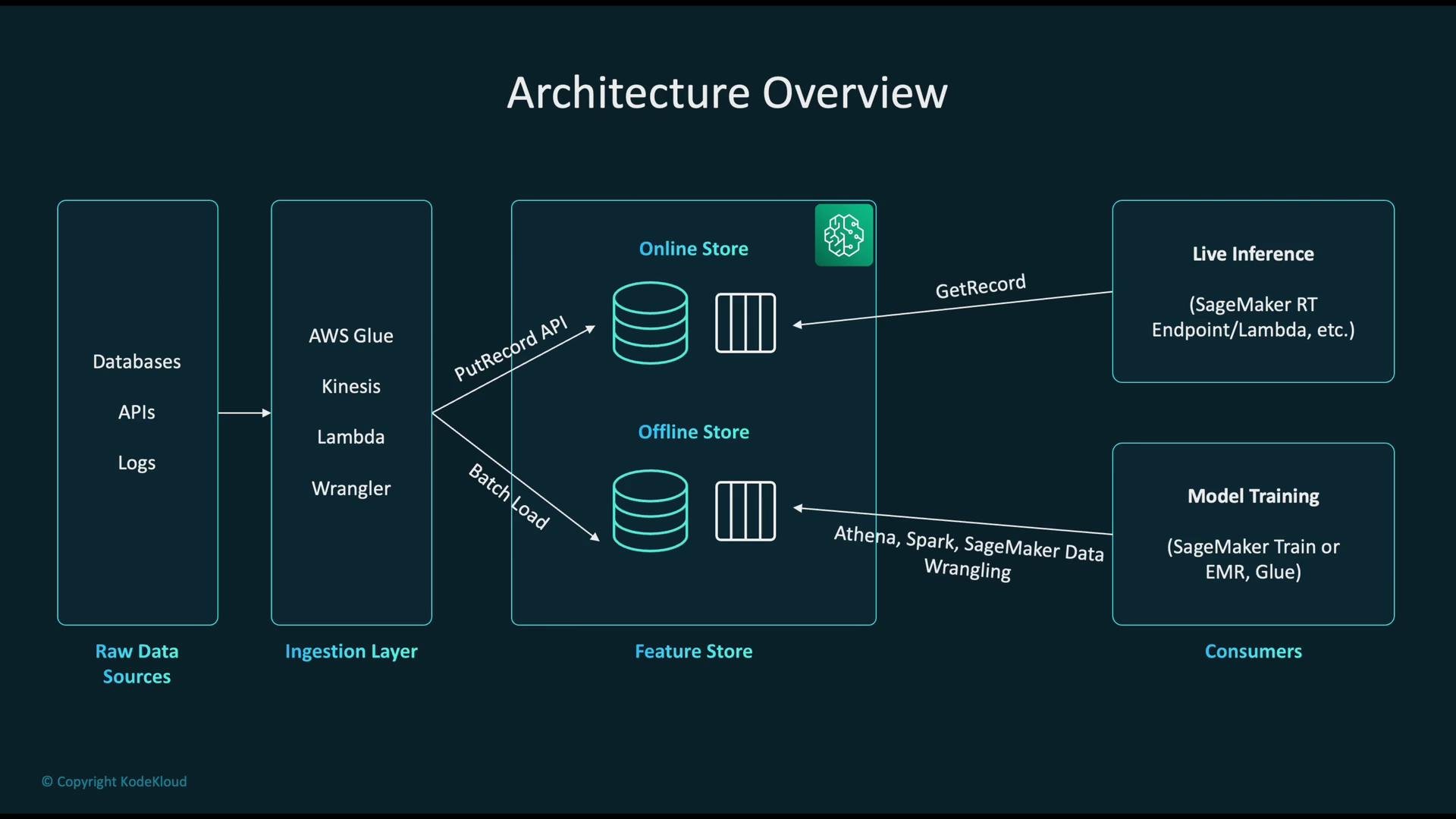
Consumers select the appropriate store:
- Use the online store for real-time predictions requiring millisecond latency.
- Use the offline store for model training, backfills, and analytical queries that operate over historical snapshots.
- Use feature groups to encapsulate entity keys, event timestamps, and feature metadata to ensure point-in-time correctness.
- Centralize feature transformations and lineage in the feature store to reduce duplication.
- Adopt consistent naming, typing, and documentation for features to enhance discoverability and governance.
- Automate ingestion and backfill pipelines to keep online and offline stores synchronized.
Use feature groups to encapsulate entity keys, event timestamps, and feature metadata. This ensures point-in-time correctness for training and consistent feature retrieval at serving time.