

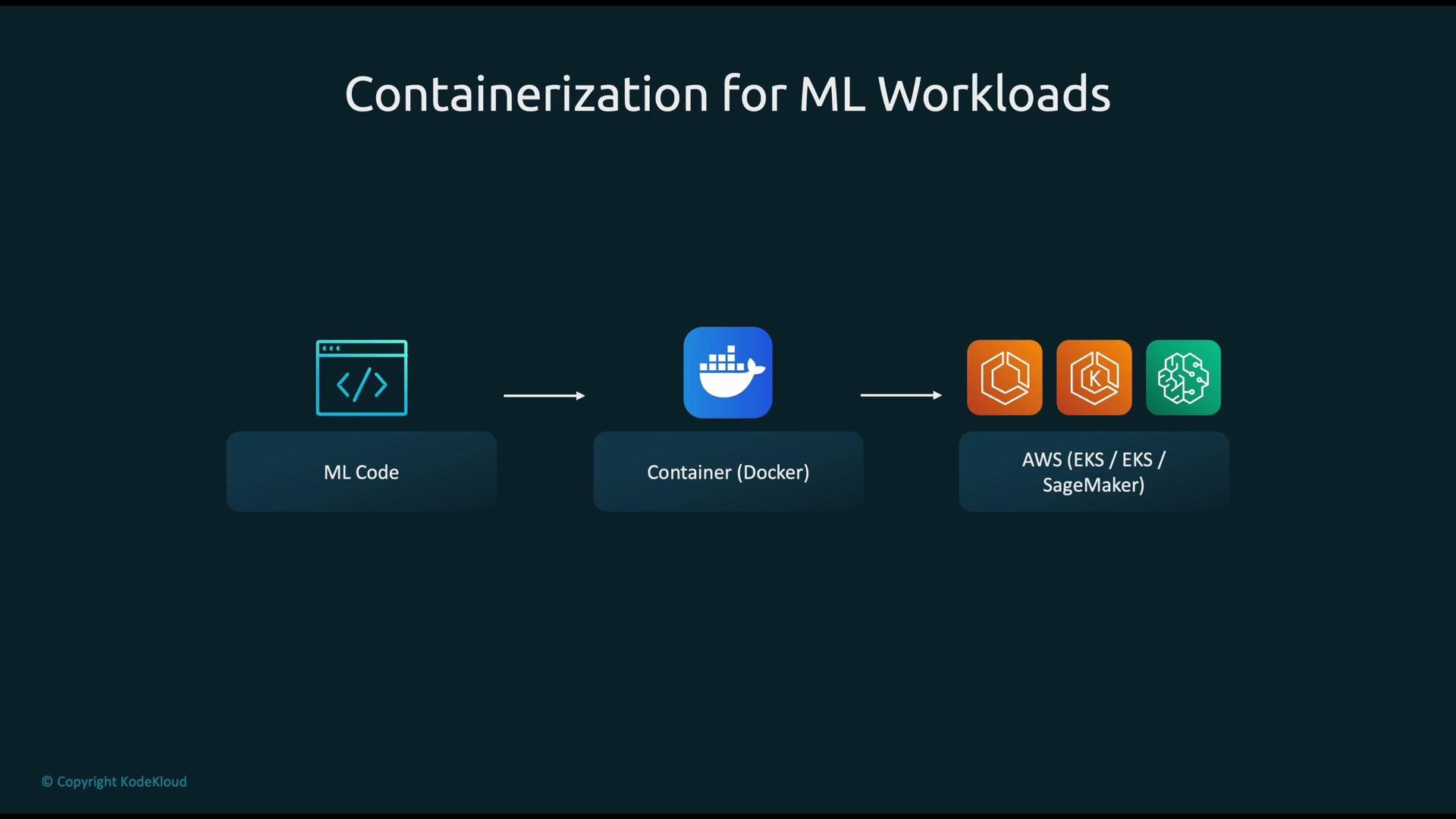
- Develop ML code (model training and inference logic).
- Package the code and all dependencies into a Docker container image.
- Push the image to a registry (for example, Amazon ECR).
- Deploy and scale that image on AWS using services such as EKS (Kubernetes), ECS, SageMaker, or Lambda.
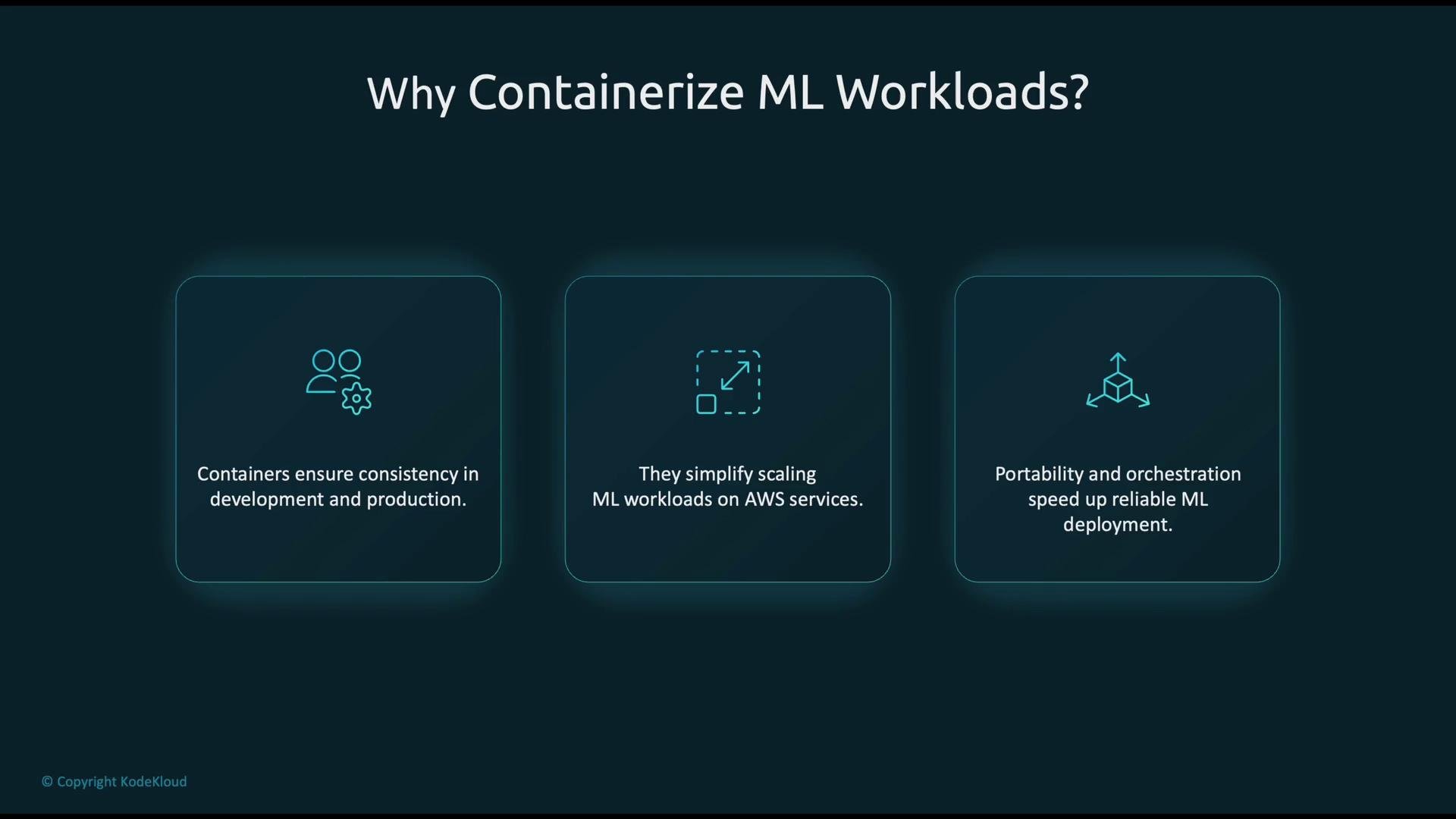
- Consistency: containers deliver identical runtime environments across developer machines, CI/CD pipelines, and production.
- Scalability: containers scale horizontally on cloud platforms, enabling responsive serving and batch workloads.
- Portability & orchestration: the same container image can be deployed on ECS, EKS, SageMaker, or Lambda, simplifying rollouts and environment parity.
- Build a Docker image that includes your ML code, model artifacts (or accessible model storage), and all runtime dependencies.
- Push the image to Amazon ECR, then choose an AWS runtime to host inference or training.
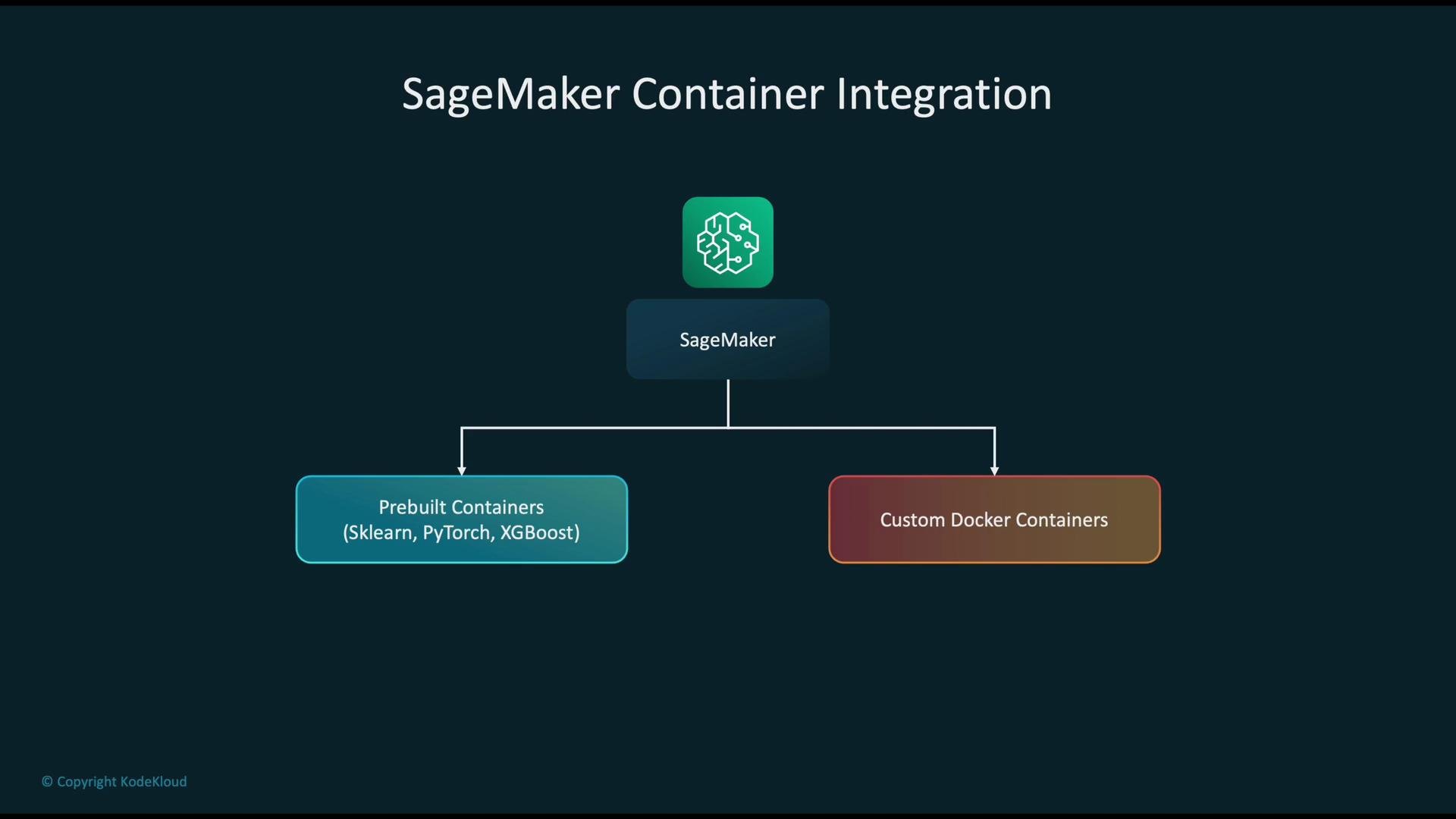
Below is a conceptual view of SageMaker’s container integration: SageMaker can run pre-built framework containers (e.g., scikit-learn, PyTorch, XGBoost) or your custom Docker container for training and inference jobs.
- ECS organizes deployments into task definitions and services. An ECS service manages multiple copies of a task (container) and exposes them through a load balancer to provide a single scalable endpoint.
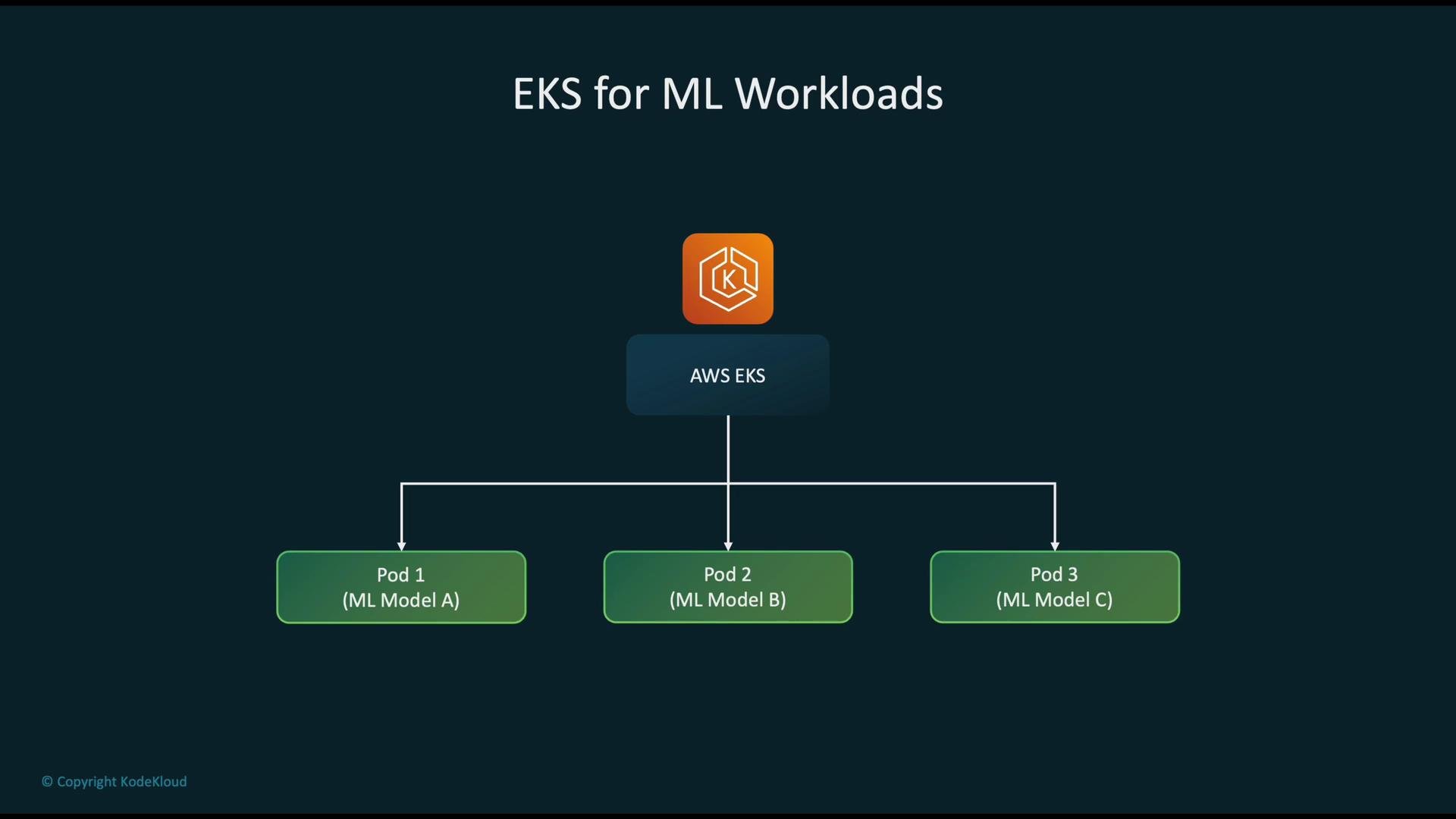
- EKS is a managed Kubernetes control plane: each model or service runs in pods. You can run Model A in pod set A, Model B in pod set B, etc., all managed by the same cluster and Kubernetes primitives.
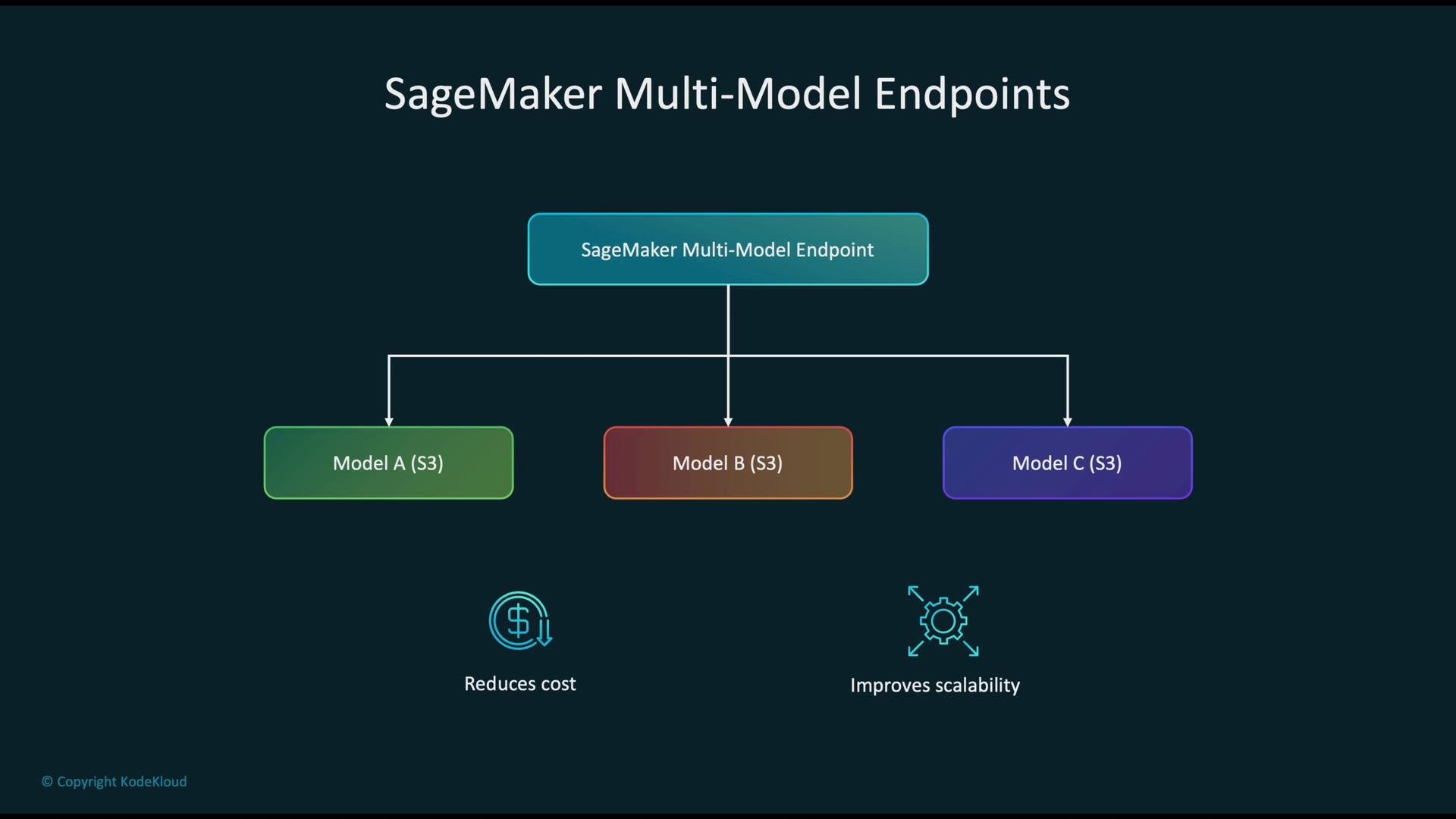
- Use MMEs when you must serve many small models. A single endpoint dynamically loads models from a shared S3 bucket and serves inference for Model A, B, C, etc.
- Benefits: reduced per-model hosting costs, simplified lifecycle management, and fewer endpoints to manage.
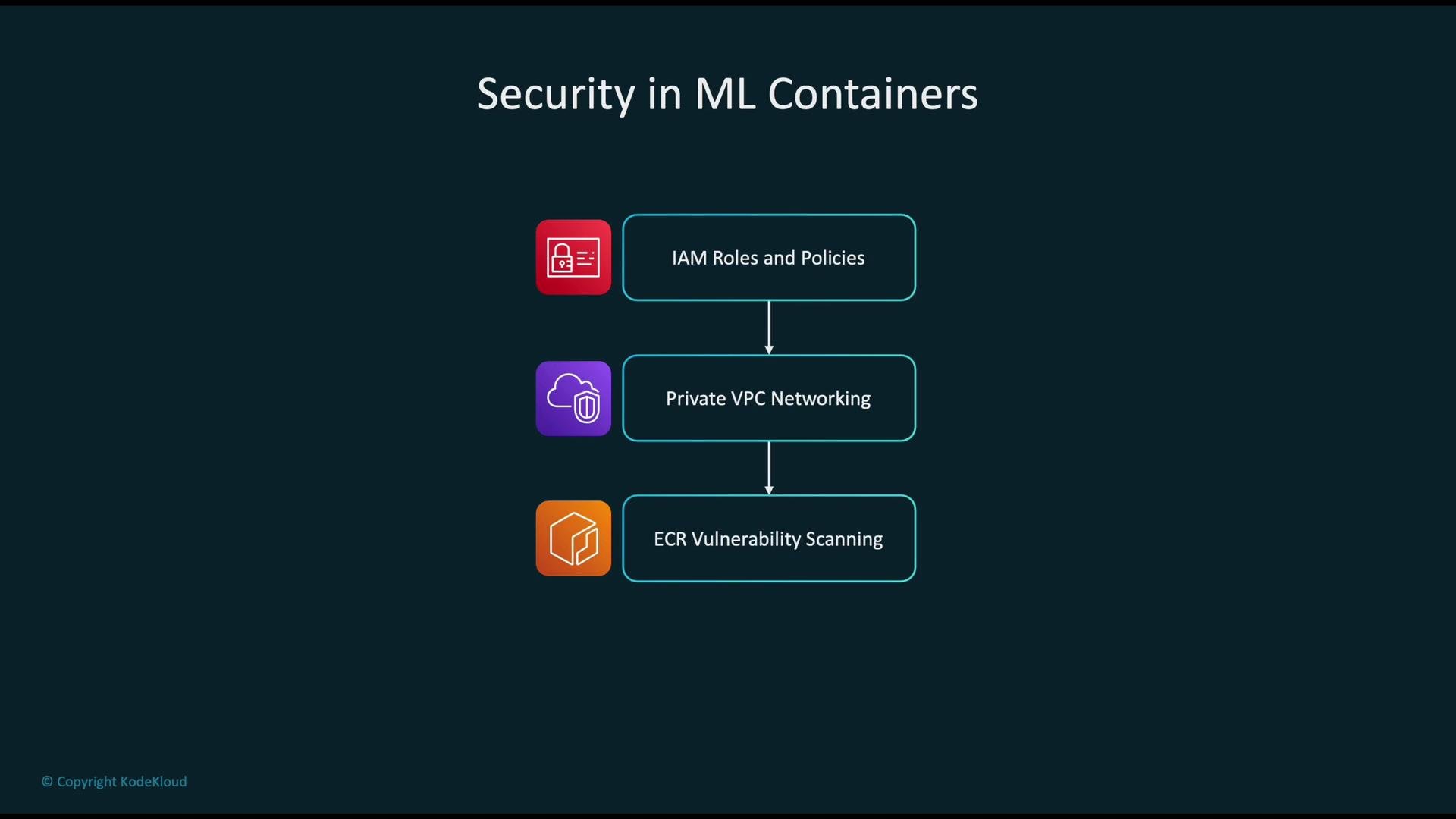
- Identity and access management: apply least-privilege IAM roles and fine-grained policies for services, build pipelines, and runtime.
- Network isolation: deploy containers in private VPC subnets and enforce network controls with security groups and NACLs. See AWS VPC docs: https://aws.amazon.com/vpc/
- Image scanning: enable ECR image scanning or use third-party scanners to detect vulnerabilities before deployment.
- Secrets and data protection: never bake secrets into images; use AWS Secrets Manager or Systems Manager Parameter Store. Encrypt sensitive data at rest and in transit.
Security tip: Use task- or pod-level IAM roles (ECS task roles or IAM Roles for Service Accounts on EKS) so containers get temporary, least-privilege credentials instead of long-lived keys.
- Dockerfile: keep it minimal and build only required runtime dependencies. Use smaller base images (e.g.,
python:3.10-slim) or distroless images where possible. - Build, tag, and push to ECR:
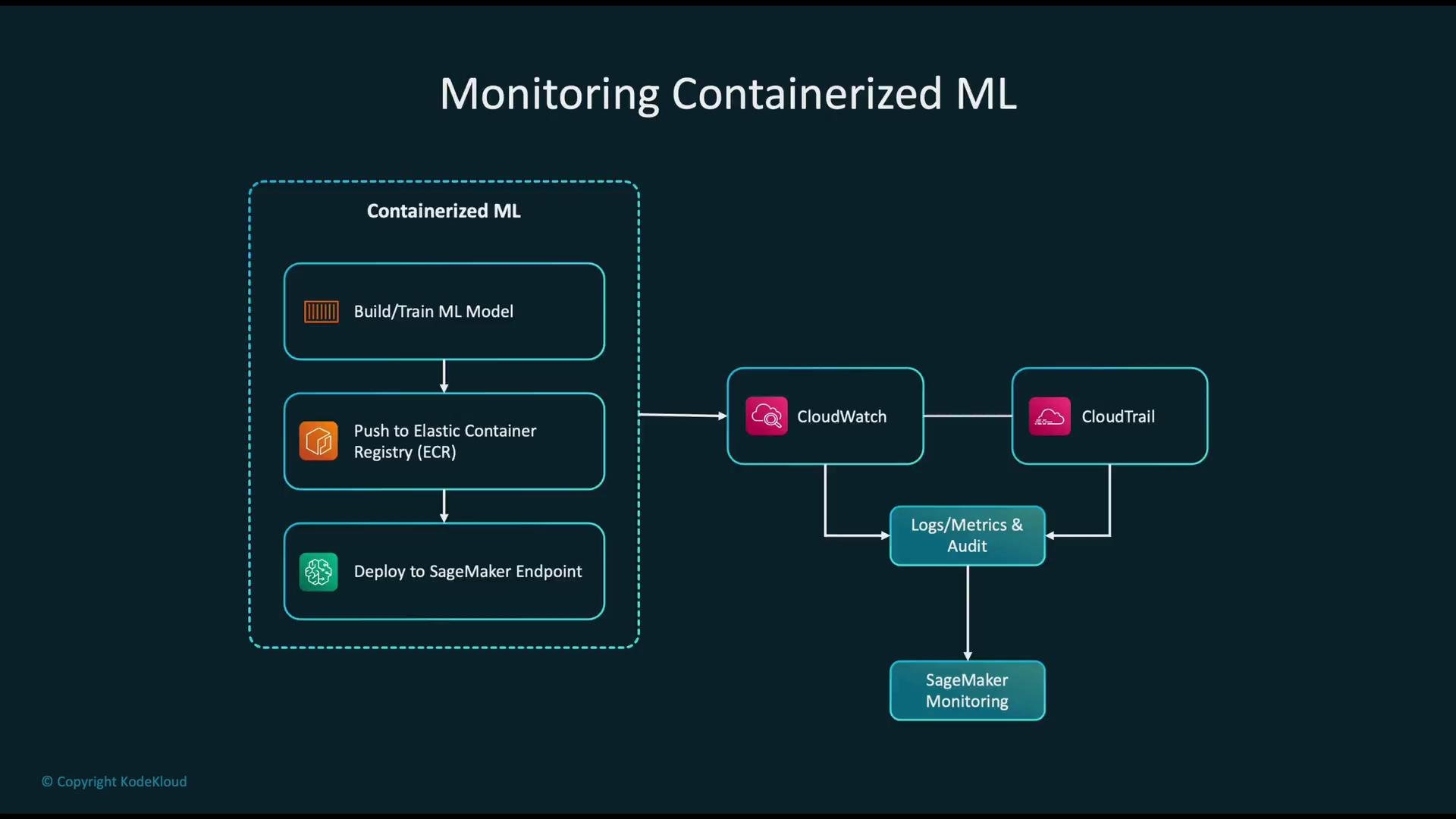
- Build and train the model; package and publish the container image.
- Push the image to Amazon ECR.
- Deploy to runtime: SageMaker endpoint, ECS service, or EKS pods.
- Emit logs/metrics to Amazon CloudWatch and capture API/activity audit logs with AWS CloudTrail.
- Use SageMaker Model Monitor (if available) and CloudWatch dashboards/alarms to observe model performance, latency, and data drift.
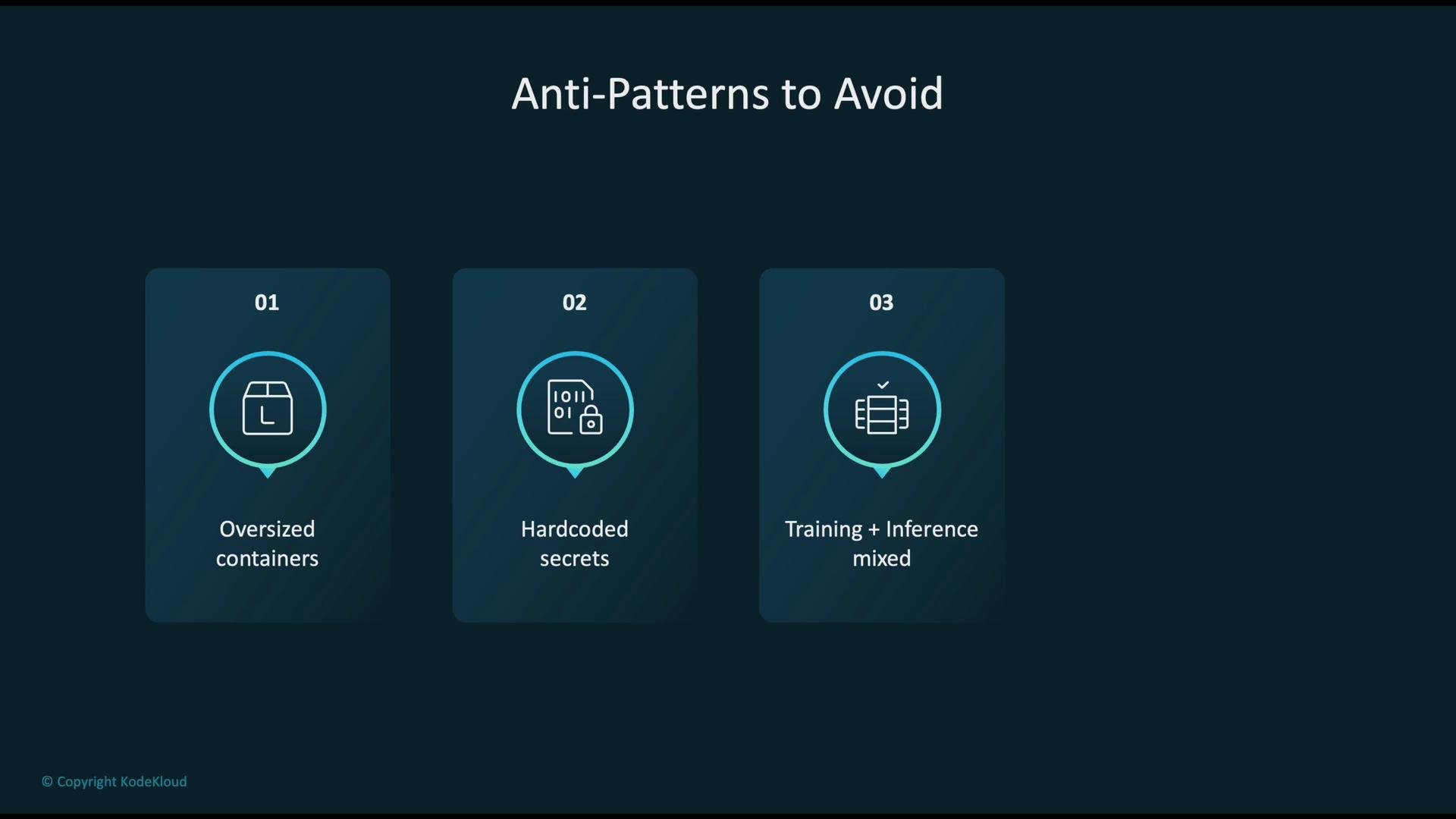
- Oversized images: include only the runtime dependencies you need. Smaller images reduce attack surface and speed deployments.
- Hard-coded secrets: never bake API keys or passwords into images. Use secrets management.
- Mixing training and inference in the same runtime: training can consume resources and destabilize inference—use separate environments.
- Skipping orchestration in production: rely on ECS/EKS/SageMaker for scaling, health checks, and rollbacks.
Avoid storing secrets in images or environment variables that are committed to source control. Use secret stores and IAM to reduce compromise risk.
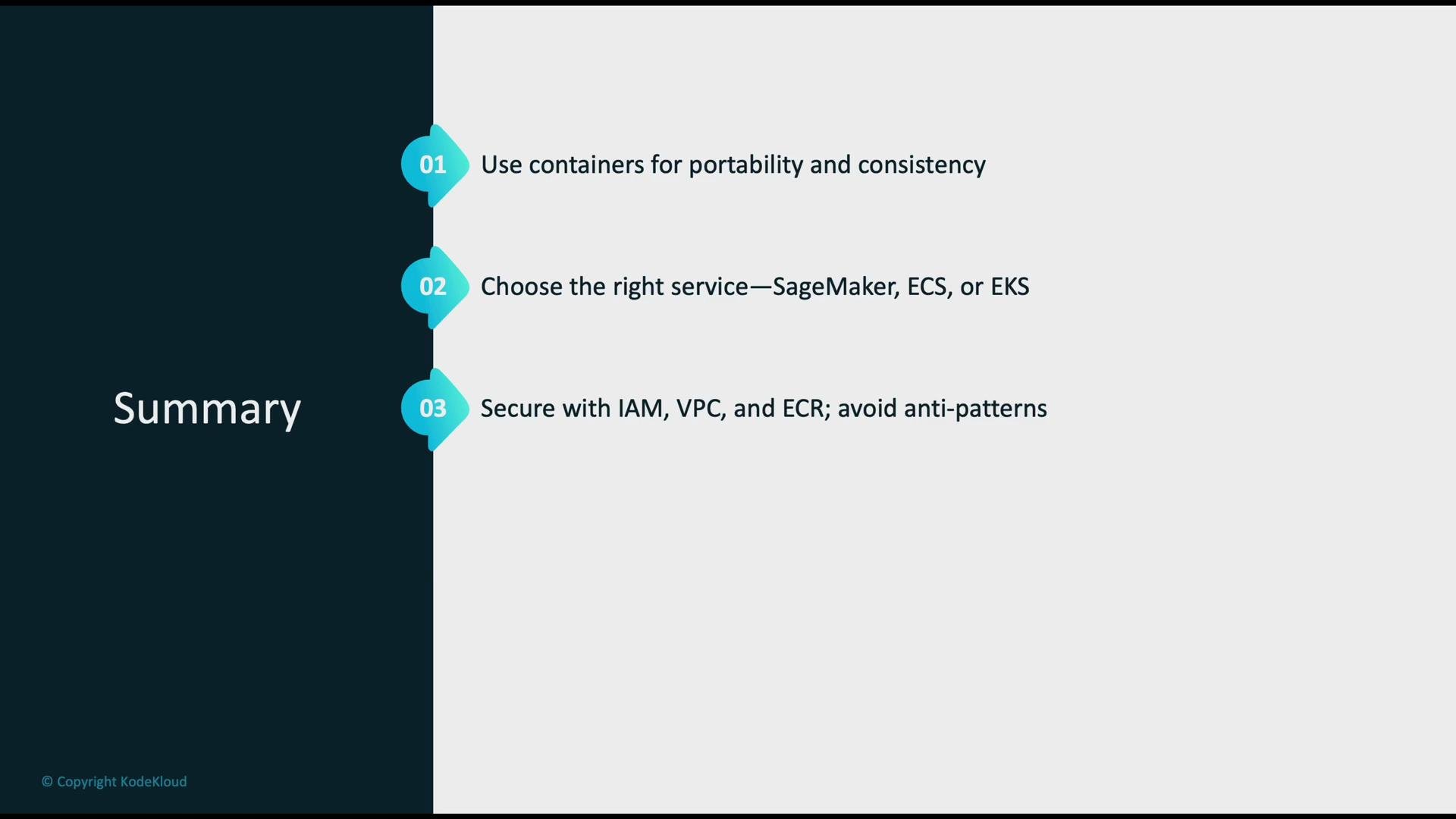
- Use containers to make ML deployments portable, consistent, and reproducible across environments.
- Choose the right AWS service:
- SageMaker for managed ML training/inference and model lifecycle tooling.
- ECS for simple container orchestration with EC2/Fargate.
- EKS for Kubernetes-driven orchestration and complex deployments.
- Secure your environment with IAM, VPC networking, image scanning (ECR), and secrets management.
- Monitor systems using CloudWatch, CloudTrail, and SageMaker Model Monitor to detect drift, latency spikes, and operational issues.
- Optimize hosting costs: use Multi-Model Endpoints where appropriate, right-size instances, evaluate serverless options, and automate model lifecycle actions.
- AWS SageMaker documentation: https://docs.aws.amazon.com/sagemaker/
- Amazon ECR image scanning: https://aws.amazon.com/ecr/
- Amazon ECS: https://learn.kodekloud.com/user/courses/amazon-elastic-container-service-aws-ecs
- Amazon EKS: https://learn.kodekloud.com/user/courses/aws-eks
- CloudWatch and CloudTrail for observability: https://learn.kodekloud.com/user/courses/aws-cloudwatch and https://aws.amazon.com/cloudtrail/