

- Why automated testing matters for ML pipelines
- Types of tests: unit, integration, and end-to-end (E2E)
- How tests improve pipeline reliability
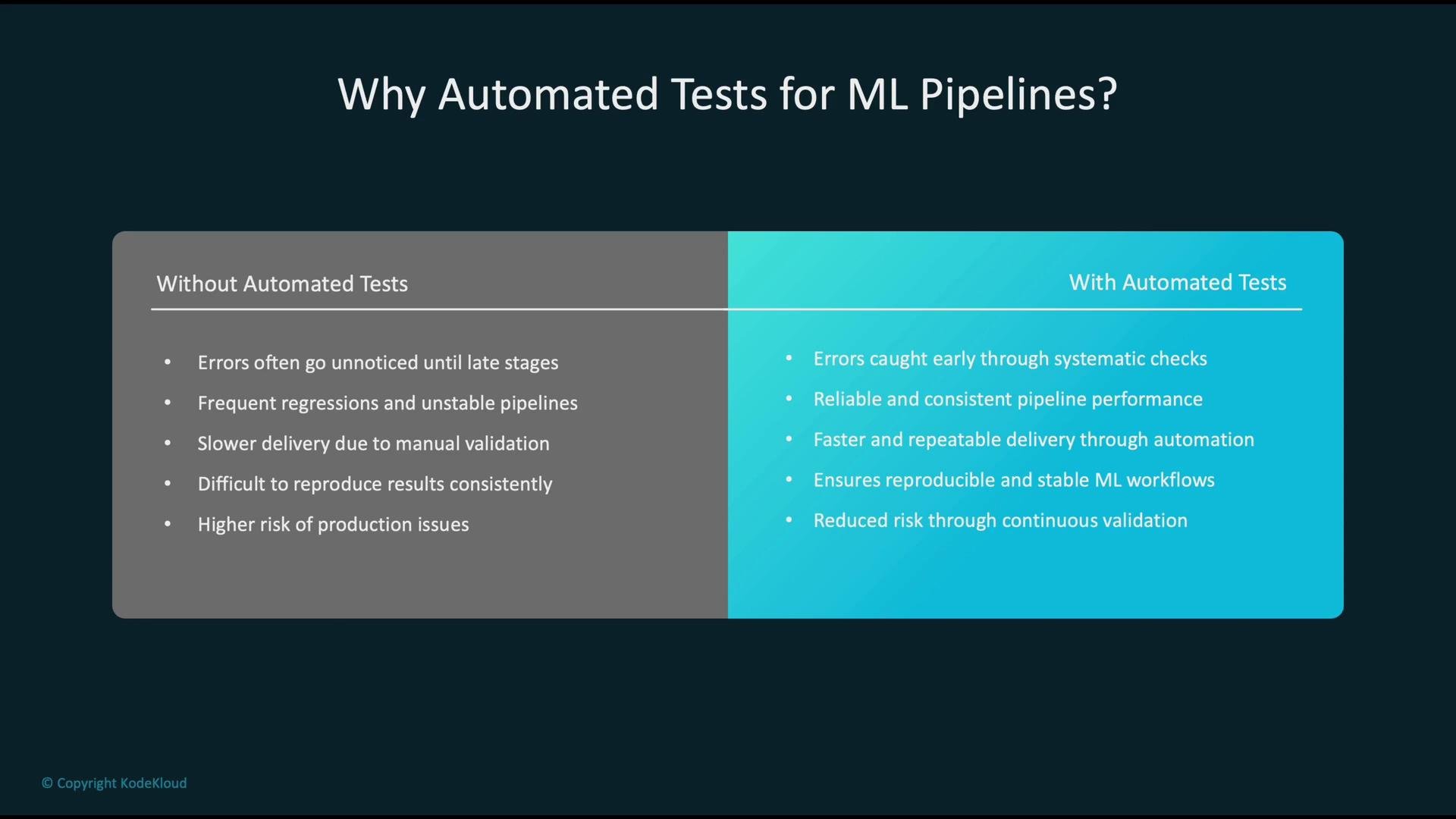
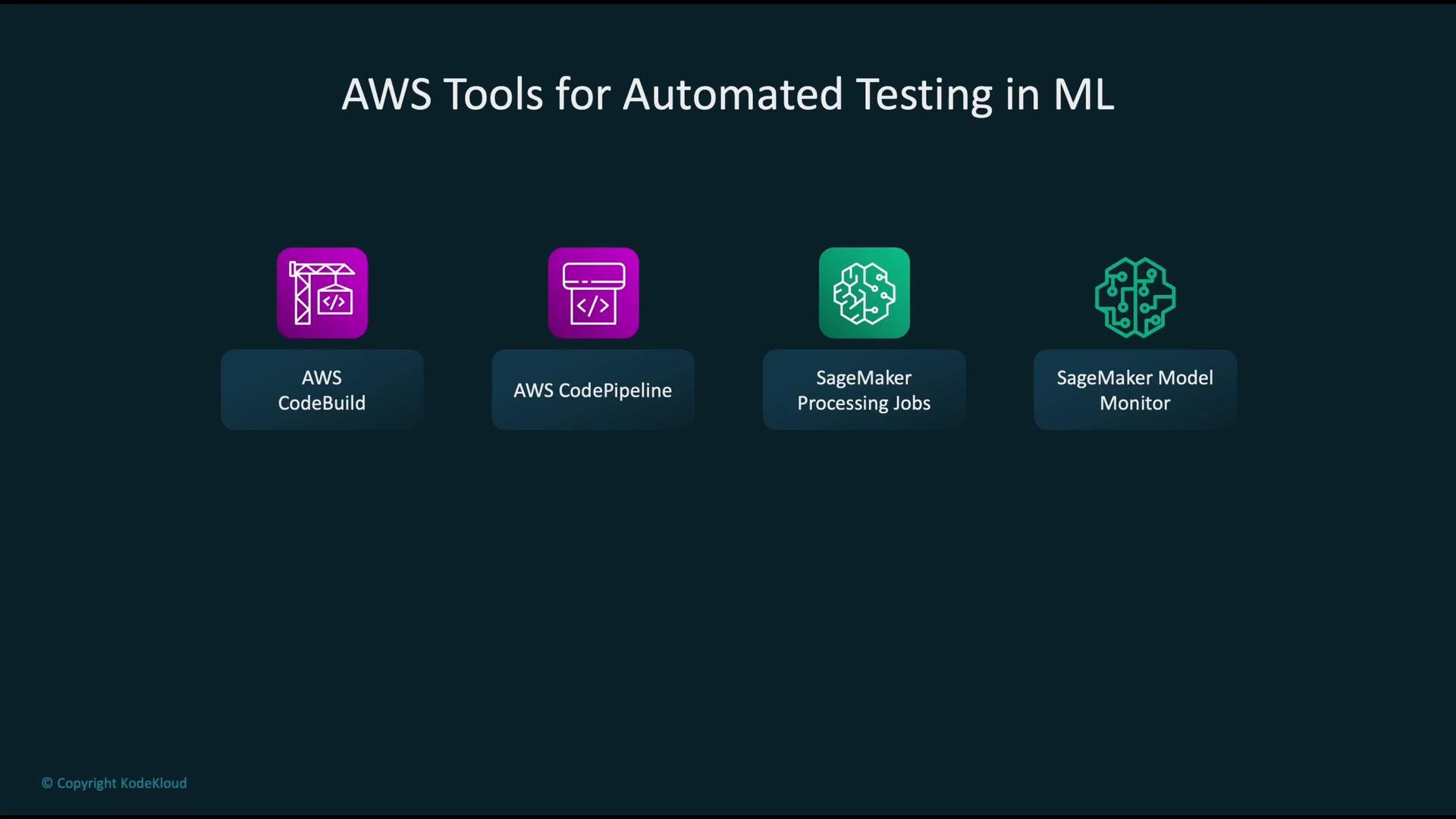
- AWS tools and patterns for automating ML tests
- Best practices: TDD, A/B testing, security, monitoring, and common anti-patterns
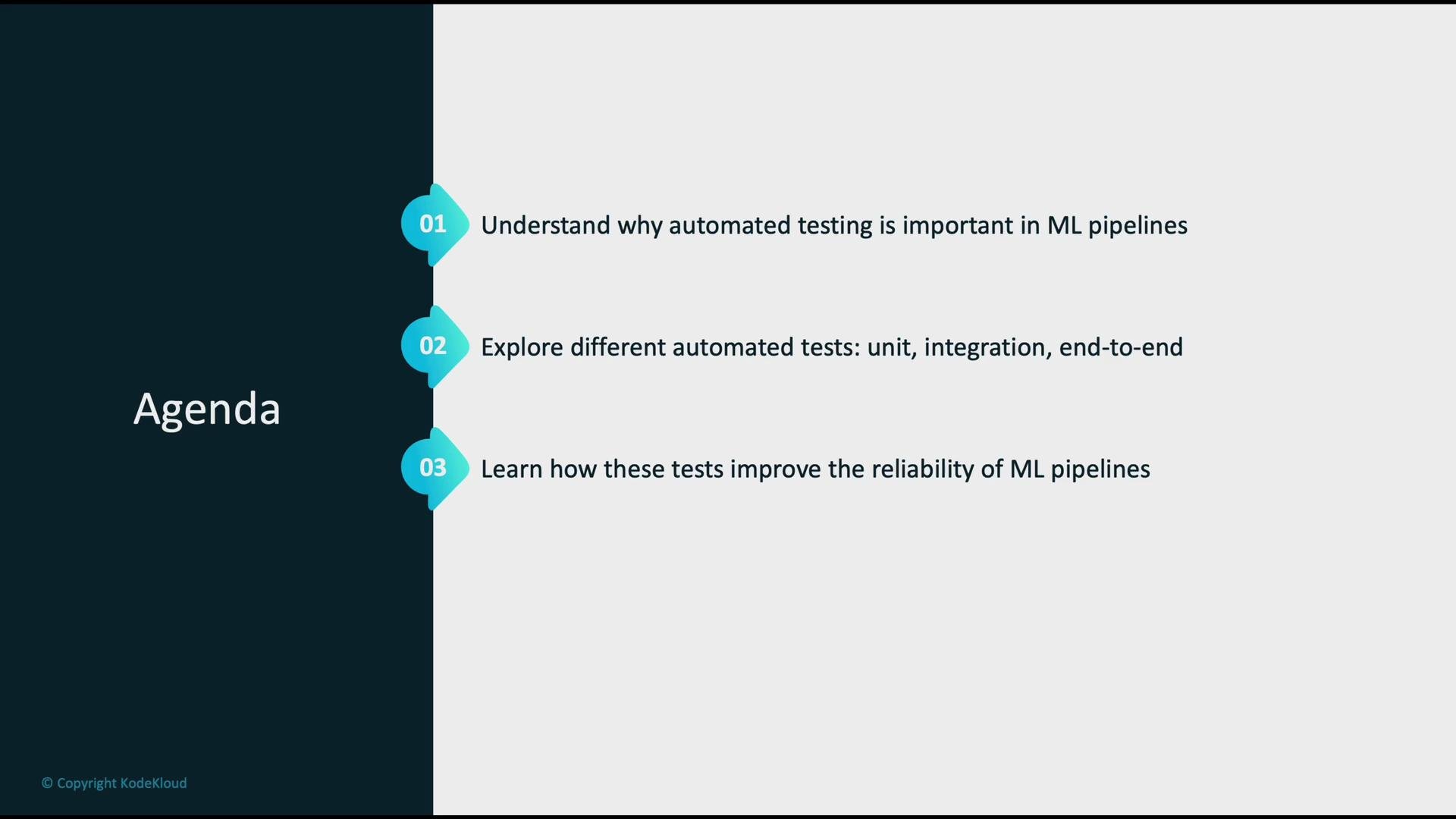
- Late discovery of defects increases remediation cost and causes regressions.
- Manual validation slows delivery, reduces reproducibility, and makes auditing difficult.
- Without continuous validation, production issues and model drift are more likely.
- Early error detection through frequent, repeatable checks.
- Consistent, reproducible pipeline runs across environments.
- Faster delivery with confidence to deploy models.
- Lower risk of production failures and regressions.
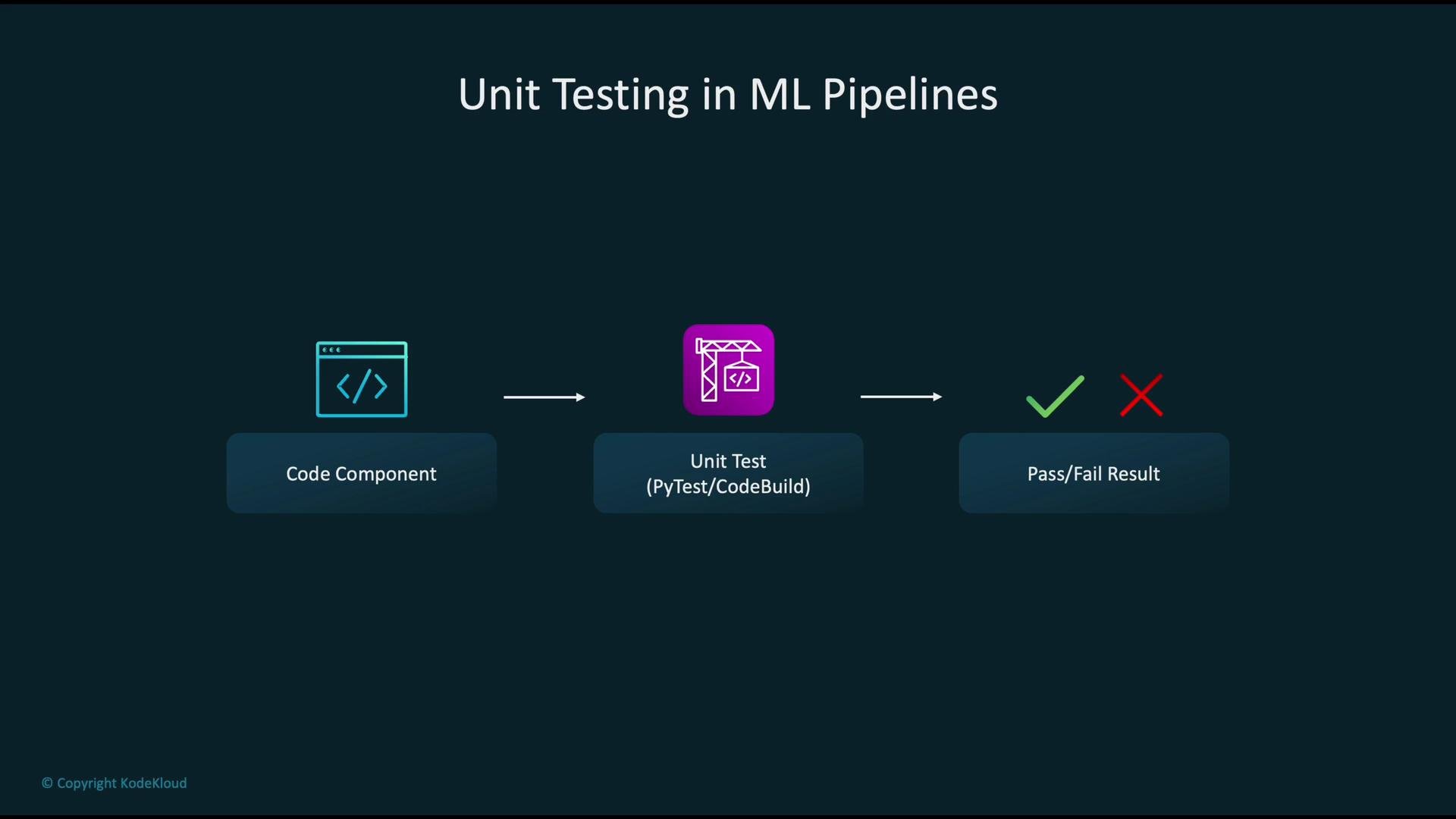
- Feature engineering functions: ensure transformations and scaling behave as expected.
- Data validators: schema checks, missing values, and boundary cases.
- Training utilities: hyperparameter parsing, metric computations, and helper logic.
- Isolate the function/module under test (e.g., a transformer).
- Run tests locally during development and in CI using
pytestor CodeBuild. - Block merges or deployments on failing tests to prevent regressions.
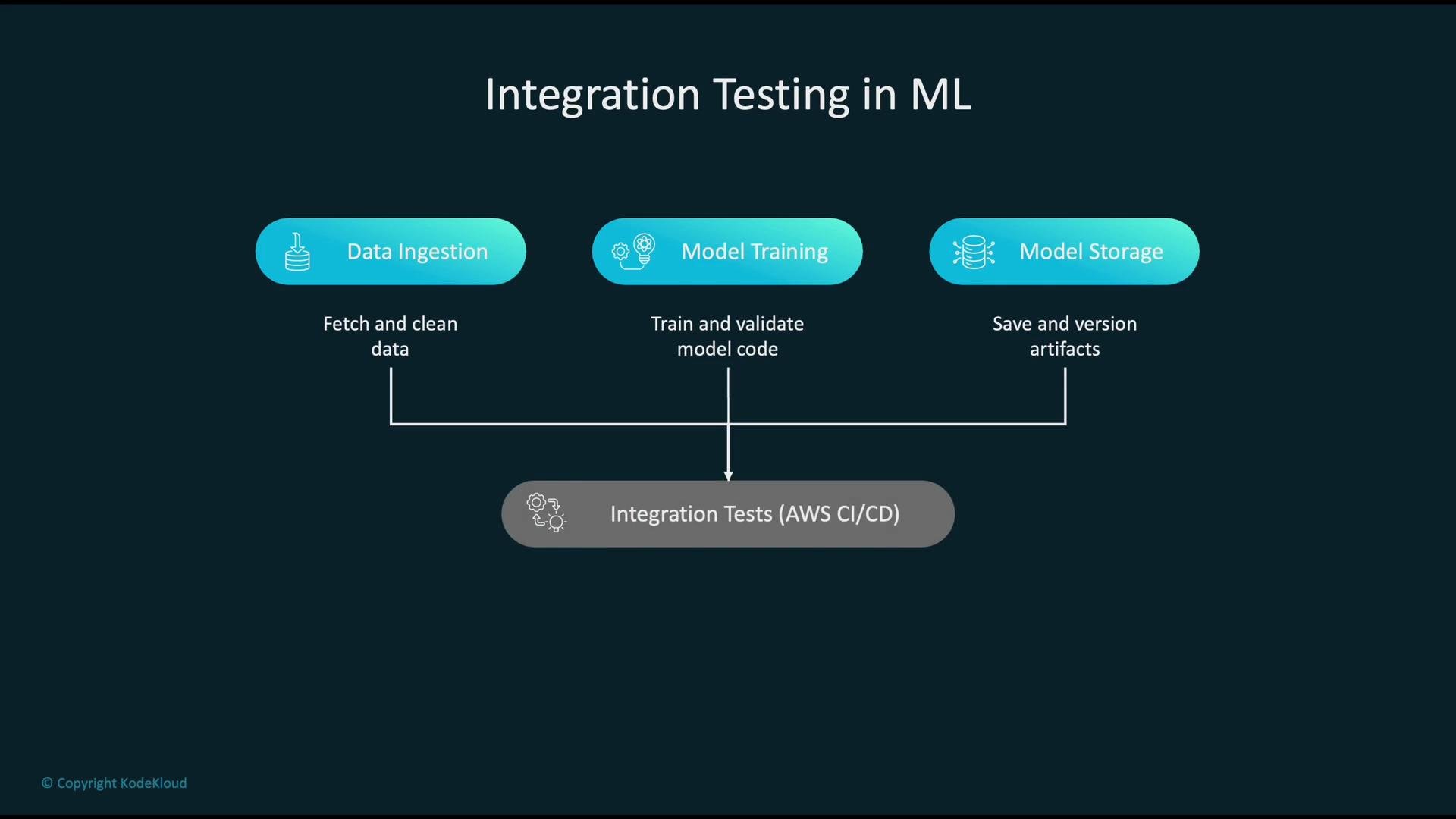
- Data ingestion → preprocessing → training → artifact storage.
- Verification that outputs from one step are valid inputs for downstream steps.
- Ensuring training jobs produce expected artifacts (model files, metrics, metadata).
- Ingest or synthesize test data and run preprocessing.
- Execute training jobs using CI (CodePipeline + CodeBuild or temporary SageMaker jobs).
- Validate produced artifacts, metadata, and model formats before promotion.
- Data schemas and formats match expectations across steps.
- Artifacts are versioned and stored correctly.
- Downstream consumers can load and use artifacts without errors.
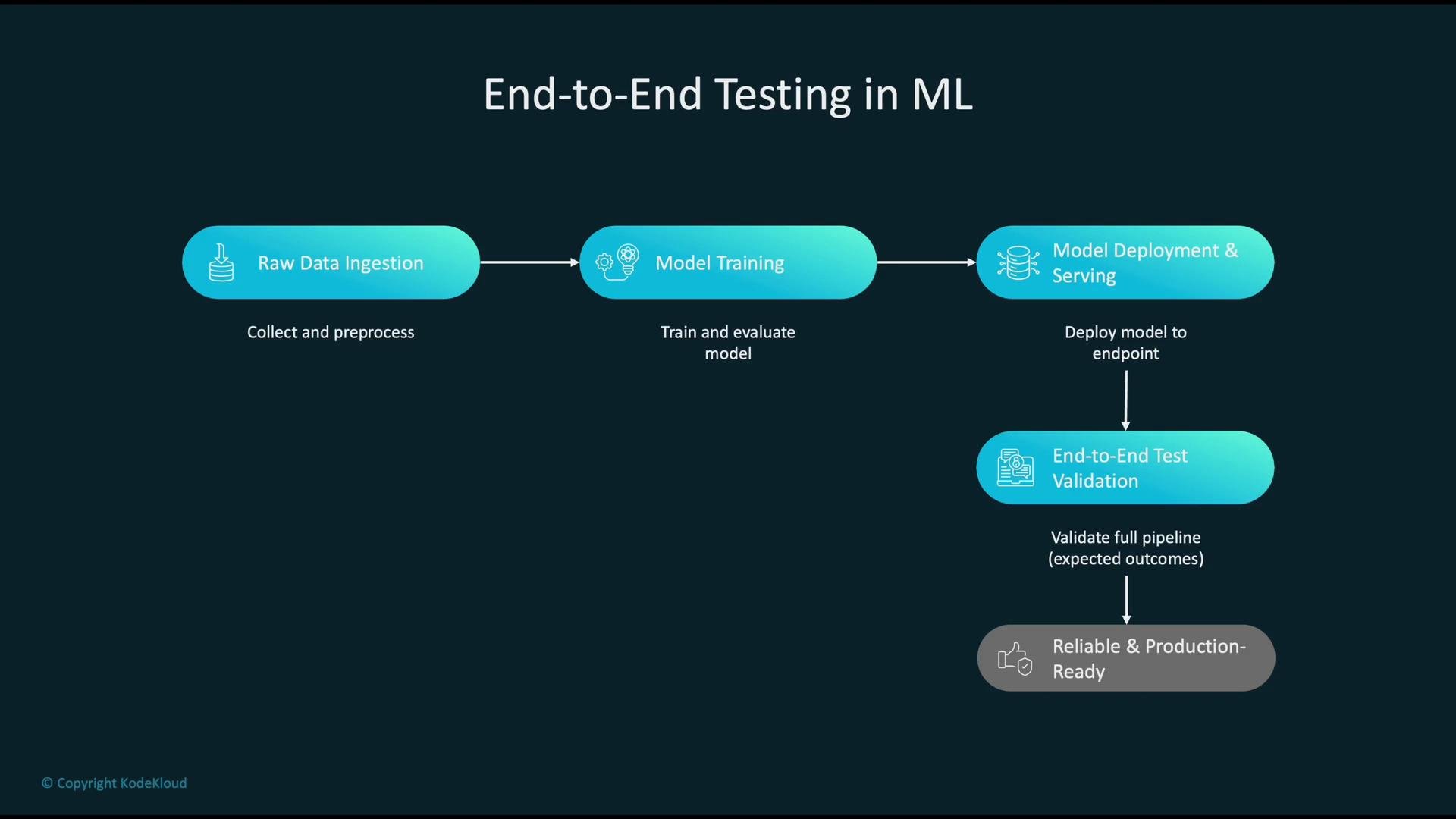
- Ingesting raw or synthetic test data through the full pipeline.
- Running training and evaluation stages and generating model artifacts.
- Deploying the model to a test serving endpoint (e.g., SageMaker endpoint).
- Sending test requests to the endpoint and validating correctness, latency, and resource usage.
- Write a failing test that specifies desired behavior (e.g., transformation output).
- Implement the minimal code to make the test pass.
- Run tests and confirm success.
- Refactor and improve the code while ensuring tests still pass.
- Repeat for additional features and utilities.
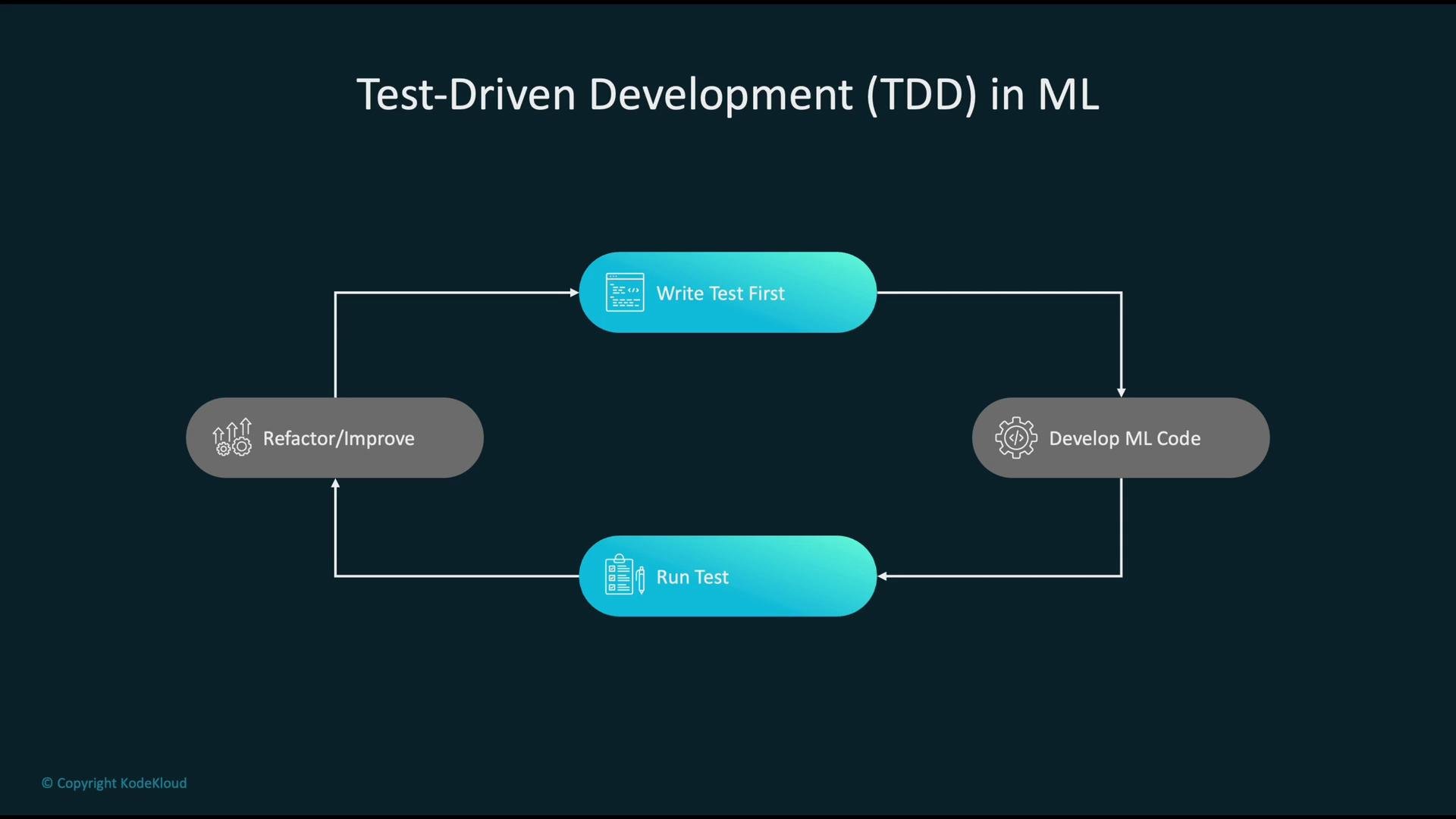
Test-Driven Development is especially valuable for deterministic parts of ML pipelines: data processing, validation logic, metric calculations, and infrastructure-as-code for reproducible deployments.
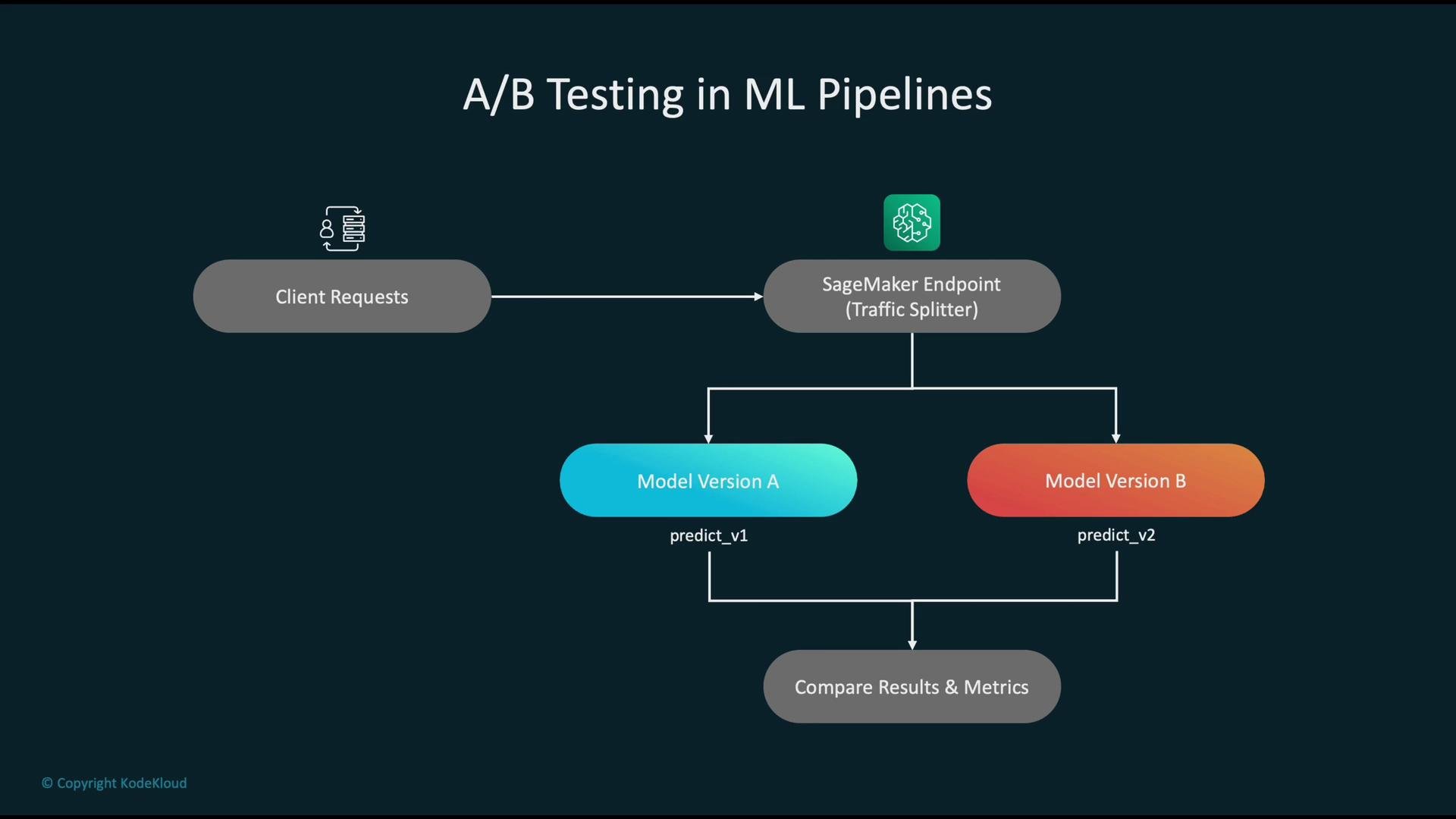
- Configure traffic splitting on a serving layer (e.g., a SageMaker endpoint or API Gateway + router).
- Route a portion of requests to model variant A and the rest to variant B.
- Collect predictions, latencies, and business metrics for both versions.
- Analyze statistical differences to select the winning model.
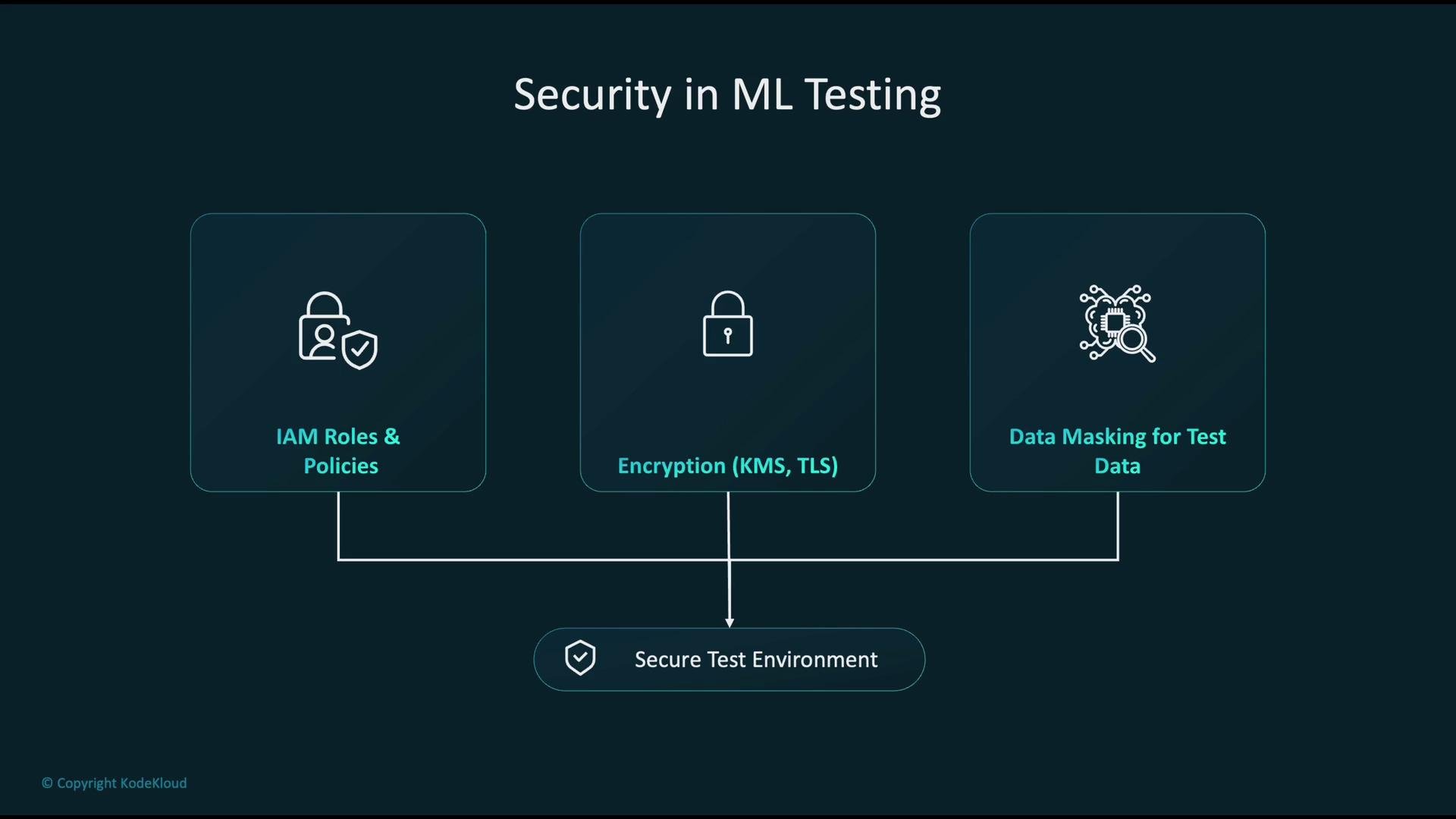
- Access control: use fine-grained IAM roles and least-privilege policies.
- Encryption: protect data at rest with AWS KMS and in transit with TLS.
- Data handling: use anonymized or synthetic datasets for tests; mask or transform any production-derived samples.
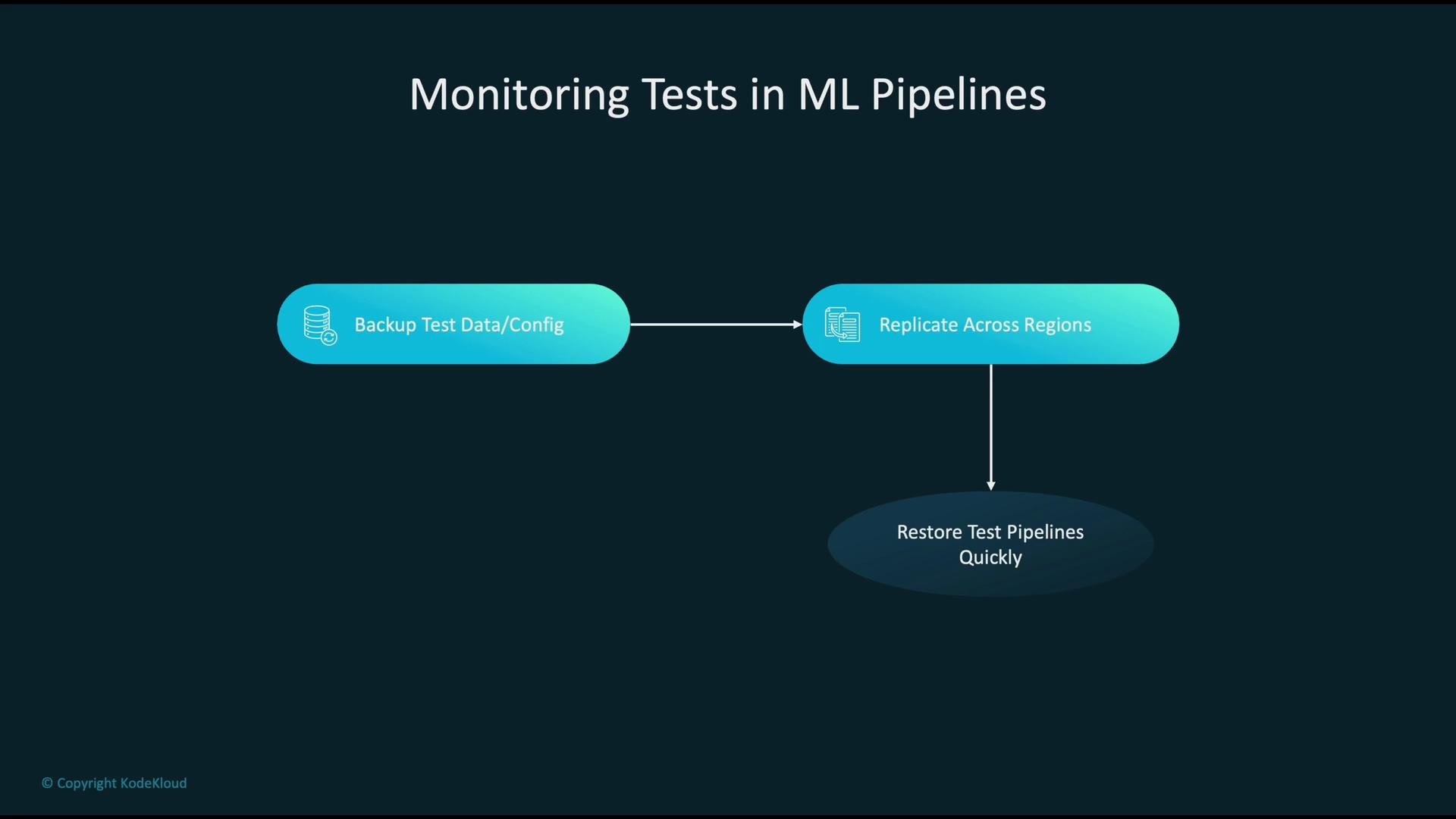
- Back up test datasets, pipeline definitions, and configs.
- Replicate backups across regions for redundancy.
- Automate restore procedures to rapidly recreate test pipelines.
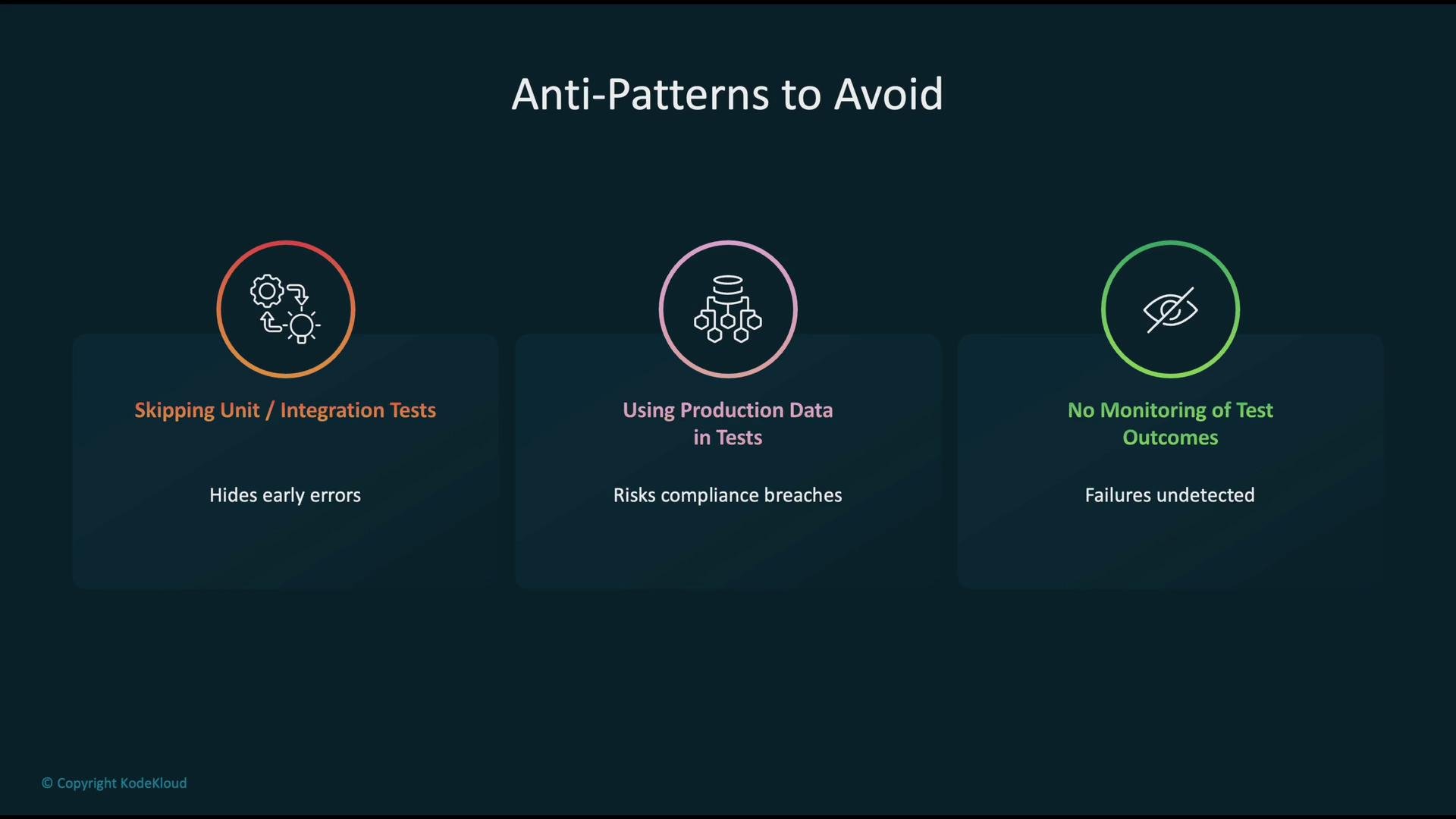
- Skipping unit or integration tests: increases the chance of costly regressions.
- Using raw production data in tests: creates privacy and compliance risks.
- Not monitoring test outcomes: failing tests that go unnoticed are worthless.
Never use raw production data in test environments unless it has been appropriately anonymized and approved. Using production data in tests can lead to serious compliance and security violations.
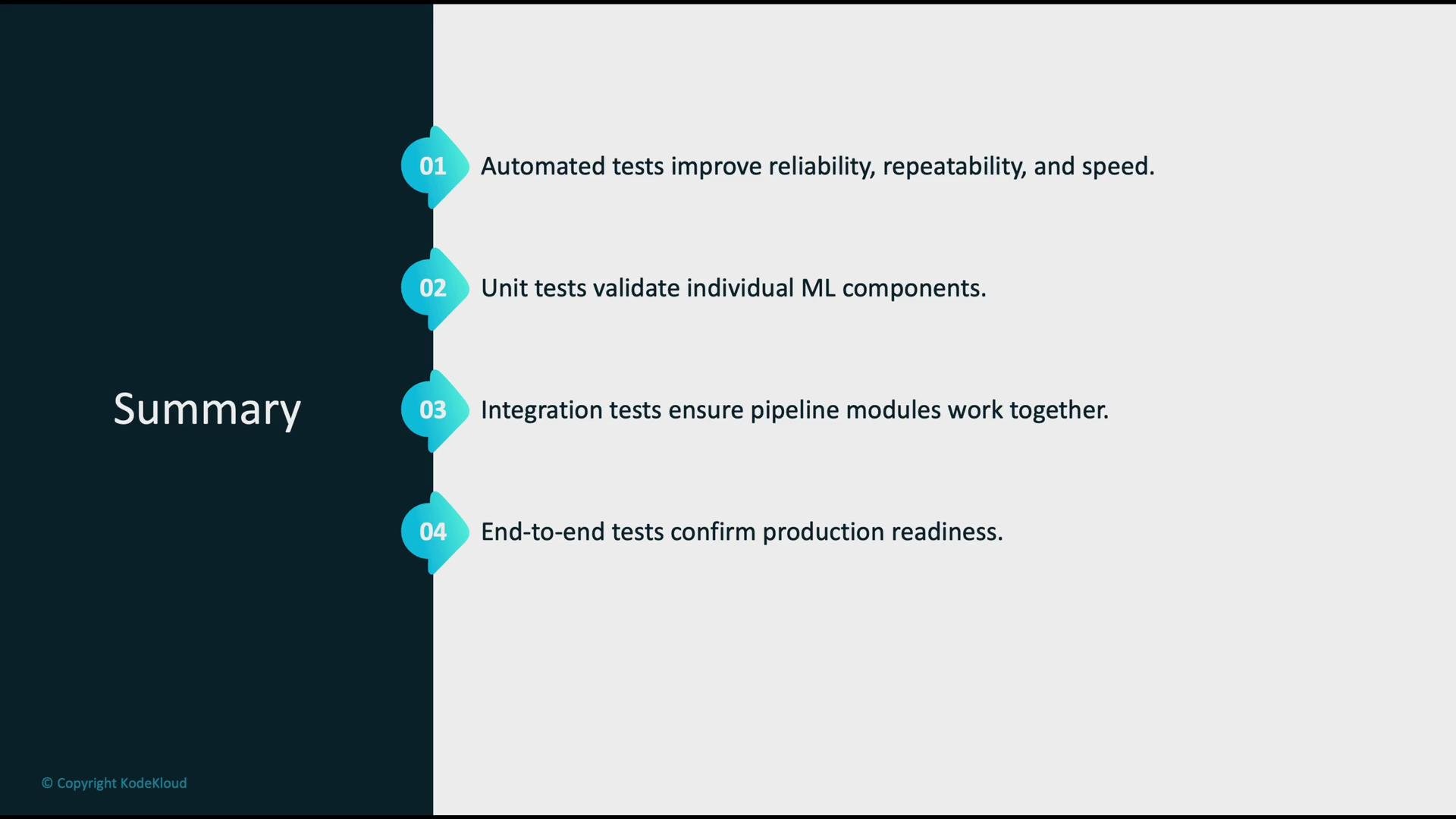
- Automated testing is essential to increase reliability, repeatability, and deployment velocity in ML pipelines.
- Test types:
- Unit tests: validate isolated functions and logic.
- Integration tests: validate interactions and artifact compatibility.
- End-to-end tests: validate the full pipeline and deployed endpoint behavior.
- Apply TDD for deterministic pipeline components and use A/B testing to evaluate models under live traffic.
- Prioritize security (IAM, encryption), monitoring (Model Monitor, logging), backups, and automated recovery.
- Avoid anti-patterns: don’t skip tests, don’t use raw production data without safeguards, and monitor all test outcomes.
- AWS CodePipeline
- AWS CodeBuild
- Amazon SageMaker Processing Jobs
- Amazon SageMaker Model Monitor
- SageMaker Endpoints (Hosting)
- pytest documentation: https://docs.pytest.org/