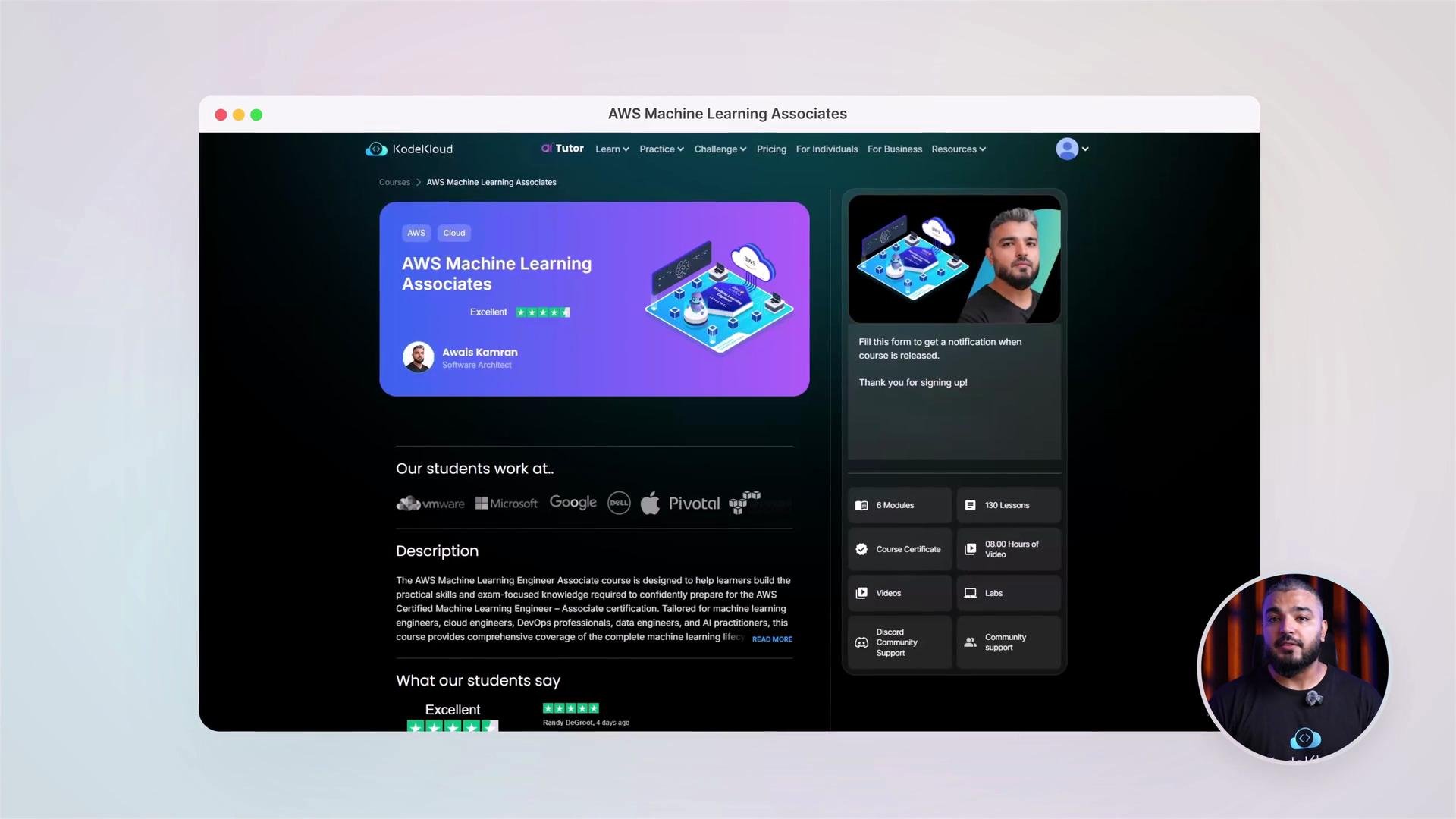
Machine learning is transforming industries — from personalized recommendations and fraud detection to generative AI and intelligent automation. Delivering ML in production, however, requires much more than a trained model: it demands reliable data pipelines, selected algorithms, scalable deployment patterns, continuous monitoring, and strong security. Those elements are what separate experimentation from production-grade machine learning engineering. Welcome to the AWS Machine Learning Associate course. I’m Awais Kamran, your instructor for this lesson. This course is designed to help you develop practical, production-focused ML skills on AWS and prepare you to pass the AWS Certified Machine Learning — Associate exam with confidence.
The image shows a webpage for an AWS Machine Learning Associates course on the KodeKloud platform, featuring course details, user ratings, and testimonials.
This course focuses on designing, building, deploying, and maintaining production-ready ML solutions using AWS services and industry best practices. Whether you are a machine learning engineer, data engineer, cloud engineer, or AI practitioner, you will gain the core skills required to operate ML systems at scale.
This course emphasizes hands-on learning: each module contains labs, guided demos, interactive exercises, and practice exams to reinforce applied skills on AWS.
Course coverage maps directly to the certification’s core domains:
  • Domain 1 — Data processing for ML: ingesting, storing, transforming, and validating data with Amazon S3, Amazon Kinesis, AWS Glue, and SageMaker Data Wrangler.
  • Domain 2 — ML development: choosing algorithms, automated training, hyperparameter optimization, and working with foundation models via SageMaker built-in algorithms and SageMaker JumpStart.
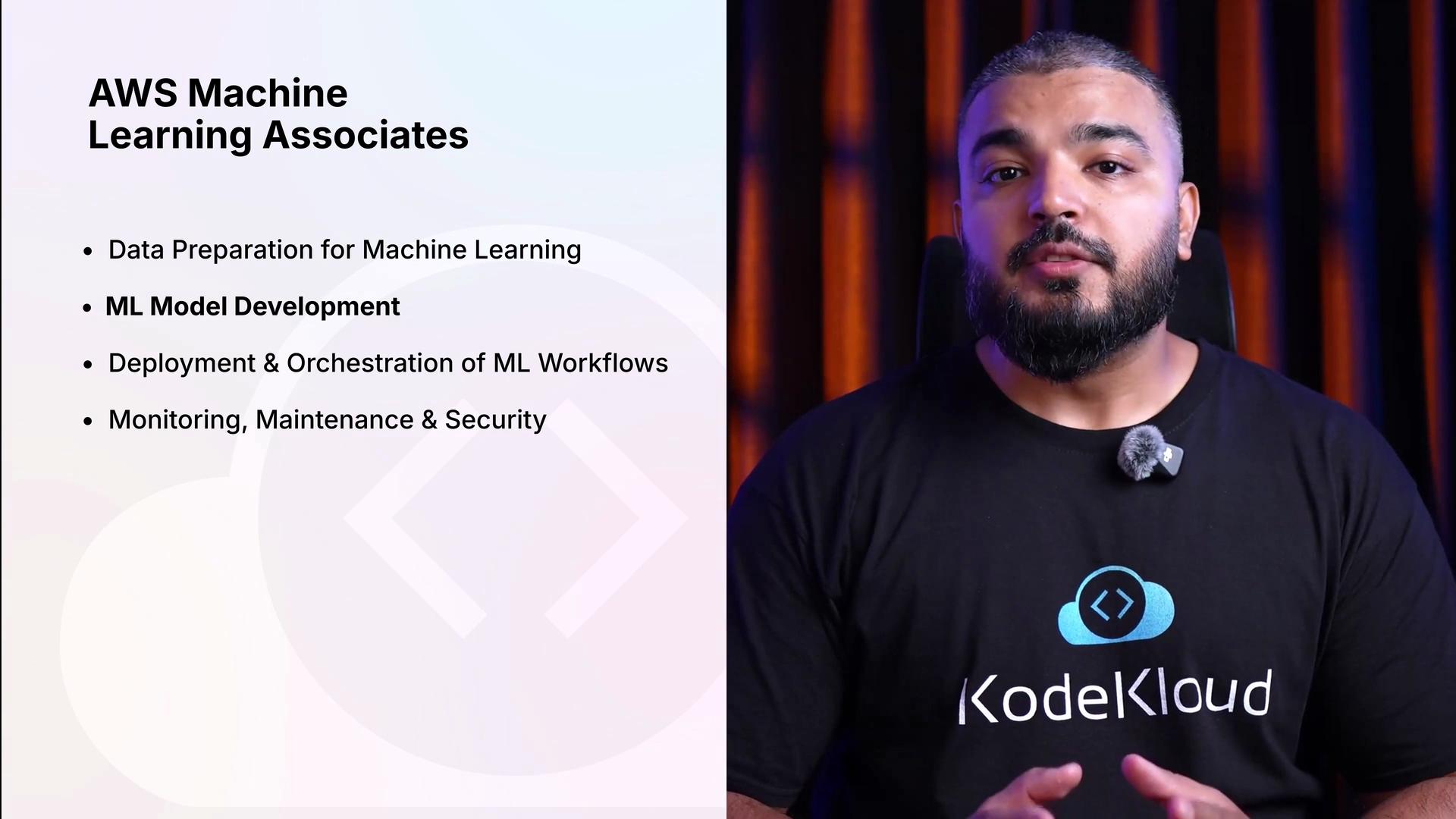
The image shows a person wearing a "KodeKloud" shirt speaking next to a slide titled "AWS Machine Learning Associates," which lists points about data preparation, model development, workflow orchestration, and monitoring.
  • Domain 3 — Deployment and orchestration: implementing real-time, batch, serverless, and asynchronous inference patterns and integrating them into production workflows.
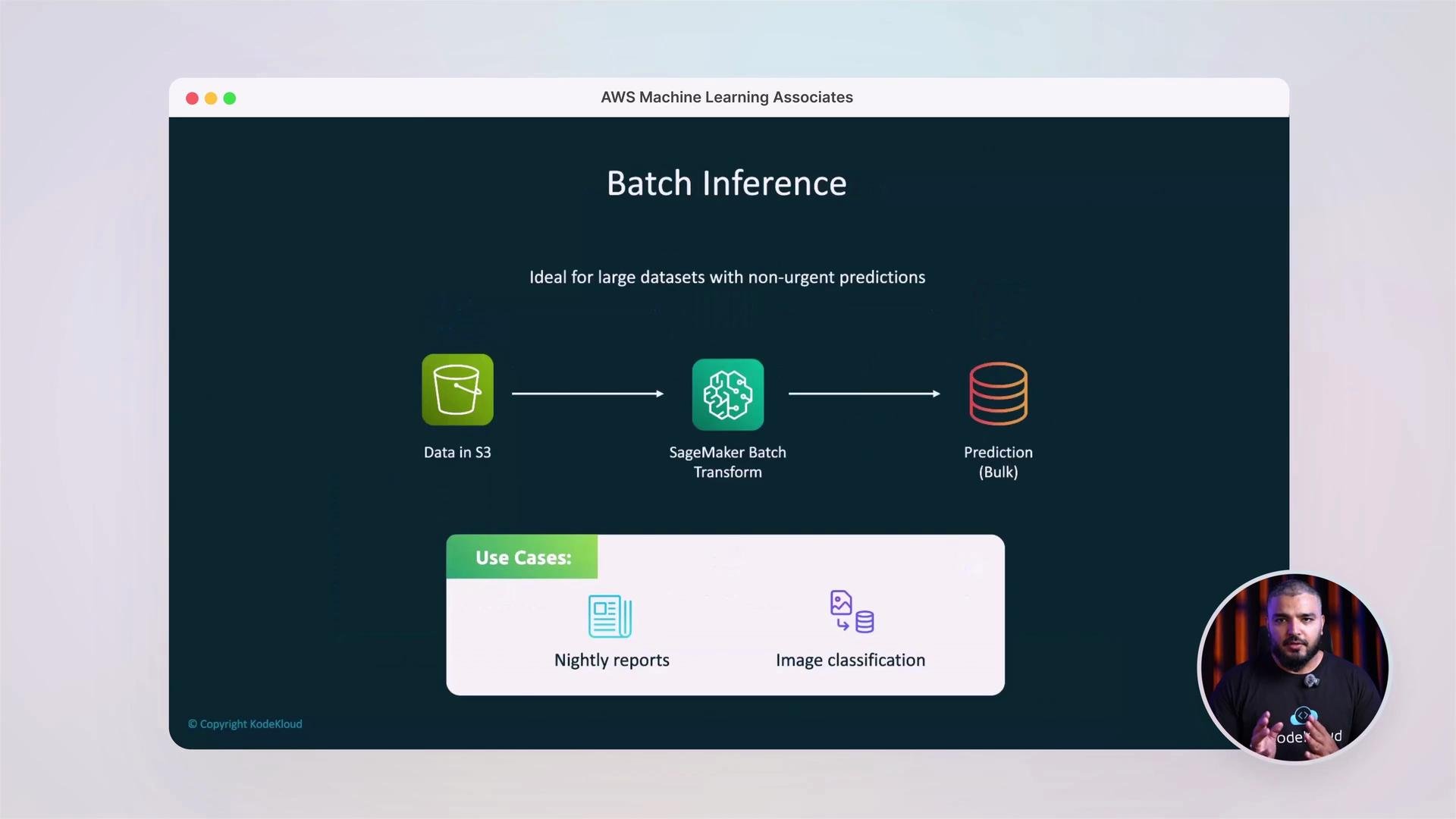
The image is a diagram explaining AWS Batch Inference using SageMaker, illustrating a process involving data in S3, SageMaker Batch Transform, and bulk predictions. It includes use cases like nightly reports and image classification.
  • Domain 4 — Monitoring, maintenance, and security: model and data monitoring (for example, using SageMaker Model Monitor to detect data and model drift), bias detection and explainability (SageMaker Clarify), plus security and governance for ML systems.
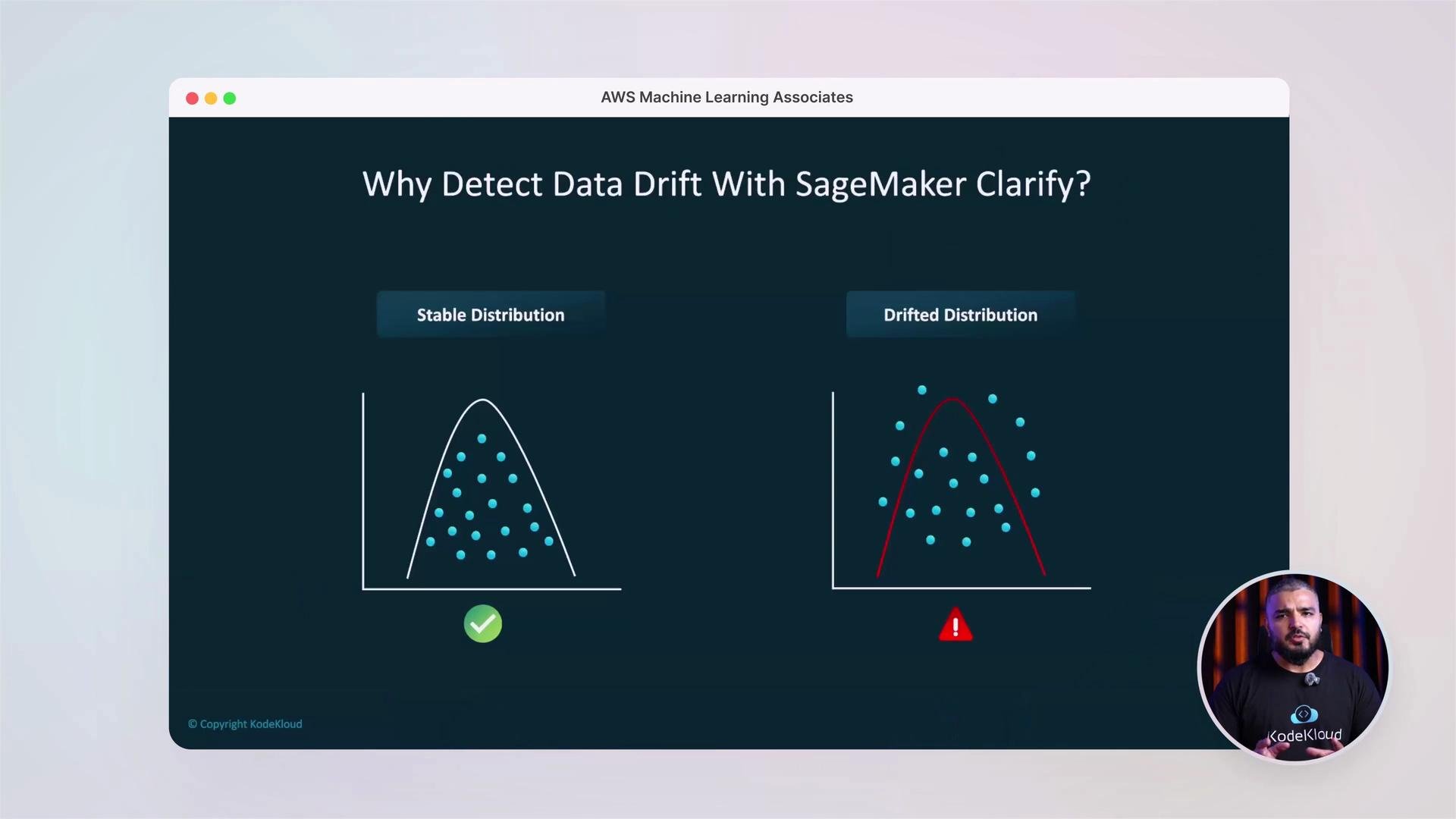
The image illustrates the concepts of stable and drifted data distributions with graphs, alongside text promoting SageMaker Clarify for detecting data drift.
For a concise overview, here’s a quick reference table of the certification domains and example AWS services: Key learning outcomes from this course:
  • Build reliable data pipelines for ML on AWS.
  • Train, tune, and validate models using SageMaker tooling.
  • Deploy models using real-time, batch, and serverless patterns.
  • Monitor model health and data drift; apply explainability and bias detection.
  • Apply security best practices to protect ML workflows and artifacts.
Recommended resources and references:
Hands-on practice is essential. The exam tests practical knowledge of AWS services and design patterns — complete the labs and practice exams included in the course to prepare effectively.
This course is community-oriented: you’ll have opportunities to ask questions, collaborate with peers, and solve real-world challenges. Machine learning is shaping the future — if your goal is to build and operate ML systems at scale on AWS, this course will set you on the right path.

Watch Video