

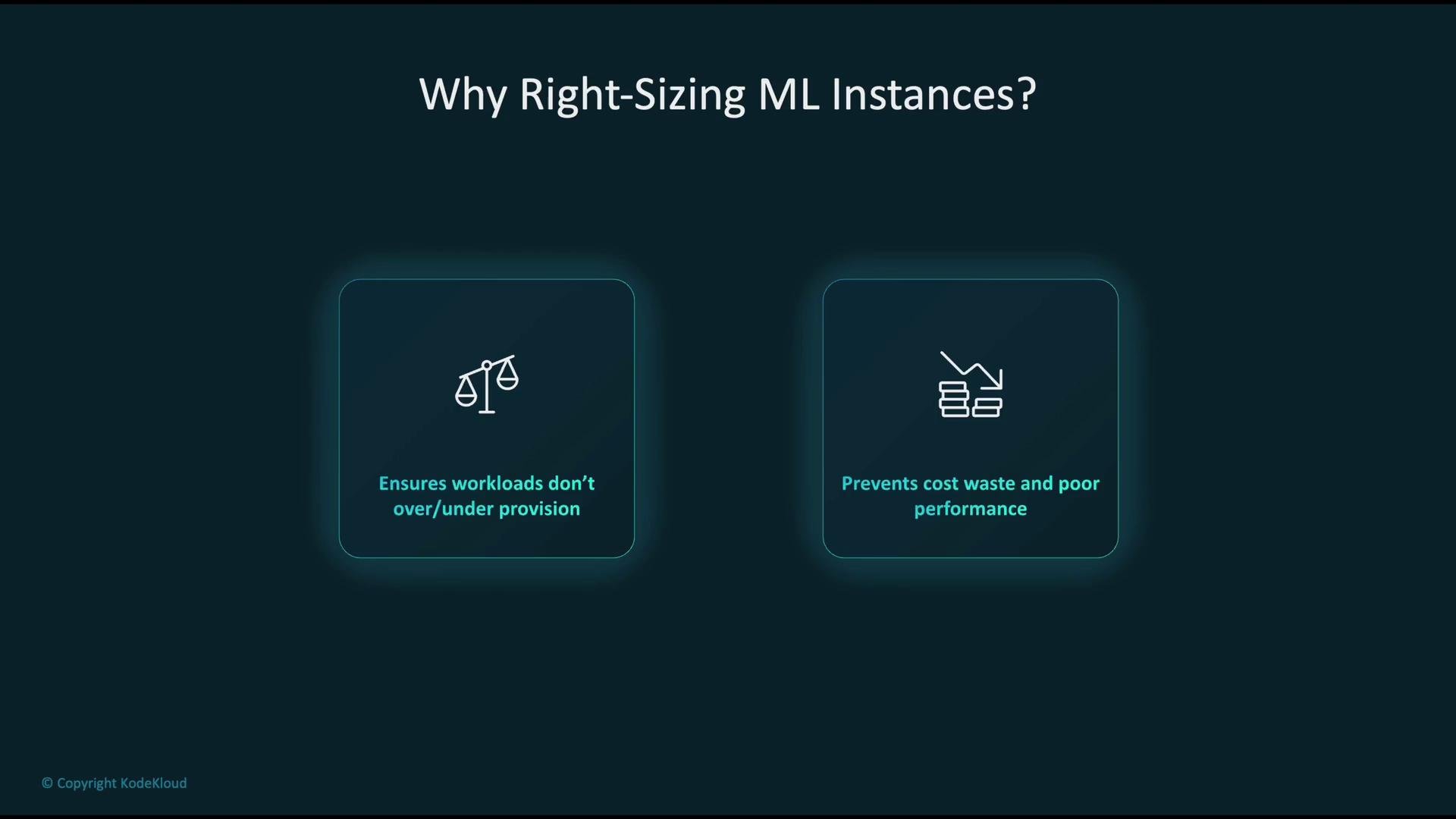
- Ensure workloads receive the appropriate CPU, memory, GPU, and network bandwidth.
- Avoid overspending on oversized instances.
- Prevent performance degradation caused by under-provisioned instances.
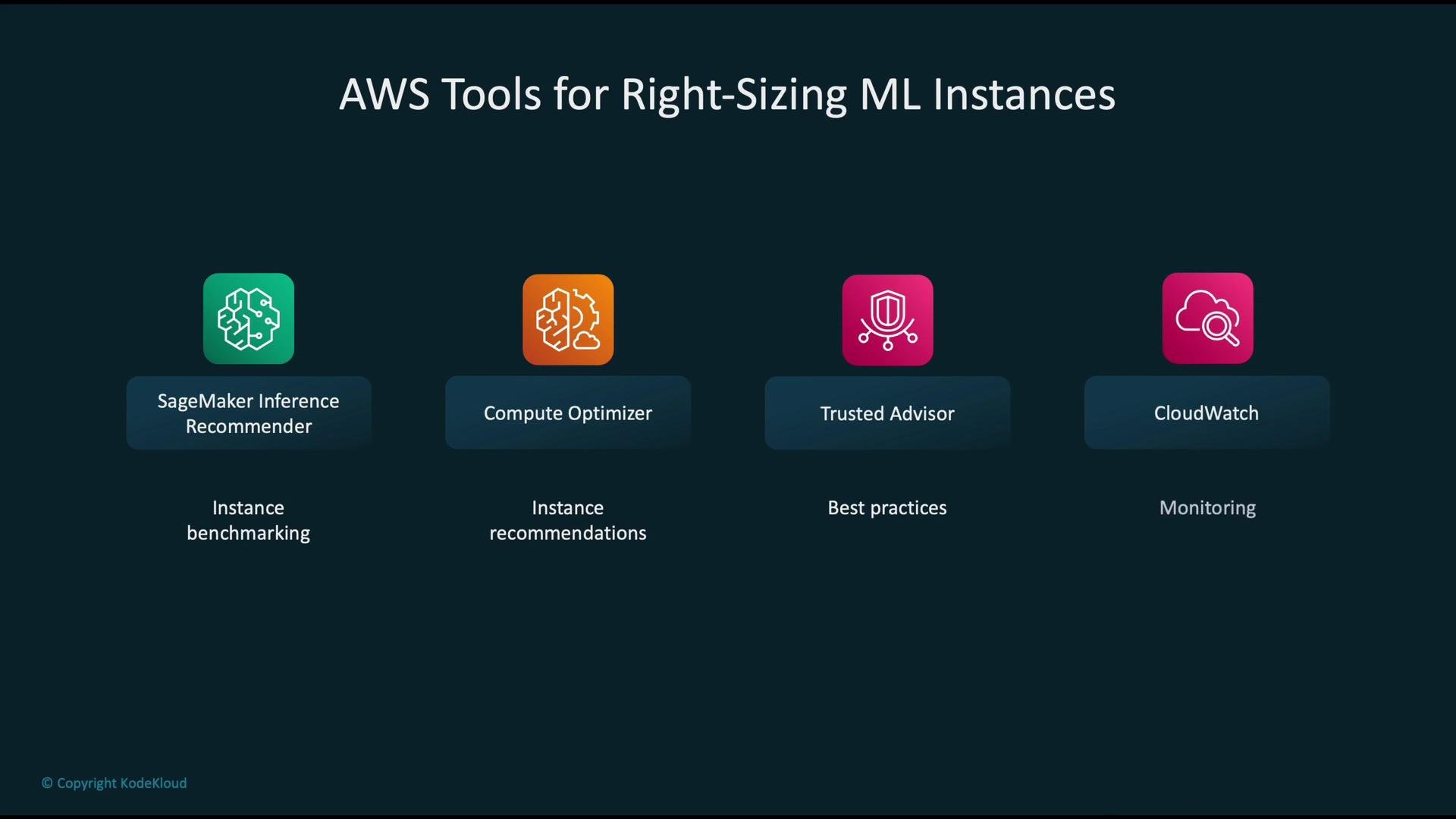
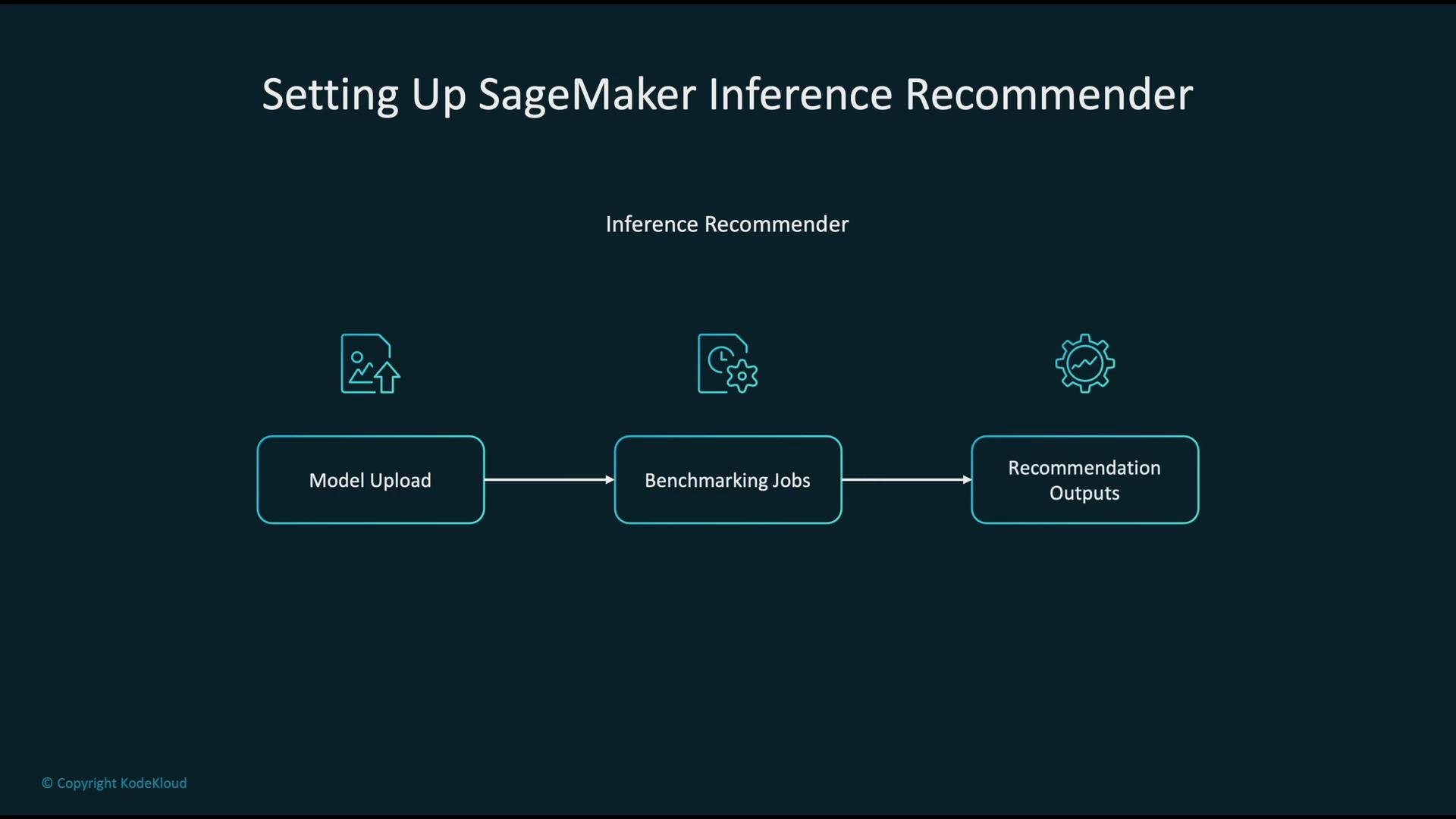
- Upload or reference your trained model or model package.
- Run benchmarking jobs across chosen candidate instance types.
- Review recommendation outputs (latency percentiles, throughput, and cost estimates) to decide endpoint configuration.
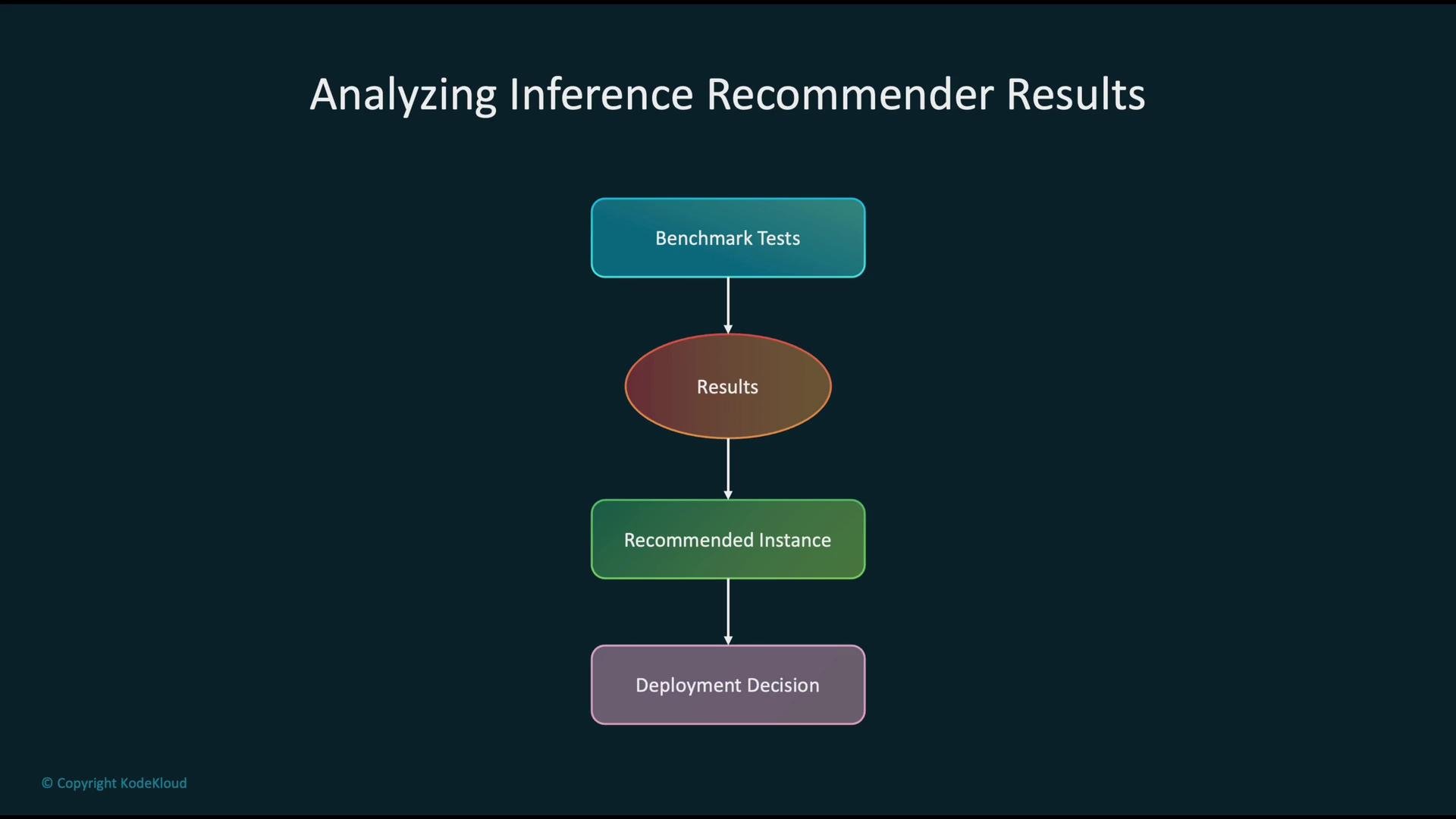
How to interpret recommendation outputs
- Compare latency percentiles (P50/P95/P99), throughput, and error rates for each candidate instance.
- Factor in cost estimates (cost per inference or hourly cost) to calculate cost/performance trade-offs.
- Select the instance that meets your SLA (latency/throughput) at the lowest acceptable cost and with room for traffic variability.
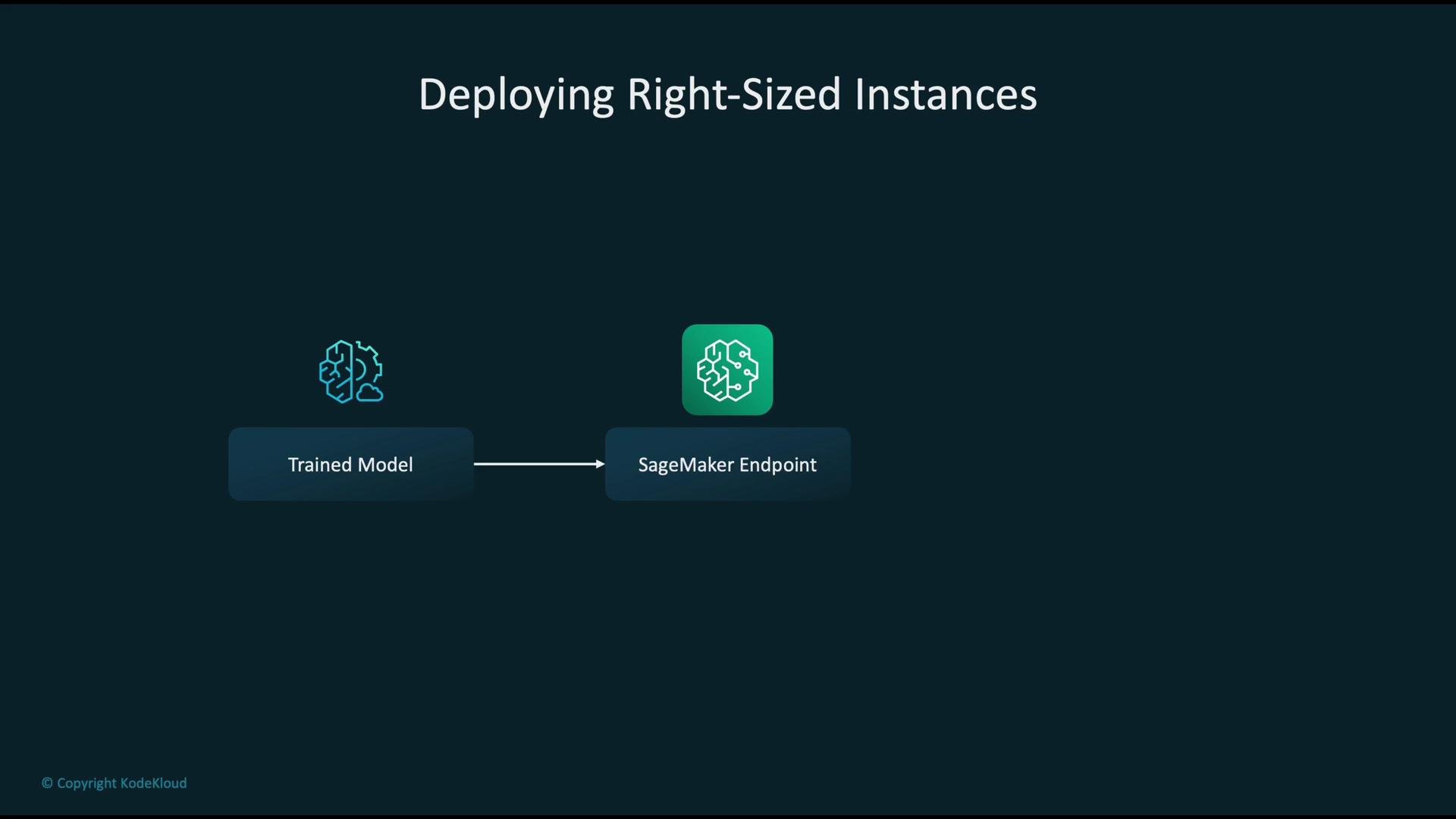
- Start from the trained model artifact or model package.
- Create a SageMaker Model and an Endpoint Configuration that uses the recommended instance type(s).
- Deploy to a SageMaker Endpoint with the selected instance type and scaling policy (single instance, multi-instance, or autoscaling).
- Confirm model container compatibility with selected instance (CPU vs. GPU).
- Configure instance count and autoscaling based on peak throughput and cost targets.
- Assign separate IAM roles for deployment and monitoring.
- Collect runtime metrics from endpoints: latency percentiles, invocation count, CPU/memory/GPU utilization, and error rates.
- Publish these metrics to CloudWatch for dashboards and alarms.
- Create CloudWatch Alarms to notify on SLA violations (e.g., latency spikes or growing error rates) so you can react and re-evaluate sizing or scaling.
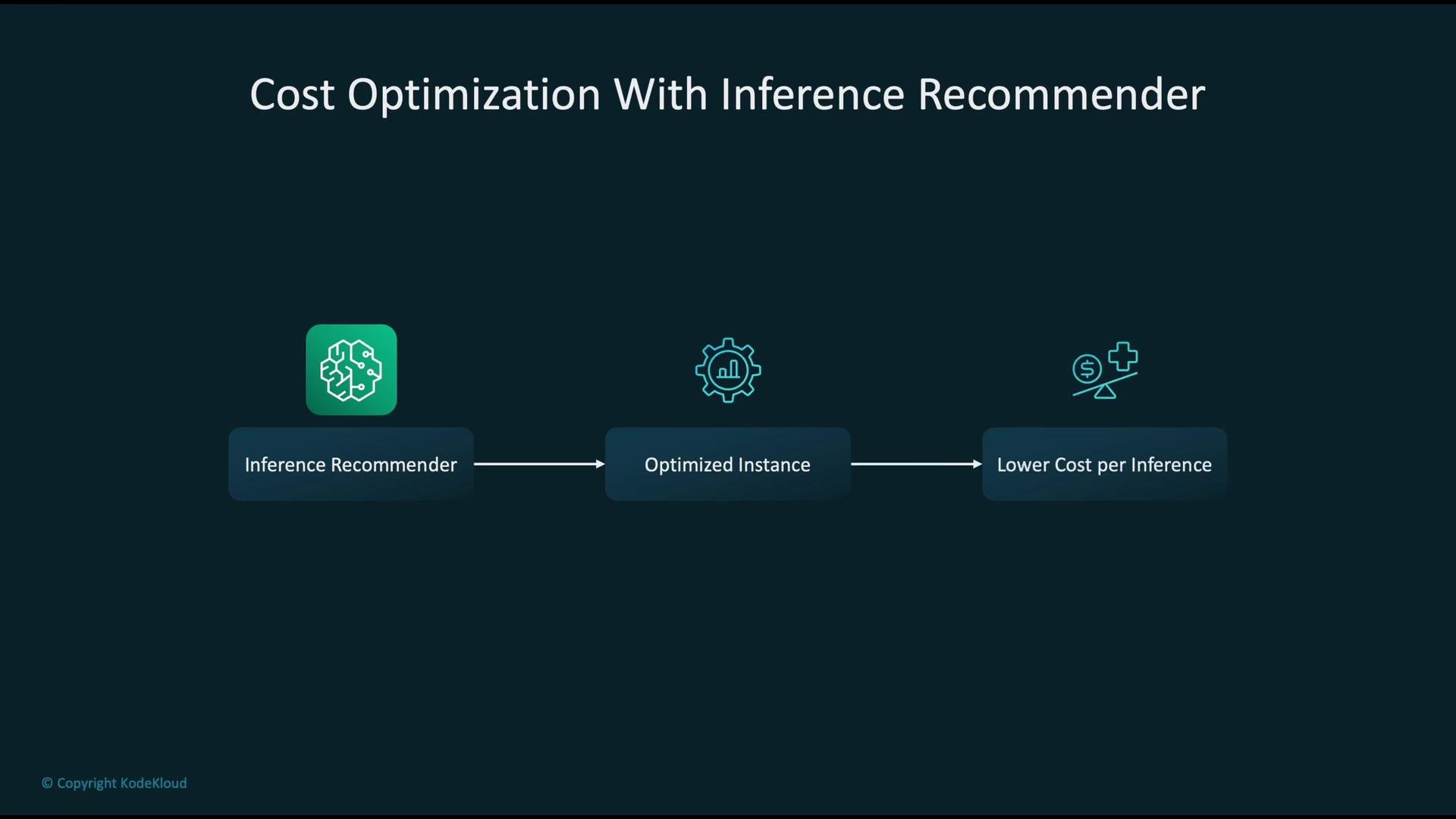
- Inference Recommender provides performance vs. cost comparisons for candidate instances.
- Tune concurrency, batch size, and replica counts to reduce cost per inference while meeting performance targets.
- Combine results with Cost Explorer and Compute Optimizer for account-level cost visibility and longer-term optimization.
- Enforce least-privilege IAM policies for users and service roles interacting with SageMaker and Inference Recommender.
- Use resource-level permissions and separate roles for benchmarking, deployment, and monitoring.
- Audit actions and access via CloudTrail.
- Ensure encryption in transit and at rest follows organizational data governance standards.
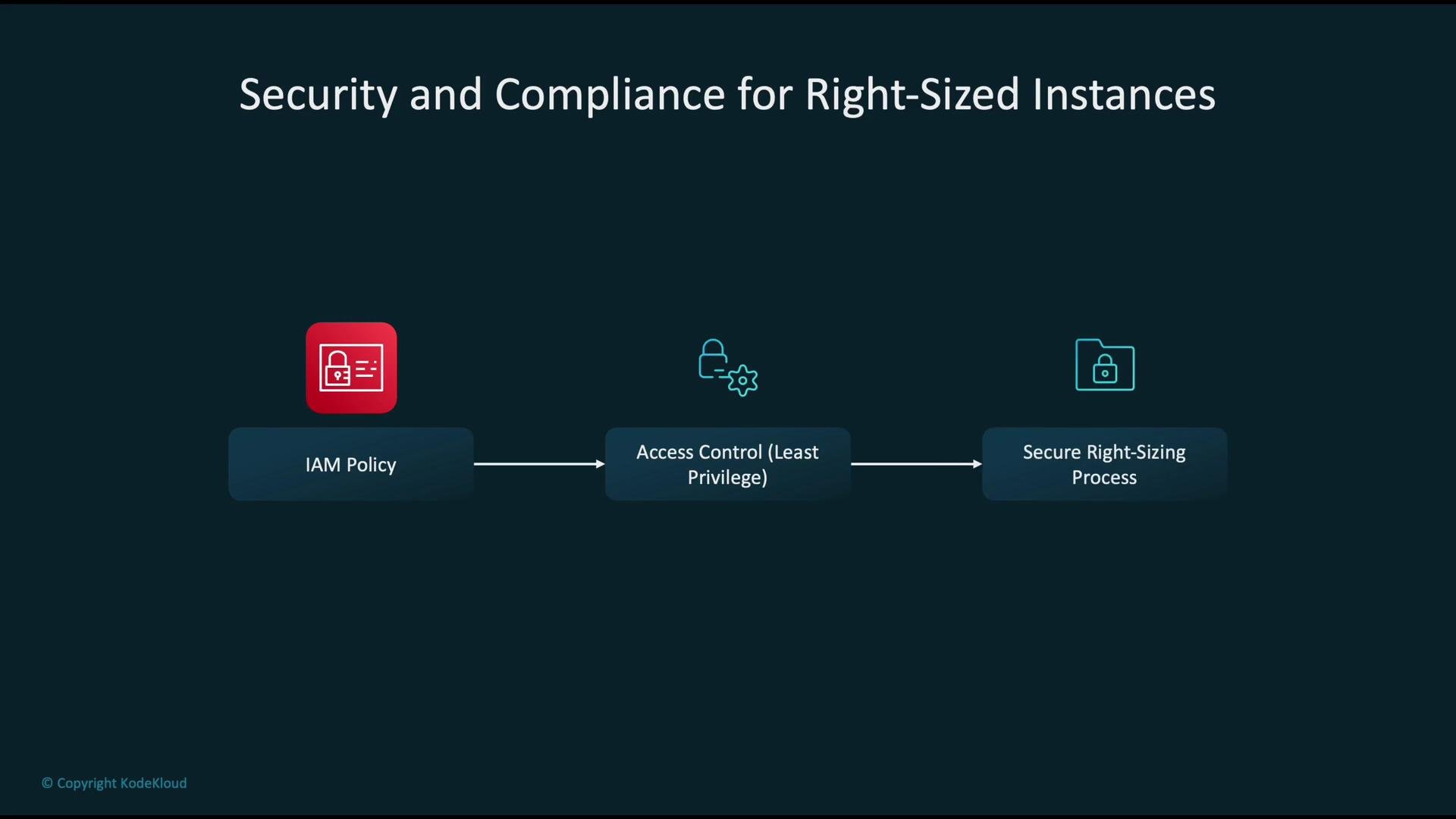
Always apply the principle of least privilege to the IAM roles used for creating recommendation jobs and deploying endpoints. Separate duties between benchmarking, deployment, and monitoring roles to reduce risk and simplify auditing.
- Don’t default to the largest instance class “just in case” — oversized instances can dramatically increase cost with marginal benefit.
- Don’t ignore Inference Recommender outputs; use them as data-driven guidance rather than opinion.
- Don’t skip post-deployment monitoring — without CloudWatch dashboards and alarms you can miss performance regressions or traffic shifts.

Beware of one-time sizing decisions. Workloads change — schedule regular re-evaluation of instance sizing and automate periodic checks with Inference Recommender and Compute Optimizer to detect drift.
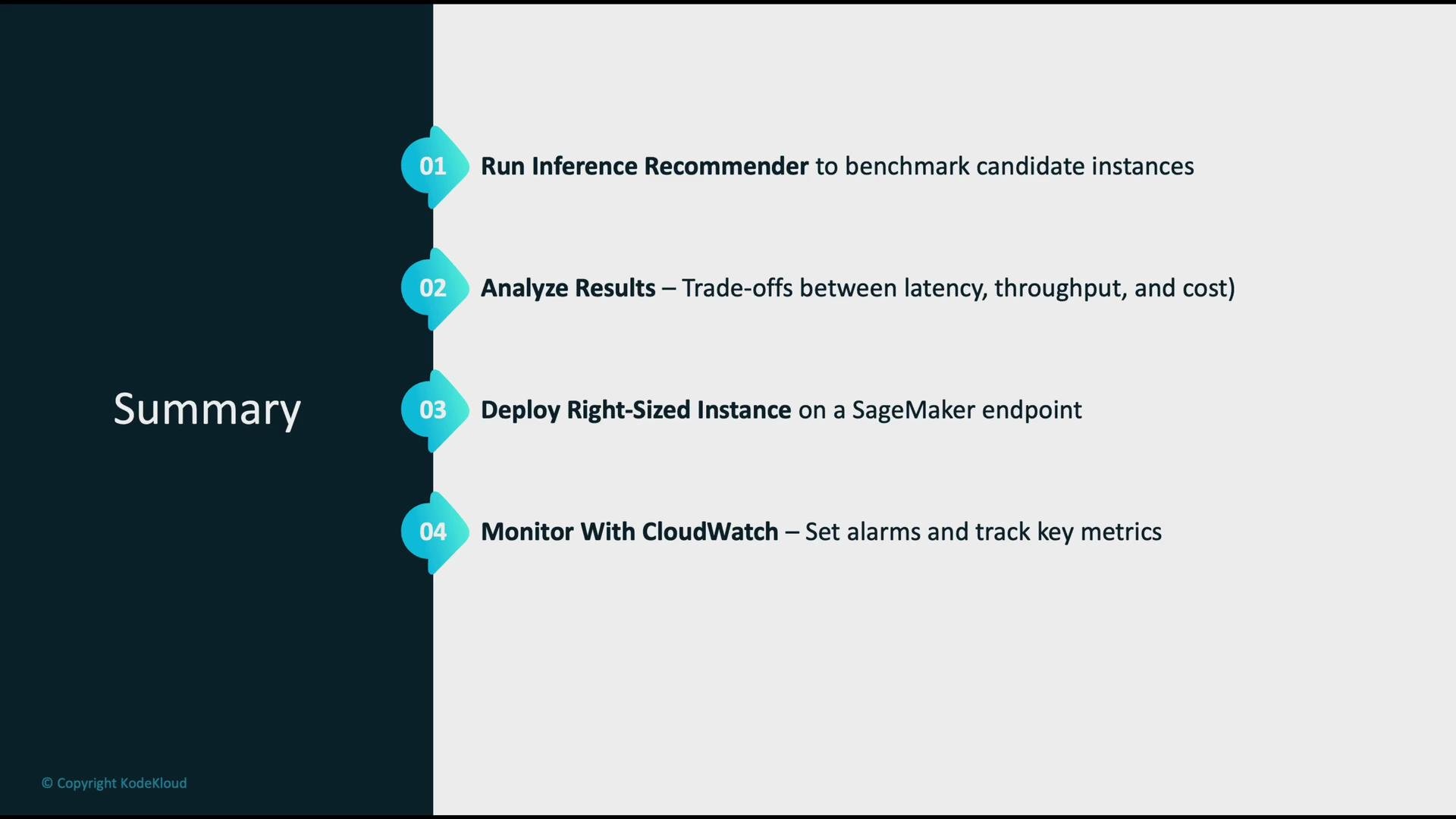
- Run SageMaker Inference Recommender to benchmark candidate instance types.
- Analyze trade-offs between latency (P95/P99), throughput, error rates, and cost from the recommendation outputs.
- Deploy the right-sized instance(s) to a SageMaker endpoint with appropriate scaling (manual or autoscaling).
- Monitor endpoint metrics in CloudWatch, and configure alarms for SLA breaches.
- Secure the workflow using least-privilege IAM roles and audit with CloudTrail.
- SageMaker Inference Recommender Documentation
- Amazon EC2 Instance Types
- CloudWatch Monitoring
- Cost Explorer Overview
- Compute Optimizer Guide
- AWS CloudTrail User Guide