In this lesson, you’ll learn how to construct and understand the endpoints required to access various services within an Azure storage account. Each storage service follows a consistent endpoint URL format, making it easy to integrate and manage your storage resources. Every endpoint is built using the following structure:
Here’s what each element represents:
  • Protocol: Either HTTP or HTTPS.
  • Storage Account Name: The unique name you have chosen for your account.
  • Service: Represents the Azure service you are accessing (e.g., blob, queue, file, or table).
  • Domain: All endpoints end with core.windows.net, which is the default domain for Azure storage.
For example, if your storage account is named KodeKloud, the corresponding endpoints would be:
  • Blob Service: kodekloud.blob.core.windows.net
  • Queue Service: kodekloud.queue.core.windows.net
  • File Service: kodekloud.file.core.windows.net
  • Table Service: kodekloud.table.core.windows.net
If your preferred storage account name is already taken, consider modifying it by appending additional characters or using a custom domain. This approach can also reinforce your branding; for example, you might configure blobs.codecloud.com to point to codecloud.blob.core.windows.net.
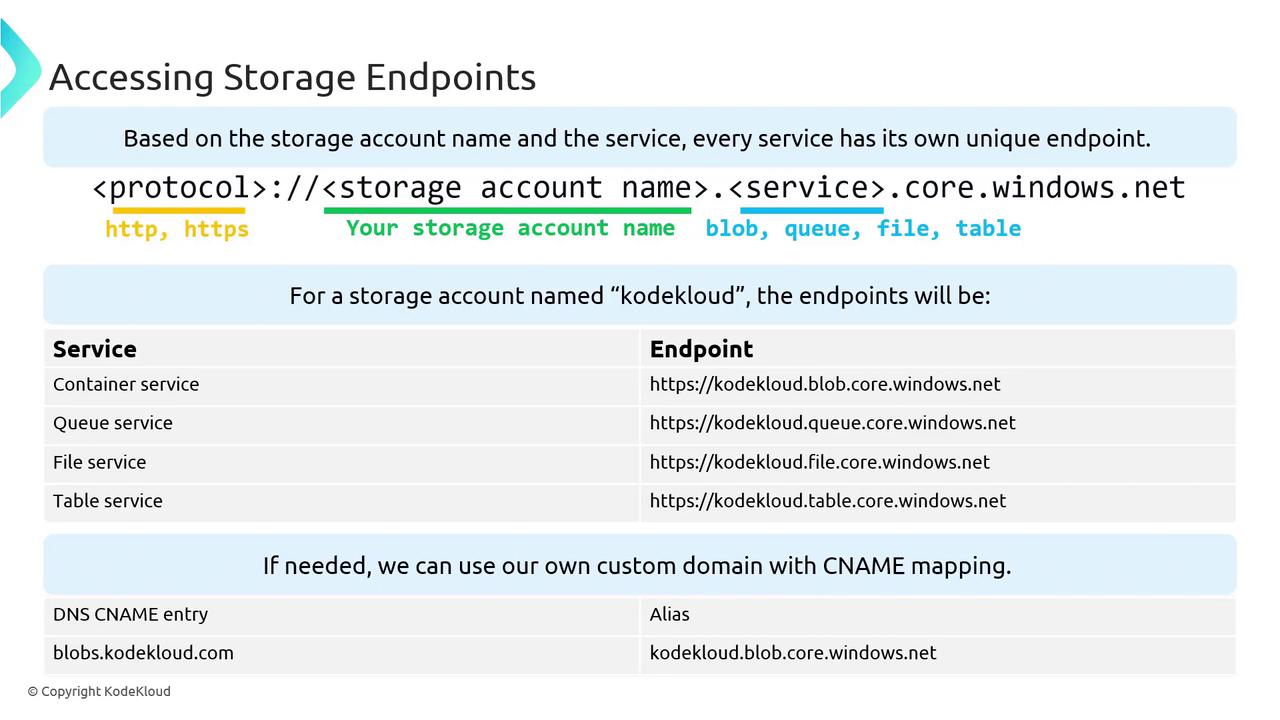
The image provides information on accessing storage endpoints for a storage account, showing the format for endpoint URLs and examples for different services like container, queue, file, and table. It also mentions using a custom domain with CNAME mapping.
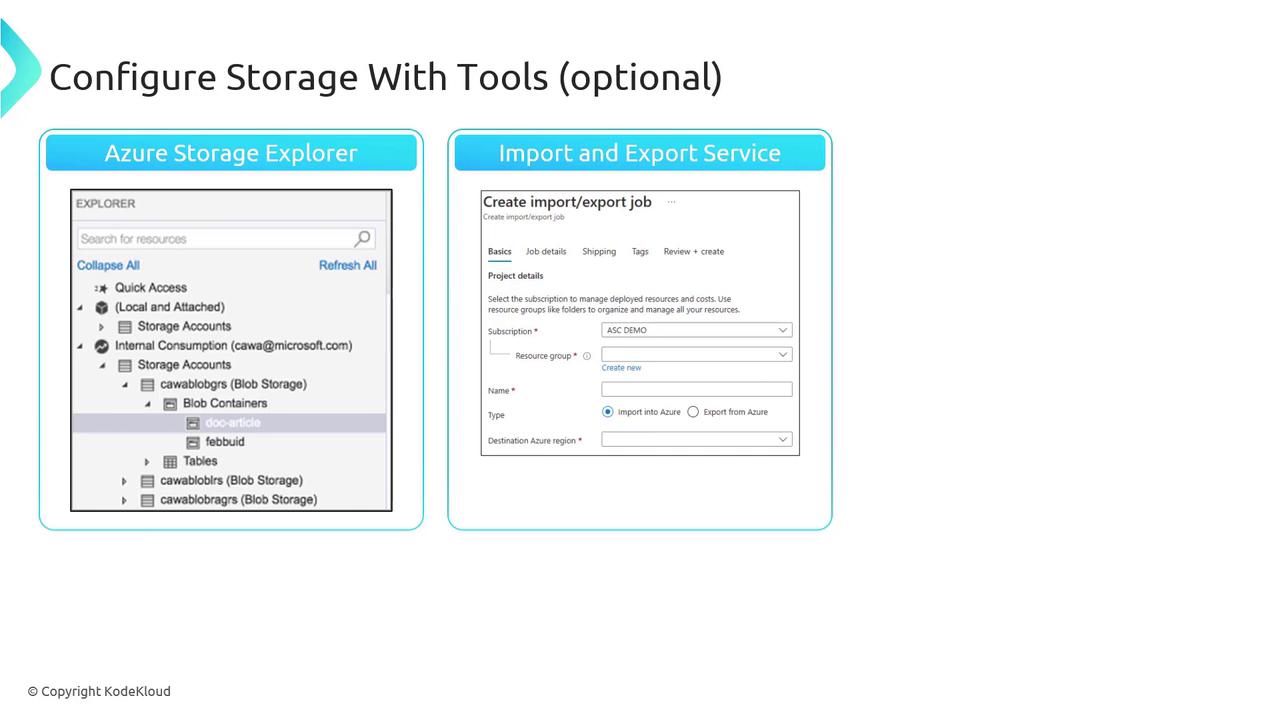
In addition to direct URL access, several tools help manage your Azure storage resources effectively:

Azure Storage Management Tools

The image shows a configuration guide for storage tools, featuring Azure Storage Explorer and an Import and Export Service interface.
For example, the following command uses AZCopy to transfer data:
This tool is especially useful for automating data workflows and migrating data between different cloud providers. When managing your storage account via the Azure Portal, you can easily capture the endpoints for blob, file, queue, table services, and even static website hosting. Additionally, services like Data Lake Store—designed for analytics—offer their own respective endpoints. Up next, we will explore how to configure Azure Blob Storage, building on the concepts discussed in this lesson.
For further reading on Azure storage, visit the Azure Storage Documentation and explore Kubernetes Basics for related containerized solutions.

Watch Video