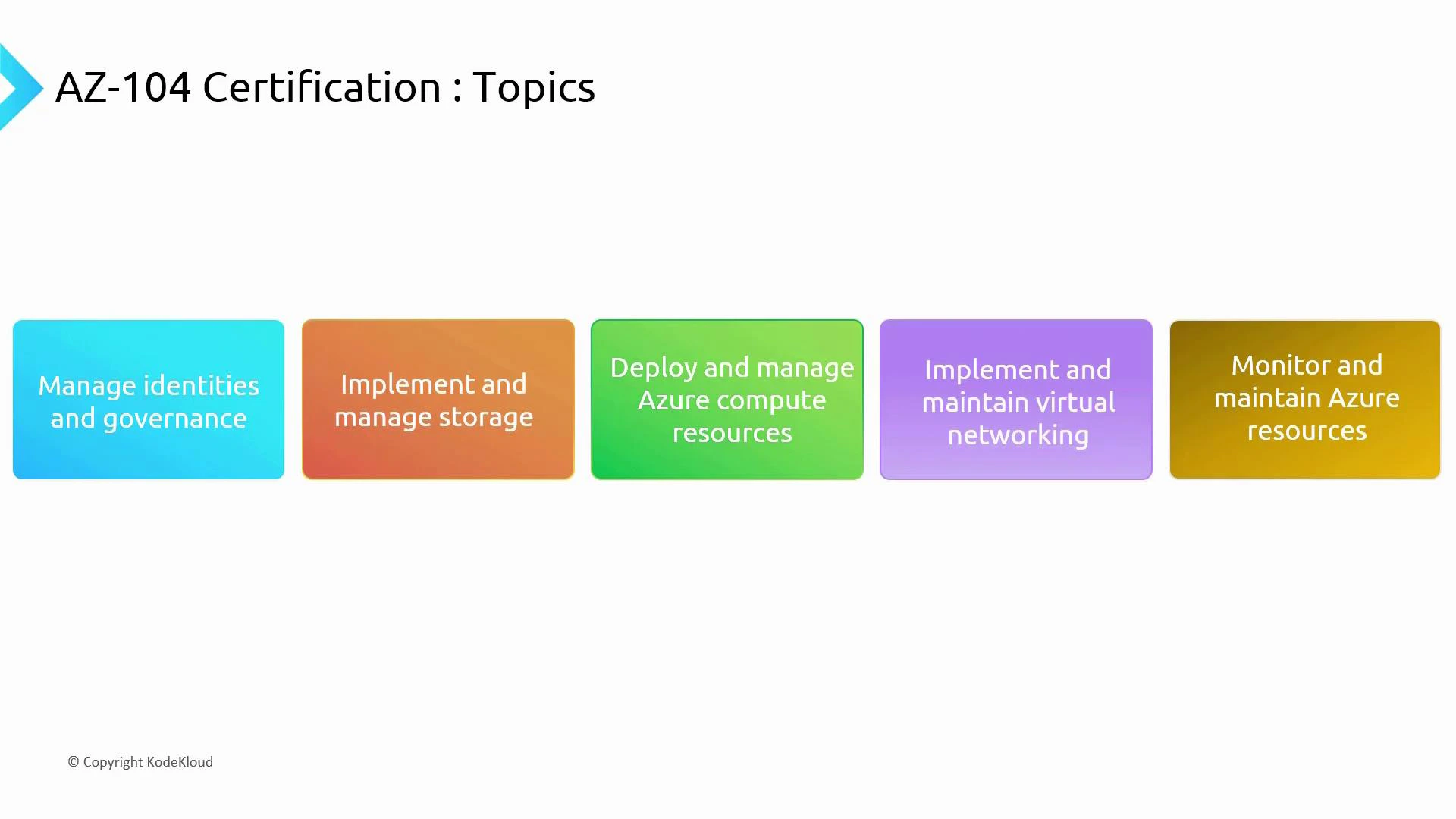
This lesson summarizes the AZ-104: Microsoft Azure Administrator exam objectives and shows the core topics to study. The AZ-104 tests skills required to manage Azure identities, governance, storage, compute, networking, and monitoring. There are five main domains in the exam:
  • Manage identities and governance
  • Implement and manage storage
  • Deploy and manage Azure compute resources
  • Implement and maintain virtual networking
  • Monitor and maintain Azure resources
Below is a quick overview followed by a deeper look at each domain and recommended topics to study.
A presentation slide titled "AZ-104 Certification: Topics." It shows five colored boxes listing exam domains: manage identities and governance; implement and manage storage; deploy and manage Azure compute resources; implement and maintain virtual networking; and monitor and maintain Azure resources.
Summary table of domains and focus areas
DomainExam weightCore topics to study
Manage identities and governance20–25%Microsoft Entra ID (Azure AD), RBAC, policies, subscriptions, management groups, ARM templates, CLI/PowerShell resource management
Implement and manage storage15–20%Storage account types, replication, access control, blob/files/queues/tables, lifecycle management
Deploy and manage compute resources20–25%Azure VMs (provisioning, sizing, extensions), PaaS compute (App Service, Container Instances, Container Apps), basic container concepts
Implement and maintain virtual networking15–20%vNets, subnets, NSGs, peering, VPN Gateway, load balancers, UDRs, routing
Monitor and maintain resources10–15%Azure Backup, Site Recovery, Azure Monitor, Log Analytics, diagnostic settings, alerts and metrics
Manage Azure Identities and Governance (20–25%) This domain tests identity management, governance, and resource administration. Key study items:
  • Microsoft Entra ID (formerly Azure AD): users, groups, service principals, managed identities.
  • Authentication and conditional access basics.
  • Role-Based Access Control (RBAC): built-in & custom roles, assignments and effective permissions.
  • Governance constructs: management groups, subscriptions, resource groups, Azure Policy (definition/assignment).
  • Resource deployment and automation: ARM templates, Bicep (if applicable), Azure CLI, and Azure PowerShell for provisioning and role assignments.
  • Troubleshooting identity and access issues.
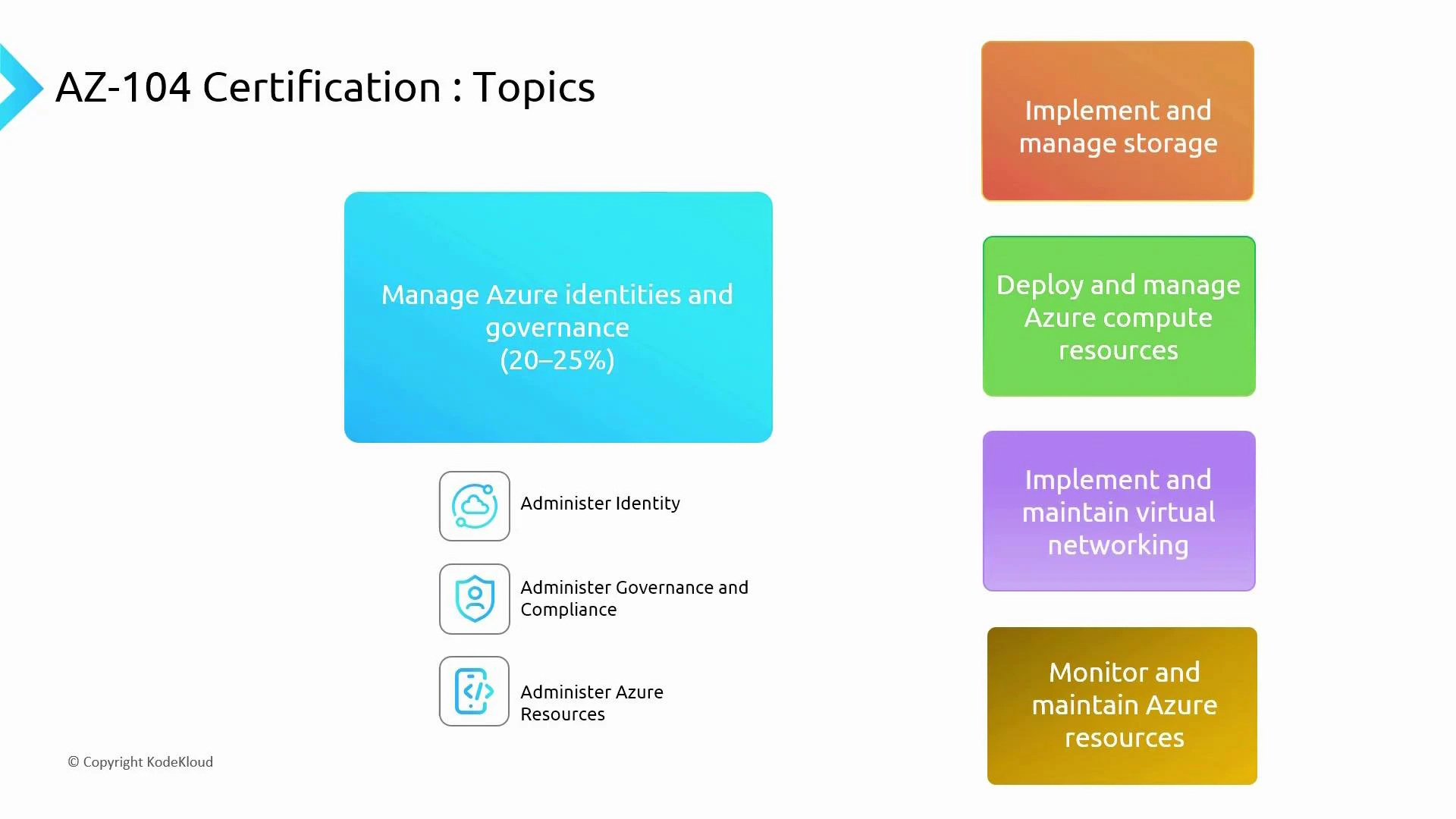
A slide titled "AZ-104 Certification: Topics" highlighting "Manage Azure identities and governance (20–25%)" with subitems (Administer Identity, Administer Governance and Compliance, Administer Azure Resources). To the right are colored boxes listing other domains: Implement and manage storage; Deploy and manage Azure compute resources; Implement and maintain virtual networking; Monitor and maintain Azure resources.
Implement and Manage Storage (15–20%) Focus on managing Azure Storage services:
  • Storage account types and tiers (Standard/Premium, hot/cool/archive).
  • Data replication options (LRS, GRS, RA-GRS, ZRS) and choosing based on availability and recovery needs.
  • Access control: shared keys, SAS tokens, Azure AD integration.
  • Data management: lifecycle policies, soft delete, immutable blobs, file shares.
Deploy and Manage Azure Compute Resources (20–25%) Understand compute options and administration:
  • Virtual Machines: deployment, sizes, extensions (e.g., custom script, VM Agent), managed disks, availability sets/zones, backups and updates.
  • PaaS compute: App Service plans and app deployment, Azure Container Instances, Container Apps and how they differ from AKS.
  • Containers and orchestration: basic container concepts and when to choose PaaS vs container services.
Note: Azure Kubernetes Service (AKS) is a deeper, specialized topic. It is useful to understand at a high level but is not a primary focus of the AZ-104 objectives. For a dedicated AKS course, see the linked resource below. Implement and Maintain Virtual Networking (15–20%) This domain covers network design, connectivity, and traffic management:
  • Virtual networks, subnets, and network security groups (NSGs).
  • Private connectivity: Virtual Network Peering and VPN Gateway for inter-site connectivity.
  • Traffic management: Azure Load Balancer, Application Gateway (high level), route tables, and user-defined routes (UDRs).
  • Network troubleshooting basics and service endpoints/private endpoints.
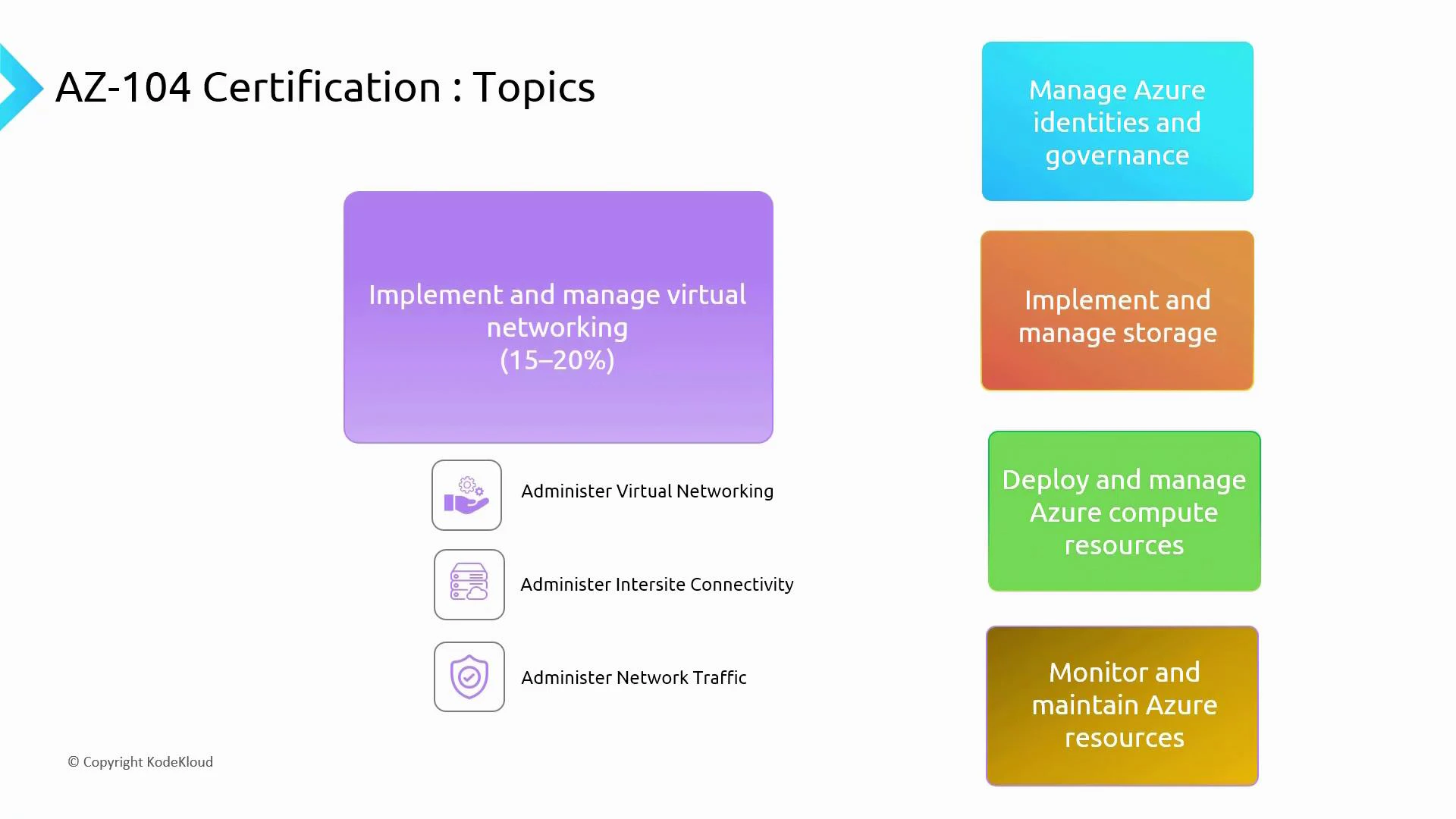
A slide titled "AZ-104 Certification: Topics" highlighting the central topic "Implement and manage virtual networking (15–20%)" with subitems for administering virtual networking, intersite connectivity, and network traffic. Four colored boxes on the right list other domains: manage Azure identities and governance, implement and manage storage, deploy/manage Azure compute resources, and monitor/maintain Azure resources.
Monitor and Maintain Azure Resources (10–15%) This domain focuses on monitoring, backup, and recovery:
  • Azure Backup: backup policies, recovery points, and restore operations.
  • Azure Site Recovery (ASR) basics for disaster recovery scenarios.
  • Azure Monitor: collecting metrics, logs, and configuring diagnostic settings.
  • Log Analytics and Kusto Query Language (KQL) basics for querying logs.
  • Setting up alerts (metric and log alerts) and automated actions.
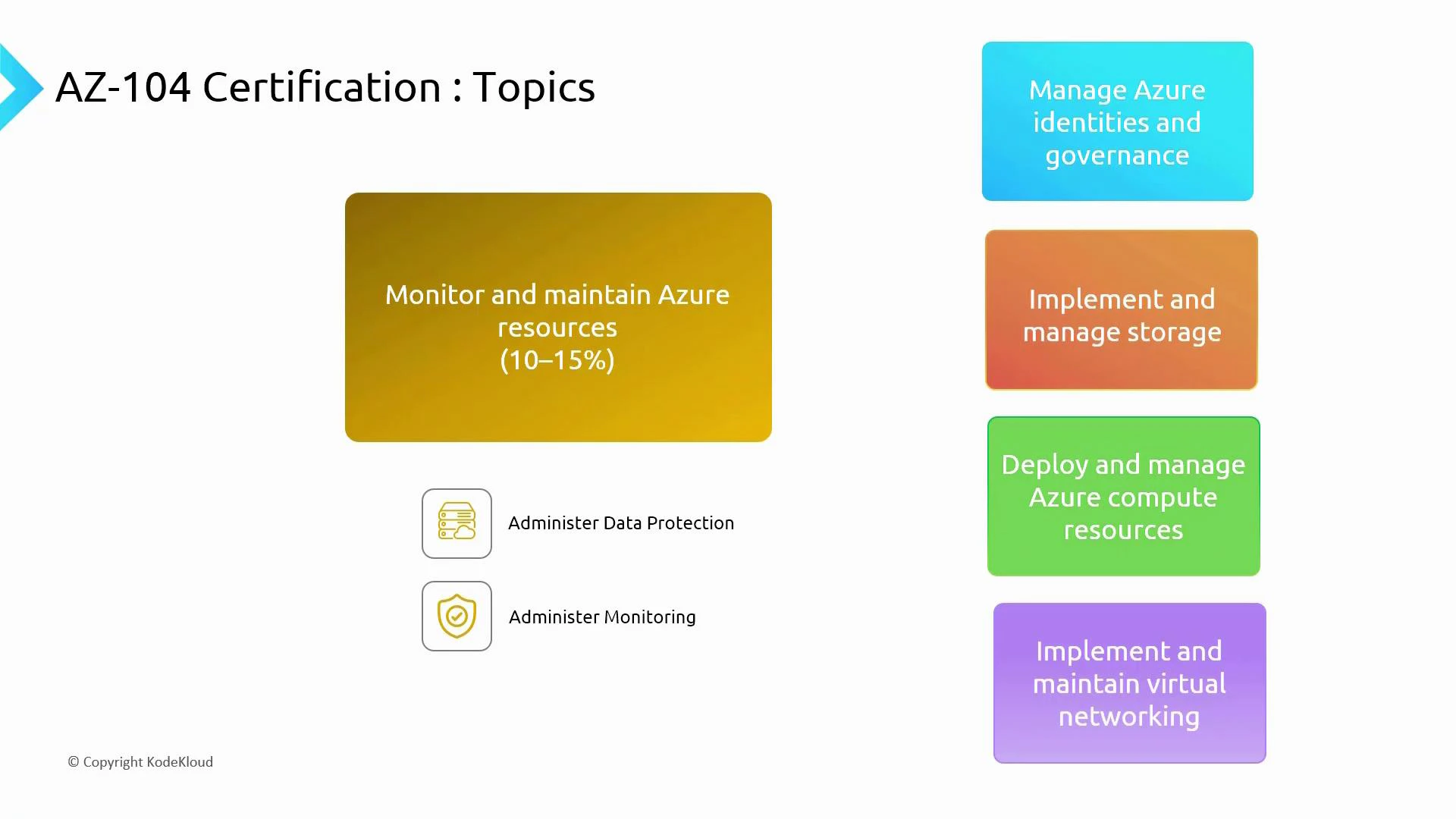
A presentation slide titled "AZ-104 Certification: Topics" highlighting "Monitor and maintain Azure resources (10–15%)" with subitems "Administer Data Protection" and "Administer Monitoring." To the right are four colored boxes listing other domains: Manage Azure identities and governance; Implement and manage storage; Deploy and manage Azure compute resources; and Implement and maintain virtual networking.
Service name changes and official resources
  • Microsoft Entra ID is the new name for Azure AD. This is a rebranding; functionality remains consistent, though some product pages and learning content may reference the new name.
  • Always verify current exam objectives and platform terminology on official Microsoft pages.
For up-to-date exam objectives and guided learning paths, rely on official sources such as Microsoft Learn and the Azure documentation. Combine hands-on practice (deploying VMs, setting up RBAC, configuring networks, and using Azure Monitor) with study modules to reinforce practical skills.
Links and references

Watch Video