Helm is a package manager and release management tool designed for Kubernetes applications. While Kubernetes excels at orchestrating complex infrastructures, managing a multitude of interdependent YAML files for a single application can quickly become overwhelming. Consider a basic WordPress deployment, which might involve multiple Kubernetes objects such as:
  • Deployment: Runs Pods for services like MySQL or web servers.
  • Persistent Volume (PV) and Persistent Volume Claim (PVC): Provides storage for databases.
  • Service: Exposes the web server to the Internet.
  • Secret: Stores sensitive data like admin passwords.
  • Job: Handles periodic tasks like backups.
Each of these resources requires its own YAML configuration file and separate kubectl apply commands. For instance, a simplified collection of YAML definitions may look like this:
Managing these files individually can be tedious, especially when default configurations such as storage size need to be updated or changed. If you download YAML files from an external source, modifying each file to fit your needs can be labor-intensive. Furthermore, as your application evolves, you might have to update numerous configurations repeatedly.
With Helm, you can treat your application as a single package rather than a collection of disparate Kubernetes objects.

The Cumbersome Approach: Multiple YAML Files

Imagine updating your application configuration over time. For example, you might modify several YAML files and then apply them individually:
  1. Update the Secret:
  2. Update the Deployment:
  3. Update the Service:
  4. Update the PersistentVolumeClaim:
  5. Update the PersistentVolume:
Later, when it comes time to upgrade or delete parts of the application, the process involves updating or removing each object—a process that can be both time-consuming and error-prone.

Introducing Helm

Helm transforms the management of Kubernetes applications by packaging all the necessary objects—Persistent Volumes, Deployments, Secrets, Services, and more—into a single, cohesive unit. This means you no longer have to manage individual YAML files for each component.
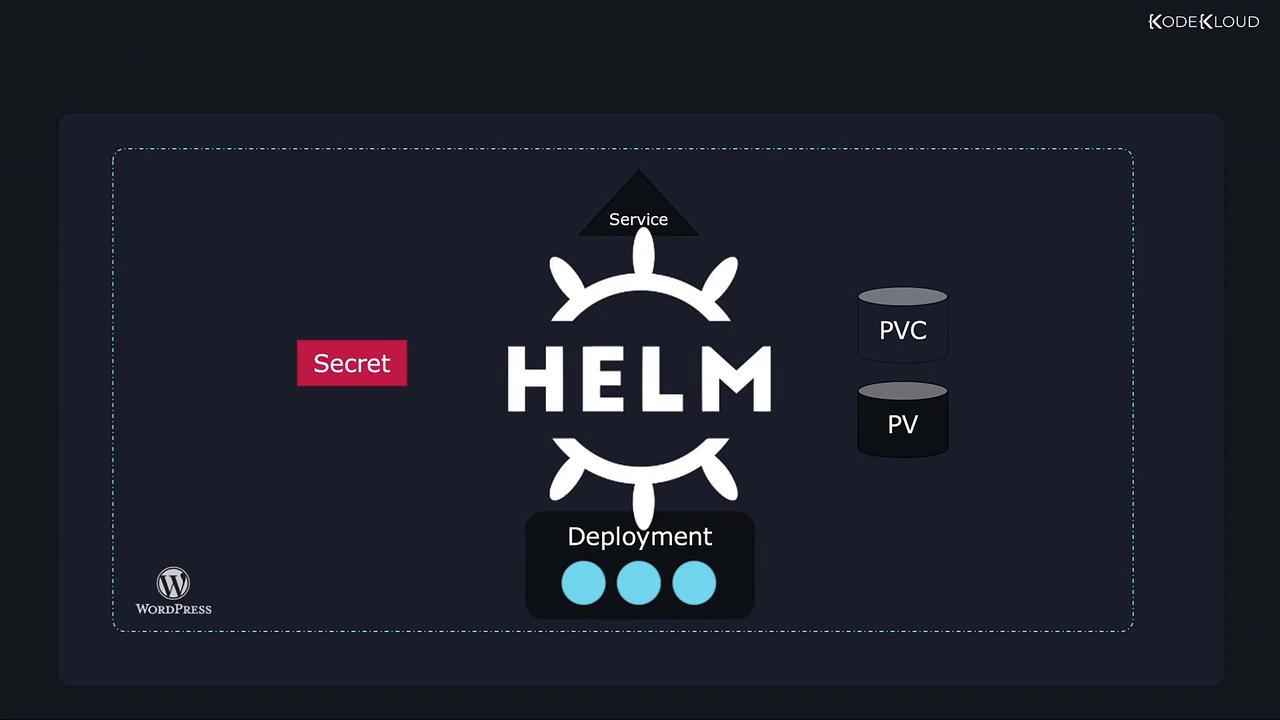
The image is a diagram illustrating a Helm deployment setup, featuring components like Service, Secret, PVC, PV, and Deployment, with a WordPress logo.
With Helm, you work with the entire application as a single package. Installing your WordPress app, for example, becomes as simple as executing:

Key Benefits of Helm

  • Centralized Configuration: Customize your application using a single values.yaml file. This file can store essential settings such as: An example values.yaml file might look like this:
  • Streamlined Upgrades and Rollbacks: Helm allows you to:
    • Upgrade your application effortlessly with:
    • Roll back to a previous release quickly using:
  • Simplified Uninstallation: Remove all associated resources with a single command:
Helm abstracts away the complexity of managing individual Kubernetes objects, enabling you to handle your application deployments as cohesive units. This can drastically reduce manual effort and minimize potential errors during upgrades or deletions.

In Summary

Helm acts as both a package manager and a release manager for Kubernetes. It provides an elegant solution for bundling together the various objects that make up complex applications. By doing so, Helm drastically simplifies the processes of installation, configuration, upgrade, rollback, and deletion. This introduction to Helm sets the stage for more advanced topics that will be explored in upcoming lessons. Stay tuned as we delve deeper into Helm’s features and commands, and learn how to harness its full power to manage your Kubernetes applications efficiently. For further information, check out the Helm documentation and keep exploring the world of Kubernetes package management.

Watch Video