

Scenario
- A cluster contains many nodes and pods from multiple teams.
- We have three color-specific nodes and three pods: blue, red, and green.
- Goal: schedule the blue pod on the blue node, the red pod on the red node, and the green pod on the green node.
- Additional requirement: prevent other teams’ pods from being scheduled onto our three color-specific nodes, and prevent our pods from being scheduled onto other (non-colored) nodes.
First approach — Taints and Tolerations
Taints are applied to nodes to repel pods that do not explicitly tolerate those taints. Tolerations are added to pods to allow them to be scheduled onto tainted nodes. Example: taint the blue node so it repels non-tolerant pods:- The blue pod can be scheduled on the blue node because it tolerates the blue taint.
- Tolerations only allow placement on tainted nodes; they do not force placement onto specific nodes.
- A pod with the toleration may still be scheduled onto any other node that meets scheduling constraints (including untainted nodes).
- Therefore, taints + tolerations alone do not guarantee that pods will end up only on the intended labeled nodes.
Second approach — Node Affinity
Node affinity uses node labels to require or prefer that pods run on nodes with specific labels. Node affinity can constrain a pod to nodes labeled with a matching value. Label the nodes by color: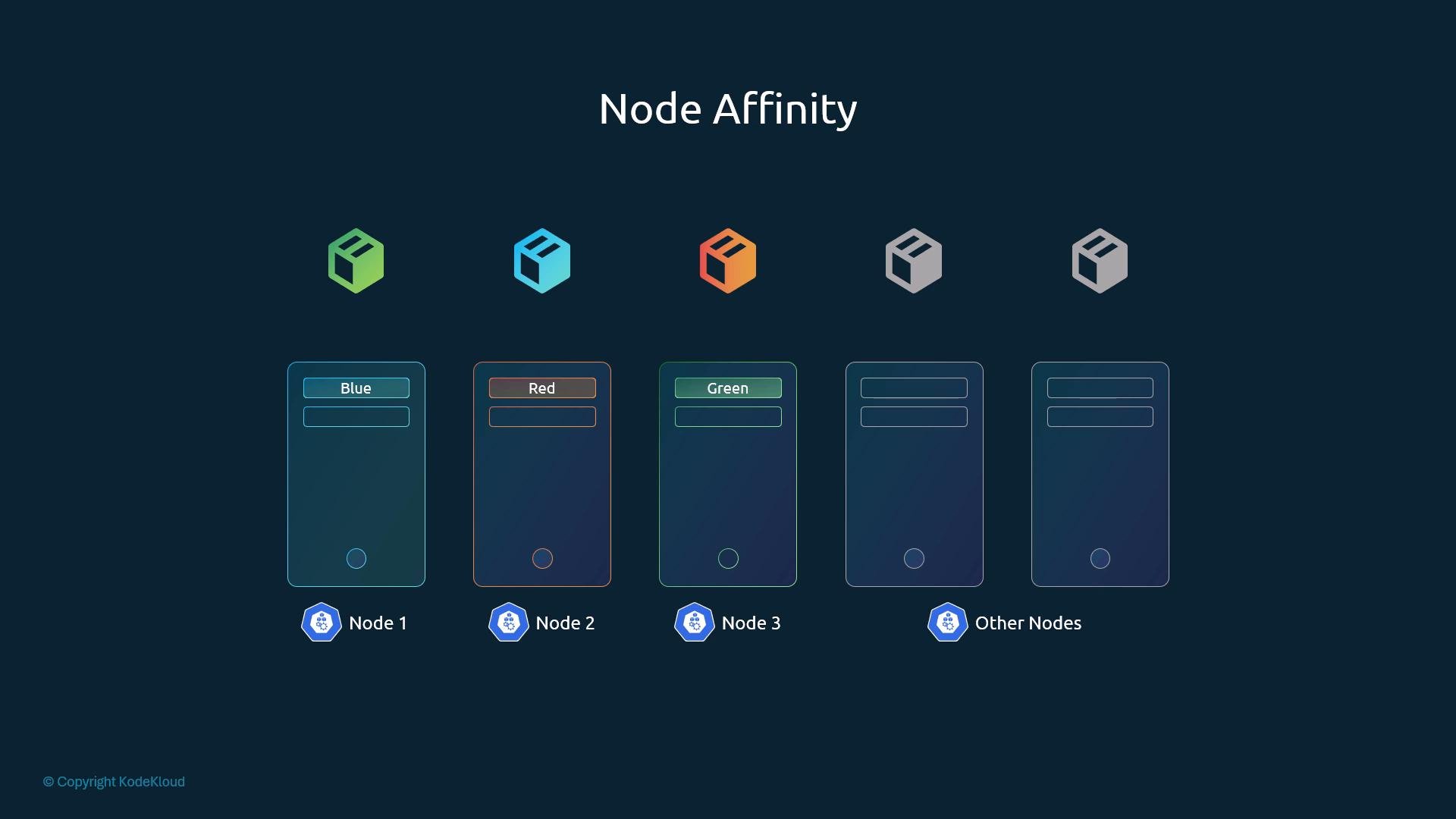
- Required node affinity forces the pod to be scheduled only on nodes whose labels satisfy the rule (e.g., nodes labeled
color=blue). - Node affinity alone does not prevent other pods from being scheduled onto the same nodes. Other teams’ pods can still land on the blue node unless they are repelled.
Recommended approach — Combine Taints/Tolerations with Node Affinity
To create effectively dedicated nodes, combine both mechanisms:- Taint each color node to repel all pods that do not tolerate that taint.
- Label each node with its color.
- Add a toleration to only the corresponding color pod so it can be scheduled onto the tainted node.
- Use required node affinity in the pod spec so the pod can only schedule onto the correctly labeled node.
- Taint the node:
- Label the node:
- Pod spec includes both tolerations and required node affinity:
- The taint prevents unrelated pods (without the matching toleration) from being scheduled onto the node.
- The pod’s toleration allows it to be scheduled onto the tainted node.
- The pod’s required node affinity forces it to target the specifically labeled node.
- Together, this creates an effectively dedicated node for that pod (repeat same configuration for red and green).
Comparison at a glance
Use required node affinity (
requiredDuringSchedulingIgnoredDuringExecution) to force a pod onto specific labeled nodes. Use taints with effect NoSchedule on those nodes to repel other pods; then add tolerations only to the pods you want to run there. If you want softer preferences instead of hard guarantees, consider preferredDuringSchedulingIgnoredDuringExecution, but that does not provide exclusivity.Links and references
- Kubernetes Scheduling: Taints and Tolerations — https://kubernetes.io/docs/concepts/scheduling-eviction/taint-and-toleration/
- Kubernetes Scheduling: Node Affinity — https://kubernetes.io/docs/concepts/scheduling-eviction/assign-pod-node/#node-affinity