

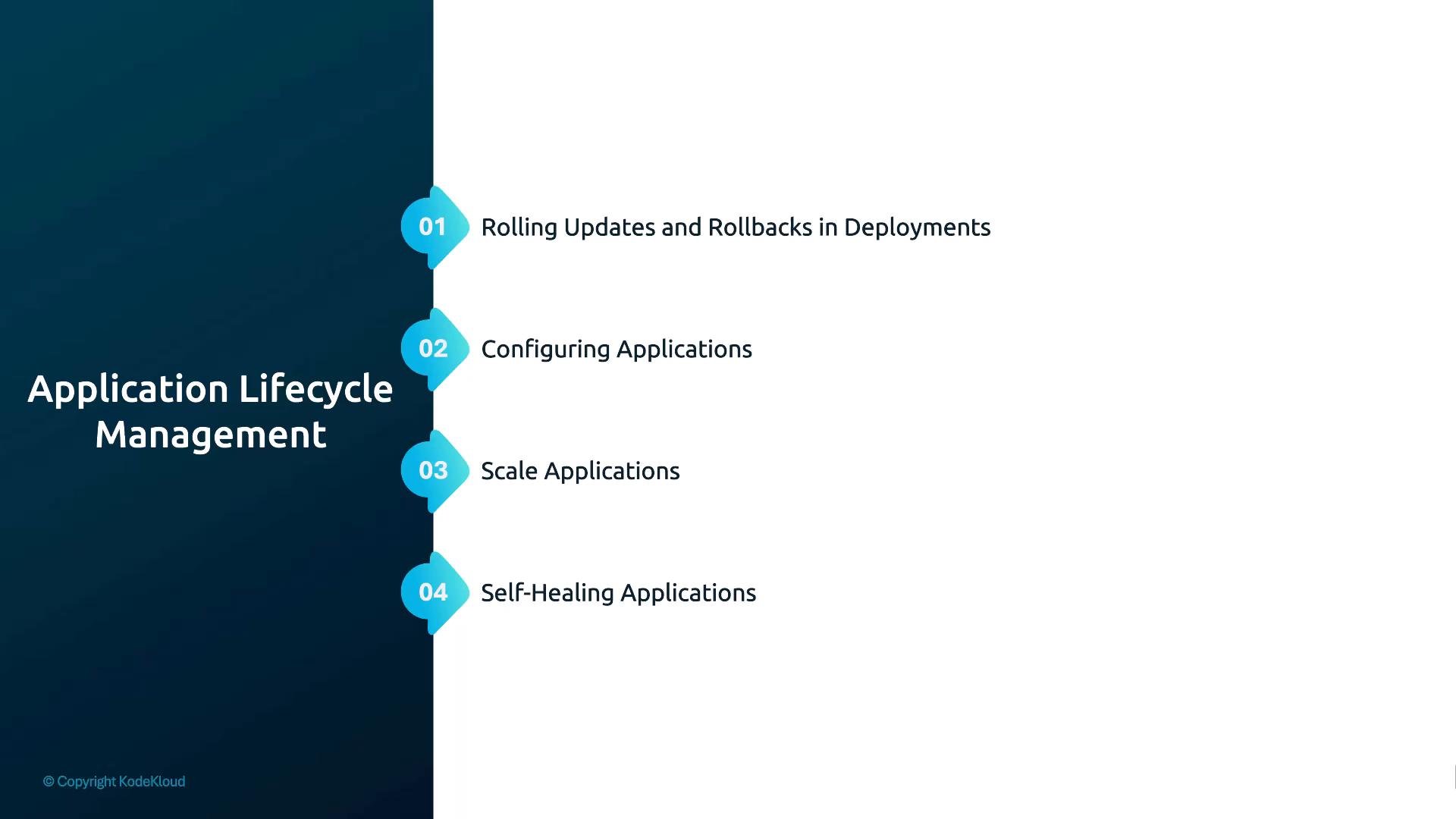
- Rolling updates and rollbacks (how to change a live application without downtime)
- Configuring applications (using secrets and configuration primitives)
- Scaling applications (manual and automated scaling strategies)
- Self‑healing applications (probes, ReplicaSets, and Deployments)
ConfigMap/Secret usage, and basic scaling. If so, you may prefer to focus on the hands‑on exercises in this lesson.
If you already understand rolling updates and rollbacks, configuration methods (like
ConfigMap and Secret), scaling strategies, and basic self‑healing primitives (readiness/liveness probes, ReplicaSet, Deployment), consider prioritizing the exercises in this lesson to practice real-world scenarios quickly.
Links and references
- Certified Kubernetes Application Developer course
- Kubernetes Concepts — Deployments
- Kubernetes — ConfigMaps
- Kubernetes — Secrets
- Kubernetes — Horizontal Pod Autoscaler
- Kubernetes — Pod Lifecycle: Probes