

runc.
Docker Engine historically relied on two core runtime pieces: containerd (which manages images and the container lifecycle) and runc (which creates and runs containers). Kubernetes only needs the container runtime portion to run workloads. With the CRI in place, Kubernetes communicates directly with CRI-compatible runtimes such as containerd or CRI-O and no longer requires Docker’s higher-level tooling.
Kubernetes used a small adapter called dockershim so the kubelet could talk to Docker Engine. Dockershim support was deprecated (announced in Kubernetes v1.20) and later removed (in v1.24). For details see the Kubernetes announcement: https://kubernetes.io/blog/2020/12/02/dont-panic-kubernetes-and-docker/
Now, that doesn’t mean Docker is entirely gone.
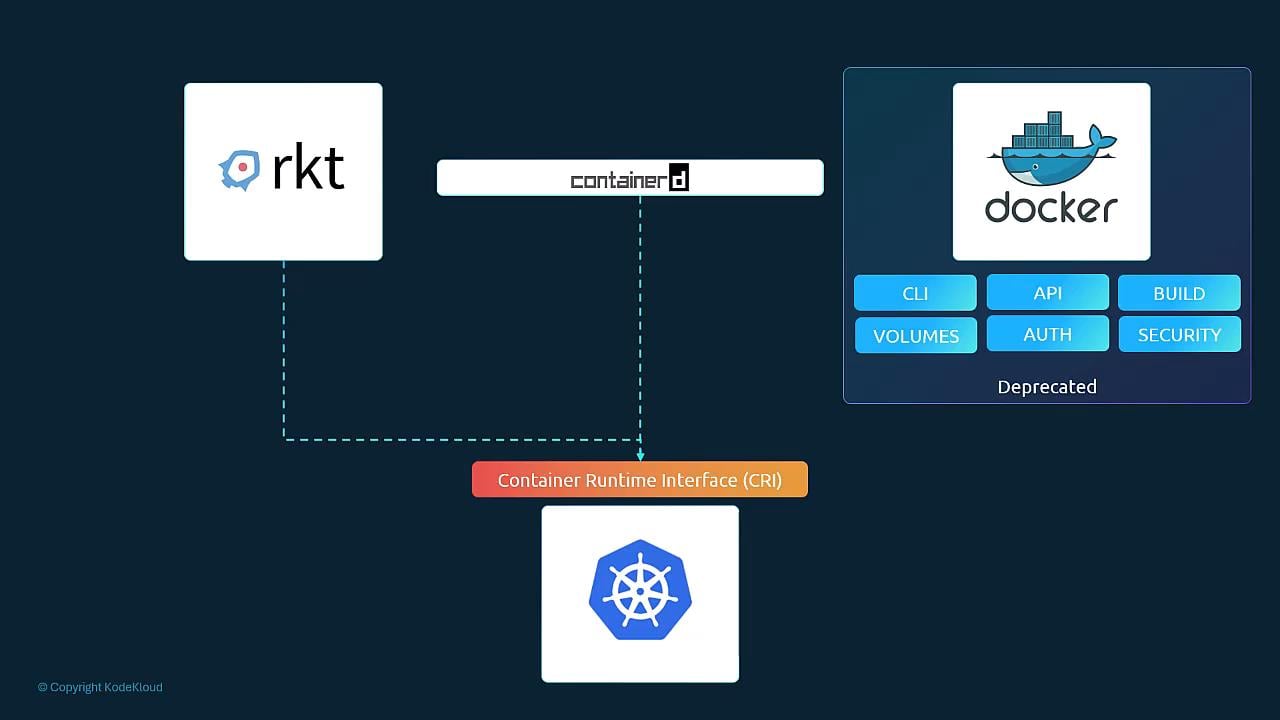
Docker being deprecated as a Kubernetes runtime refers to the removal of the dockershim adapter — not to Docker images or Docker as a developer tool. Docker images remain OCI-compatible and will work with other CRI runtimes.
containerd directly, nerdctl often serves as a drop-in replacement for many Docker commands.
Examples:
containerd with nerdctl:
- Docker (the product) is still widely used for development, CI/CD, and building images. You can continue using Docker Desktop, Docker CLI, and Docker Build for these workflows.
- Kubernetes requires a CRI-compatible runtime on cluster nodes; Docker Engine is not required on nodes. Popular CRI runtimes include
containerdandCRI-O. - Images built by Docker follow the OCI spec and run on other CRI runtimes without modification.
- If Docker is not available on your machine, use
nerdctlfor local development againstcontainerd.
- Kubernetes: https://kubernetes.io/
- Container Runtime Interface (CRI): https://kubernetes.io/docs/concepts/architecture/cri/
- Kubernetes dockershim announcement: https://kubernetes.io/blog/2020/12/02/dont-panic-kubernetes-and-docker/
- containerd: https://containerd.io/
- CRI-O: https://cri-o.io/
- OCI (Open Container Initiative): https://opencontainers.org/
- Docker Desktop: https://www.docker.com/products/docker-desktop
- nerdctl (containerd-compatible CLI): https://github.com/containerd/nerdctl
- BuildKit: https://github.com/moby/buildkit
- runc: https://github.com/opencontainers/runc