

Why adopt InnerSource?
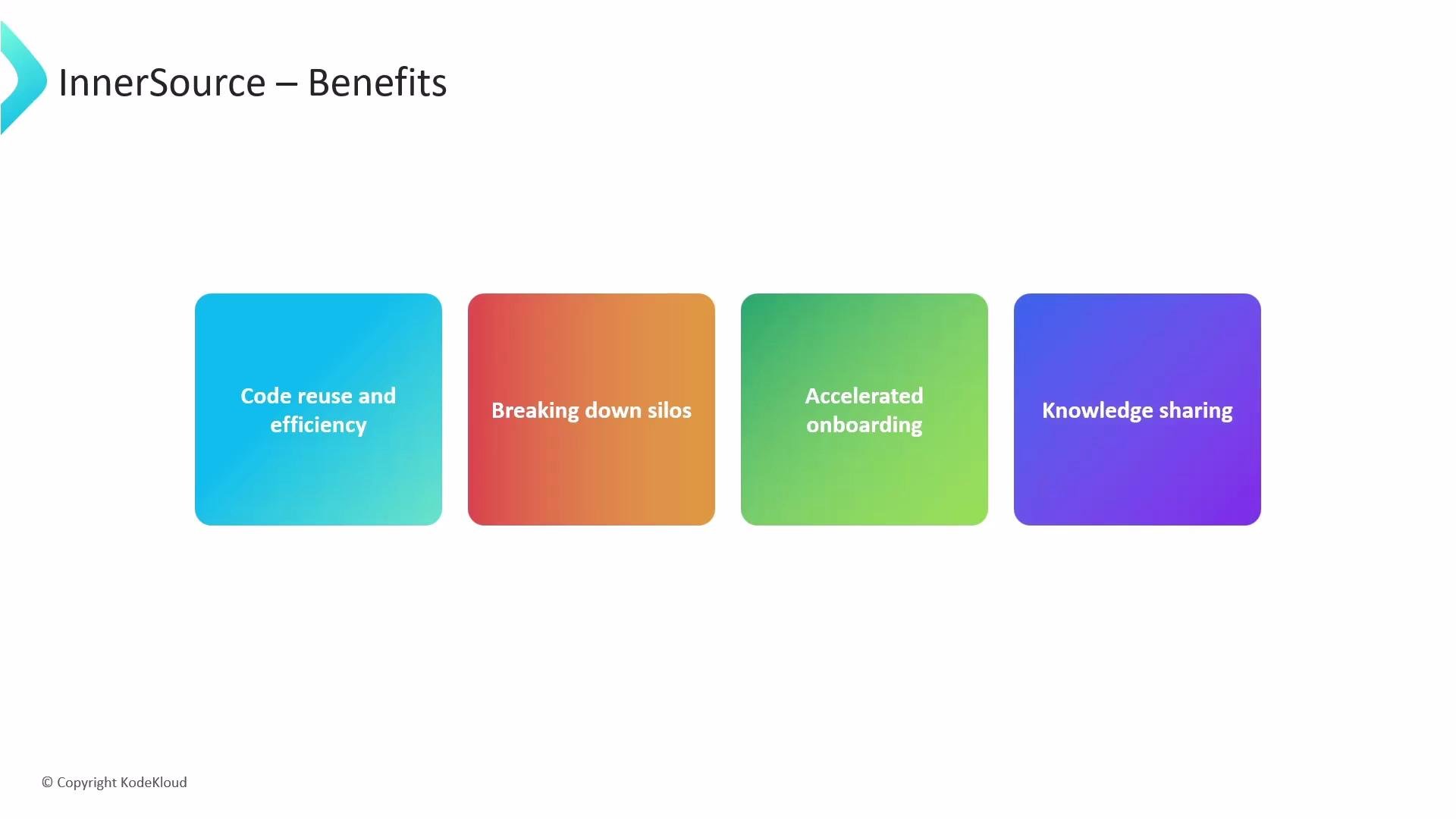
InnerSource brings proven open-source workflows into your corporate environment to increase reuse, improve quality, and speed onboarding. Key benefits include:-
Code reuse and efficiency
One shared implementation (e.g., a single login module) reduces duplication and maintenance costs across teams. Shared components get higher-quality updates and bug fixes faster. -
Breaking down silos
Cross-team contributions let engineers fix issues or add enhancements without waiting on the owning team’s backlog, reducing bottlenecks. -
Accelerated onboarding
Repositories that follow open-source conventions—clear READMEs, contribution guides, API docs, and examples—make it faster for new hires to understand and contribute. -
Knowledge sharing
Public internal discussions, PR reviews, and documented design decisions become a searchable knowledge base that helps junior and senior engineers alike.
Side-by-side comparison
Detailed differences
-
Visibility and access
- InnerSource: Repos are discoverable internally and follow company access controls (IAM, SSO, RBAC).
- Open source: Public repos accept contributions from anyone subject to project contribution rules.
-
Licensing and distribution
- InnerSource: Distribution handled via internal policies; public licensing is rare without legal approval.
- Open source: Projects use explicit licenses (e.g., MIT, Apache, GPL) that define public rights.
-
Community and contributors
- InnerSource: Bounded by employment or contracting relationships; contributions are typically cross-functional.
- Open source: Global community participation requires onboarding, code of conduct, and sometimes formal governance.
-
Governance and decision-making
- InnerSource: Priorities align with company goals, product roadmaps, and compliance mandates. Maintainers are typically internal.
- Open source: Governance models must balance transparency and community needs; decision processes are often documented publicly.
-
Security and compliance
- InnerSource: Easier to enforce internal security reviews, IP protections, and regulatory compliance.
- Open source: Public projects need dedicated vulnerability disclosure and security response processes.
-
Incentives and recognition
- InnerSource: Contributors earn internal credit—performance metrics, visibility within the company, career growth.
- Open source: Contributors gain public reputation, speaking opportunities, and broader industry visibility.
-
Contribution workflow and tooling
Both models benefit from the same practices: branching strategies, clear PR processes, code reviews, CI/CD, issue tracking, and comprehensive READMEs and contribution guides. InnerSource applies these within organizational boundaries.
InnerSource is not a weaker form of open source — it’s the intentional application of open-source principles (discoverability, contribution workflows, and documentation) inside an organization. This approach increases reuse, accelerates onboarding, and broadens participation while keeping internal controls intact.
Practical steps to adopt InnerSource
- Start small: pilot InnerSource with a few non-critical libraries, shared tools, or infra projects to validate processes and measure impact.
- Define contribution rules and ownership: publish how to propose changes, who reviews them, expected SLAs, and how releases are managed.
- Improve discoverability: create a searchable component registry, tag repos, and maintain clear READMEs and API docs.
- Provide templates and automation: standardize issue templates, PR templates, CI checks, and dependency management to reduce friction.
- Train maintainers and contributors: run workshops on code review, documentation standards, and how to use internal contribution workflows.
- Measure outcomes: track reuse, contributor counts, time to resolve cross-team bugs, and onboarding time to quantify value.