

- Reduce latency by routing users to the nearest edge POP (point of presence) and sending traffic across the Microsoft backbone.
- Improve reliability with continuous health monitoring and automatic failover.
- Offload TLS termination at the edge to reduce CPU load on origin servers.
- Centralize routing, certificate management, and telemetry for multi-region, multi-site deployments.
-
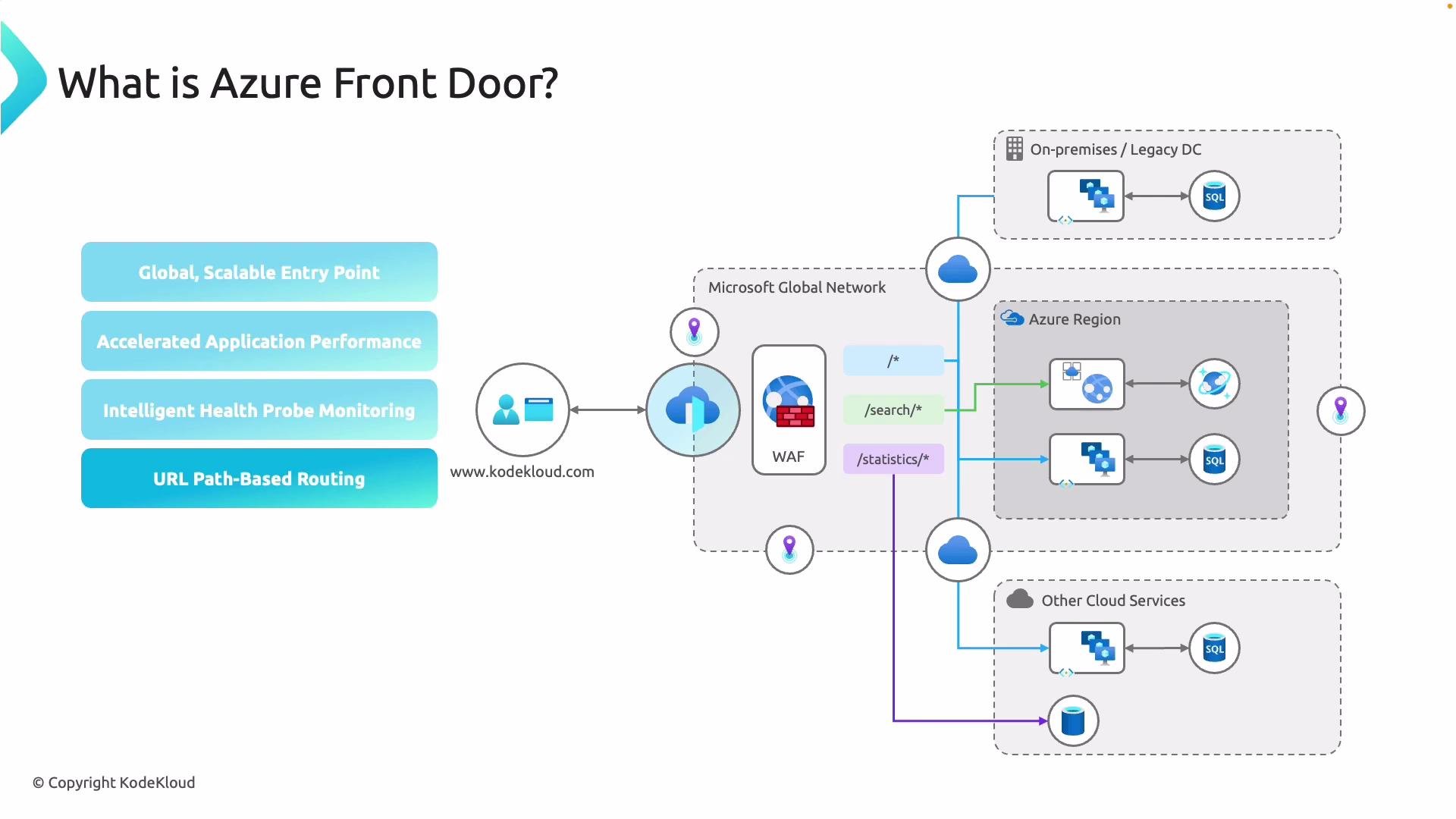
Global entry point and accelerated delivery
Front Door uses the Microsoft Edge network to bring users to the nearest edge POP, reducing latency for both static and dynamic content. -
Anycast routing and TCP optimizations
Anycast routes user requests to the closest POP. Front Door then leverages TCP connection optimizations across Microsoft’s backbone so requests traverse the shortest, fastest path to your origin. -
Health probes and automatic failover
Continuous health probing of backend endpoints enables fast, automatic rerouting to healthy endpoints when an origin fails—minimizing downtime and eliminating manual failover steps. -
Path- and URL-based routing
Route traffic by path to different backend pools (for example, send/images/*to a CDN-backed pool, and/api/*to application servers), allowing workload-specific optimization. -
TLS termination and end-to-end TLS options
Terminate TLS at the edge to reduce origin CPU overhead and manage certificates from the Azure portal. If required, configure end-to-end TLS so traffic remains encrypted all the way to origin. -
Layered security with integrated WAF and bot mitigation
Front Door integrates WAF rule sets, bot protection, and threat-intelligence based blocking to protect your applications at the edge. -
Host multiple domains and central telemetry
A single Front Door frontend configuration can host multiple custom domains, centralize TLS certificate management, and provide unified traffic and health telemetry for multi-region deployments.
For more details, see the official Azure Front Door documentation: Azure Front Door documentation.
Choosing between Standard and Premium SKUs
Both Standard and Premium SKUs provide the core global delivery features: edge acceleration for static and dynamic content, URL/path-based routing, health probes and failover, TLS termination at the edge, and centralized telemetry.
Common features across Standard and Premium:
- Global acceleration using the Microsoft Edge network
- Automatic traffic balancing and fast failover across backend regions
- TLS termination and managed certificate options for custom domains
- Telemetry and logging for traffic, health, and diagnostics
When to pick each SKU:
- Start with Standard if your primary needs are global acceleration, basic WAF protections, edge TLS, and simplified certificate management.
- Choose Premium when you need enterprise-grade security controls, advanced WAF customizations, bot protection, Private Link for private backend connectivity, or deeper security telemetry and integrations.
- Evaluate using a staged approach: deploy Standard to validate routing, performance, and cost, then upgrade to Premium only if your threat model, regulatory requirements, or private connectivity needs demand the enhanced capabilities.
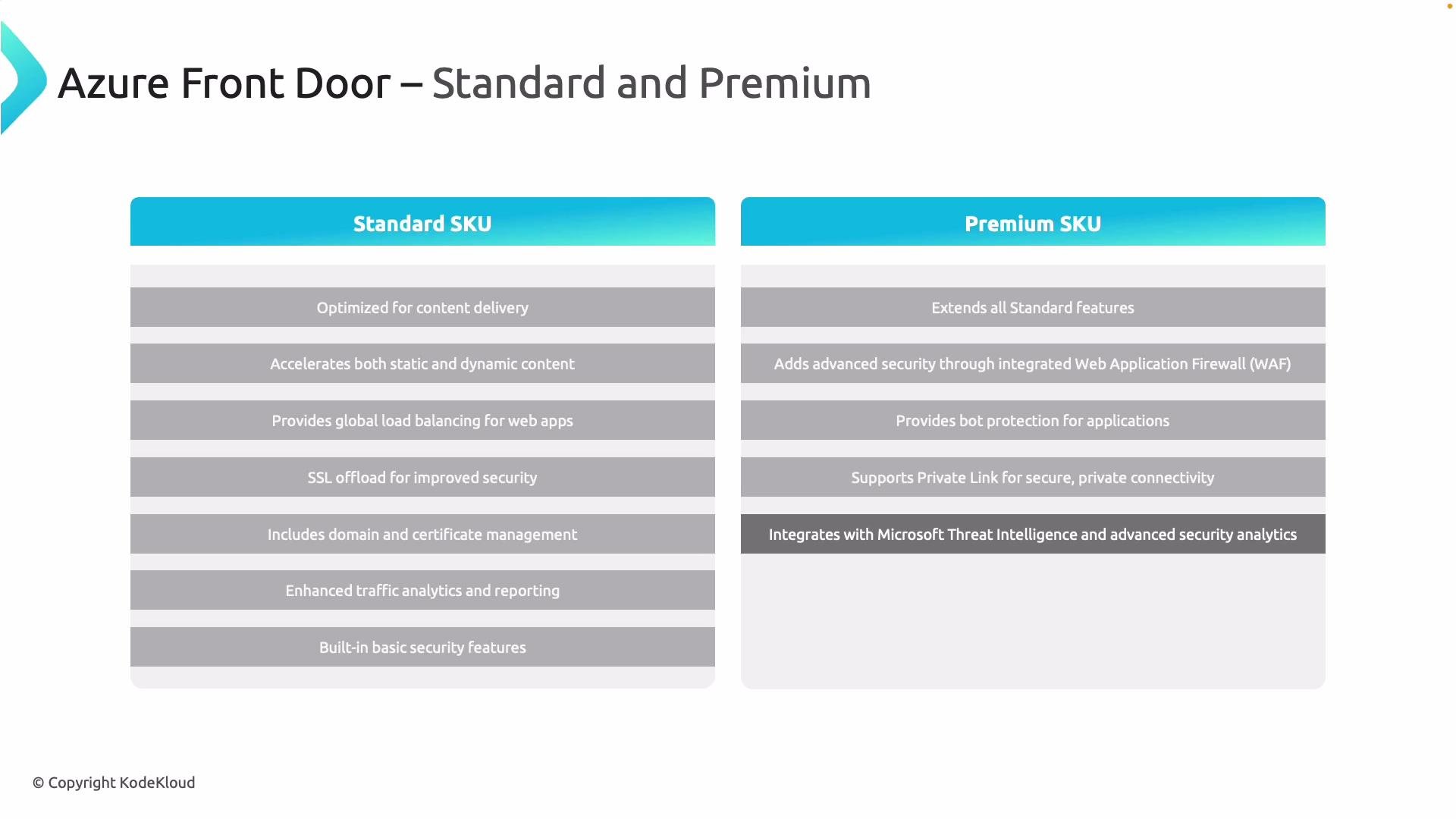
When evaluating SKUs, base your decision on your threat model, compliance needs, and whether you require private back-end connectivity. Start with Standard for broad acceleration and move to Premium when you need enterprise-grade security and Private Link.