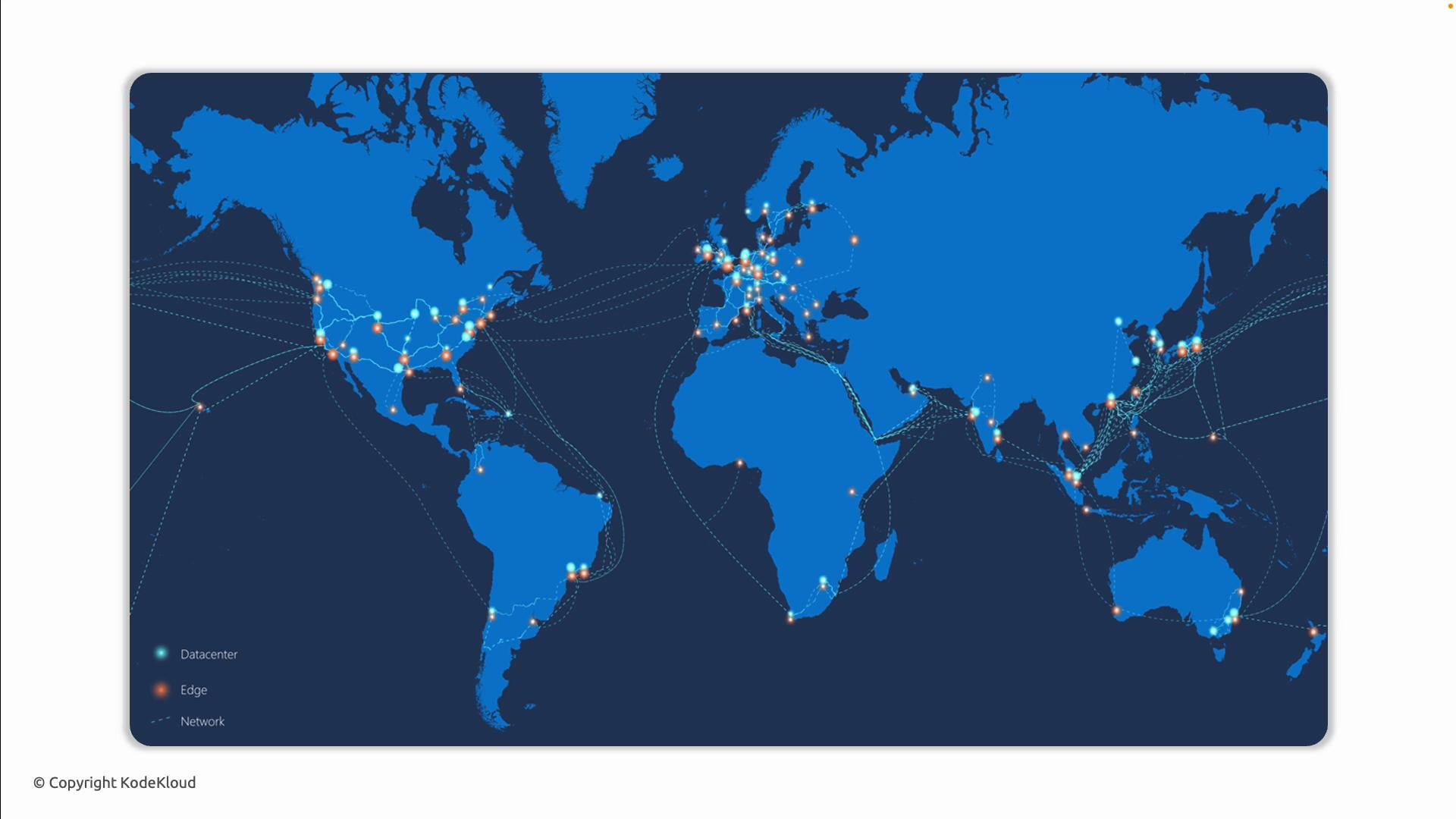
In this lesson you’ll learn how to select the right peering location when deploying Azure ExpressRoute. A peering location is the physical point where your network connects to Microsoft’s global backbone. These sites are usually major colocation facilities (data centers) where carriers, service providers, and enterprise networks interconnect. Microsoft operates many edge locations across North America, Europe, and Asia Pacific; your choice of peering location affects latency, redundancy, and cost. Key factors to evaluate when choosing a peering location:
FactorWhy it mattersWhat to check
Proximity to on-premisesReduces latency and improves performance for latency-sensitive appsMap data centers/branches and pick locations that minimize aggregate latency for important traffic flows
Redundancy & availabilityProtects against facility-level failure and improves uptimeDeploy circuits in multiple peering locations across different metros or fault domains
Service & SKU supportNot all locations support every ExpressRoute SKU, peering type, or capacityVerify support for the ExpressRoute SKU, private peering (and Microsoft services), and any additional services you need
Connectivity providers & on-rampsProvider selection impacts SLA, cost, and provisioning speedConfirm which carriers serve the location, cross-connect options, SLAs, and lead times
Latency, path diversity & routingAffects performance, resiliency, and traffic engineeringTest or obtain provider measurements, evaluate BGP behavior and path diversity options
Cost & egress/ingress region implicationsA peering location can determine egress billing and data residencyCheck billing for egress, potential cross-border routing, and regulatory compliance impacts
Detailed considerations
  • Proximity to your on-premises network
    Choose peering locations that are geographically close to your data centers or branch sites to reduce latency. If you operate multiple sites, prioritize locations that minimize end-to-end latency for critical application flows.
  • Redundancy and availability
    For higher availability, provision ExpressRoute circuits in multiple peering locations, ideally in different metro areas or fault domains. Separate-facility redundancy protects against localized outages and speeds recovery.
  • Service and SKU support
    ExpressRoute capabilities vary by location. Confirm that your chosen location supports the ExpressRoute SKU and capacity you require, and validate support for private peering and Microsoft connectivity (note that public peering has been deprecated).
  • Connectivity providers and on-ramps
    Each peering location is served by a subset of carriers. Choose a provider that matches your preferred network operator, offers an acceptable SLA, and can provision connections within your project timelines.
  • Latency, path diversity, and routing considerations
    Review routing behavior and BGP capabilities at the peering location. If possible, test latency and path diversity with provider measurements or pilot traffic to ensure real-world performance matches expectations.
  • Cost and egress/ingress region implications
    The peering location often determines the egress region for many Azure services, which can affect billing and regulatory compliance. Confirm how egress is billed and whether routing could expose data to different jurisdictions.
Choosing a peering location can change your egress region and therefore impact compliance and costs—verify regulatory requirements and cost models before finalizing.
Practical tips and workflow
  1. Map traffic flows
    • Identify the apps, services, and data centers that need low latency or high bandwidth. Rank traffic by criticality.
  2. Shortlist candidate peering locations
    • Filter by geographic proximity, provider presence, supported SKUs, and regulatory constraints.
  3. Validate provider capabilities
    • Contact prospective connectivity providers for SLAs, cross-connect options, pricing, and provisioning timelines.
  4. Design for redundancy
    • Plan multiple circuits across different peering locations (separate metros/facilities) to improve resilience.
  5. Test and iterate
    • After provisioning, validate BGP routing, measure latency, and run throughput tests. Adjust location or provider choices if results differ from expectations.
Quick decision checklist
  • Have you mapped major traffic flows and latency-sensitive apps?
  • Do shortlisted locations support the ExpressRoute SKUs and capacities you need?
  • Are there multiple carriers at the chosen location with acceptable SLAs and lead times?
  • Will your chosen location create unwanted cross-border egress or regulatory exposure?
  • Have you planned redundant circuits across at least two peering locations?
References and further reading By weighing proximity, redundancy, service support, provider options, and compliance/cost implications, you can select the peering location(s) that best meet the performance, availability, and regulatory needs of your ExpressRoute deployment.