

- How push subscriptions deliver messages to HTTPS endpoints
- How pull subscriptions let clients fetch messages (synchronously or via streaming)
- When to choose each approach, with practical examples and a decision guide
Push subscriptions
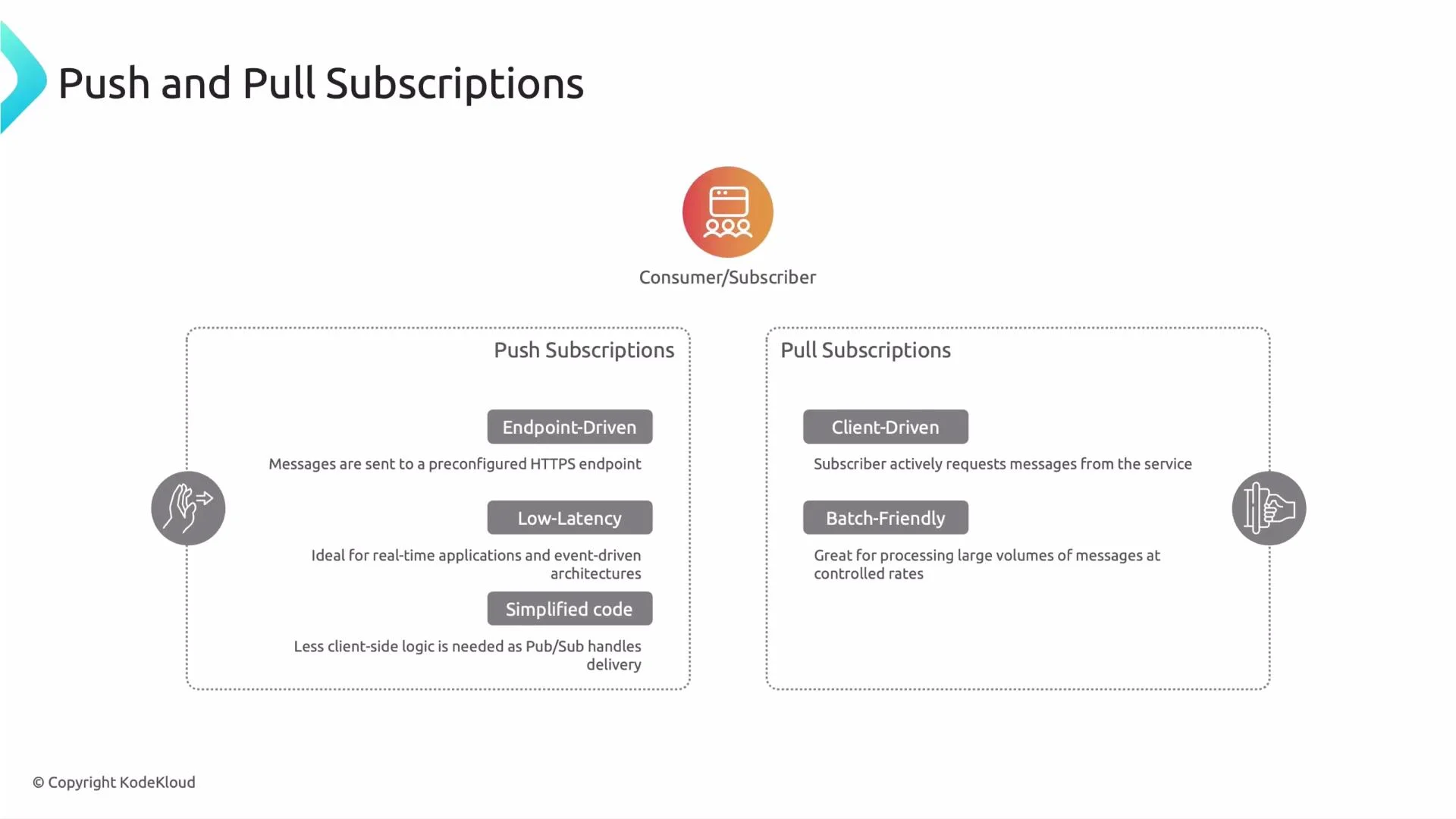
Push subscriptions are endpoint-driven: Cloud Pub/Sub delivers messages by making HTTPS POST requests to a pre-configured endpoint. Typical endpoints include App Engine apps, Cloud Run services, Compute Engine load balancers that terminate HTTPS, or any properly configured HTTPS server reachable by Pub/Sub. Key behaviors and characteristics:- Delivery: Pub/Sub sends each message to the subscriber endpoint as an HTTPS POST containing the message and attributes.
- Acknowledgement: The subscriber must return an HTTP 2xx response to acknowledge receipt. Non-2xx responses or network errors trigger retries with exponential backoff until the message is acknowledged or the message retention / dead-letter policy takes effect.
- Low latency: Because Pub/Sub actively pushes messages, push subscriptions are well suited for real-time use cases such as fraud detection, notifications, or IoT scenarios that need immediate reaction.
- Simplified client logic: The subscriber does not poll for messages; delivery, retry mechanics, and basic flow control are managed by Pub/Sub.
- The
datafield is base64 encoded; your subscriber must decode it. - To acknowledge the message, return an HTTP
200 OK(or any 2xx) response.
- Your application requires near-instant processing of individual messages.
- You can host a reliable HTTPS endpoint (or use Cloud Run/App Engine) that can scale or handle retries.
- You prefer simplified subscriber logic and offloaded retry handling.
Pull subscriptions
With pull subscriptions, the subscriber is responsible for actively requesting messages from Pub/Sub. Pull has two models:- Synchronous Pull API: the client issues Pull requests to fetch messages.
- StreamingPull: a long-lived gRPC stream that delivers messages to the client, improving throughput and latency for high-volume consumers.
- Client-driven: The subscriber controls when and how many messages to fetch, and must explicitly acknowledge messages using the Ack API.
- Ack deadline: Messages must be acknowledged within the ack deadline (default 10s); otherwise the message becomes available for redelivery. Subscribers can call ModifyAckDeadline to extend processing time.
- Batch- and throughput-friendly: Pull is ideal when you want to batch-process large volumes of messages at controlled rates — for example, periodic ingestion into BigQuery or feeding Dataflow pipelines.
- Flexible scaling: You can scale worker instances up or down to match processing capacity; pull gives you finer control over parallelism and batching behavior.
ackIds; to acknowledge:
- You process messages in batches or at scheduled intervals (e.g., 15-minute or hourly batches).
- You need explicit control over concurrency, rate limiting, or ack timing.
- You integrate with batch-oriented systems or worker pools that coordinate parallel processing.
Feature comparison
Quick decision guide
- Need instant, per-message processing? Choose push.
- Processing in near real-time batches or large-volume batch jobs? Choose pull (StreamingPull for high throughput).
- Want simplified subscriber code and managed retries? Push is simpler.
- Need fine-grained control over batching, concurrency, and ack deadlines? Use pull.
This lesson focused on how messages are delivered (pushed vs pulled). Related topics to review next: acknowledgement types, ack deadlines, retry strategies, dead-letter topics, and how to determine that a message was successfully processed (not just delivered).