

TrueTime is a central piece of Spanner’s design. If you want a deeper dive, see the Cloud Spanner documentation for implementation details and design notes.
Problem: clock skew in a distributed system
In globally distributed systems, server clocks drift. Even with NTP (Network Time Protocol), perfectly synchronized clocks across continents are unrealistic. Small differences—milliseconds or less—make it ambiguous which event happened first. That ambiguity undermines strong consistency and can break serializability guarantees in distributed databases.TrueTime: interval-based time with bounded uncertainty
Instead of returning a single timestamp, TrueTime returns a time interval that is guaranteed to contain the real time now. Each API call yields:Time sources and infrastructure
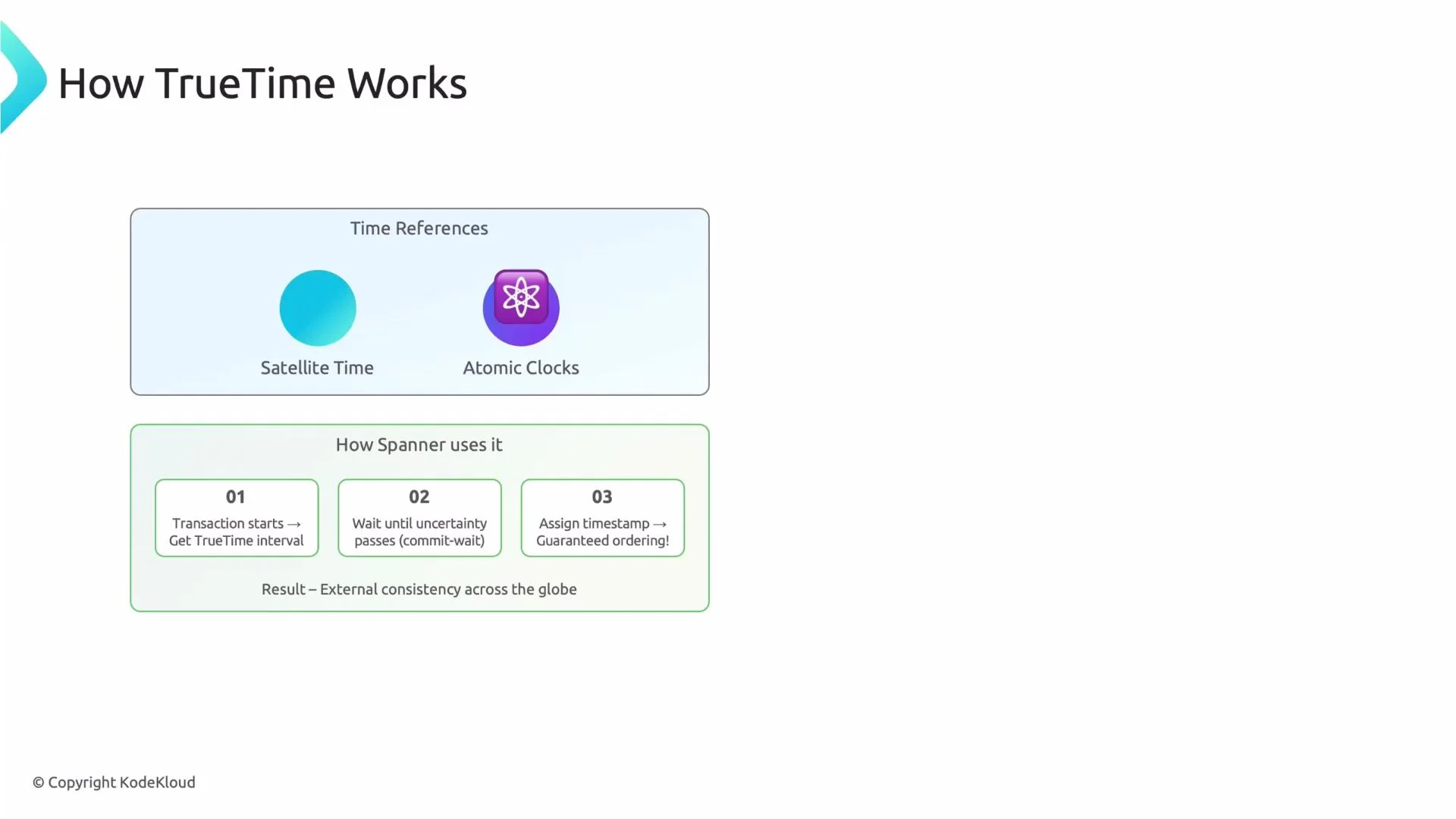
TrueTime maintains accuracy and bounds uncertainty using multiple, independent references:
These redundant sources and filtering reduce the risk that a single failed source causes incorrect time readings.
How Spanner uses TrueTime to guarantee external consistency
Spanner leverages TrueTime intervals to assign globally meaningful timestamps and to enforce a single global ordering of transactions. Conceptually, a write (commit) transaction follows three steps:-
Assign a commit timestamp
- The transaction coordinator picks a commit timestamp that respects previously observed timestamps and read dependencies. The chosen timestamp must be at least as large as any timestamp the coordinator has seen and must account for current TrueTime uncertainty.
-
Commit-wait (wait out uncertainty)
- Before making the write visible, the coordinator waits until the commit timestamp is guaranteed to be in the past globally. Concretely:
- This “commit-wait” makes the assigned timestamp unambiguous for all clients, preventing a future transaction from being assigned a timestamp earlier than this commit.
- Before making the write visible, the coordinator waits until the commit timestamp is guaranteed to be in the past globally. Concretely:
-
Finalize and make the commit visible
- After the wait completes, the transaction is durable and can be published with the assigned timestamp. Because the system has waited out the uncertainty window, the timestamp now represents a globally consistent ordering.
Operational considerations
- TrueTime’s uncertainty window is intentionally small, but it is non-zero. The commit-wait introduces a small latency (on the order of the uncertainty window) to guarantee correctness.
- Spanner combines TrueTime-based timestamps with distributed replication and consensus (Paxos/raft-like protocols) to ensure both durability and external consistency.
Commit-wait ensures correctness but adds a small, bounded latency equal to TrueTime’s uncertainty. For low-latency workloads, design your data and transaction patterns accordingly (e.g., minimize cross-region contention).
Why this matters — key benefits
- Global ordering of transactions
- Distributed transactions behave as if executed on a single, serial system. This simplifies application reasoning and correctness proofs.
- Eliminates ambiguity from clock skew
- The commit-wait ensures assigned timestamps are consistent across regions, avoiding anomalies from unsynchronized clocks.
- Enables true ACID transactions at global scale
- By combining global timestamping (TrueTime) with distributed consensus for replication, Spanner provides serializable, strongly consistent transactions across regions.
Summary
TrueTime provides a small, bounded interval for “now” and enables Spanner to enforce an externally consistent, globally ordered timeline of transactions. By assigning timestamps that account for uncertainty and waiting until those timestamps are safely in the past, Spanner removes the ambiguity that clock skew introduces—making global ACID guarantees practical. Links and references- Google Cloud Spanner documentation: https://cloud.google.com/spanner/docs
- Network Time Protocol (NTP): https://www.ntp.org/
- Research paper: “Spanner: Google’s Globally-Distributed Database” — for design and paper-level details.