Welcome back. This lesson is a compact, exam-focused recap of Google Cloud Bigtable. The single most important theme: Bigtable performance and scalability hinge on schema design—especially row keys and column families. Below are four core concepts you must know for both the exam and practical system design.
  1. Wide-column model
Bigtable is a wide-column (column-family) datastore. Unlike relational databases that require a rigid schema, Bigtable lets you add columns dynamically and allows different rows to have different columns. This makes it ideal for very large, evolving datasets (think terabytes to petabytes). Why this matters:
  • Horizontal scalability for large analytical and time-series workloads.
  • Flexible, sparse schema that adapts as data changes.
  • For exam scenarios asking which GCP database suits huge, evolving datasets with a column-family model, choose Google Cloud Bigtable.
  1. Performance tuning: column families
Column families control how related columns are stored and accessed on disk. Thoughtful grouping reduces disk I/O and improves read performance. Best practices:
  • Group hot, frequently-read columns in the same column family.
  • Put optional or infrequently-read data into separate families to avoid unnecessary I/O.
  • When you query only one family, Bigtable reads just that family efficiently.
Example grouping:
  • requests — high-frequency, hot fields
  • logs — larger, less frequent access
  • metadata — small, infrequently updated attributes
  1. Row key impact
Row keys determine physical data ordering, distribution across nodes, and query efficiency. Bigtable stores rows in lexicographic order by row key, so monotonic row keys (like raw timestamps) cause write hotspotting on a single node. Row key guidance:
  • Avoid monotonic or sequential keys (e.g., raw timestamps or increasing integers).
  • Use hashed prefixes, salting, or reversal strategies to distribute writes.
  • Design row keys around your primary read patterns so reads are efficient and parallelized.
If asked on the exam how to prevent hotspotting: answer — redesign row keys (e.g., add hashed prefixes / salt) to spread load across nodes.
  1. Access patterns drive schema design
Bigtable is a query-driven schema system. Decide how the application will read and write data before finalizing row key and column family design. Key points:
  • Design row keys and column families to match read/write patterns.
  • Changing access patterns later requires costly data migrations.
  • Plan for read hotspots and shard keys accordingly.
Exam & practical tip: prioritize your access patterns and row-key strategy first. Use column families to separate hot vs. cold data, and avoid sequential row keys to prevent hotspotting.
Summary table — Bigtable design essentials
TopicWhy it mattersBest practice
Data modelWide-column store for sparse and evolving schemasUse column families and flexible columns instead of fixed relational schemas
Column familiesControls disk layout and I/OGroup hot fields; separate cold or bulky attributes
Row keysAffects distribution and read/write performanceAvoid sequential keys; salt or hash prefixes to distribute load
Schema planningChanging later is expensiveDesign based on queries and access patterns up front
Common row-key anti-patterns and fixes
Anti-patternProblemFix
Sequential timestampsHotspotting at single nodeAdd hashed or salted prefix, reverse key parts
Long, complex keysLarger index size, slower scansUse compact, meaningful prefixes; keep keys concise
Designing without queriesInefficient access and costly migrationsModel for dominant read/write patterns first
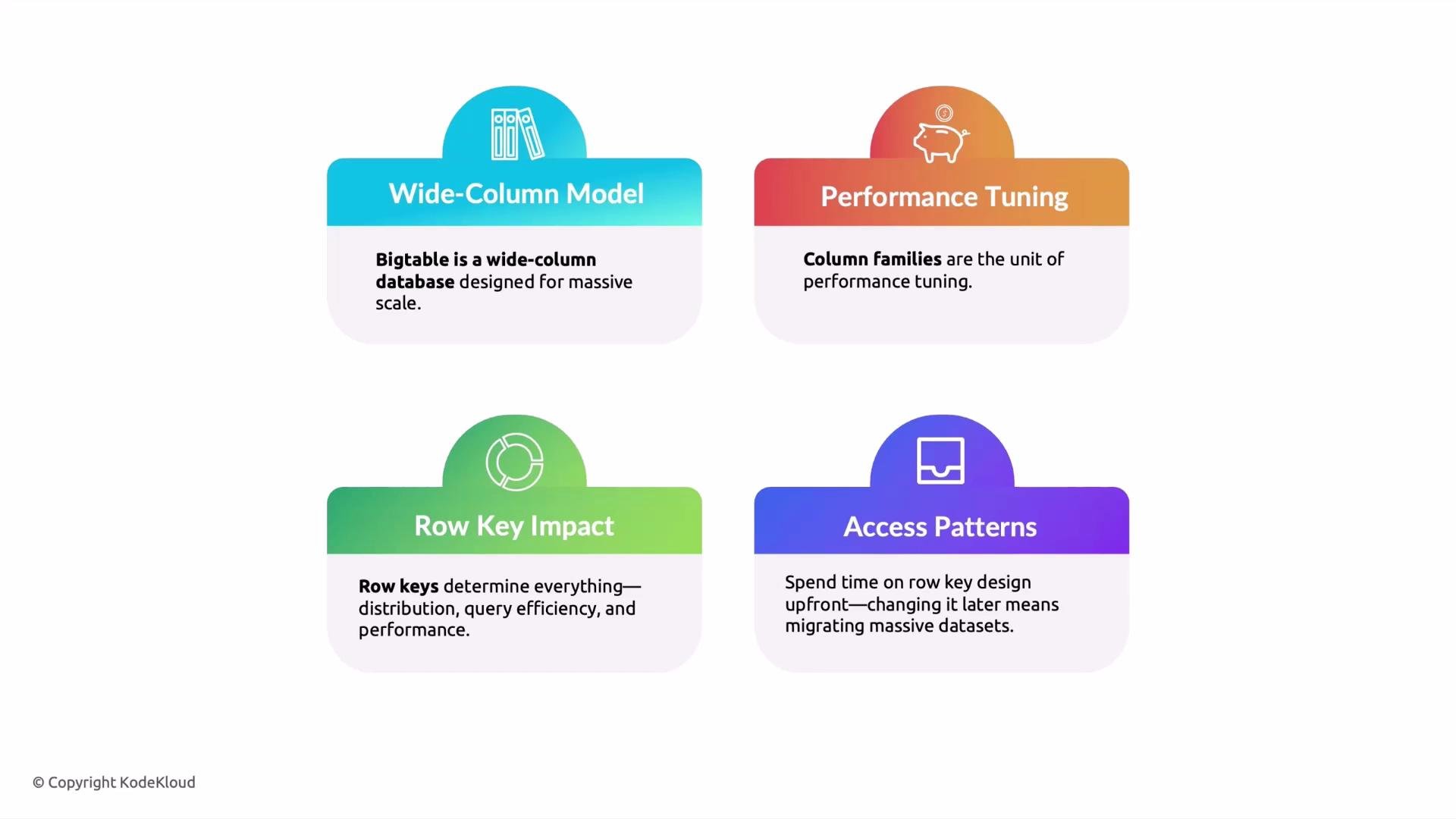
An infographic showing four colorful rounded panels that summarize Bigtable concepts: "Wide-Column Model," "Performance Tuning," "Row Key Impact," and "Access Patterns," each with a small icon and brief explanatory text. The image is branded with a © Copyright KodeKloud mark at the bottom.
Further reading and references That’s it for this quick summary. Thanks for reading.

Watch Video