

- Strong consistency + relational semantics: schemas, ACID transactions, and SQL queries (GoogleSQL).
- Horizontal scale: scale out by adding nodes; Spanner automatically shards and rebalances data.
- Global consistency and high availability: consistent reads and strongly consistent transactions across regions using TrueTime and distributed consensus.
- Fully managed: Google handles infrastructure, replication, patching, backups, and maintenance.
- High SLA: Multi-region configurations can provide very high availability for production-critical systems.
- Relational semantics: ACID transactions, schema support, and a SQL dialect compatible with standard SQL.
- Horizontal scale: Elastic, node-based scaling for throughput and storage growth.
- Global consistency: External consistency across regions due to TrueTime (bounded clock uncertainty) and Paxos-based replication.
- Automatic sharding and replication: Data is shard-balanced and replicated automatically for resilience and performance.
- Managed operations and backups: Built-in automated backups, maintenance, and monitoring.
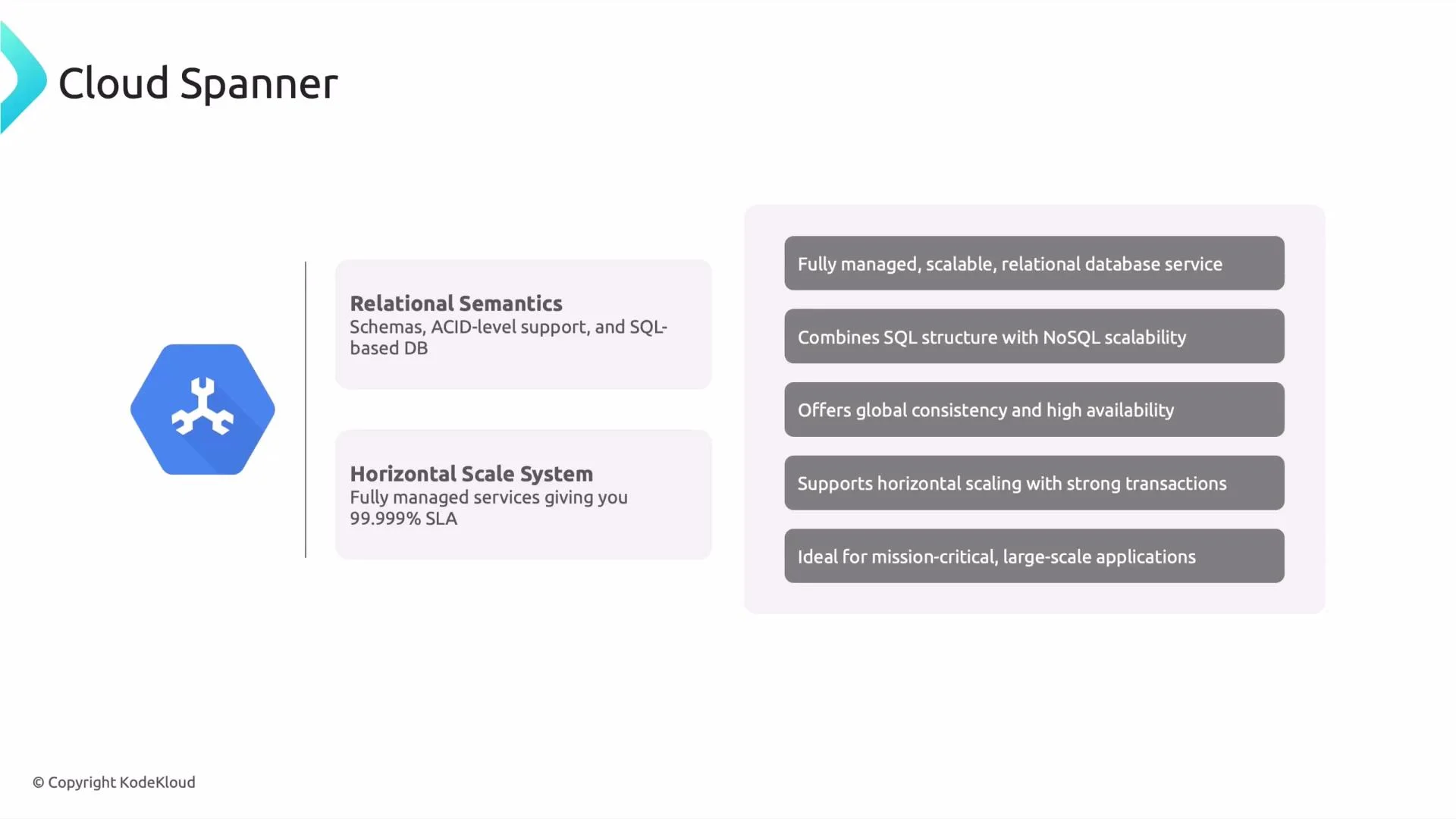
If a requirement calls for global scale + SQL + strong consistency, Cloud Spanner is the appropriate Google Cloud product to consider.
- TrueTime: bounded clock uncertainty that enables externally consistent distributed transactions.
- Paxos-based replication: consensus algorithms to ensure durability and consistency across replicas.
- Automatic sharding (splits) and load balancing: Spanner partitions data across nodes and moves splits as workload changes.
- Distributed transaction manager: coordinates multi-row and multi-shard ACID transactions across the cluster.
When to pick Cloud Spanner
- You require SQL plus global, strongly consistent transactions.
- Your workload needs horizontal scale beyond what a single-region RDBMS can provide.
- You need high availability and disaster recovery across regions with strong consistency.
Cloud Spanner is powerful but introduces additional cost and operational considerations compared to single-region Cloud SQL. If you don’t need global scale or strong cross-region consistency, Cloud SQL is often a simpler and more cost-effective choice.
- Cloud Spanner documentation: https://cloud.google.com/spanner
- TrueTime and how Spanner provides external consistency: https://research.google/pubs/pub38166/
- Spanner best practices and architecture: https://cloud.google.com/spanner/docs