

Why this certification matters
- The Google Cloud Professional Data Engineer credential validates your ability to design, build, operate, and secure data processing systems on Google Cloud.
- It requires more than console familiarity—expect end-to-end knowledge across data ingestion, transformation, storage, analytics, machine learning, and operational concerns such as monitoring, reliability, and security.
- At the professional level, you must demonstrate advanced, real-world skills that employers expect for data platform design and operation.
How the certification fits into the Google Cloud roadmap
Google Cloud certifications are commonly presented in three tiers: Foundational, Associate, and Professional. Use the table below to quickly see where the Professional Data Engineer sits relative to other tiers and target audiences.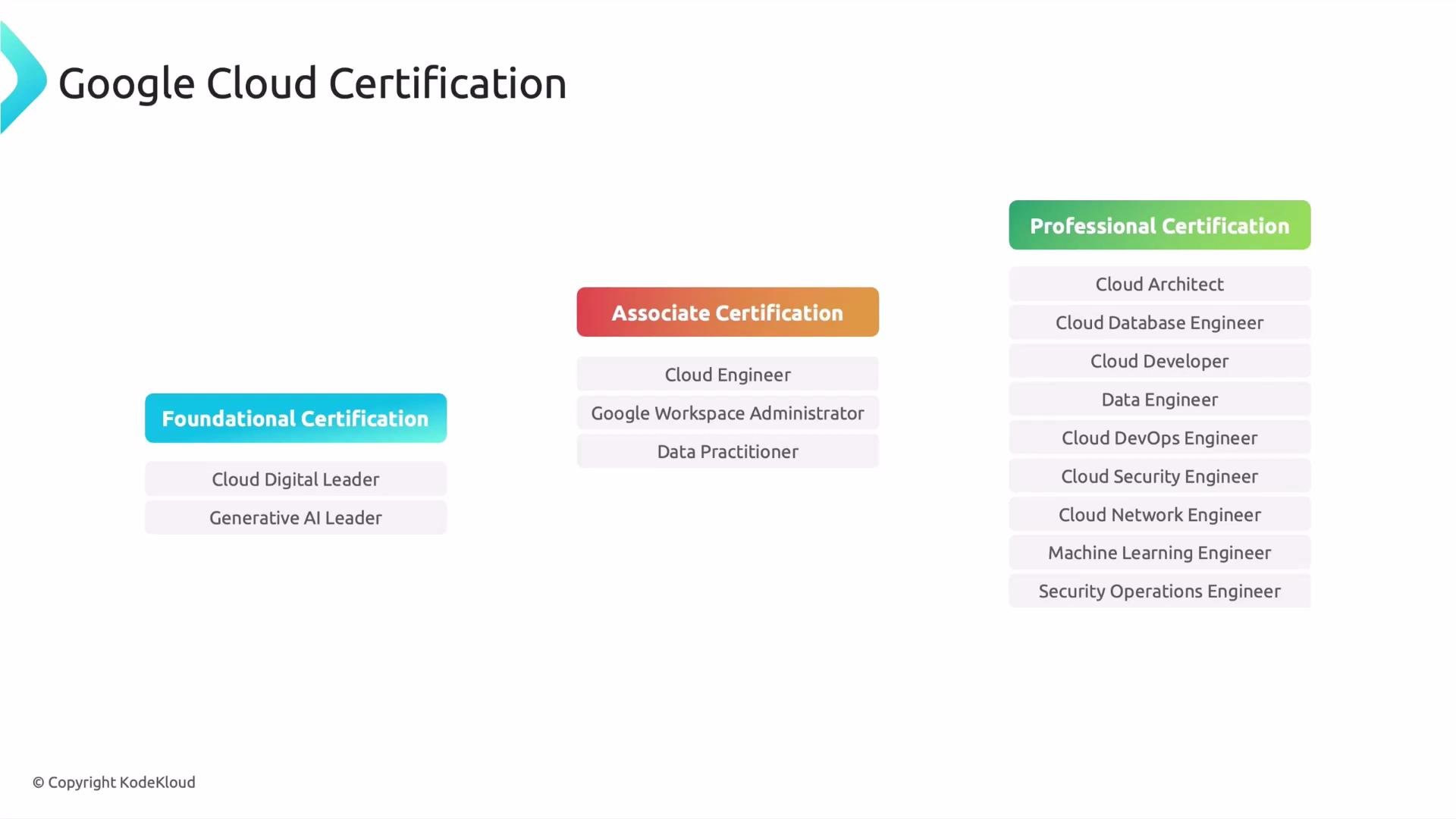
Cross-cloud equivalents and naming differences
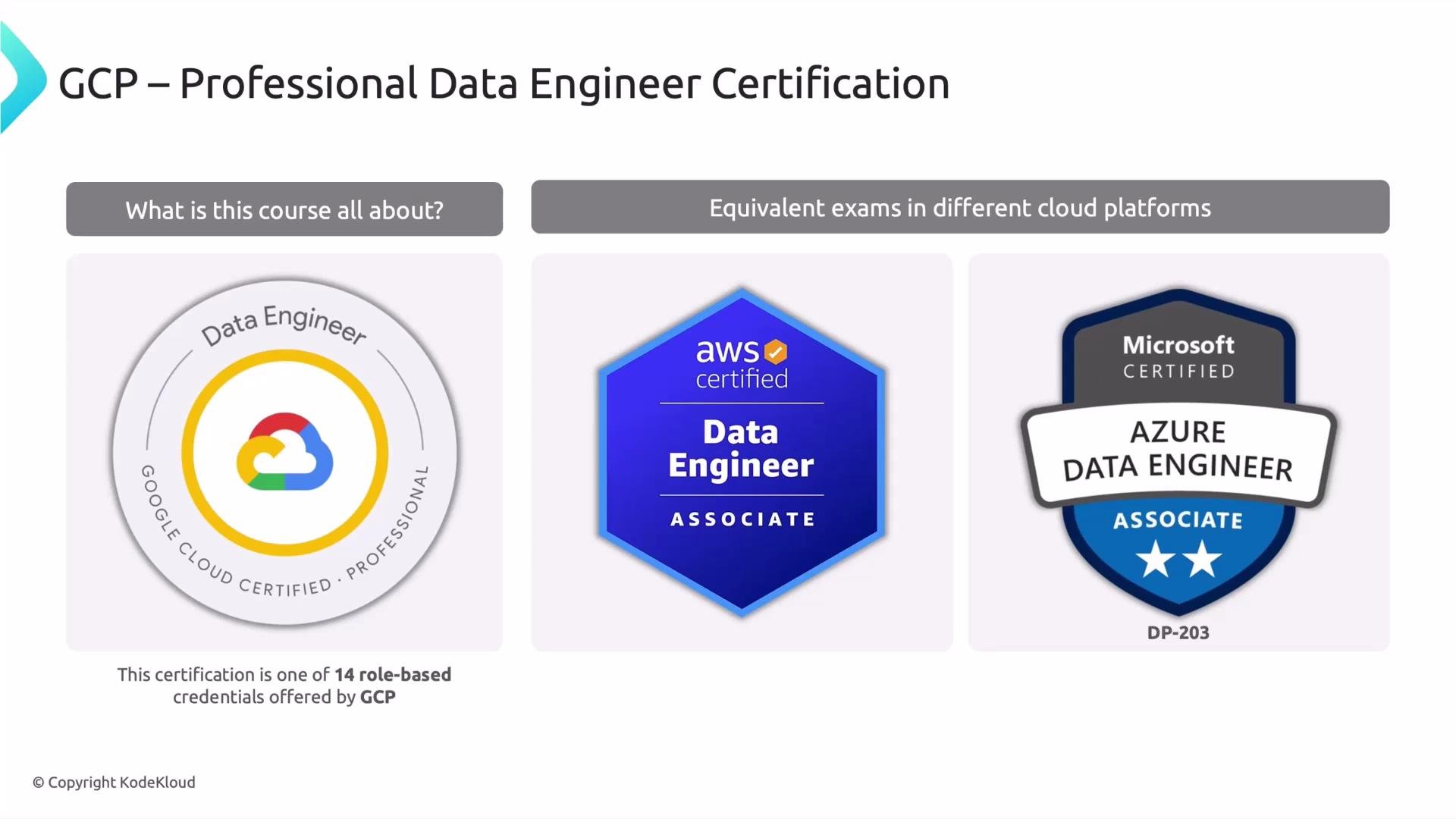
Different cloud providers use different titles and scopes. Below is a quick comparison to help you map skills across clouds.
The core skills—data ingestion, transformation, storage, and analytics—are similar across clouds. The main difference is platform-specific tooling and implementation details.
Core GCP technologies encountered by a Professional Data Engineer
Key services you should be comfortable with:- BigQuery — analytics data warehouse and SQL-based analytics
- Dataflow — unified stream and batch processing (Apache Beam)
- Pub/Sub — messaging/event ingestion
- Cloud Composer — managed orchestration (Apache Airflow)
- Cloud Storage, Dataproc, Bigtable, Firestore — platform-specific storage and processing
- Vertex AI and related AI/ML tooling for model training and deployment
The GCP data engineering ecosystem — practical responsibilities
A Professional Data Engineer typically owns responsibilities across the data lifecycle:- ETL / ELT pipelines: implement with Dataflow, Dataproc, or SQL transformations in BigQuery
- Data platforms: design schemas, partitions, and storage choices for BigQuery, Cloud Storage, Bigtable
- ML platforms: prepare datasets, train and serve models using Vertex AI and related tools
- Orchestration & monitoring: implement workflows (Cloud Composer), add observability (Cloud Monitoring, logging), and meet SLAs
- Security & governance: configure IAM, VPC, encryption, DLP, and cataloging tools
Day-one responsibilities for a Professional Data Engineer
Common day-one and early responsibilities include:- Managing the data lifecycle: ingest (Pub/Sub, Transfer Service), transform (Dataflow, BigQuery), and publish datasets, dashboards, and APIs
- Solution evaluation: choose managed services based on cost, latency, scale, and operational overhead
- System creation and management: design pipelines, implement workflows, add monitoring/alerting, and automate deployments
- Platform maintenance: design for reliability and scalability, enforce security and compliance, and maintain observability
Exam overview — logistics and expectations
Below is a concise summary of the exam logistics and what to expect on exam day.Google strongly recommends hands-on, practical experience for this exam. Reading alone is unlikely to be sufficient—practice implementing pipelines, querying BigQuery, building Dataflow jobs, configuring Pub/Sub, and setting up security and monitoring.
Exam details (price, languages, format) can change. Always verify the latest exam information on the official Google Cloud certification page: https://cloud.google.com/certification/data-engineer
Next steps
This lesson provided a perspective on what the Professional Data Engineer certification means and how it fits into the cloud ecosystem. Focus your preparation on the data lifecycle—ingestion, transformation, storage, analytics, ML, and operational concerns—so you’re ready for both the exam and practical data engineering work. Recommended next actions:- Build hands-on projects using BigQuery, Dataflow, and Pub/Sub
- Practice query optimization, partitioning, and cost control in BigQuery
- Implement a sample data pipeline and add monitoring/alerting
- Review Google Cloud’s official exam guide and practice questions