

Quick overview
- Cloud SQL: a managed relational database service for MySQL, PostgreSQL, and SQL Server. Best for conventional, regional workloads and teams familiar with standard RDBMS tooling.
- Cloud Spanner: a globally distributed, horizontally scalable relational database with strong transactional consistency. Designed for mission-critical, large-scale, globally-distributed systems.
Feature-by-feature comparison
Storage capacity and scaling
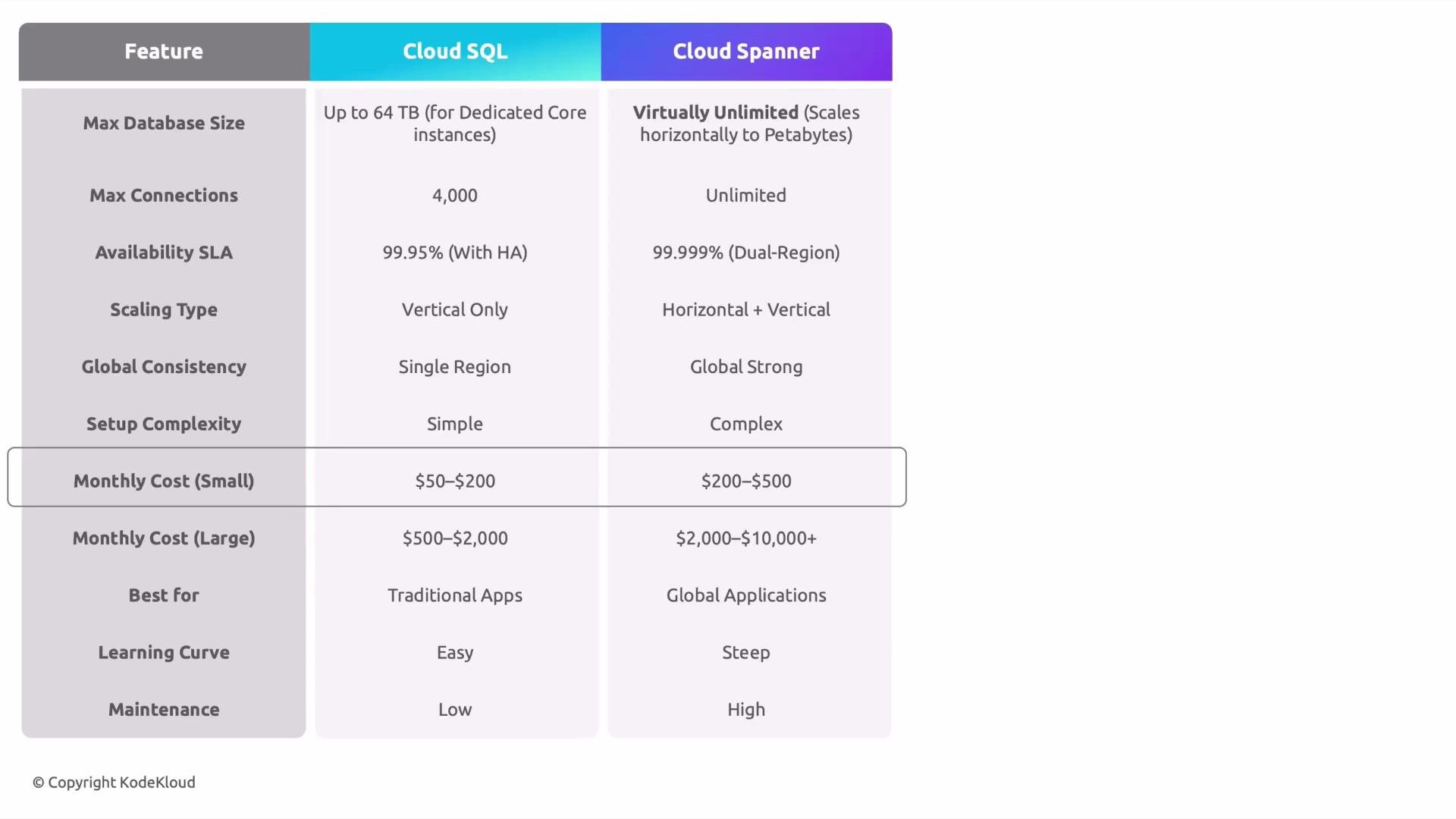
Cloud SQL supports large databases up to ~64 TB (varies by engine and configuration). Cloud Spanner, however, is built for horizontal scaling: you add nodes and Spanner distributes data across them and across regions, enabling effectively unlimited capacity. Organizations with massive, growing datasets typically choose Spanner because of this horizontal scale and seamless growth characteristics.Connections and concurrency
Cloud SQL has connection limits tied to the database engine and instance size (often in the low thousands). For high-concurrency workloads you should use connection pooling, for example:- PgBouncer for PostgreSQL: https://pgbouncer.github.io/
Availability and SLA
Cloud SQL (with high availability enabled) typically provides a 99.95% SLA. Cloud Spanner offers stronger availability guarantees — common multi-region configurations can give 99.999% uptime. For systems where downtime causes direct revenue loss (banking, global e-commerce), Spanner’s replication and SLA are important differentiators.Consistency and transactional semantics
- Cloud SQL: standard relational consistency within a regional deployment, typical multi-node setups use replicas primarily for reads.
- Cloud Spanner: supports strong, external consistency across regions. This ensures globally consistent reads and transactional semantics that behave like a single, consistent database.
Setup complexity and operational considerations
Provisioning a Cloud SQL instance is straightforward and familiar to many developers. Cloud Spanner is also provisioned easily, but operating Spanner at scale requires deliberate schema and data locality design:- Use interleaved tables and schema choices to optimize locality and performance.
- Size nodes according to read/write throughput and replication needs.
- Understand replication configurations (single-region, multi-region, dual-region) and the impact on latency and cost.
Cost considerations
- Cloud SQL: generally the lower-cost option for small to medium deployments. Monthly costs can fall into the low dozens up to a couple hundred dollars depending on CPU, memory, and storage.
- Cloud Spanner: higher baseline and scales with nodes, storage, and replication. Typical entry costs are higher (often hundreds per month), and costs grow predictably with additional nodes and multi-region setups.
Use cases — when to choose which
Learning curve and maintenance
Most developers are already comfortable with conventional relational databases, making Cloud SQL quicker to adopt. Cloud Spanner requires different design patterns (schema locality, interleaved tables, careful indexing) and more operational planning (node sizing, replication). Both are managed, but expect more design and operational effort for Spanner to achieve optimal performance and cost-efficiency.Cost breakdown guidance
Start with Cloud SQL for prototypes, small services, or cost-sensitive use cases. For example, a small global price-comparison microservice that stores modest data volumes typically fits Cloud SQL. If your product grows and requires global scale and strong consistency, evaluate migrating to Cloud Spanner.Start with Cloud SQL for cost-efficiency and simplicity. Migrate to Cloud Spanner only when you need global scale, strong global consistency, and the higher availability guarantees it provides.
Alternatives for semi-structured or NoSQL use cases
Consider other GCP services when a relational model is not required:- Bigtable — wide-column store for time-series and large analytical workloads. https://cloud.google.com/bigtable
- Firestore — serverless document database for mobile/web apps and hierarchical data. https://cloud.google.com/firestore
Quick exam-style question
Which service is generally more expensive and why? Answer: Cloud Spanner is generally more expensive because it provides global replication, stronger availability SLAs, and horizontal scaling across nodes and regions — all of which increase baseline and operational costs compared to a regional, vertically scaled Cloud SQL instance.Bottom line
- Cloud SQL: cost-effective and easy for most conventional, regional workloads.
- Cloud Spanner: powerful, highly available, and horizontally scalable for global, mission-critical workloads — with higher cost and a steeper operational/design learning curve.
Links and references
- Cloud SQL documentation: https://cloud.google.com/sql
- Cloud Spanner documentation: https://cloud.google.com/spanner
- PgBouncer (PostgreSQL connection pooling): https://pgbouncer.github.io/
- Bigtable: https://cloud.google.com/bigtable
- Firestore: https://cloud.google.com/firestore