

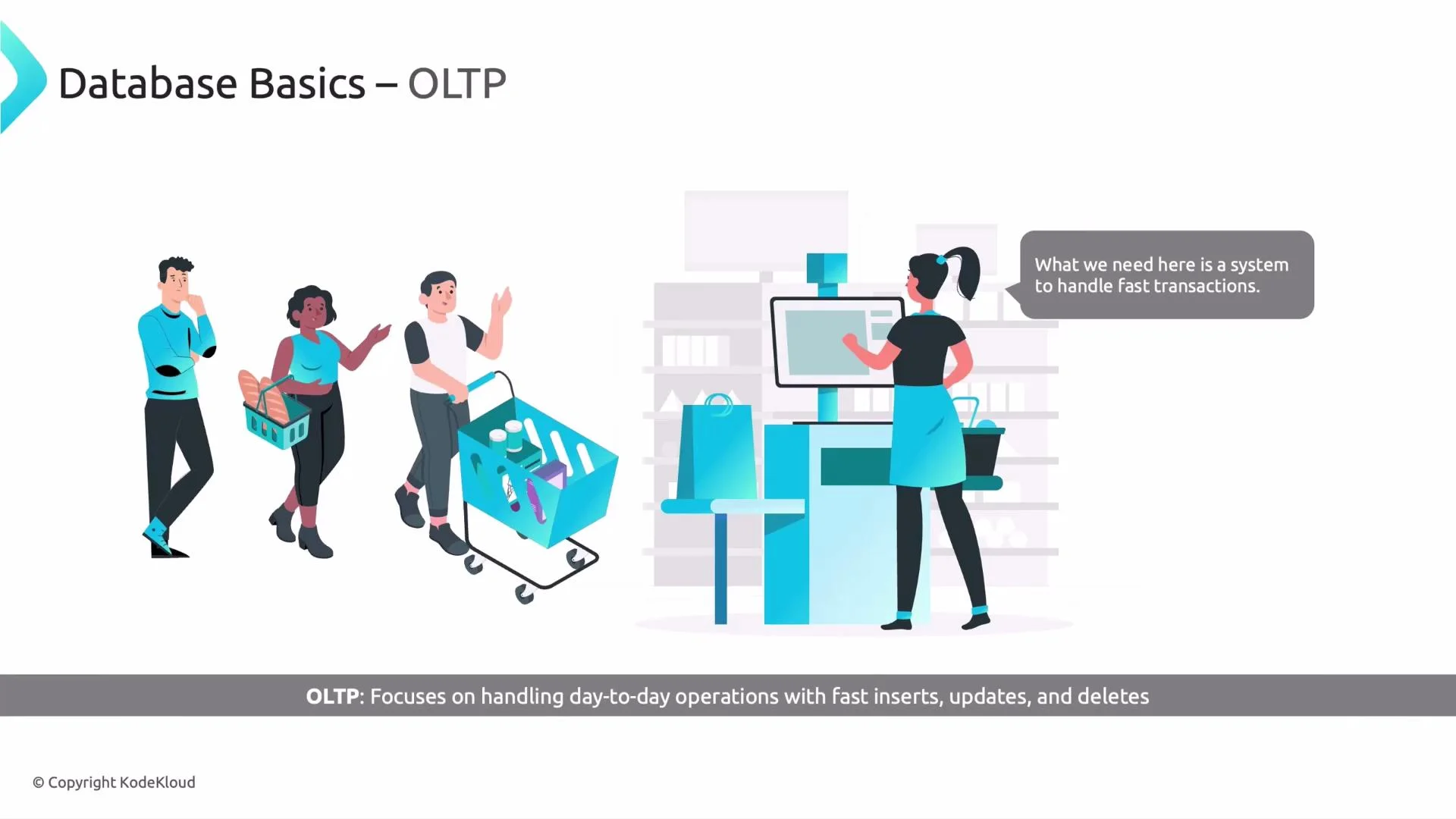
- Designed for many short, concurrent transactions (inserts, updates, deletes) with very low latency.
- Typically enforce ACID properties to ensure correctness and handle concurrency.
- Use normalized schemas to reduce redundancy and enable fast point lookups and updates.
- Examples: point-of-sale (POS) systems, bank ATMs, shopping carts, and most microservice-backed operational databases.
- Real-time, up-to-date data for operational decision-making.
- High throughput for transactional workloads.
- Strong consistency guarantees when using ACID-compliant databases.
- Not optimized for large-scale aggregations or long-running analytical queries.
- Transaction-optimized schemas can make complex analytical joins and reporting inefficient.
- Historical trend analysis at scale is typically better served by OLAP systems.
OLTP systems are optimized for fast, correct transactional operations. Use them for operational workloads where low latency and strong consistency matter.
- Optimized for complex, ad-hoc queries and large-scale aggregations over historical data.
- Often use dimensional models (denormalized star schemas or snowflake variants) and columnar storage to accelerate scans and aggregations.
- Prioritize query throughput over low write latency; data loading is commonly done in batches via ETL/ELT.
- Typical implementations: data warehouses and data lakes.
- Excellent for multi-dimensional analysis (time, location, product lines) and business intelligence.
- Support complex analytical queries and reporting across historical datasets.
- Enable strategic decision-making and trend analysis.
- Higher latency for ingest and updates compared to OLTP; not suitable for real-time transactional needs.
- Designing and maintaining OLAP systems (data modeling, ETL pipelines, storage tuning) can be complex and resource-intensive.
- Analytical workloads can require substantial compute and storage.
Bringing OLTP and OLAP together
Operational systems (OLTP) keep your applications running in real time, while analytical systems (OLAP) provide insights and business intelligence. Most architectures synchronize transactional data into an analytical store using ETL/ELT or change-data-capture (CDC) streams so each system remains optimized for its purpose.
Common patterns to integrate OLTP and OLAP
- Batch ETL/ELT: Periodically extract transactional data, transform, and load into a warehouse.
- Streaming / CDC: Use tools that capture data changes and stream them into analytic targets for near real-time analytics.
- Hybrid approaches: Keep both near real-time dashboards and deep historical analytics by combining streaming and batch pipelines.
Be mindful of data duplication, consistency windows, and cost when copying operational data into analytical stores. Choose CDC when you need near real-time analytics and batch ETL when eventual consistency is acceptable.
-
OLTP / transactional:
- Cloud SQL — managed relational (MySQL/PostgreSQL) for traditional transactional workloads. https://cloud.google.com/sql
- Cloud Spanner — globally-distributed, strongly consistent relational database for high scale. https://cloud.google.com/spanner
- Firestore / Firebase Realtime Database — serverless NoSQL for mobile/web apps. https://cloud.google.com/firestore
- Bigtable — wide-column store for very high throughput and low-latency reads/writes. https://cloud.google.com/bigtable
- Memorystore — Redis-compatible in-memory store for very low-latency caching. https://cloud.google.com/memorystore
-
OLAP / analytical:
- BigQuery — serverless, highly scalable, columnar data warehouse for analytics and BI. https://cloud.google.com/bigquery
- Cloud Storage — data lake storage for raw or staged data. https://cloud.google.com/storage
- Dataflow / Pub/Sub — streaming ingestion and processing. https://cloud.google.com/dataflow, https://cloud.google.com/pubsub
- Dataproc — managed Spark/Hadoop for analytics workloads. https://cloud.google.com/dataproc
- Looker / Data Studio — BI and visualization tools integrating with OLAP stores. https://cloud.google.com/looker
- Choose OLTP systems for low-latency transactional needs and strong consistency.
- Choose OLAP systems for analytical queries and long-term trend analysis.
- Use ETL/ELT or CDC patterns to keep both worlds in sync.
- BigQuery: https://cloud.google.com/bigquery
- Cloud Spanner: https://cloud.google.com/spanner
- Cloud SQL: https://cloud.google.com/sql
- Designing data architectures for analytics: https://cloud.google.com/architecture