

Why datastore choice matters
- Performance: Latency and throughput characteristics differ between vertically scaled and horizontally scaled systems.
- Scalability: Some services scale vertically (bigger machines), others horizontally (shard and distribute).
- Consistency and transactions: ACID, strong consistency, and distributed transactions vary by product.
- Operational overhead and cost: Managed features (backups, patches, HA) reduce operational load but affect pricing.
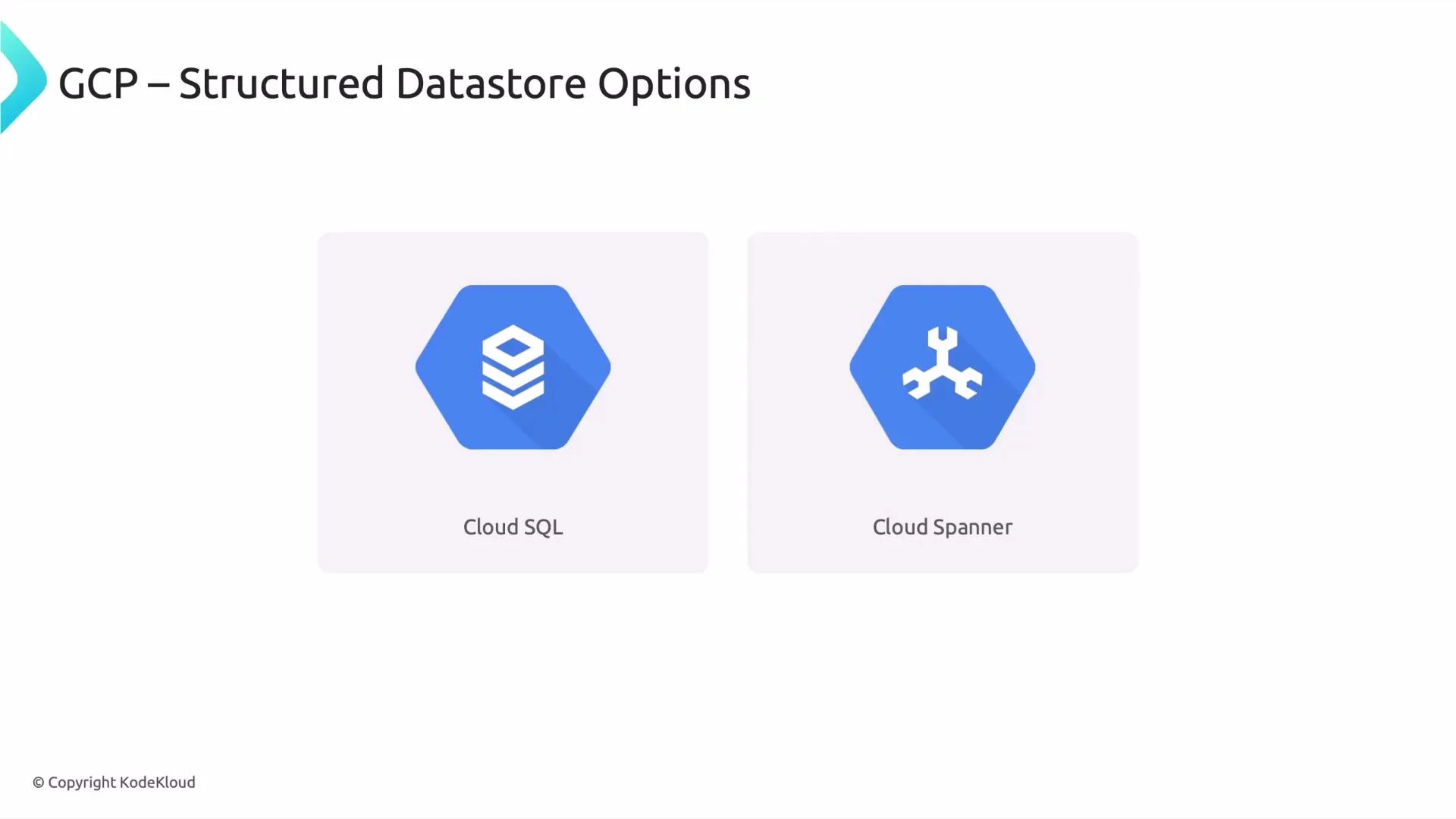
- Cloud SQL
- Cloud Spanner
Cloud SQL (Managed MySQL / PostgreSQL / SQL Server)
Cloud SQL is a fully managed relational database service that provides MySQL, PostgreSQL, and SQL Server instances. It is best suited for conventional OLTP workloads, small-to-medium scale applications, and lift-and-shift migrations where application compatibility and familiar relational features are important. Key characteristics:- Engines: MySQL, PostgreSQL, SQL Server
- Scaling: Vertical scaling (increase machine size); supports read replicas for read scaling
- High availability: Regional high-availability with automated failover to a standby in a different zone
- Operational features: Automated backups, patching, maintenance windows, point-in-time recovery
- Use cases: Web apps, content management systems, single-region transactional workloads, legacy RDBMS migrations
- Not designed for transparent global horizontal scaling
- Cross-region synchronous replication and globally consistent transactions are not native features
Cloud Spanner (Horizontally scalable, globally distributed RDBMS)
Cloud Spanner is Google’s fully managed, horizontally scalable relational database combining relational schema and SQL semantics with global distribution and strong consistency. It is designed for large-scale transactional systems that require global availability and low-latency reads/writes across regions. Key characteristics:- Scaling: Horizontal scaling across nodes and regions
- Consistency: Strong (external) consistency using Google’s TrueTime
- Availability: Built-in multi-region configurations for high availability
- Transactions: Distributed ACID transactions at global scale
- Use cases: Global financial systems, large-scale OLTP, gaming backends with cross-region users, inventory/order systems with global consistency needs
- Higher cost for small workloads compared with Cloud SQL
- Different operational model and SQL dialect nuances compared with standard MySQL/Postgres
Which one to pick? — Quick guidance
- Use Cloud SQL when you need:
- A managed MySQL/PostgreSQL/SQL Server instance
- Single-region transactional workloads or lift-and-shift of existing apps
- Simpler operations and lower cost for small-to-medium workloads
- Use Cloud Spanner when you need:
- Horizontal scalability across nodes and regions
- Global consistency with low-latency reads/writes across multiple regions
- Built-in high availability and distributed transactions at scale
When exam or architecture keywords include global scale, horizontal scalability, multi-region availability, or strong transactional consistency at scale, Cloud Spanner is usually the intended choice. For traditional relational needs, compatibility with existing MySQL/Postgres apps, or simpler operational requirements, Cloud SQL is the common answer.
Feature comparison (at a glance)
Decision checklist
- Does your app require multi-region global consistency? → Cloud Spanner
- Do you need a managed MySQL/Postgres instance for compatibility? → Cloud SQL
- Is your workload small-to-medium and single-region? → Cloud SQL
- Do you expect massive scale with distributed transactions? → Cloud Spanner
Links and references
- Cloud SQL Documentation
- Cloud Spanner Documentation
- Choosing a database: Cloud SQL vs Cloud Spanner (GCP whitepaper)