

- Scope: Compare primary goals, outcomes, and appropriate use cases for Data Catalog and Dataplex.
- Goal: Help you choose the right tool for metadata discovery, tagging, governance, monitoring, and policy enforcement across Google Cloud data platforms (BigQuery, Cloud Storage, streaming sources).
- Audience: Data engineers, data stewards, security/ compliance teams, and cloud architects designing governed data platforms.
-
Data Catalog — metadata discovery and classification
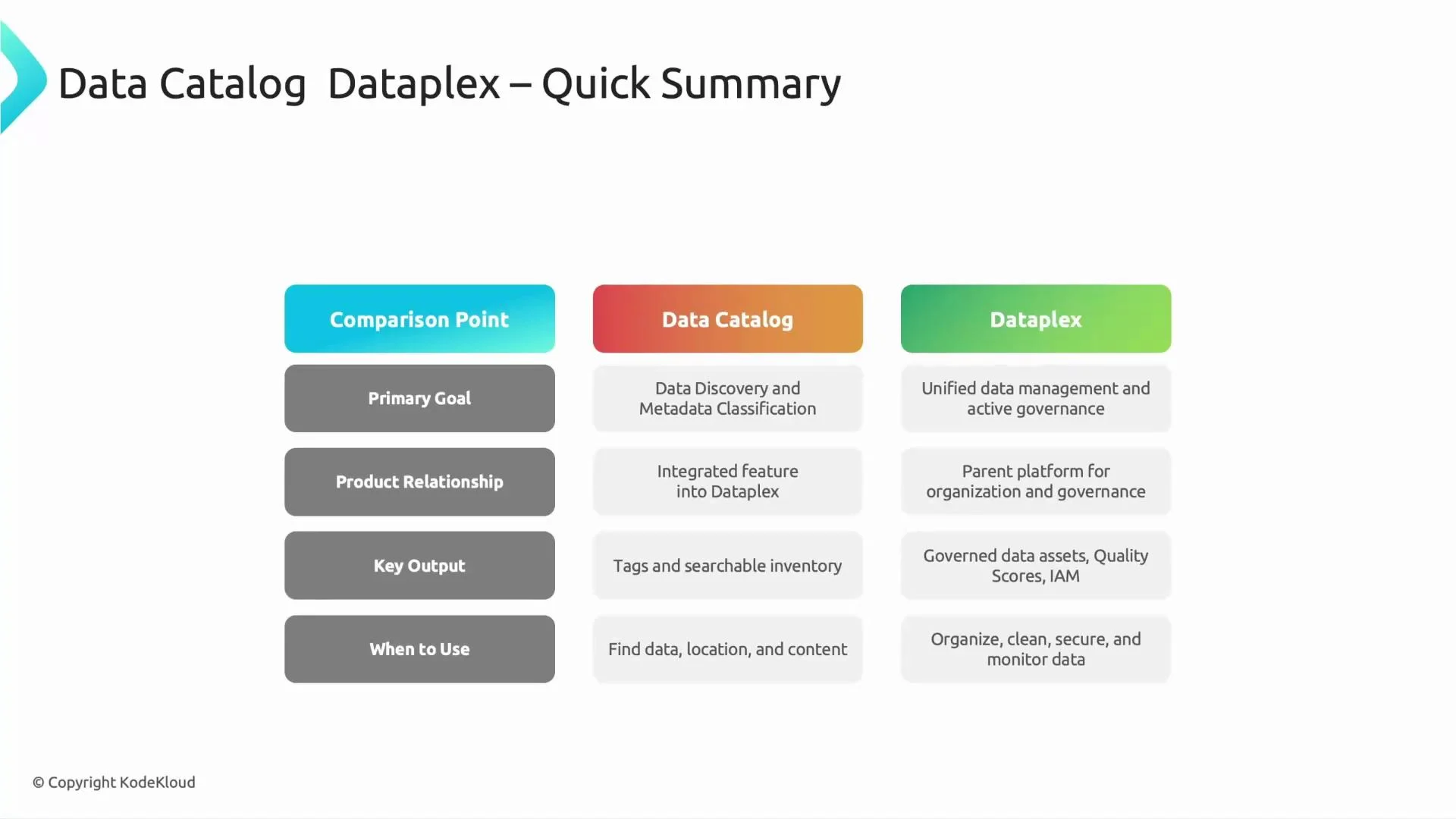
- Purpose: Provide a searchable metadata inventory and flexible tagging system so users can discover datasets, tables, columns, and other assets across Google Cloud.
- Core capabilities: Asset discovery, schema inspection, custom tags, policy tags (PII/sensitivity), and search across projects.
- Use case example: An analyst or ML engineer locating the latest BigQuery table or identifying the column that contains email addresses.
-
Dataplex — unified data management and active governance
- Purpose: Organize data into lakes, zones, and domains; apply governance policies; monitor data quality and lineage; and automate operational controls across distributed storage and compute.
- Core capabilities: Zone/domain organization, policy enforcement (IAM, data access), automatic discovery (via Data Catalog), data quality checks, lineage, and lifecycle automation.
- Use case example: Enforcing consistent IAM settings and quality checks across Cloud Storage and BigQuery before datasets are available for analytics.
- Dataplex is a higher-level governance and operational platform that leverages Data Catalog for metadata inventory, tagging, and discovery.
Data Catalog provides the searchable metadata inventory and tagging system; Dataplex uses that capability as part of its broader governance and policy enforcement workflows.
Key outputs and deliverables
-
Data Catalog
- Searchable metadata catalog of datasets, tables, columns, and other assets.
- Custom tags and policy tags that describe ownership, sensitivity, and business context.
- Faster discovery for analysts and ML engineers (reduce time-to-insight).
-
Dataplex
- Governed domains with consistent IAM, lifecycle, and quality controls.
- Observability: data quality scores, automated checks, and lineage for trust signals.
- Automated enforcement workflows so data is production-ready and compliant.
-
Choose Data Catalog when you need to:
- Quickly locate datasets or specific columns across projects.
- Discover dataset owners, schemas, and descriptions.
- Tag columns that contain PII and index business metadata for search.
- Example: A new ML engineer must find and inspect the training dataset and its tagged PII columns.
-
Choose Dataplex when you need to:
- Govern and monitor datasets across many zones, storage types, or domains.
- Enforce access controls, lifecycle rules, and automated data quality checks.
- Provide centralized observability (lineage, quality scores) and operational enforcement.
- Example: Ensuring each dataset in Cloud Storage adheres to IAM policies and quality thresholds before downstream consumption.
-
Q: You need to ensure every dataset in Cloud Storage has the correct access permissions and data quality checks before analytic teams use it. Which platform enforces that automatically?
A: Dataplex. -
Q: You want to tag a BigQuery column containing PII (e.g., email addresses). Where do these tags live?
A: Tags are stored in Data Catalog (and are accessible when Dataplex uses them for governance). -
Q: How does an organization prove that data in a dashboard is accurate and trustworthy?
A: Dataplex provides governance signals — data quality scores, lineage, and policy enforcement — to demonstrate trustworthiness.
- Data Catalog helps you find and describe data; Dataplex helps you organize, secure, and actively govern it.
- Google Cloud Data Catalog: https://cloud.google.com/data-catalog
- Google Cloud Dataplex: https://cloud.google.com/dataplex
- Google Cloud documentation (general): https://cloud.google.com/docs