

What is Cloud Workflows?
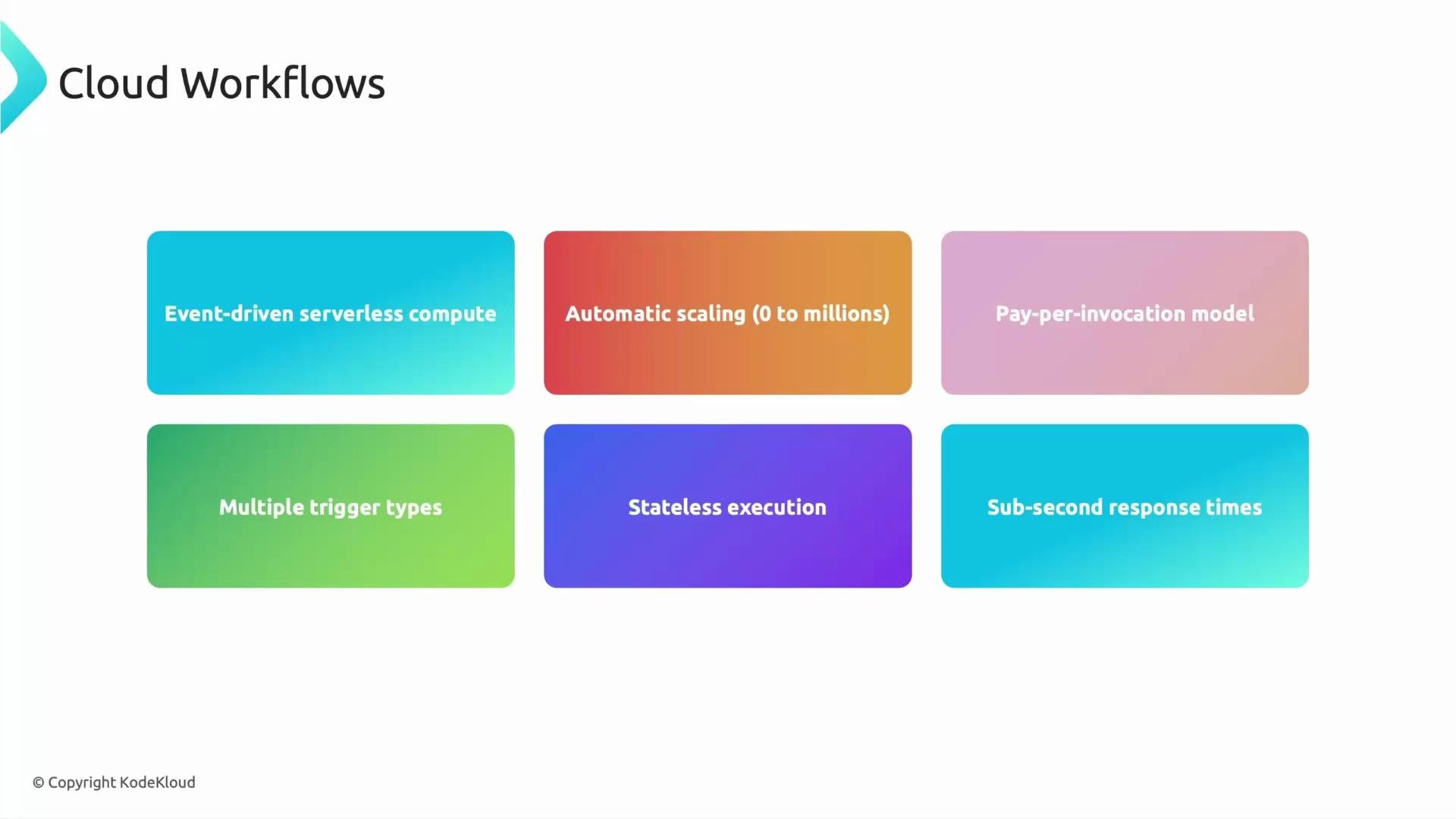
Cloud Workflows is a serverless, event-driven orchestration service that sequences API and microservice calls as a single, maintainable execution. It’s ideal for application-level orchestration, business processes, and API sequencing where you want minimal operational overhead. Key capabilities- Event-driven, serverless execution: run workflows in response to HTTP requests, Pub/Sub events, Cloud Scheduler, and other triggers.
- Automatic scaling: scales from zero to meet demand — no capacity planning.
- Pay-per-invocation billing: you pay for workflow executions and steps.
- Multiple triggers: HTTP, Pub/Sub, Cloud Scheduler, and integrations with other Google Cloud services.
- Isolated, stateless executions: each run is independent; step-to-step data belongs to the execution.
- Fast startup: low latency for user-facing orchestrations.
A concise exam-style answer: Cloud Workflows is serverless orchestration because it is event-driven, auto-scales from zero, supports multiple triggers, bills per execution, and requires no server or VM management.
When to use Cloud Workflows
- Orchestrate ordered API calls that pass intermediate data between steps.
- Implement multi-step business processes (e.g., order processing) with conditional logic, retries, and error handling.
- Coordinate microservices without building or managing orchestration infrastructure.
- Replace brittle function chains with readable, maintainable orchestration logic.
Why not just use a single Cloud Function?
- Cloud Functions are stateless and have execution-time limits; chaining complex logic across many steps quickly becomes hard to maintain.
- Workflows provides explicit sequencing, in-execution data passing, retry policies, and structured branching — all in one place.
- Use Cloud Functions for single-purpose handlers and short-running tasks; use Workflows to coordinate those functions as part of a larger process.
Composer vs Workflows — short comparison
Use Cloud Composer (Apache Airflow) when:- You need complex, scheduled, data-oriented pipelines.
- DAG-centric orchestration and heavy data-engineering integrations are required.
- You need lightweight, serverless orchestration of APIs and microservices.
- You prefer pay-per-execution pricing and minimal operational overhead.
Cloud Functions vs Workflows — clear differences
Short scenario (example)
Placing an online order orchestration:- Workflow receives an order event.
- Call payment API and wait for confirmation.
- If payment succeeds, call inventory API.
- If inventory is available, call shipment API and notify the customer.
- If any step fails, perform retries or compensation actions (e.g., refund).
Minimal example — YAML workflow
Below is a simple illustrative YAML workflow that sequences two HTTP calls and handles a conditional response. This sample shows the high-level structure (steps, calls, and branching).Quick troubleshooting and tips
- Use step-level retries and exponential backoff for transient failures.
- Keep sensitive data out of logs; use Secret Manager and proper IAM roles.
- Visualize execution traces in the Cloud Console to debug step-by-step failures.
- Test each API call independently before composing them into a workflow.
Comparison table (Composer, Workflows, Functions)
Links and references
- Cloud Workflows documentation
- Cloud Workflows pricing
- Cloud Composer (Apache Airflow)
- Cloud Functions documentation
- Composer for complex, scheduled data pipelines;
- Workflows for application-level orchestration and API sequencing;
- Cloud Functions for single-purpose, event-driven compute.