

- Creates a landing zone: a secure, well-architected foundation for a multi-account AWS Organization.
- Builds a recommended account structure (for example: management, log archive, audit, sandbox, test, staging, prod) and groups accounts into Organizational Units (OUs).
- Configures centralized Single Sign-On via AWS IAM Identity Center.
- Provides an Account Factory that automates provisioning of new accounts with baseline configurations and enforced guardrails.
- Allows you to import existing AWS accounts into the Control Tower-managed Organization for centralized governance.
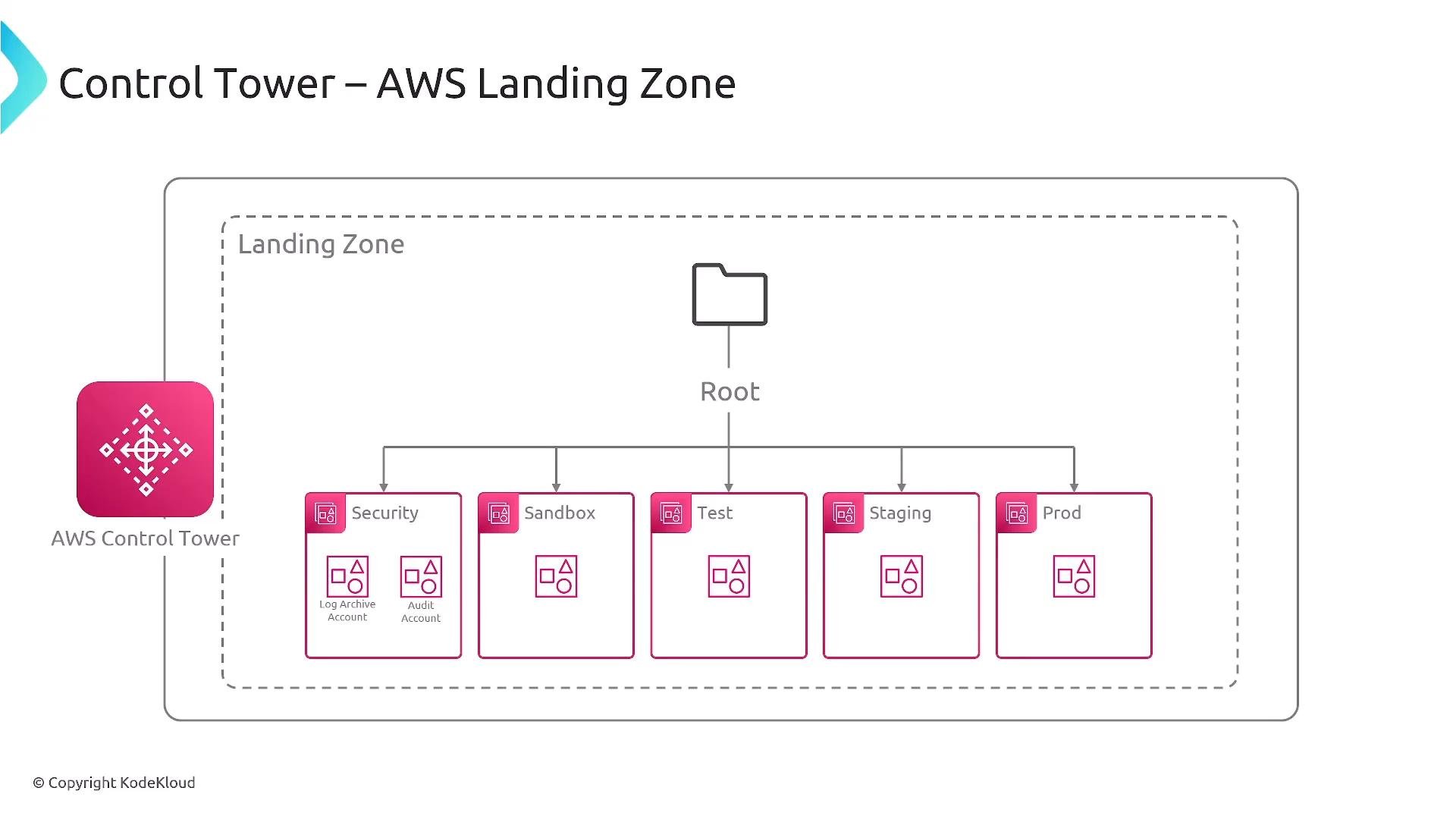
Key components and benefits
- Landing zone: A pre-configured environment that accelerates secure account adoption.
- Account Factory: Automates account provisioning with baseline guardrails and network/security settings.
- IAM Identity Center (SSO): Centralizes user and role assignment across accounts and OUs.
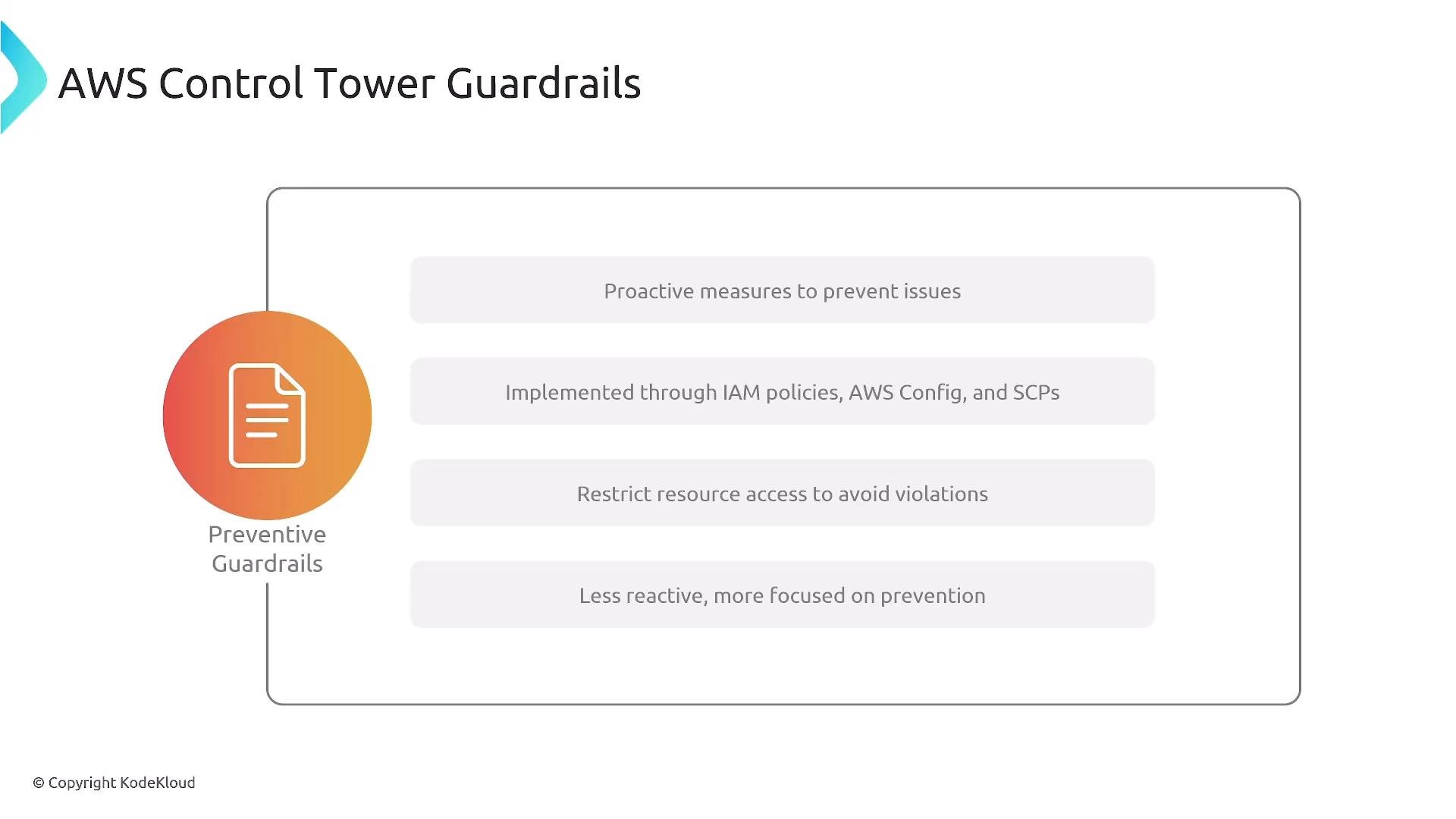
- Guardrails: High-level rules implemented as Service Control Policies (SCPs), IAM policies, and AWS Config rules to enforce governance.
Guardrails are implemented using a combination of AWS Config rules, IAM policies, and Service Control Policies (SCPs). They can be applied at the Organizational Unit (OU) level so the same controls apply to every account placed in that OU.
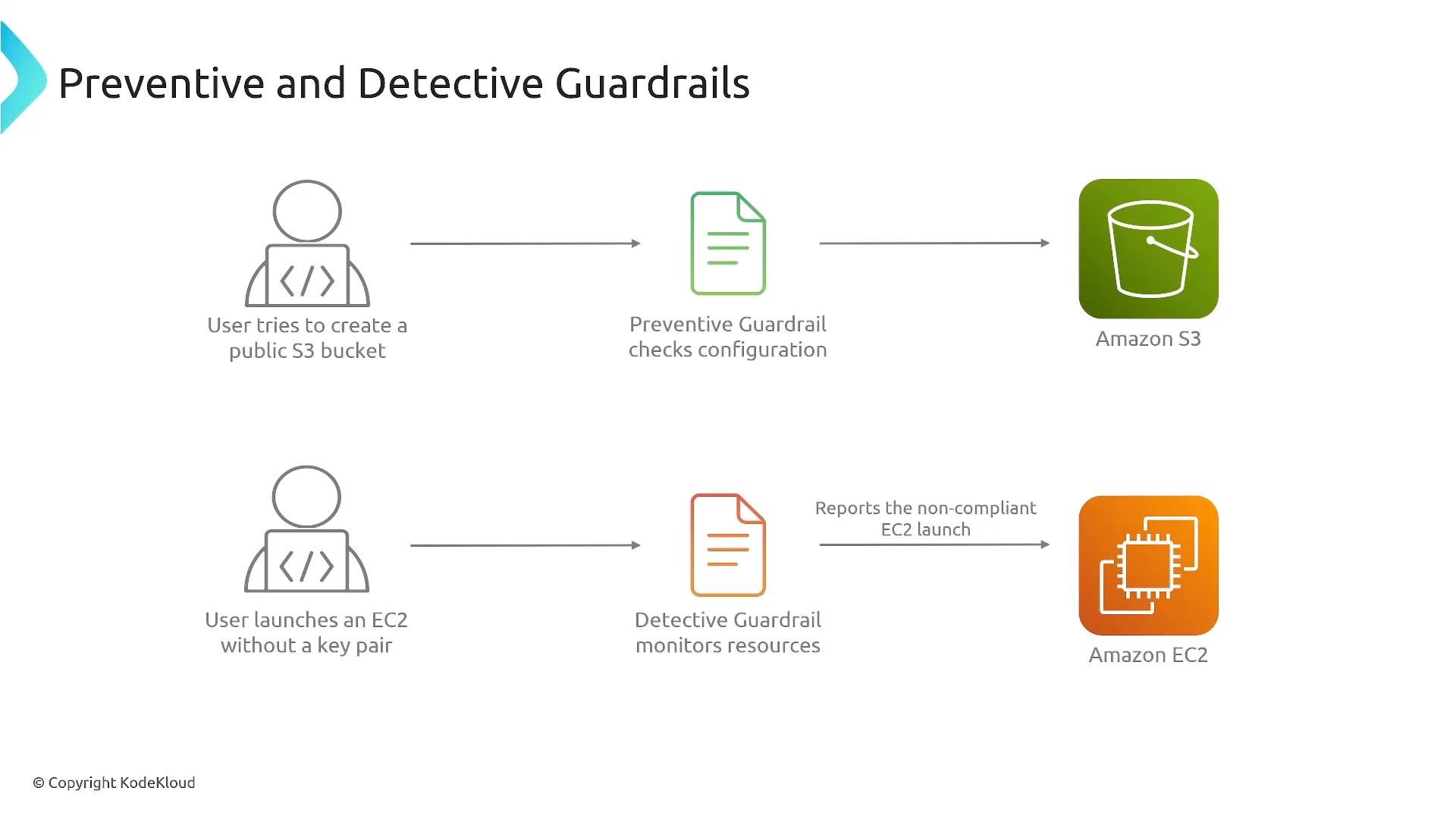
- Purpose: Proactively block disallowed actions to prevent misconfiguration or insecure resources.
- How: Implemented as SCPs or IAM policies that stop operations before they occur.
- Examples: blocking public S3 buckets, restricting certain regions, preventing changes to centralized logging.
- Purpose: Monitor, detect, and report configuration drift or suspicious activities; provide visibility and forensics without necessarily blocking actions.
- How: Implemented via AWS Config rules, CloudWatch Events, and integrated logging/alerting to surface violations for remediation.
- Examples: detecting an EC2 instance launched without a key pair, identifying publicly accessible S3 buckets, or flagging resources created outside approved regions.
- Account Factory (account vending) automates standard account creation: it provisions accounts into the correct OU, applies required baseline configurations (networking, logging, security), and ensures guardrails are attached.
- AWS IAM Identity Center (formerly AWS Single Sign-On) integrates with Control Tower so you can centrally provision user access and assign cross-account roles without creating separate IAM users in each account.
- Control Tower delivers a repeatable, well-architected multi-account baseline that enforces governance through preventive and detective guardrails.
- It centralizes security and logging, simplifies provisioning, and reduces drift by standardizing how accounts are configured and monitored.
- Existing accounts can be imported into Control Tower to bring legacy resources under the same governance model.
- AWS Control Tower documentation: https://docs.aws.amazon.com/controltower/latest/userguide/what-is-control-tower.html
- AWS Organizations: https://docs.aws.amazon.com/organizations/latest/userguide/orgs_introduction.html
- IAM Identity Center (SSO): https://docs.aws.amazon.com/singlesignon/latest/userguide/what-is.html