

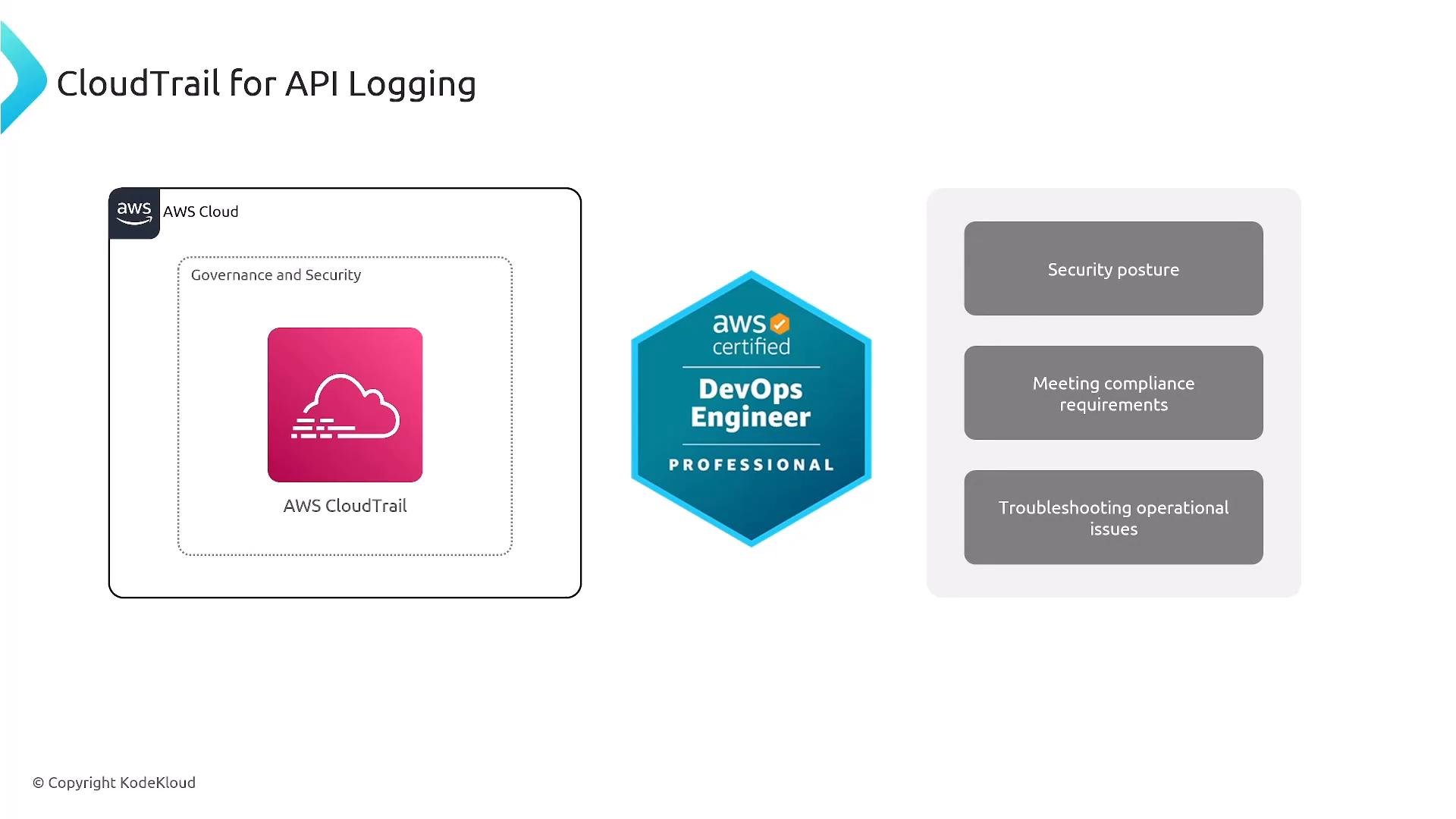
- Security auditing: detect unauthorized or unexpected API activity and track principals, source IPs, and request parameters.
- Compliance evidence: provide tamper-evident, provable logs for auditors (retainable and verifiable).
- Troubleshooting and forensics: reconstruct operational incidents, changes, and root causes by reviewing API call history.
- Management events (control plane) record operations that manage AWS resources (for example: CreateBucket, RunInstances, DeleteDBInstance, CreateFunction). These are the default, primary audit source for account governance.
- Data events (data plane) capture resource-level activity such as S3 object-level operations (GetObject, PutObject, DeleteObject), Lambda function invocations, DynamoDB item-level operations, and API Gateway executions. These provide fine-grained visibility but are opt‑in.
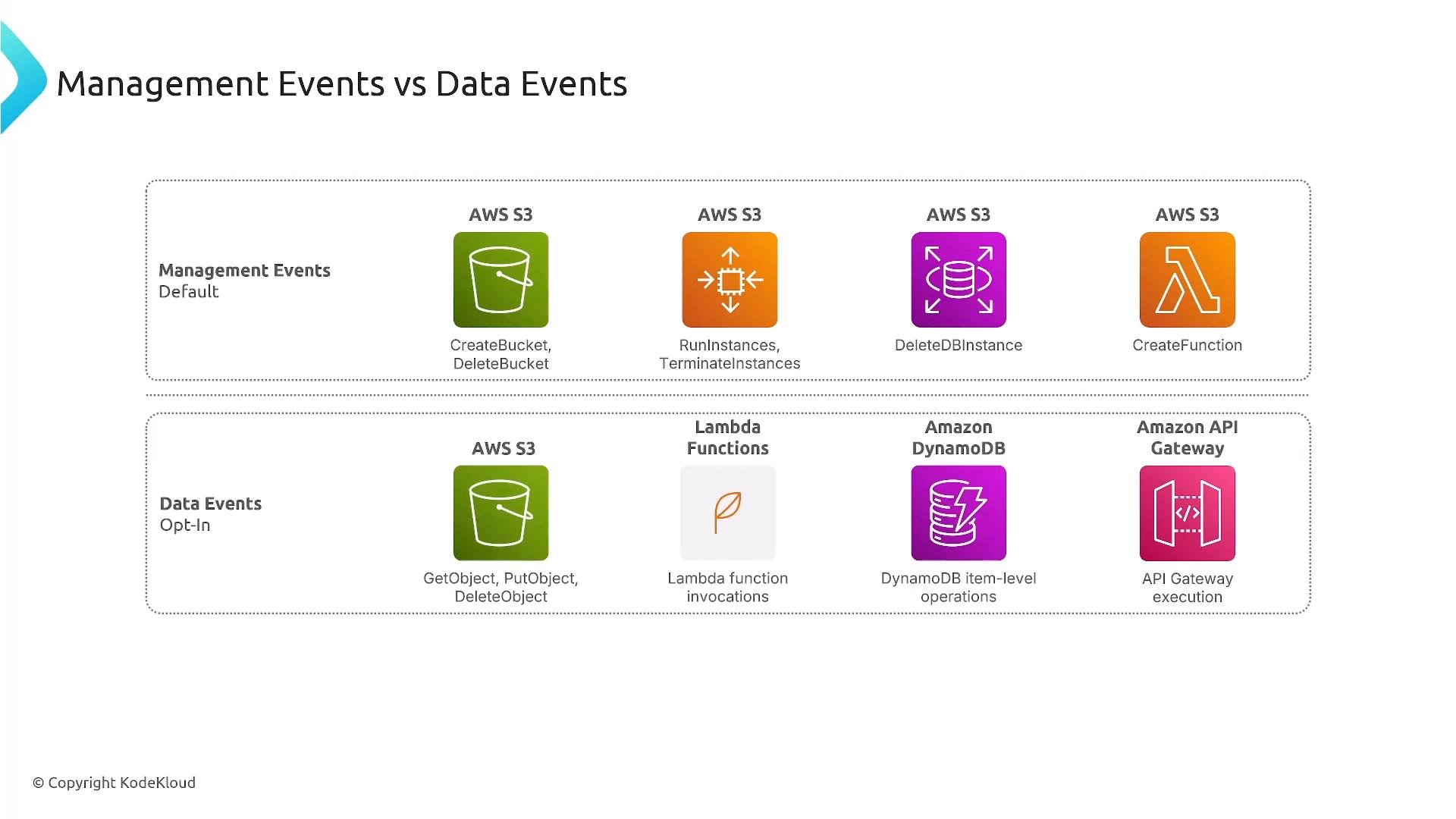
Management events are the primary audit source for governance. Data events are not logged by default and must be explicitly enabled (opt-in) when you need detailed, per-object or per-item tracking.
- CloudTrail Event history in the console provides a 90‑day view of management events even if you haven’t created a trail.
- For long‑term retention, secure storage, cross-account aggregation, and data events, create a trail and configure delivery (S3 and optionally CloudWatch Logs).
- For exams and operational planning: management events = default; data events = opt‑in and cost extra.
Organization-wide (multi-account) logging
For enterprises, use a centralized organization trail that collects CloudTrail events from all AWS Organization member accounts. Benefits:
- Automatic coverage for existing and newly created member accounts.
- Centralized delivery to a single S3 bucket for retention and analysis.
- Simplified operations and consistent retention/access controls.
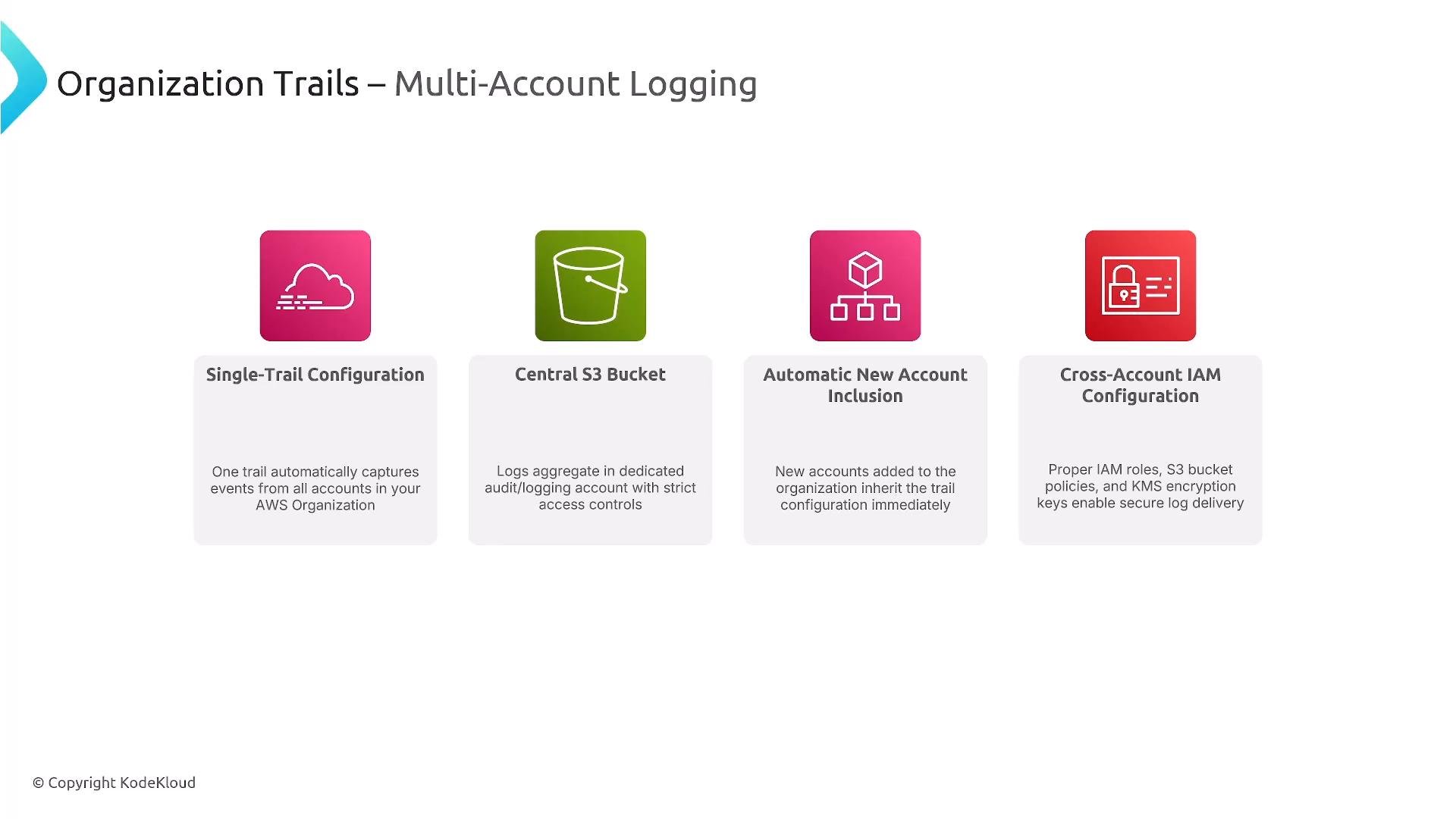
- Centralization reduces management overhead and standardizes retention and access controls.
- Apply least-privilege IAM roles for log delivery and restrict who can list/read buckets and decrypt logs via KMS.
- Use a dedicated KMS key for CloudTrail encryption; manage key policies so only required principals can use the key for log delivery and decryption.
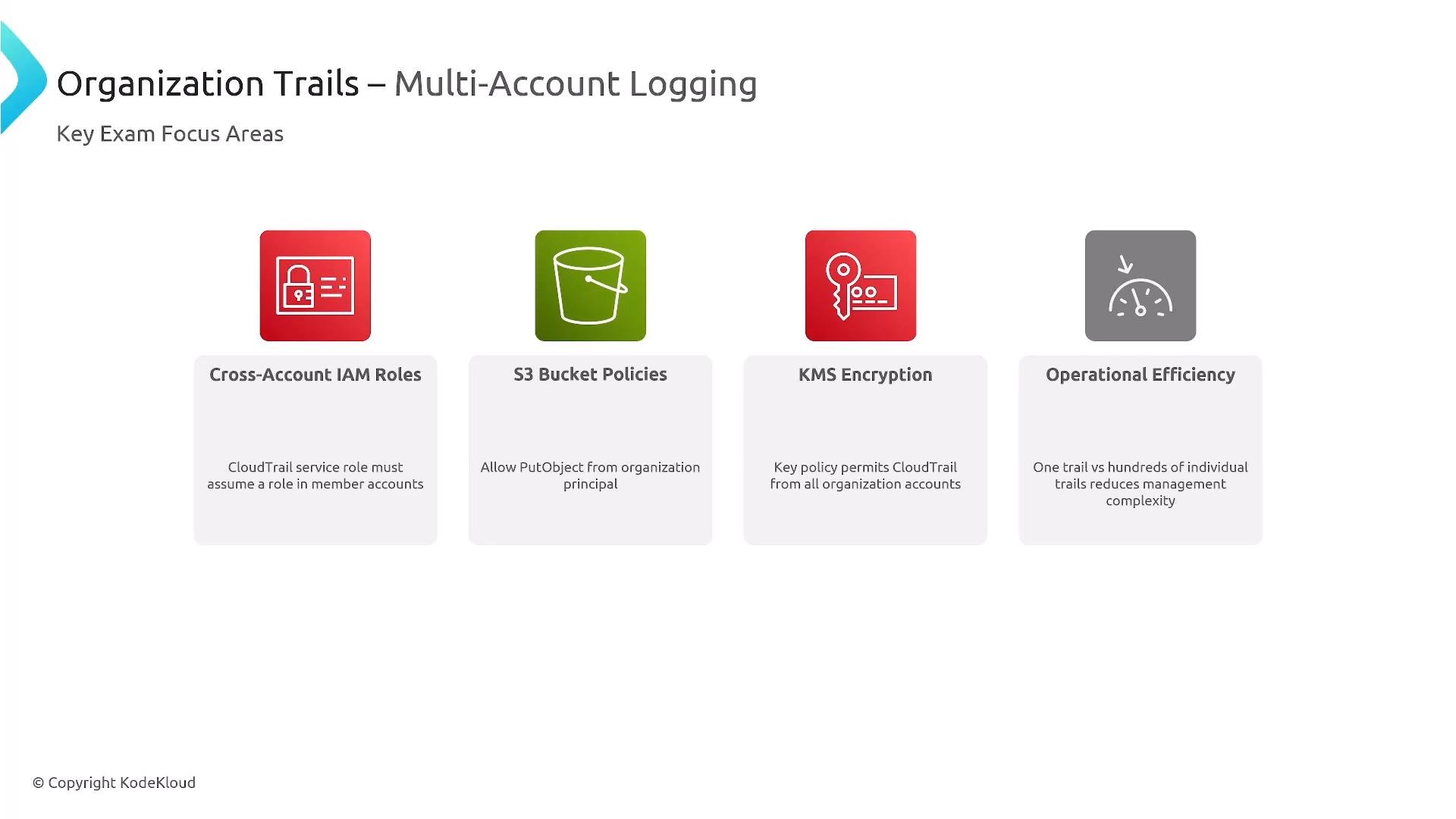
When centralizing logs, ensure cross-account permissions are strictly limited. Misconfigured bucket policies or overly permissive KMS access can expose sensitive audit data or allow unauthorized tampering.
- Enable log file validation when you create the trail to generate verification digests.
- Use S3 Object Lock (WORM) and retention policies for immutable storage where compliance requires write-once-read-many.
- Archive long-term copies to governed stores (for example, S3 Glacier) and protect access via strict KMS and bucket policies.
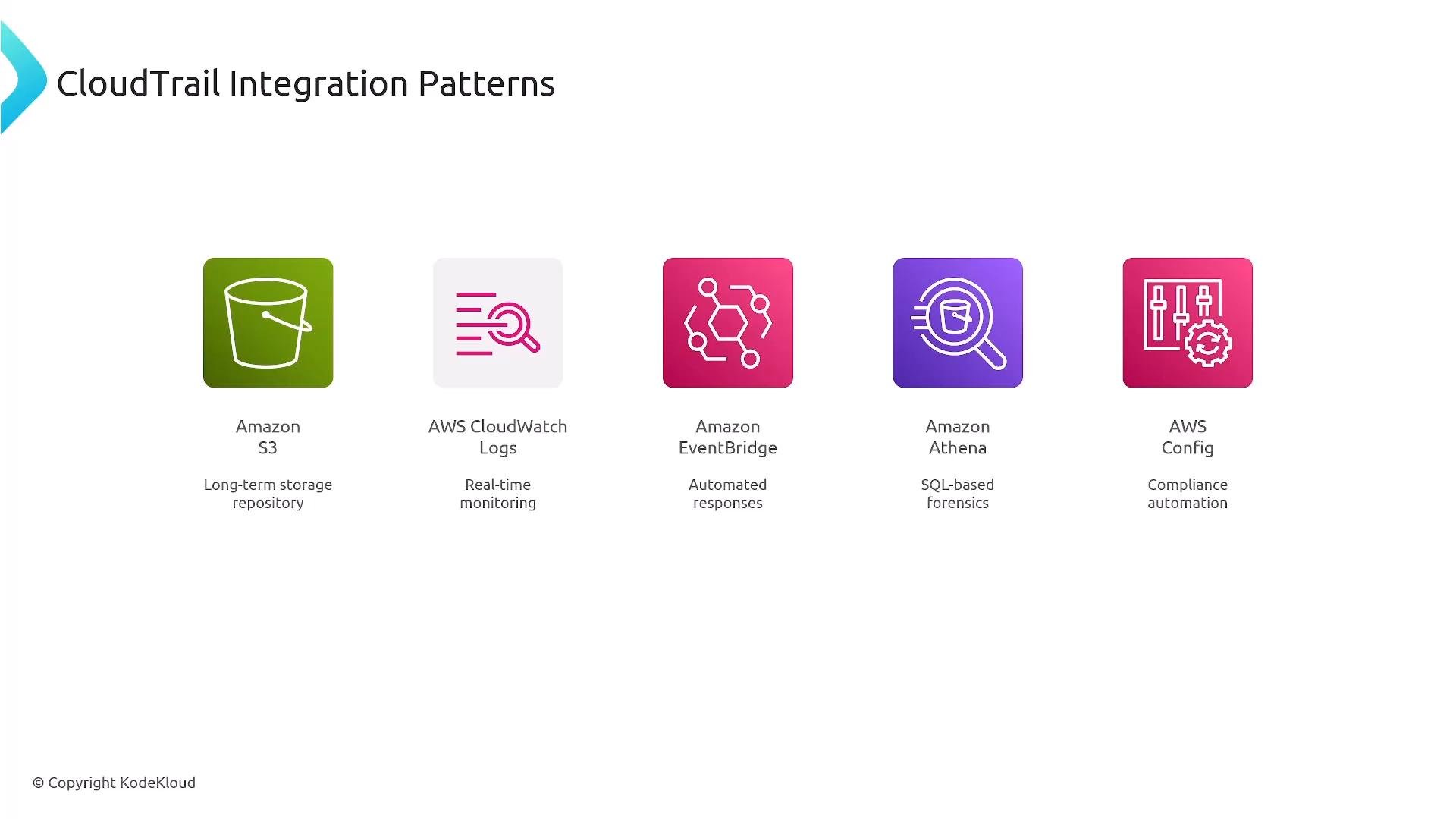
- S3 — long-term storage of delivered log files.
- CloudWatch Logs — stream logs for real-time monitoring and metric/alert generation.
- EventBridge (CloudWatch Events) — trigger automation (such as auto-remediation) from API activity.
- Athena — run SQL queries over logs delivered to S3 for ad-hoc forensics.
- AWS Config — complement CloudTrail with configuration snapshots and continuous compliance checks.
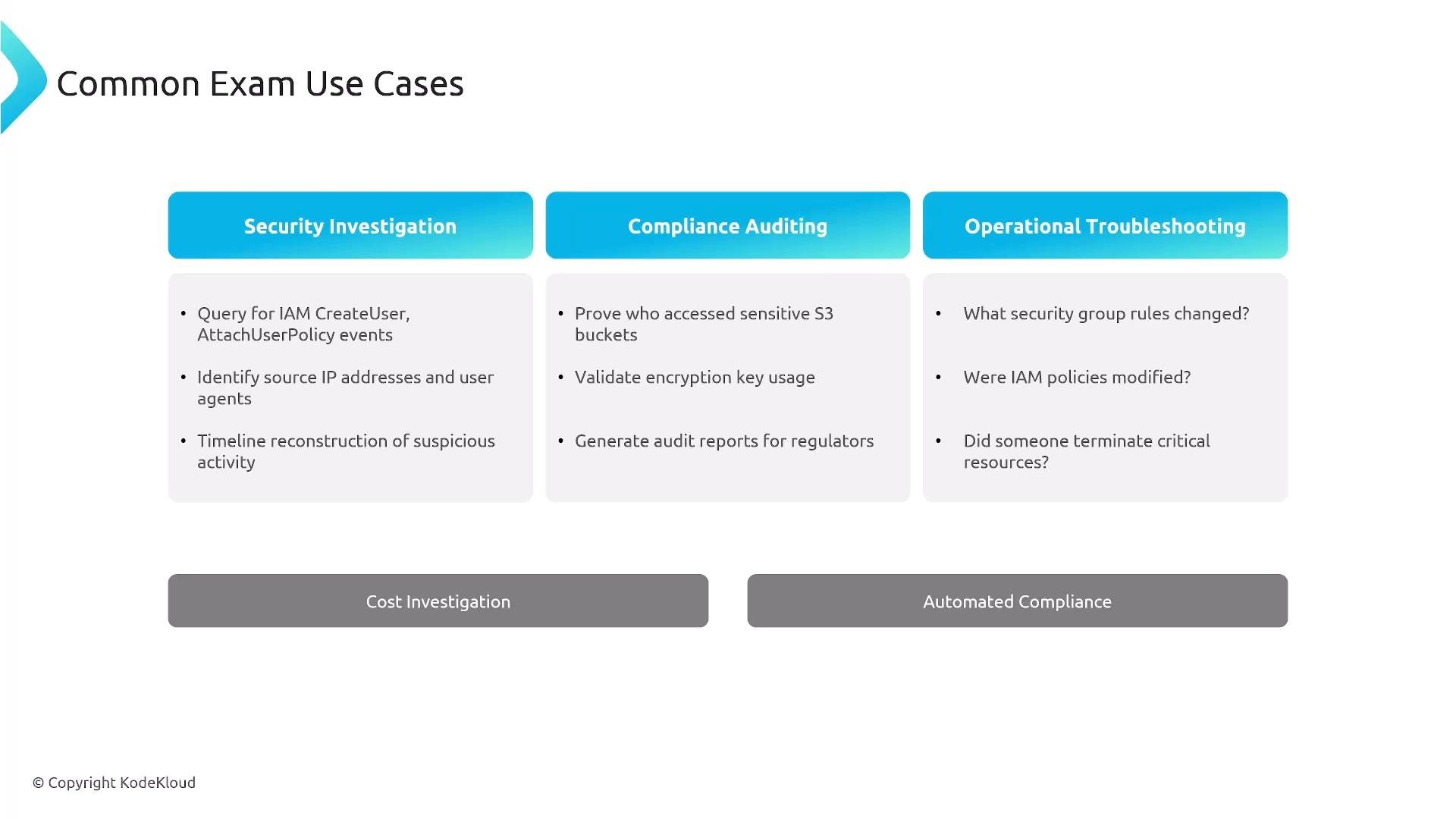
- Security investigations: review IAM changes, suspicious API calls, and source IPs during incident response.
- Compliance audits: produce an auditable trail of access and changes to sensitive resources.
- Operational troubleshooting: identify configuration changes, the actor behind an outage, or who modified a resource.
- Cost/change analysis: correlate resource creation with API calls to understand chargebacks or unexpected provisioning.
- Automated remediation/self-healing: use EventBridge + Lambda or Systems Manager runbooks to react to dangerous API actions (e.g., close an open security group).
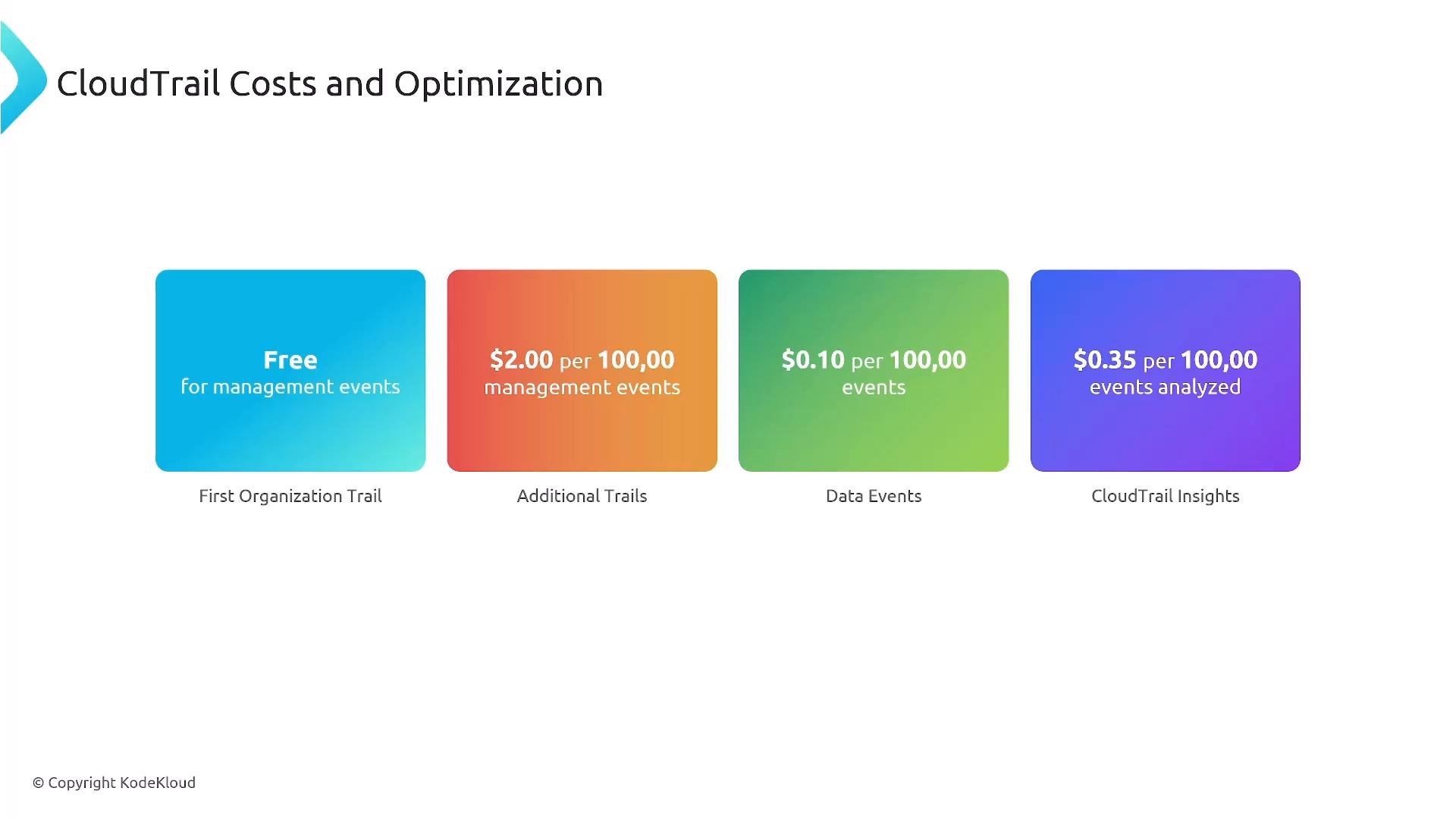
- The first organization trail commonly captures management events with no per-event charge in many scenarios (confirm current AWS terms). Additional trails and data events are billed separately.
- Data events and CloudTrail Insights incur additional charges.
- Cost optimization tips:
- Enable data events selectively (only for buckets, functions, or tables that require them).
- Consolidate trails where feasible to reduce per-trail overhead.
- Use lifecycle policies and Athena partitioning to reduce query costs.
Always confirm the latest pricing: https://aws.amazon.com/cloudtrail/pricing/
- Treat CloudTrail as a central control-plane audit source: enable organization trails to centralize multi-account logging and enforce retention and access policies.
- Enable data events only when you need object/item-level auditing and are prepared for the cost.
- Protect log integrity: enable log file validation and consider S3 Object Lock plus strict KMS policies for immutable storage.
- Integrate CloudTrail with CloudWatch Logs, EventBridge, Athena, and AWS Config to enable detection, automated response, and efficient forensic analysis.
- Document and test your cross-account roles, bucket policies, KMS keys, and lifecycle rules as part of your governance playbook.
- AWS CloudTrail documentation: https://docs.aws.amazon.com/cloudtrail
- AWS CloudTrail pricing: https://aws.amazon.com/cloudtrail/pricing/
- S3 Object Lock: https://docs.aws.amazon.com/AmazonS3/latest/userguide/object-lock.html
- AWS Security best practices and logging patterns (EventBridge, CloudWatch, Athena)