

Overview & exam logistics
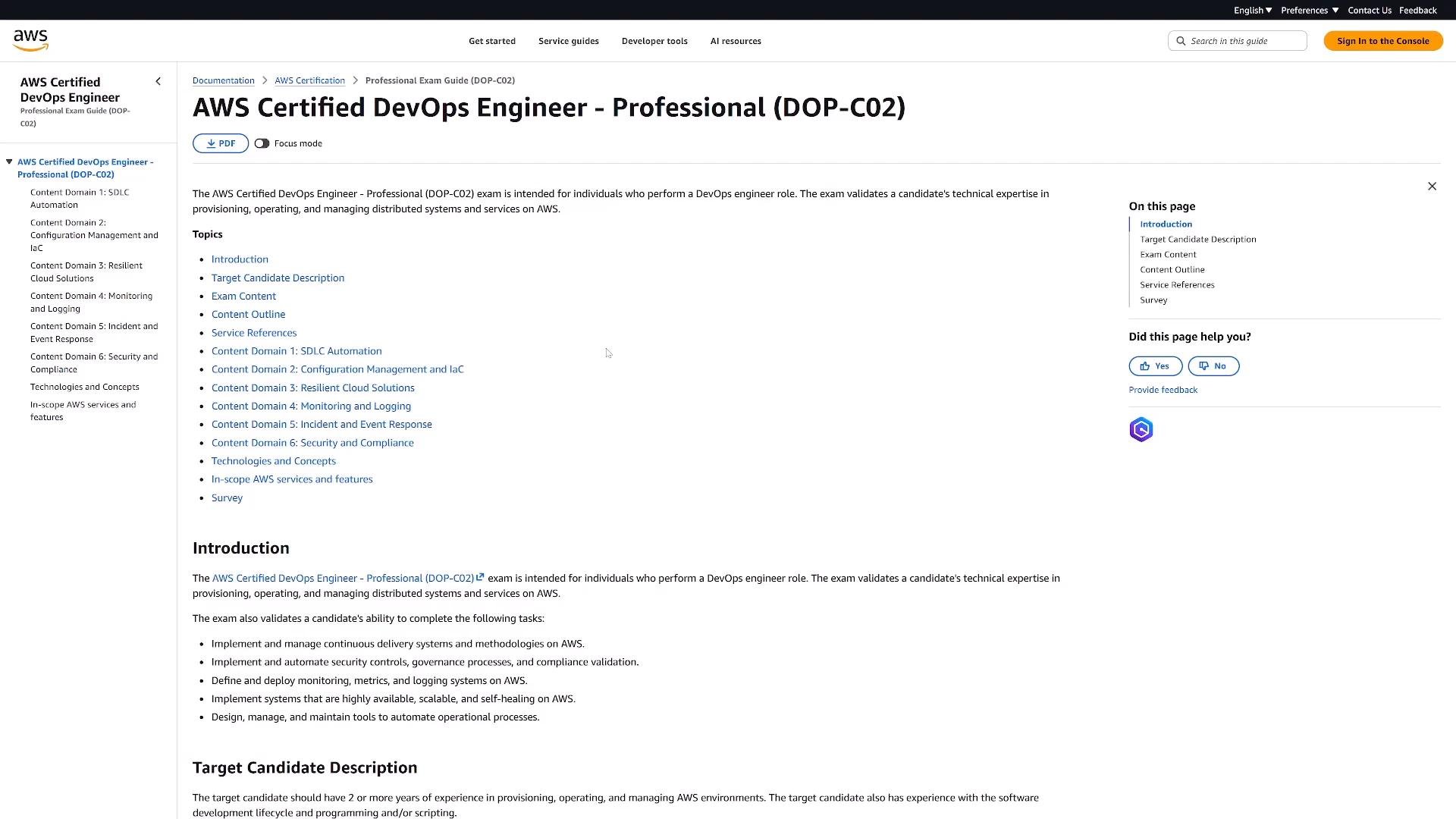
This section summarizes the exam format and logistics so you can plan study time, practice exams, and review.Tip: Memorize the exam format (question count and passing score) and use the official task statements as your study checklist — they define what the exam expects you to know.
How the guide is organized
The AWS exam guide is delivered as one consolidated document with anchor links to each domain. Each domain contains task statements and knowledge/skill bullets — these are the highest-value study targets because the exam is based on them, not on memorizing every service detail. Domain content is grouped by practical responsibilities: CI/CD, IaC, resiliency, monitoring, incident response, and security compliance. Below we break down each domain with focused study recommendations.Domain 1 — SDLC automation (CI/CD)
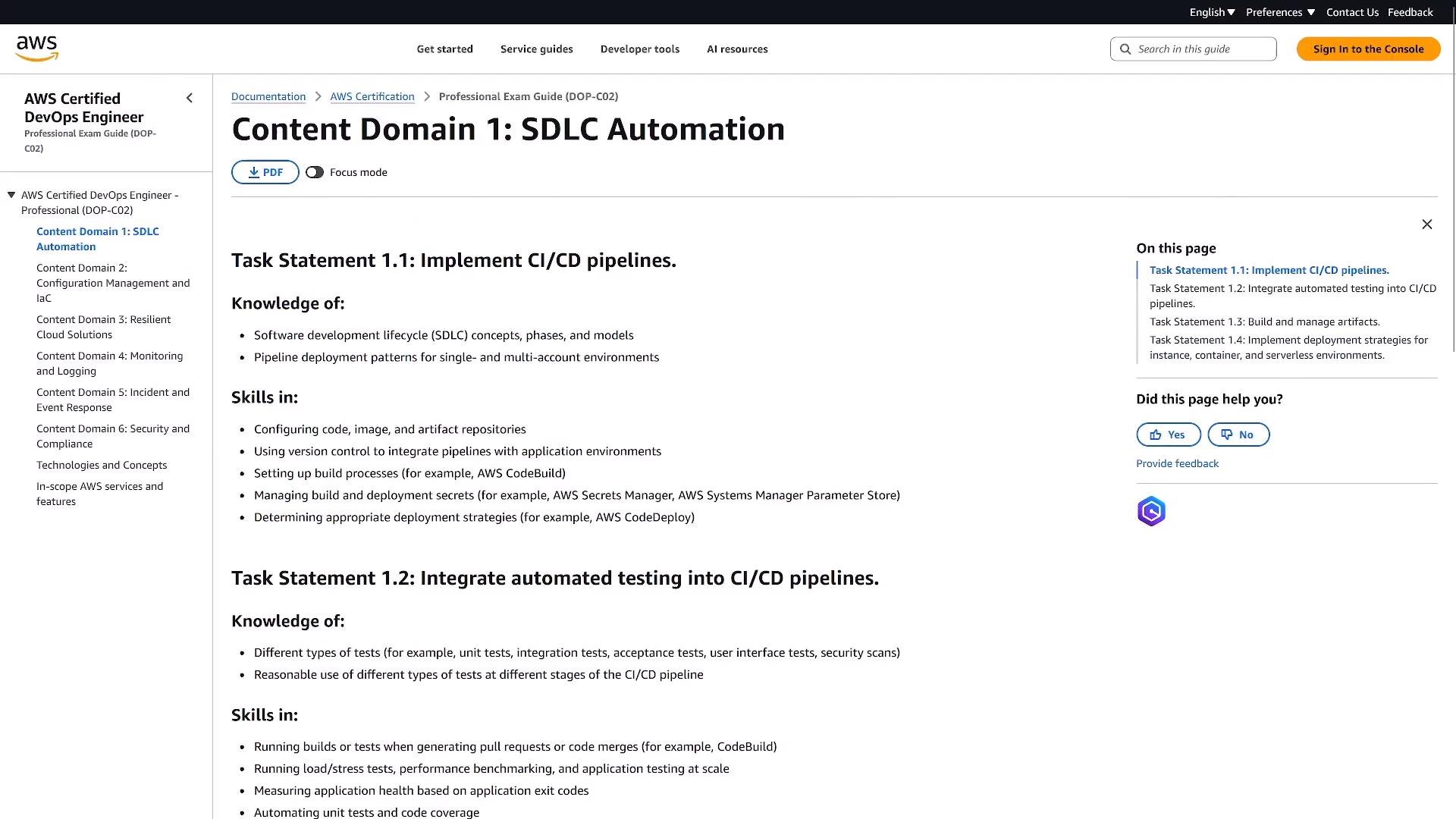
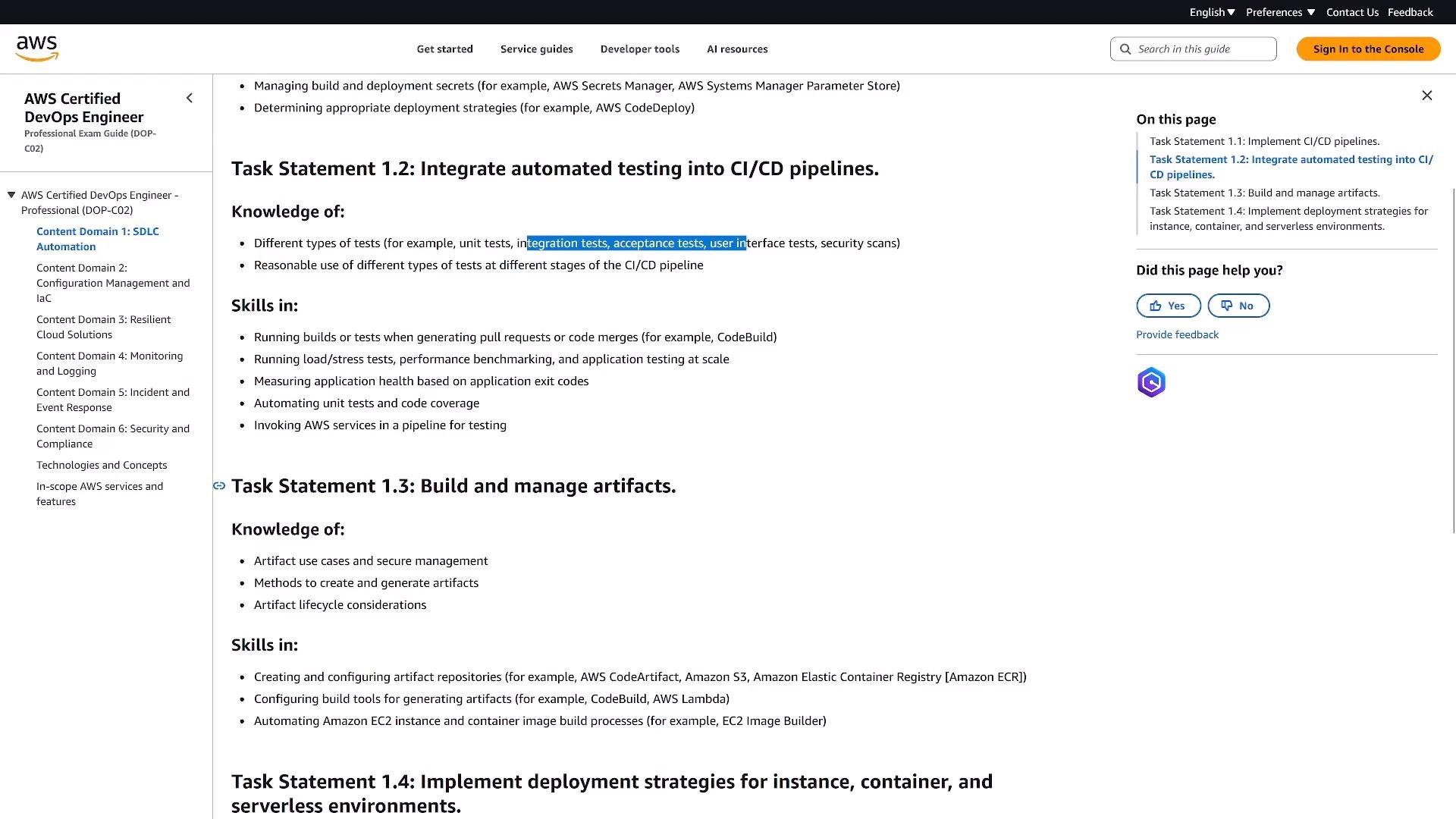
Focus on designing and implementing CI/CD pipelines, integrating automated testing, managing build artifacts, and choosing deployment strategies across EC2, containers, and serverless.- Core tasks: pipeline design, automated testing integration, artifact management and promotion, and deployment patterns (blue/green, canary, rolling).
- Services & features to map: AWS CodeBuild (build/test), Amazon ECR (container registry + image scanning), AWS CodeArtifact (artifact repository), CodePipeline, and how CI/CD maps to Lambda, ECS, EKS, and EC2.
- Study suggestions: practice scenario-based questions that require choosing the right pipeline components and artifact promotion strategies for different workloads.
Domain 2 — Configuration management & Infrastructure as Code (IaC)
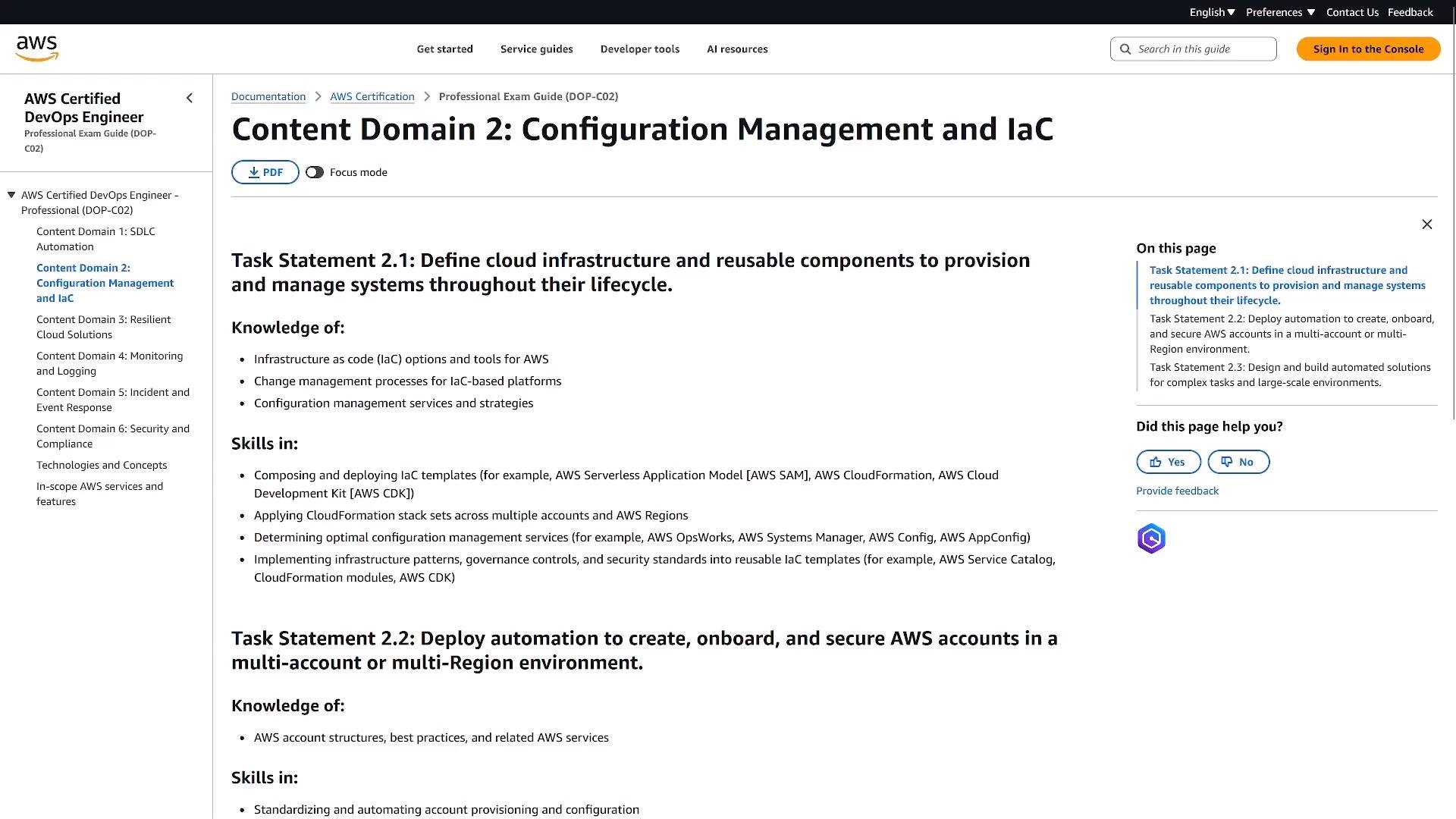
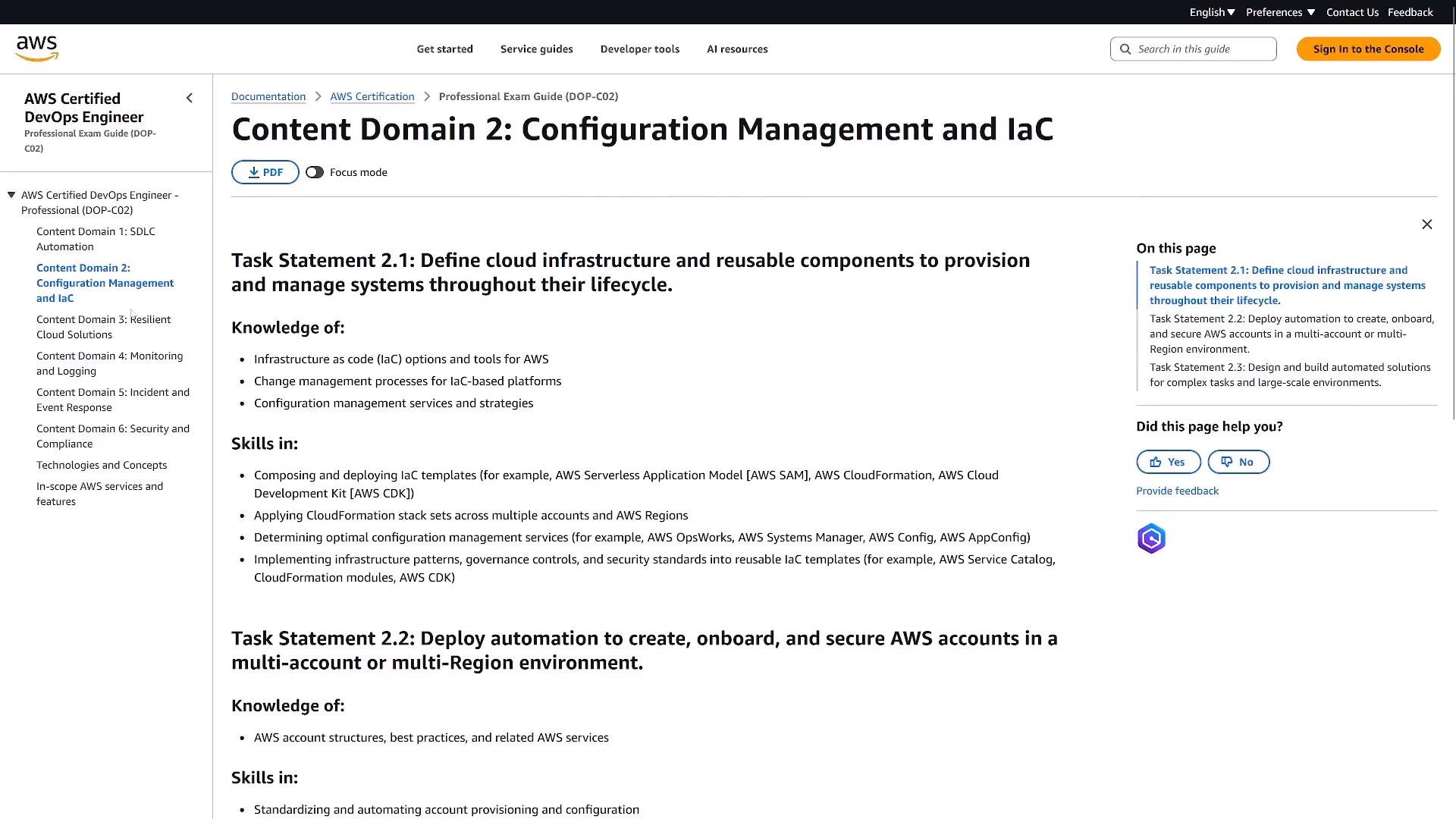
Focus on authoring and managing infrastructure using IaC and configuration automation across accounts and regions.- Core tasks: authoring templates, deploying at scale, cross-account and multi-region automation, drift detection, and repeatable deployments.
- Technologies to focus on: AWS CloudFormation, AWS CDK, CloudFormation StackSets, AWS Systems Manager (including Parameter Store and Automation), AWS Config, AppConfig, and AWS Service Catalog.
- Study suggestions: understand typical IaC workflows, drift remediation patterns, and how to implement change management across accounts.
Domain 3 — Resiliency (High availability, scaling, and recovery)
Design highly available, scalable systems and implement automated recovery and disaster recovery strategies.- Core tasks: define RTO/RPO, select failover strategies, design multi‑AZ and multi‑Region architectures, apply Auto Scaling and load balancing, and plan graceful degradation.
- Study suggestions: practice designing architectures that meet specified availability and recovery objectives for varied workload types and constraints.
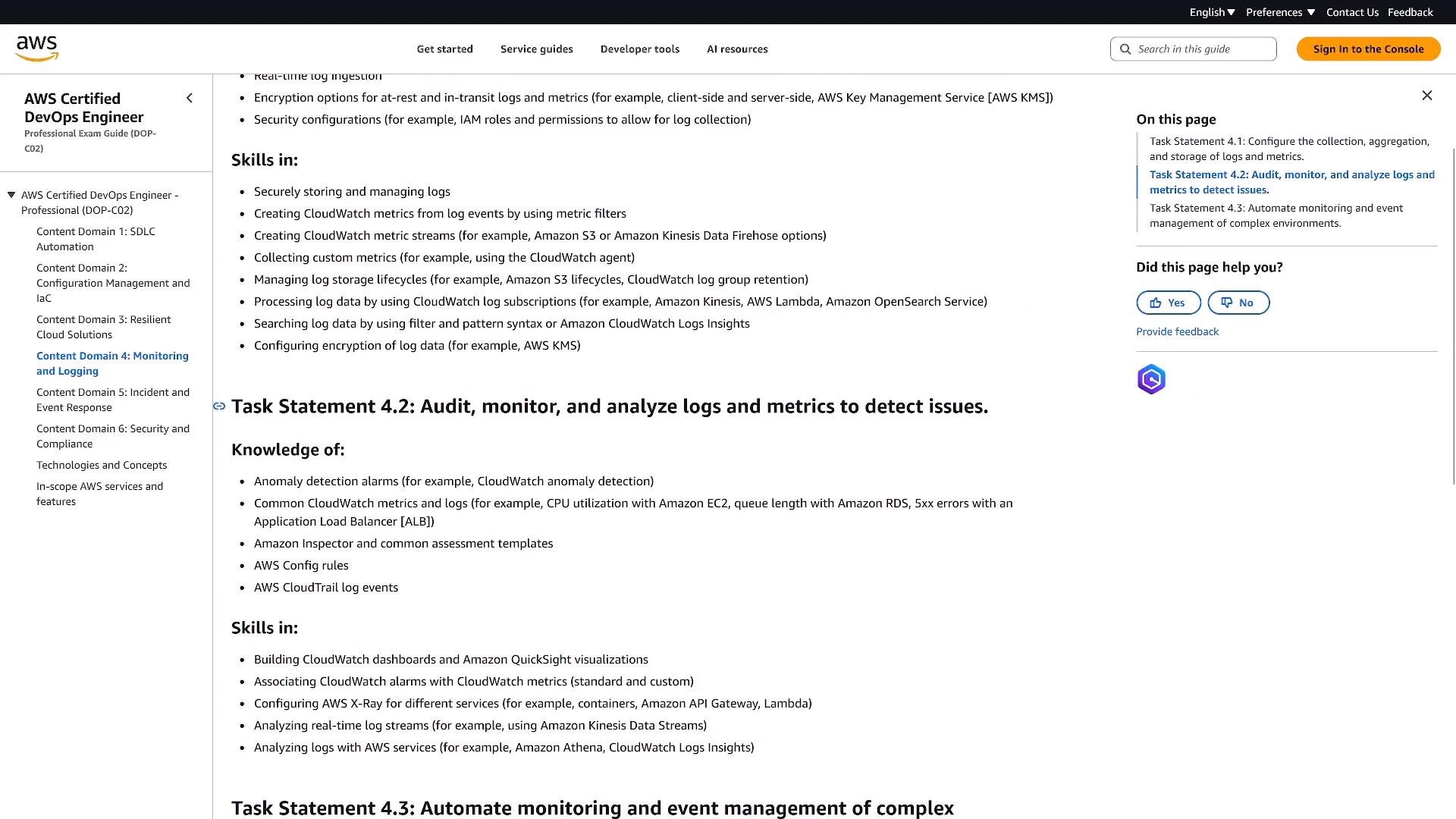
Domain 4 — Monitoring and logging
Collect, aggregate, and analyze logs and metrics to detect and remediate issues.- Core tasks: implement metrics and logging pipelines, alerting and dashboarding, and log retention/encryption strategies.
- Services & features to map: Amazon CloudWatch (metrics, logs, dashboards, alarms), AWS CloudTrail (API auditing), Amazon EventBridge (event routing), and AWS KMS for encryption.
- Study suggestions: focus on designing monitoring that enables rapid detection and automated remediation; understand event-driven patterns that integrate CloudWatch, EventBridge, and Systems Manager.
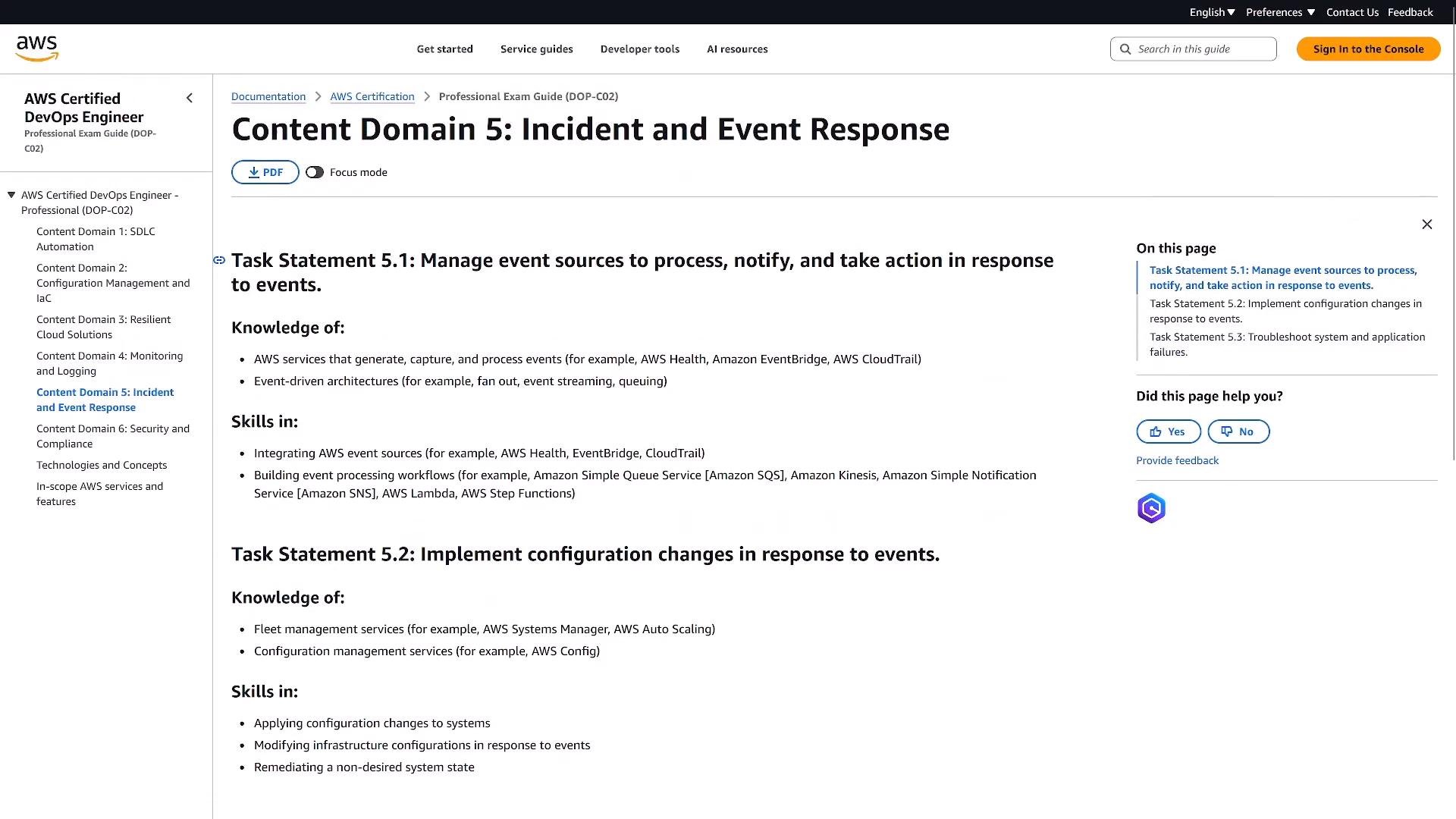
Domain 5 — Incident and event response
Manage event sources, define automated responses and runbooks, and troubleshoot system and application failures.- Core tasks: build incident response playbooks, integrate EventBridge with automated runbooks, and design for rapid detection, containment, and remediation.
- Study suggestions: practice mapping events to automated remediation and manual incident workflows; know how to use Systems Manager Automation and Run Command in operational playbooks.
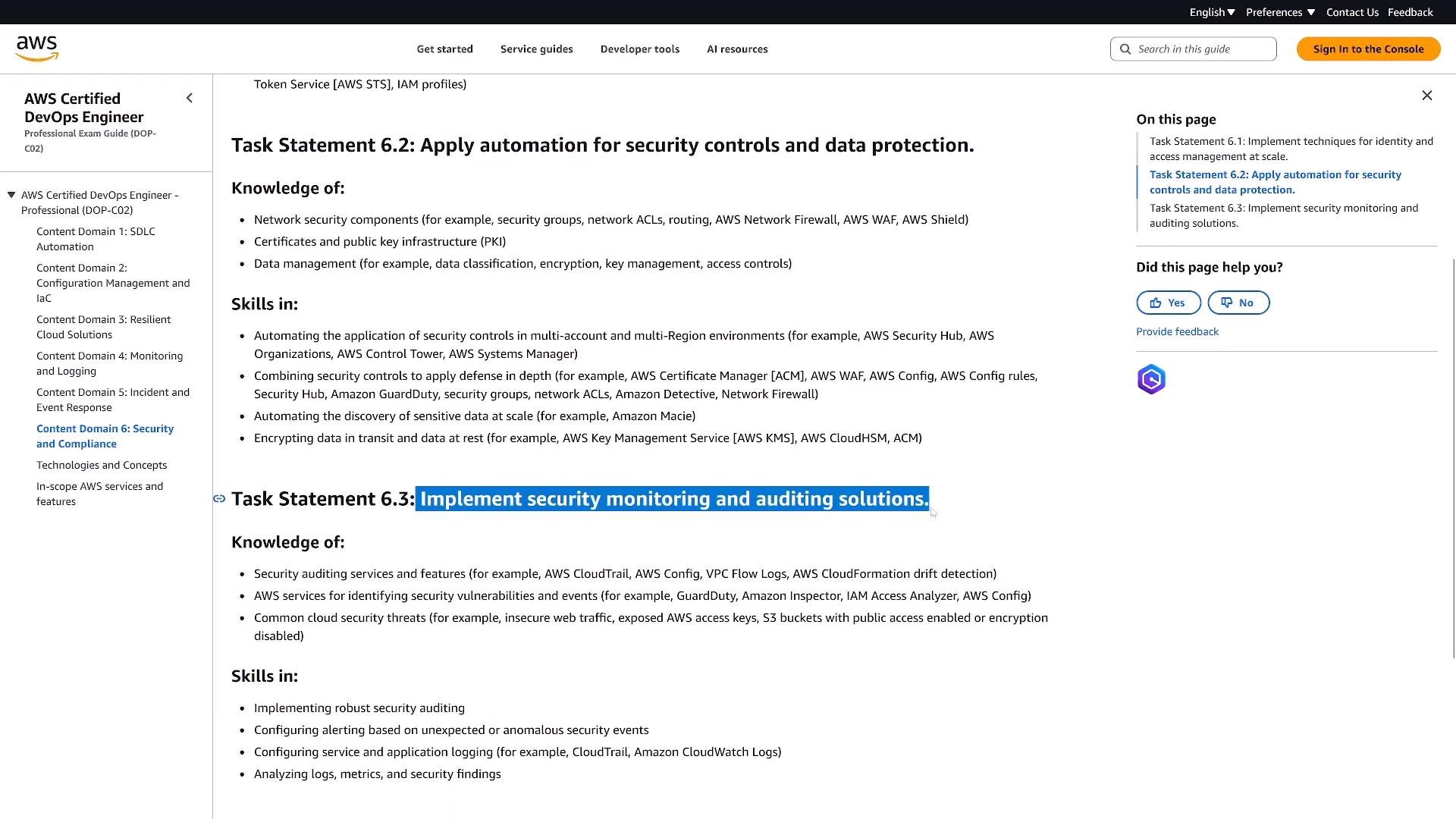
Domain 6 — Security and compliance
Design identity, access, and automation controls at scale and implement monitoring and auditing for data protection.- Core tasks: design IAM at scale (roles, policies, cross-account access), apply encryption and KMS practices, automate security remediation, and implement auditing and logging for compliance.
- Study suggestions: understand IAM design patterns, key rotation, KMS usage, and how to incorporate security checks into CI/CD pipelines and operational playbooks.
High-level recap
Use the table below to review domains and their core focus areas at a glance.How to use the exam guide effectively — practical workflow
- Read each domain’s task statements and mark any unfamiliar items.
- Use the knowledge/skills bullets to create a targeted study list (service docs + hands-on labs).
- Align lessons and practice questions to specific task statements — prioritize scenarios that require design decisions, not just service facts.
- Fill gaps by studying individual services and patterns (e.g., Systems Manager Parameter Store, ECR image scanning, CodeBuild lifecycle).
- Practice scenario-based questions that force architecture and trade‑off decisions.
A final note on evolving content
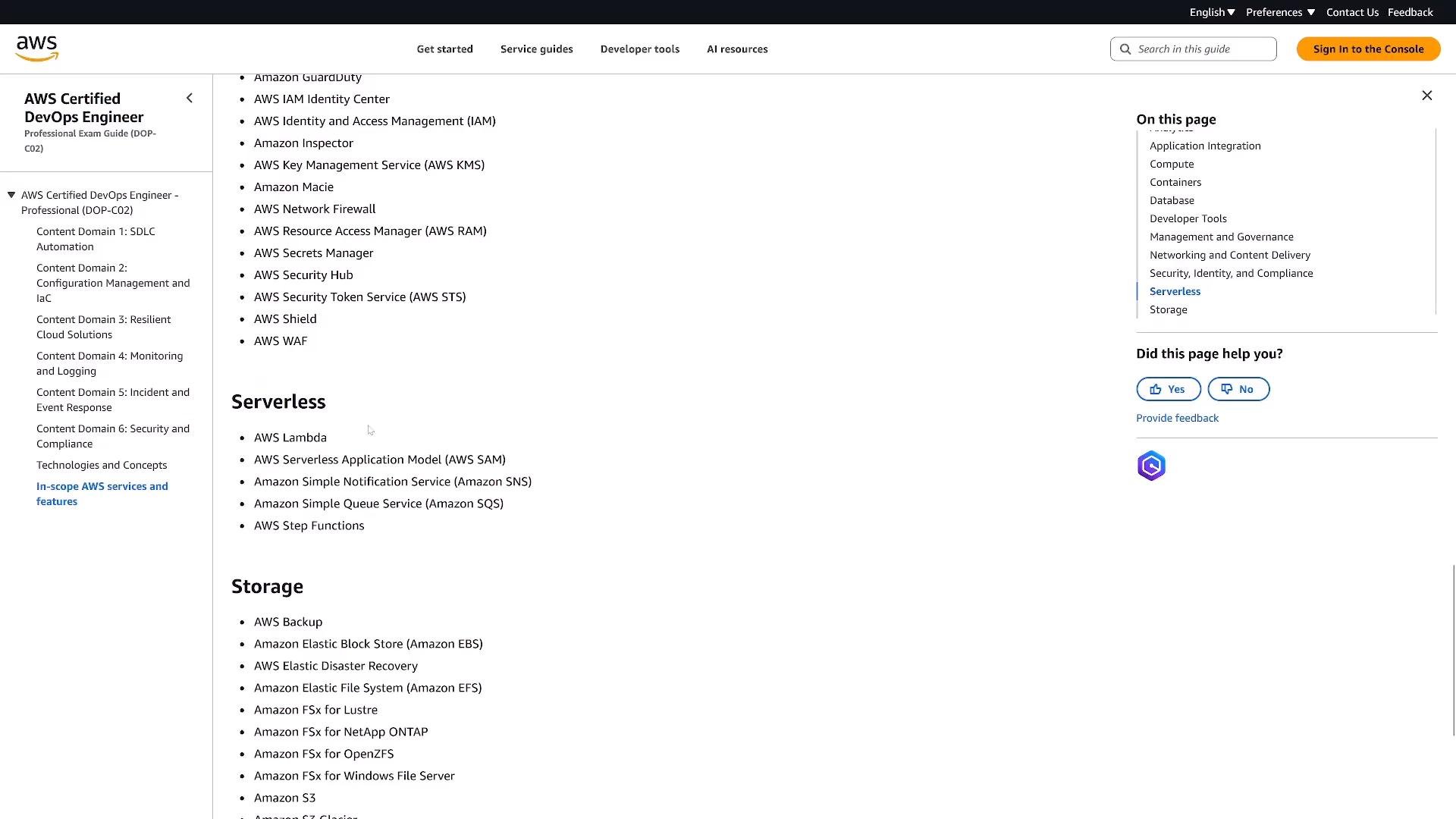
AWS updates documentation and service features regularly. The consolidated exam guide format (single PDF with anchor links) is current at the time of this guide, but links and scope items may change. Treat task statements and the knowledge/skills lists as your canonical checklist.Warning: Service names, capabilities, and recommended patterns evolve. Always verify ambiguous or unfamiliar items with the latest AWS documentation before an exam.
Where to go next (Action plan)
- Read each domain’s task statements in the official exam guide and highlight unfamiliar items.
- Build a study plan that maps lessons and labs to those task statements.
- Practice scenario-based questions and timed practice exams to improve decision-making speed.
- Revisit any weakest domains and re-scan the official documentation for services that appear in the task statements.
Links and references
- Official exam guide — AWS Certification: https://aws.amazon.com/certification/certified-devops-engineer-professional/
- AWS documentation home: https://docs.aws.amazon.com/
- Useful services reference pages:
- Amazon CloudWatch — https://docs.aws.amazon.com/cloudwatch/
- AWS CloudFormation — https://docs.aws.amazon.com/cloudformation/
- AWS Systems Manager — https://docs.aws.amazon.com/systems-manager/
- Amazon ECR — https://docs.aws.amazon.com/ecr/