

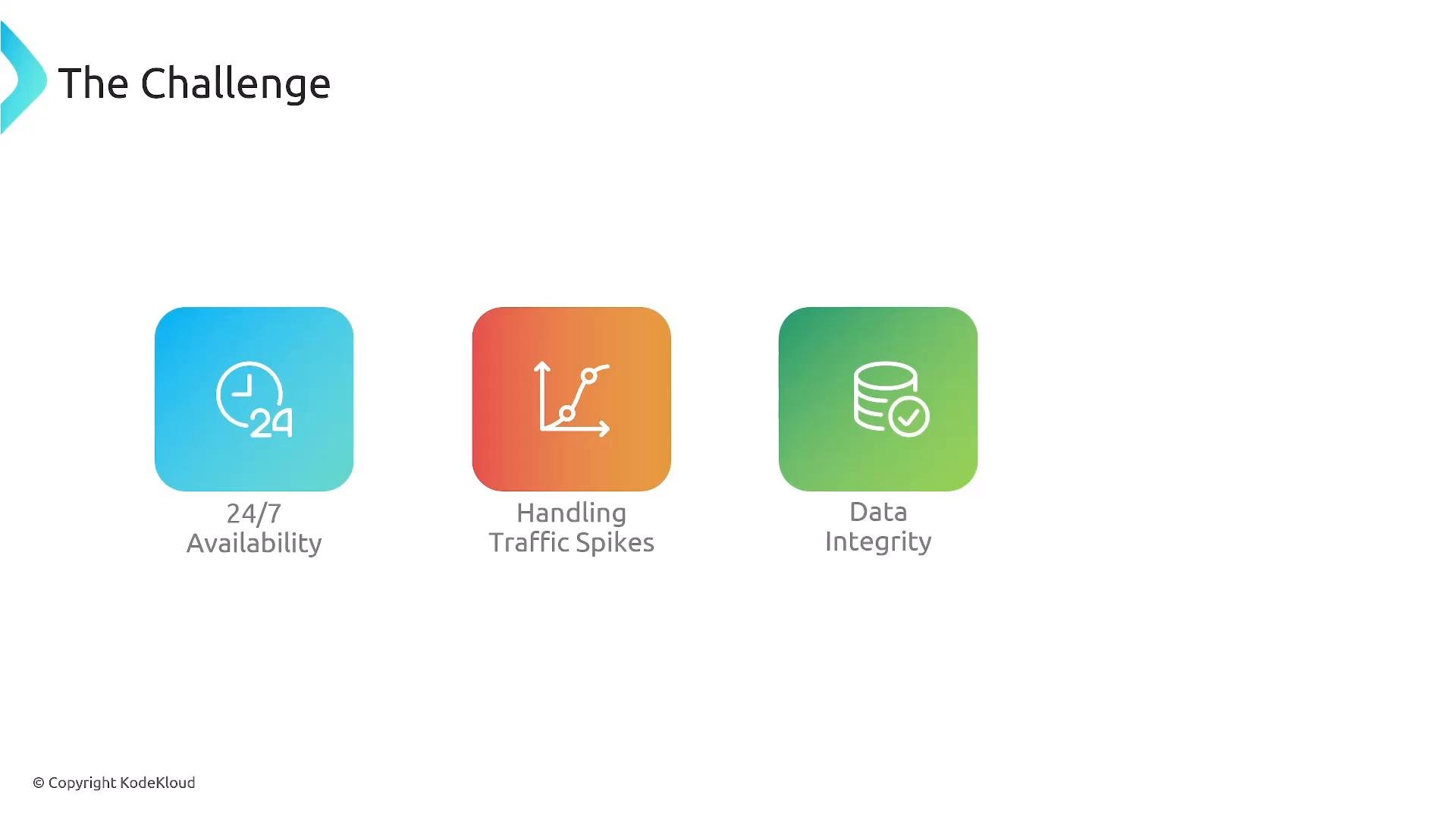
- 24/7 availability so customers can complete purchases any time of day.
- Handle traffic spikes (e.g., Black Friday) without service degradation.
- Preserve data integrity for order history, billing, and customer data.
- High availability — keep services reachable even if whole servers or AZs fail.
- Fault tolerance — enable replacement components to take over quickly after a component failure.
- Scalability — elastically scale capacity up and down to match demand without unnecessary cost.
- Disaster recovery (DR) — recover from region-level failures and large-scale disasters.
- High availability distributes workloads across multiple Availability Zones (Multi-AZ) and uses services with built-in redundancy, for example:
- Multi-AZ RDS
- DynamoDB Global Tables
- Elastic Load Balancers with cross-zone load balancing
- Fault tolerance targets single-component failures (failed EBS volume, NIC, or EC2 instance). Typical patterns:
- Auto Scaling groups with health checks to automatically replace unhealthy instances
- Stateless application tiers that can be scaled horizontally
- Stateful services with synchronous replication or quorum mechanisms
- Scale to meet peak traffic and scale back to control costs. Common patterns:
- Auto Scaling (EC2 Auto Scaling Groups)
- Serverless (AWS Lambda) for event-driven workloads
- Storage tiering (S3 lifecycle policies, S3 Intelligent-Tiering)
- Reduce cold-start impact for serverless functions by warming strategies, provisioned concurrency, or pre-provisioning compute.
- DR prepares for region-wide outages. Techniques include:
- Route 53 DNS failover
- Cross-region backups and replication (S3 Cross-Region Replication, RDS cross-region read replicas)
- AWS Global Accelerator for resilient global traffic management
- Multi-region deployments (pilot light, warm standby, or active-active)
- AWS recommends distributing workloads across Availability Zones, and when necessary, across multiple regions.
- Route 53 routing policies let you control traffic direction: failover, weighted, latency-based, geolocation, and more.
- Use multi-region strategies for global failover and low-latency access; use Multi-AZ for localized resiliency within a region.
- Example strategy: run active-active with a small percentage of traffic in a secondary region (e.g.,
95/5or80/20) and shift weight during failover.
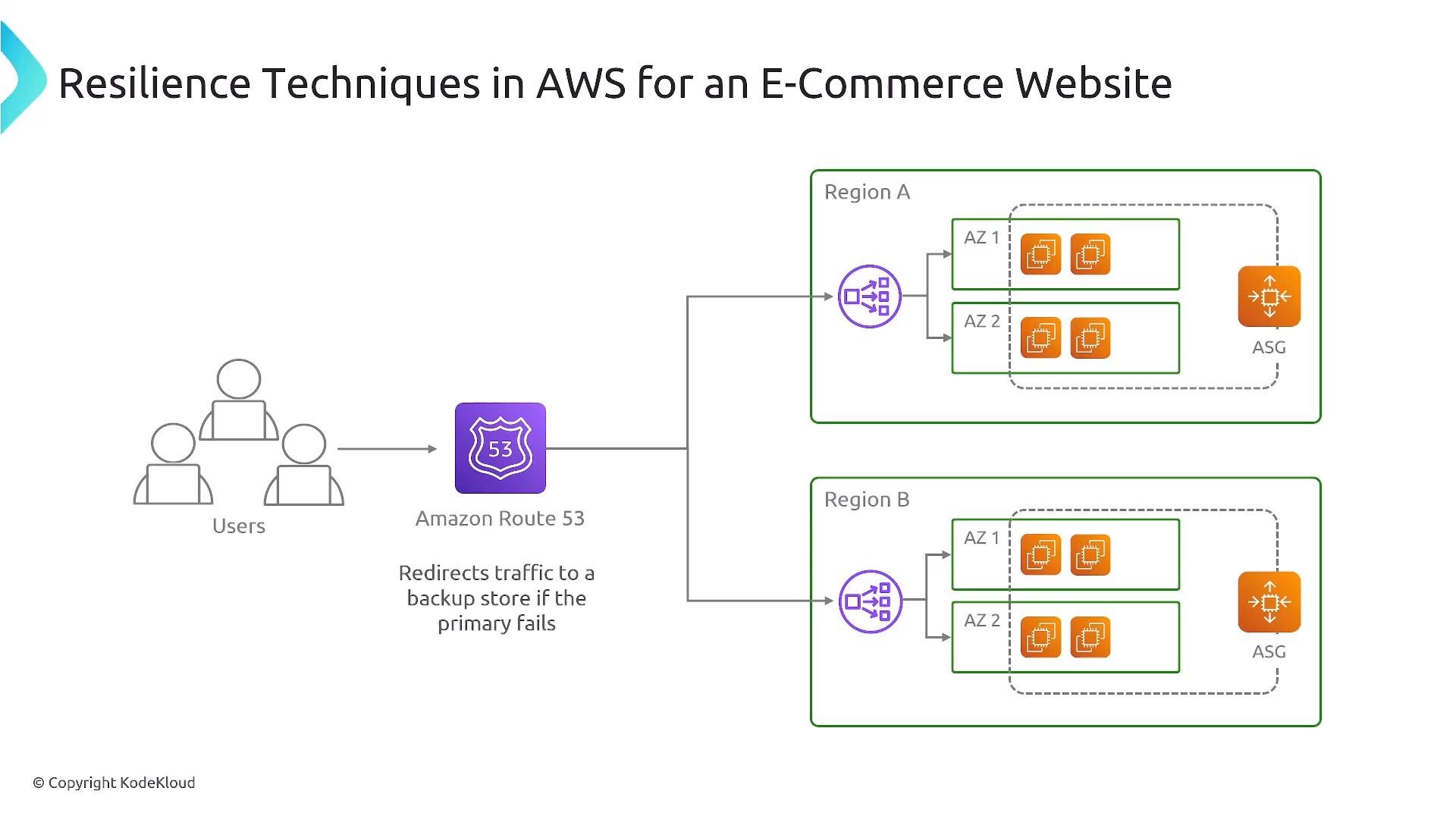
- Active-active: both regions serve live traffic; reduces failover time and improves global latency. Requires data replication (DynamoDB Global Tables, bi-directional replication) or conflict resolution.
- Active-passive (warm or cold standby): the passive region has pre-provisioned or minimal resources; failover is usually faster than cold starts but slower than active-active.
- Pilot light: minimal resources kept warm in the DR region; scale up during recovery.
- Use traffic shifting (weighted routing) for gradual cutovers and canary failovers during tests.
Implementation tips
- Enable cross-zone load balancing on ALBs to spread traffic evenly across AZs.
- Use read replicas in other regions for read-heavy workloads and as part of DR plans.
- Test backup and restore procedures regularly (automated recovery drills).
- Automate infrastructure as code (CloudFormation, Terraform) to reproduce environments quickly.
- Monitor metrics and set SLOs/SLAs with alerting tied to runbooks for escalation.
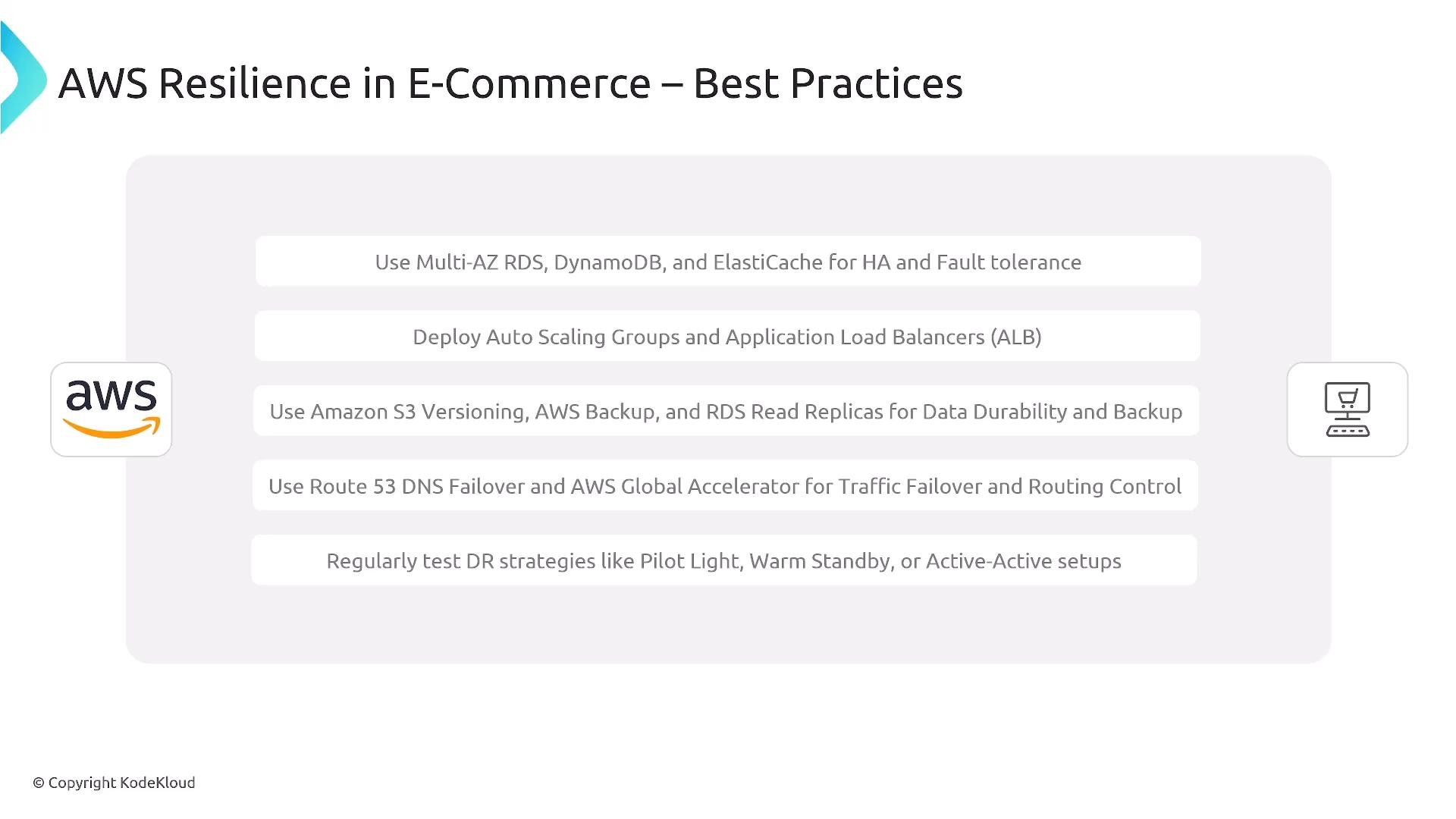
Plan and test your recovery strategies proactively. Regular DR drills (pilot light, warm standby, active-active) reveal gaps in automation, runbooks, and replication before a real incident occurs. Combine automated tests with manual runbooks to validate both automatic and human-driven recovery steps.
- Schedule regular DR exercises and validate RTO/RPO against business requirements.
- Use traffic shifting (Route 53 weighted routing) to perform canary failovers.
- Verify data consistency after failover (check replication lag, reconciliation steps).
- Maintain runbooks and automate as much of the failover process as possible.
- AWS Well-Architected Framework — Reliability Pillar
- Amazon Route 53 routing policies
- AWS Disaster Recovery whitepaper
- DynamoDB Global Tables