

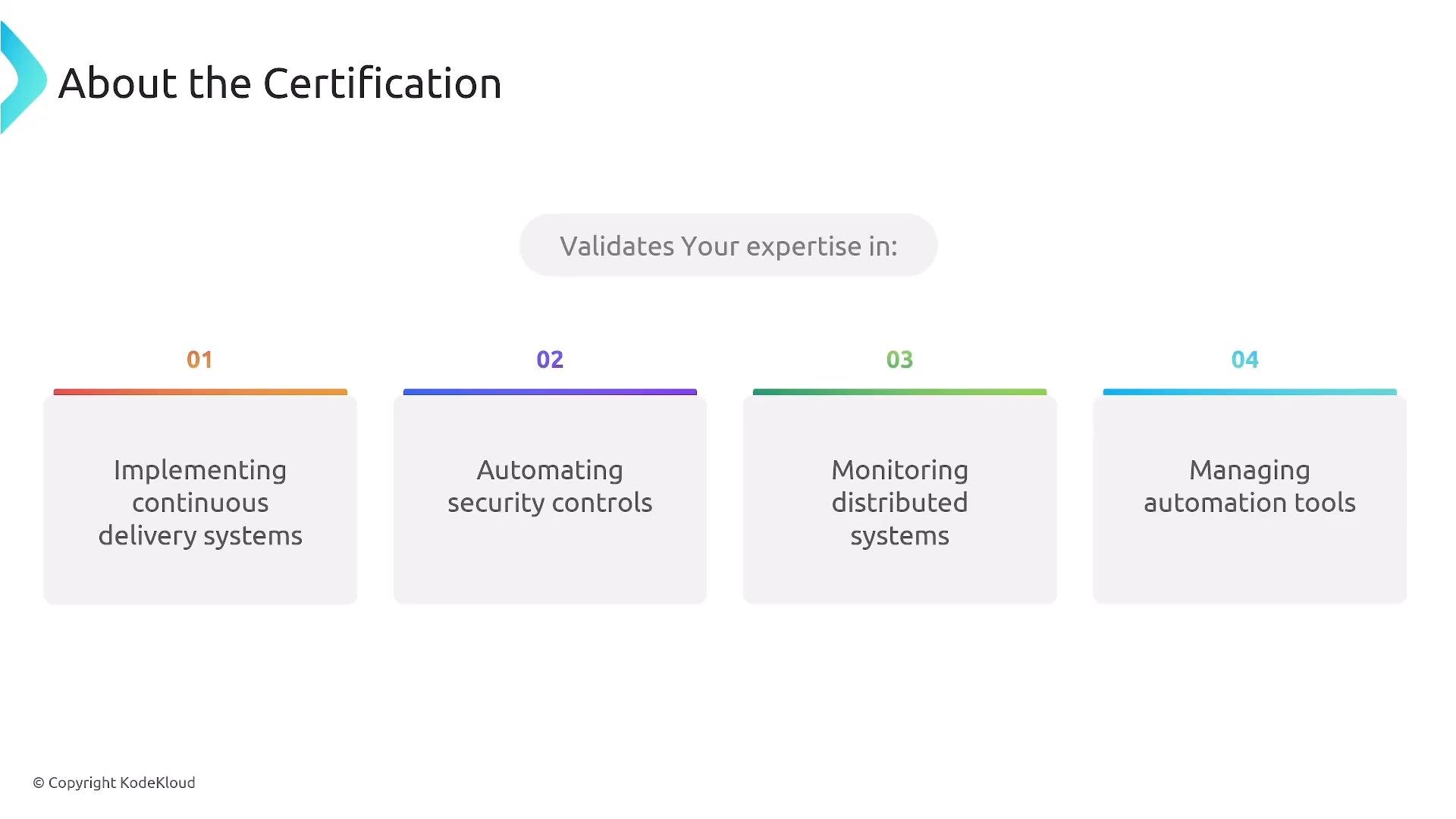
Why take the mock/prerequisite exam?
The optional mock exam is a quick, objective way to identify gaps in the foundational knowledge expected for a professional-level curriculum. It mimics the scenario-based format of the real exam to help you:- Measure your current skills and knowledge against exam-level expectations.
- Discover specific topics or domains that need review before starting the full course.
- Choose whether to begin the professional track immediately or first strengthen associate-level skills.
- Below 70%: We recommend completing an associate-level course first (for example, the AWS Certified CloudOps Engineer – Associate course on KodeKloud) to build the necessary foundation.
- Around 70% or higher: You are likely ready to proceed with the DevOps Engineer – Professional material.
Mock exam coverage — six key domains
The course and the mock exam align across six primary domains. Use the table below as a study map and to prioritize review based on your mock results.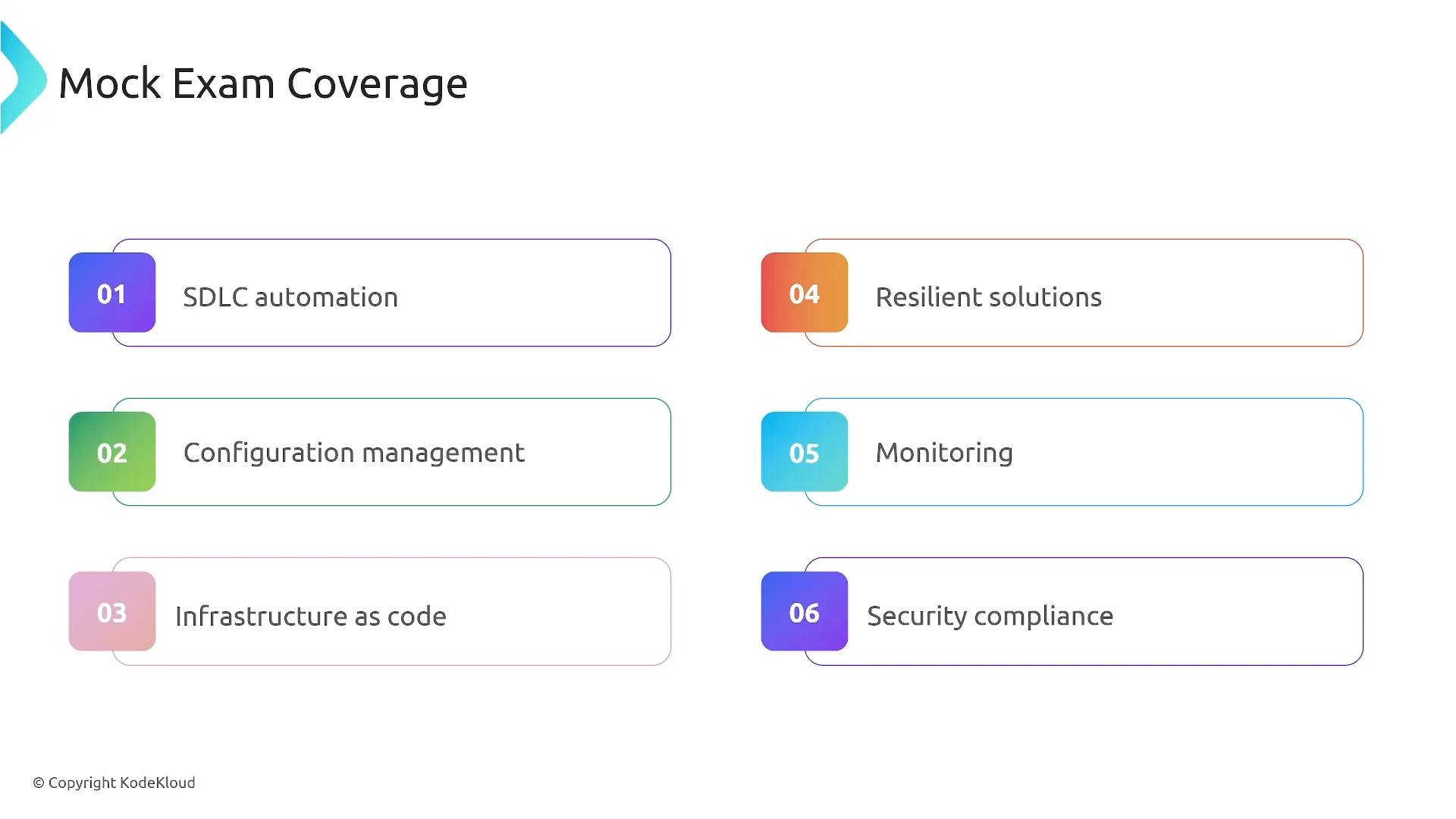
How to use your mock exam results
- Take the mock exam under timed conditions to simulate the real experience.
- Review incorrect answers and identify which of the six domains they map to.
- If multiple weaknesses show up in associate-level topics (e.g., basic networking, compute fundamentals, or core IAM concepts), plan to complete an associate-level course first.
- If most errors are domain-specific to professional skills (complex pipeline design, advanced monitoring, or large-scale IaC), focus on targeted modules in the DevOps Engineer – Professional material.
Taking the mock exam is a quick, practical way to measure readiness. Treat a score below 70% as a sign to strengthen associate-level skills before advancing.
Next steps and resources
- If you need to revisit fundamentals, consider the AWS Certified CloudOps Engineer – Associate course or equivalent associate-level resources.
- Use the mock exam to guide a prioritized study plan that focuses on your weakest domains first.
- For community help, discussion, or questions, visit the KodeKloud community forums or contact Michael at KodeKloud.com.