

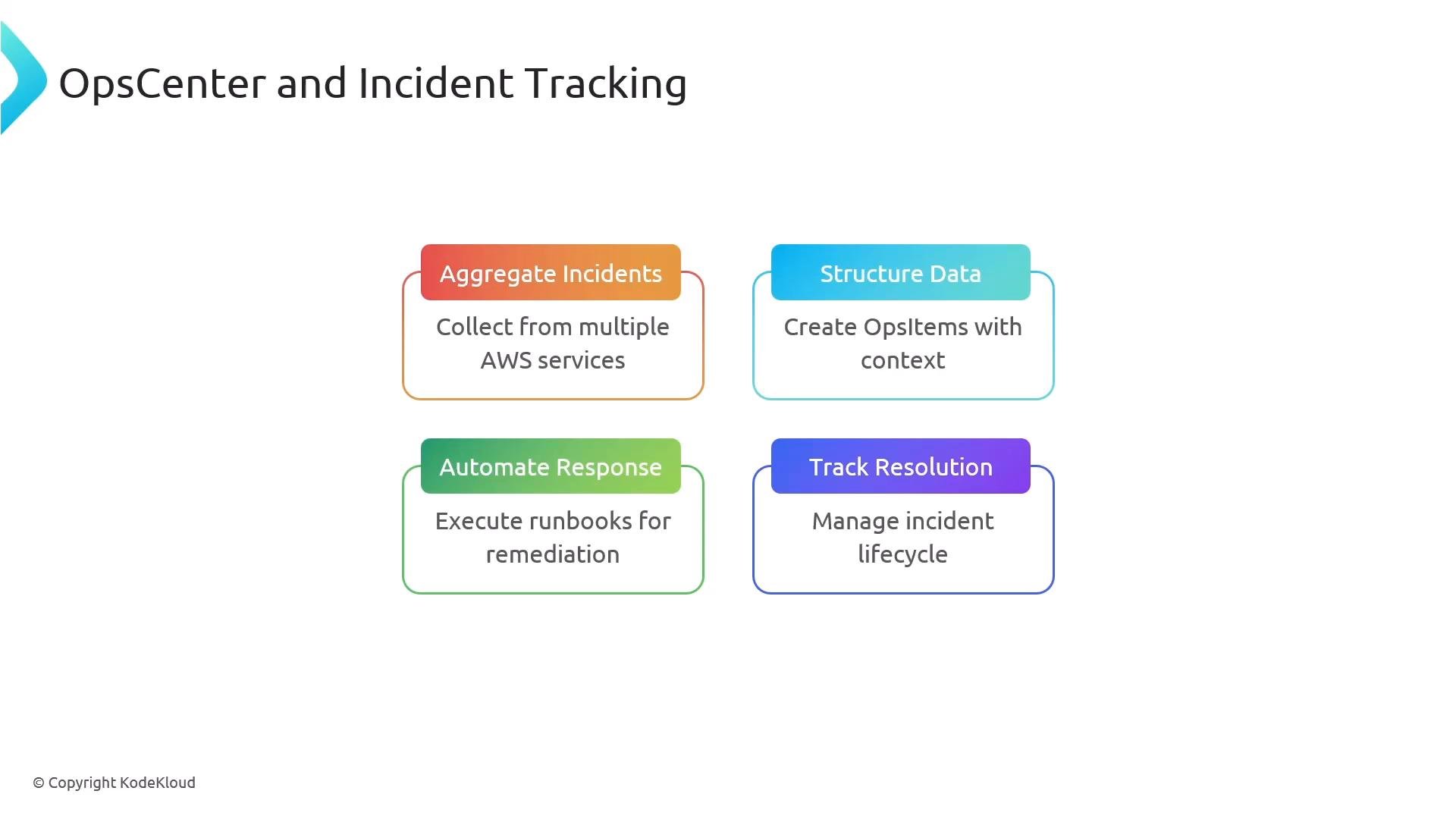
What OpsCenter provides (at a glance)
OpsCenter centralizes incident records and offers:- Aggregation of incidents from multiple AWS services.
- Structured incident records (OpsItems) with metadata and operational data.
- Automated remediation by associating runbooks (Systems Manager Automation documents).
- Lifecycle tracking from detection through remediation and resolution.
OpsItems — structured incident records
OpsCenter stores incidents as OpsItems. Each OpsItem is a structured record containing metadata, operational data, and references to related AWS resources or external findings (for example, Security Hub or AWS Config results). This structure makes triage, automation, and auditing simpler and more consistent. Key parts of an OpsItem: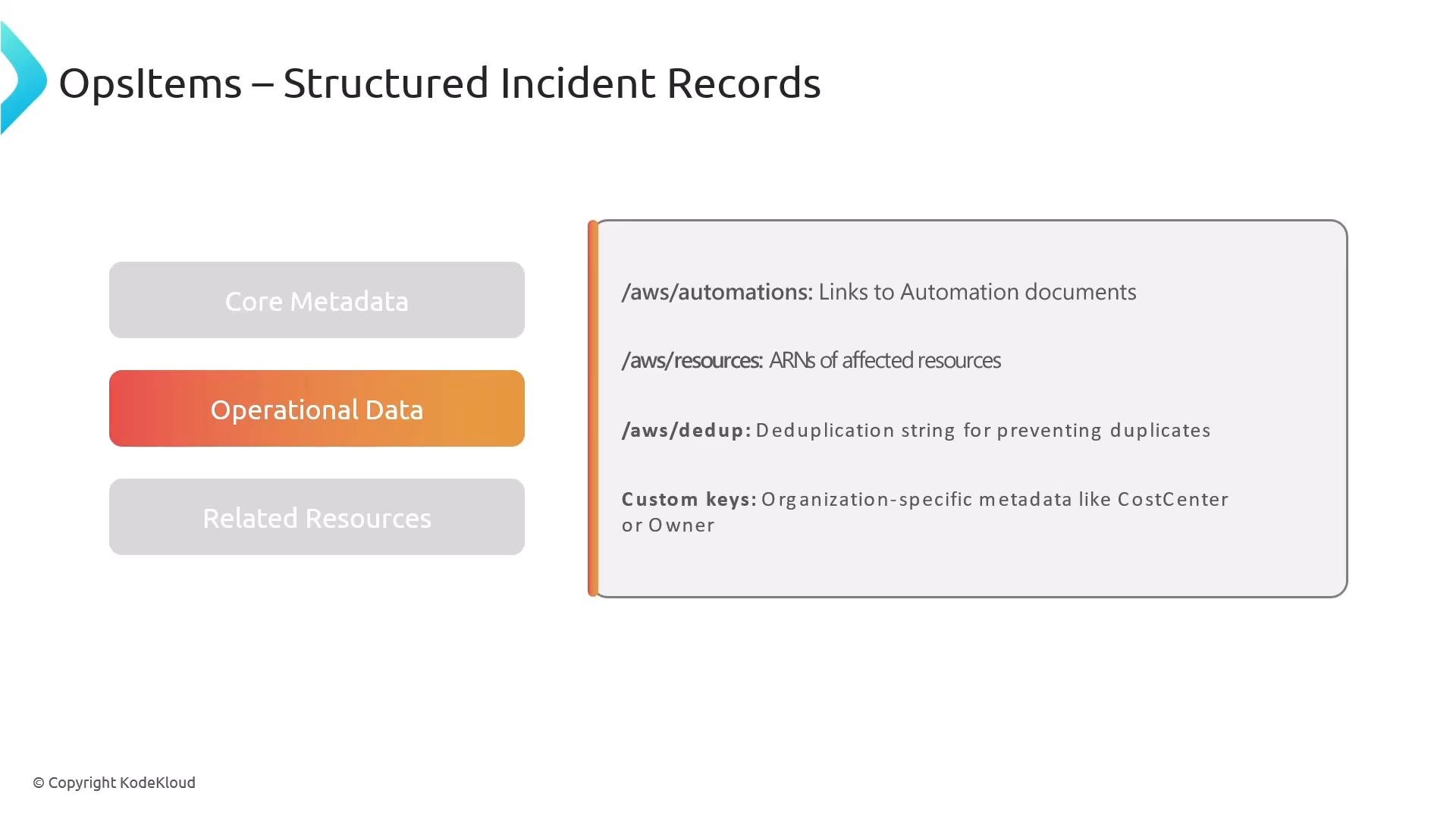
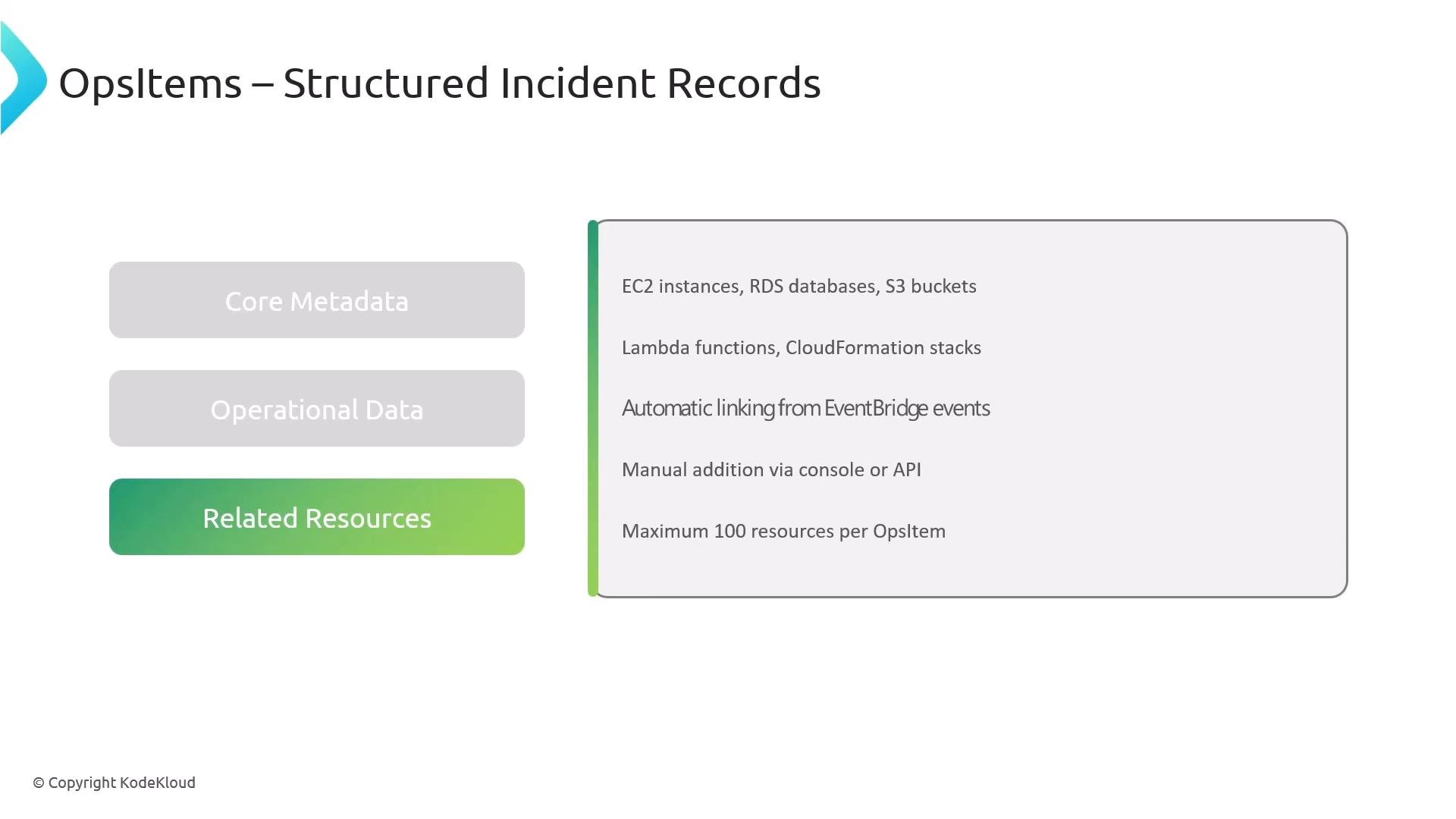
Event sources that create OpsItems
OpsItems can be created by a variety of event sources. Common integrations include:
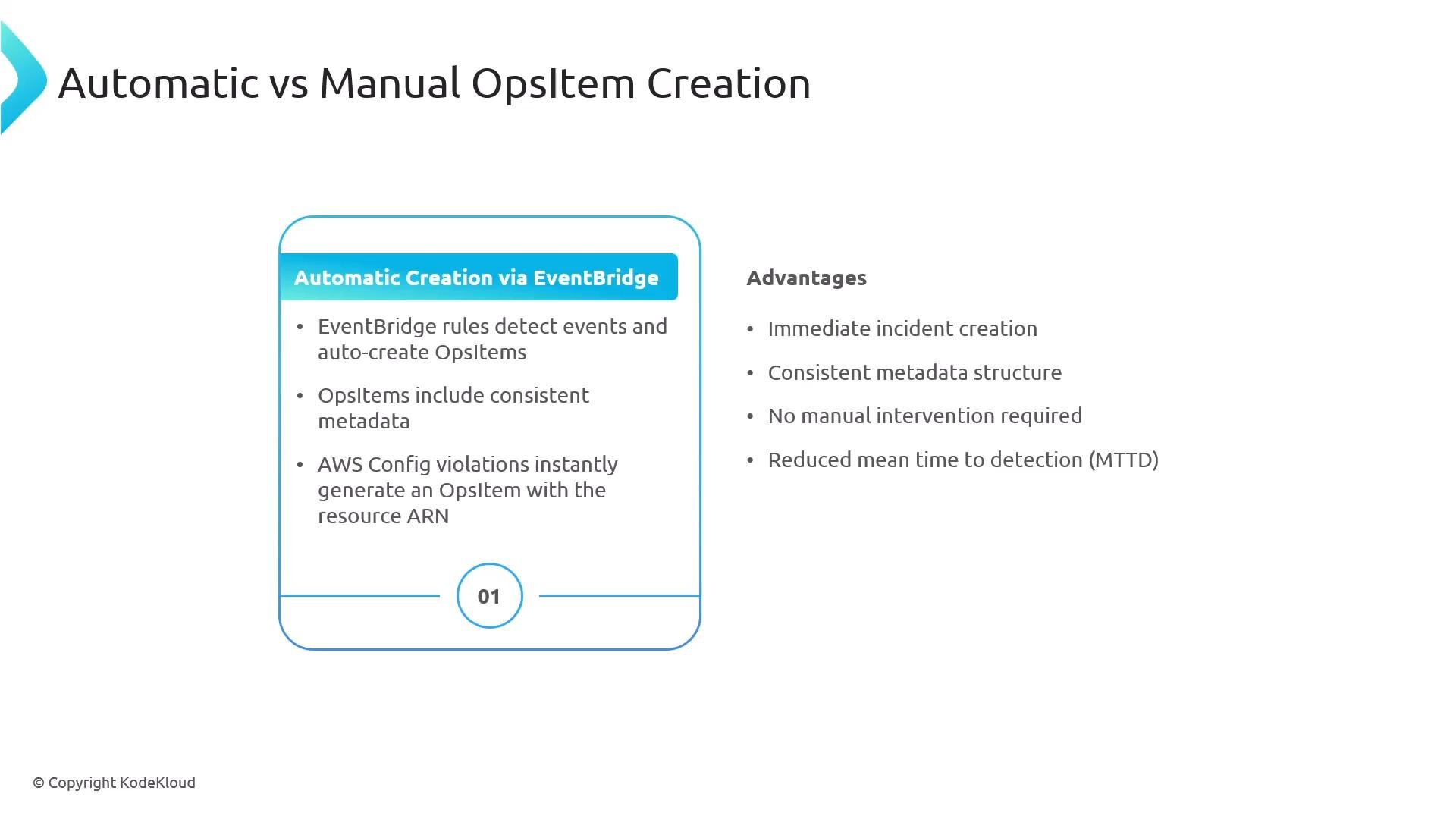
EventBridge is frequently used as the centralized ingestion point because it can translate and route events into OpsItem creation consistently and immediately.
EventBridge is the recommended integration pattern for automated OpsItem creation because it enforces consistent payloads and reduces manual steps. Use EventBridge rules to transform service events into OpsItems so you can reliably trigger runbooks and downstream integrations.
Automatic vs manual OpsItem creation
- Automatic creation: Preferred for high-frequency, machine-detectable incidents (CloudWatch alarms, AWS Config violations, Security Hub findings). Automation ensures consistent metadata and rapid response.
- Manual creation: Useful for ad-hoc issues, external incidents, or findings from systems that cannot be captured automatically. Reserve manual creation for infrequent or exceptional cases.
Example: EventBridge payload that creates an OpsItem
Below is an example target payload for an EventBridge rule that invokes Systems Manager to create an OpsItem. It includes a role and OpsItem parameters such as title, source, severity, category, and operational data pointing to affected resources:Runbooks and automated remediation
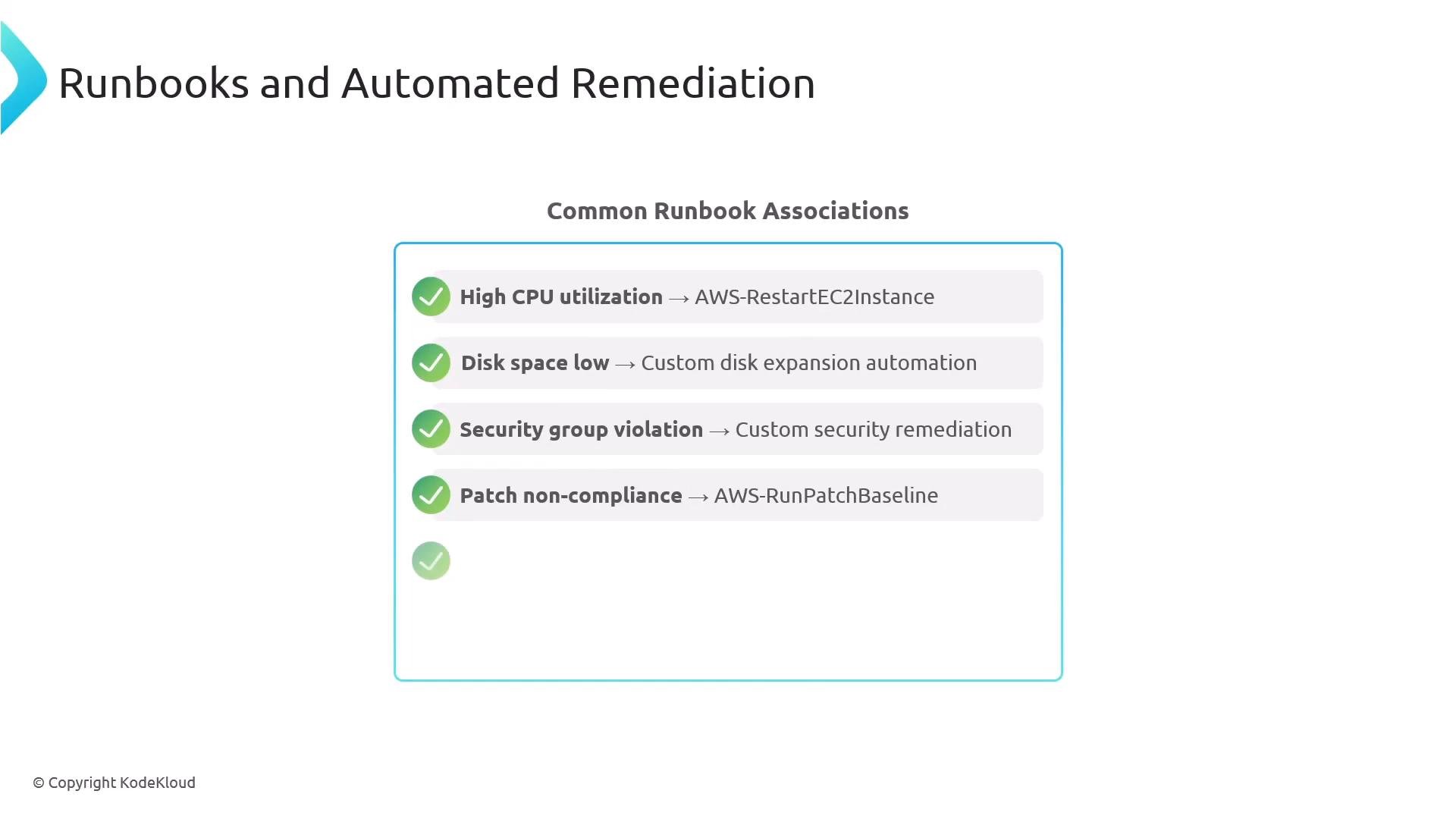
Runbooks in Systems Manager Automation are the primary mechanism for automated remediation. You can associate one or more runbooks with an OpsItem and execute them automatically (triggered by EventBridge or Lambda) or manually from the OpsCenter console. Systems Manager records execution history alongside the OpsItem for auditing and post-incident review.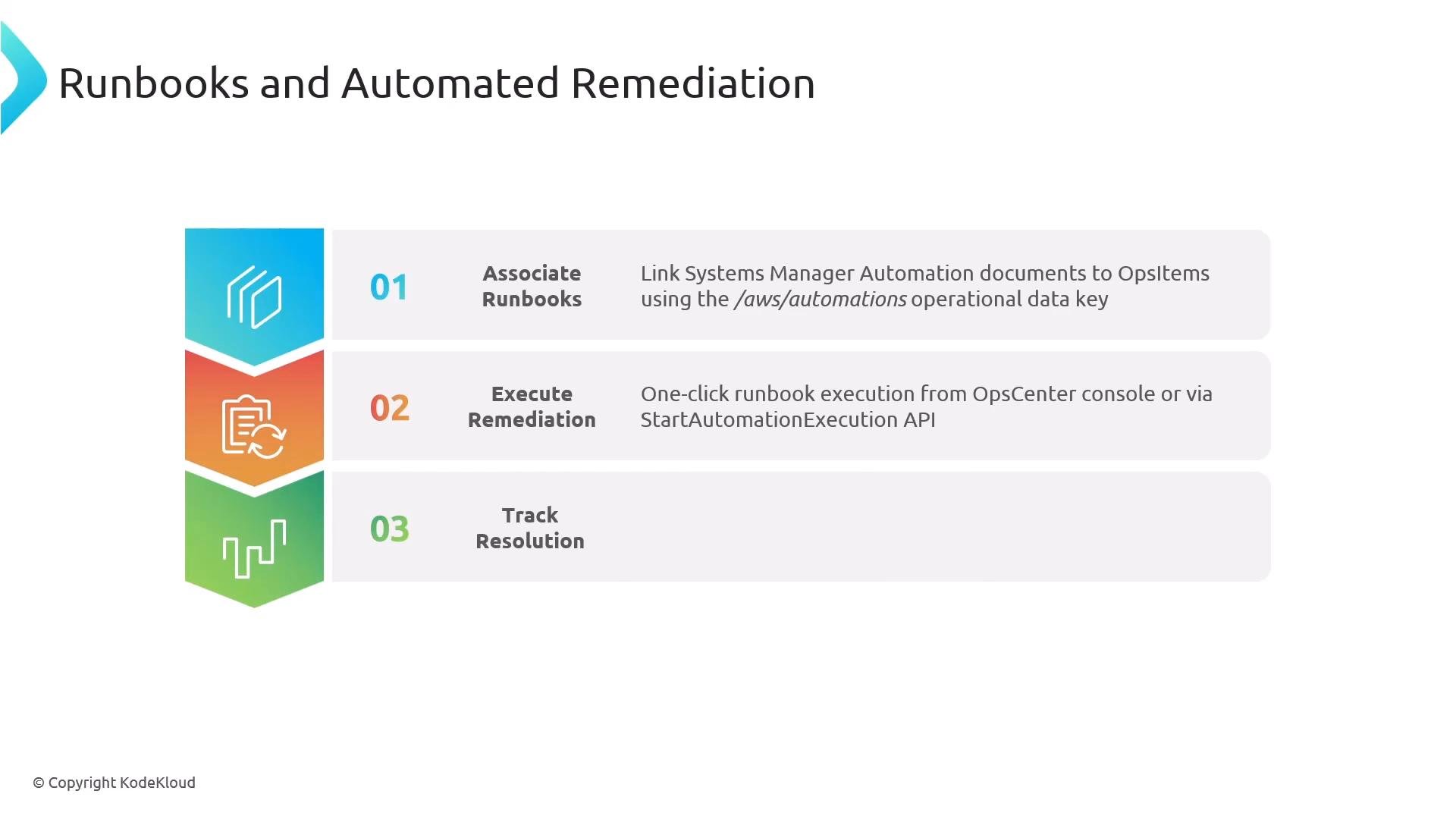
Use parameterized runbooks so the same Automation document can operate across different resource types by receiving resource IDs and remediation parameters from the OpsItem OperationalData.
Third-party integration and cross-account aggregation
OpsItems can be integrated with ITSM platforms (ServiceNow, Jira) and aggregated from multiple AWS accounts. Integration patterns:- OpsCenter → EventBridge → Lambda → ServiceNow REST API
- OpsCenter → EventBridge → API Gateway webhook → Third-party endpoint
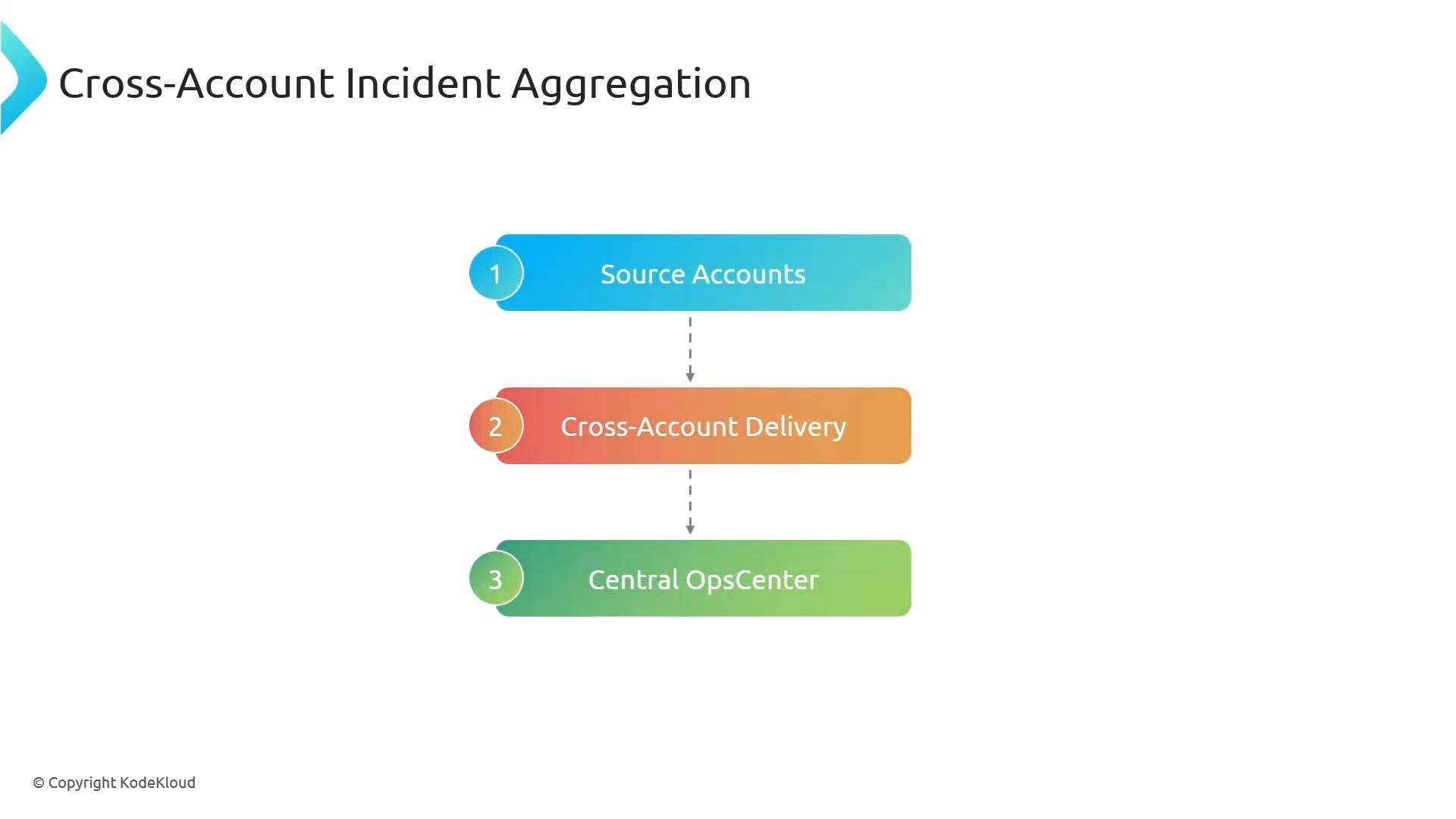
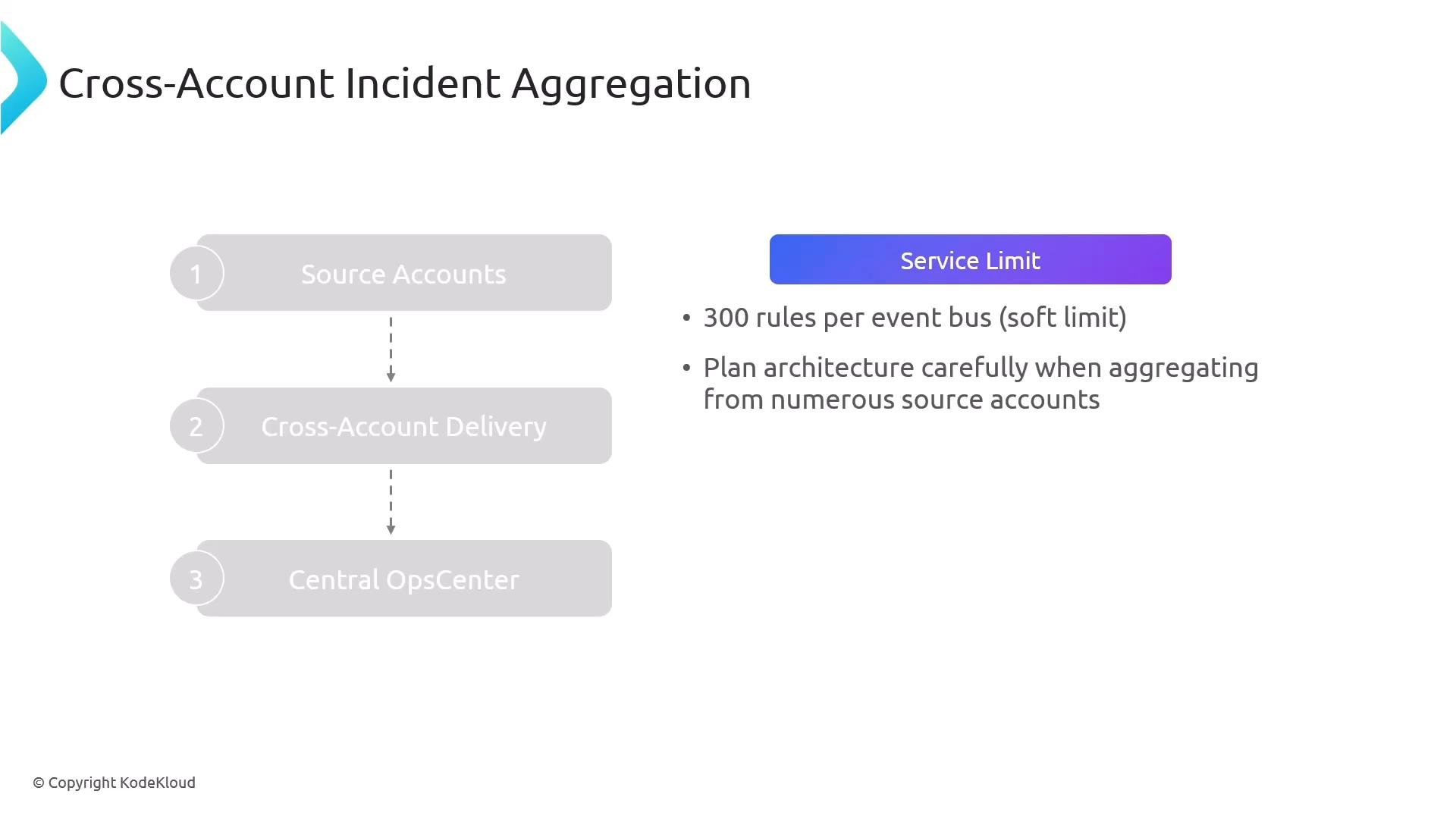
When aggregating events across accounts, plan for EventBridge service limits (for example,
300 rules per event bus soft limit). Consider partitioning across multiple event buses, consolidating rules, or using filtering logic to avoid hitting limits in large organizations.OpsCenter vs CloudWatch vs X‑Ray — complementary tools
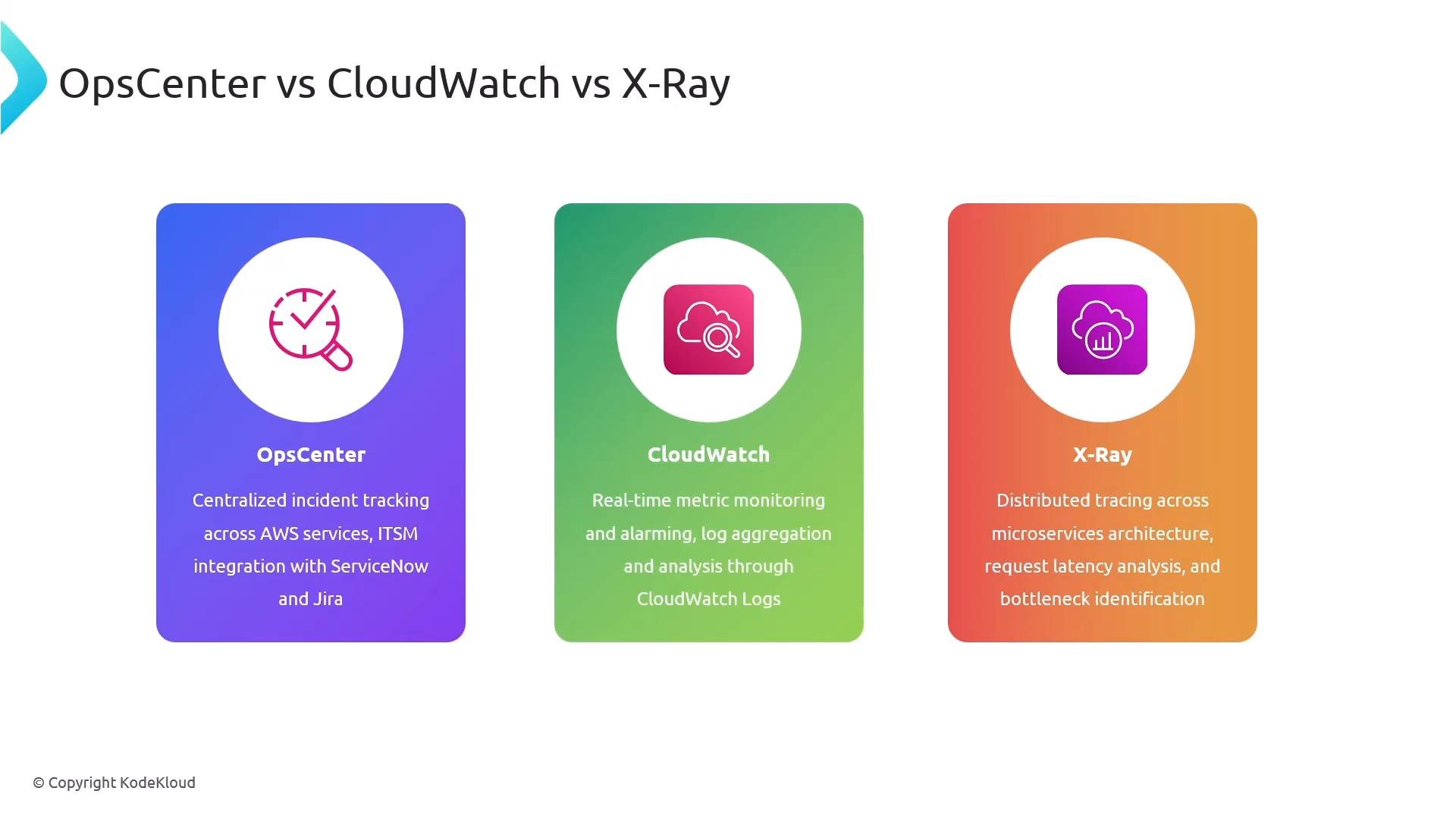
These services each serve a distinct role in observability and incident response:- OpsCenter: centralized incident tracking and lifecycle management; correlates events, stores OpsItems, and integrates with ITSM tools.
- CloudWatch: metrics, logs, dashboards, and alarms for detection and alerting.
- X‑Ray: distributed tracing and latency analysis for root-cause analysis.
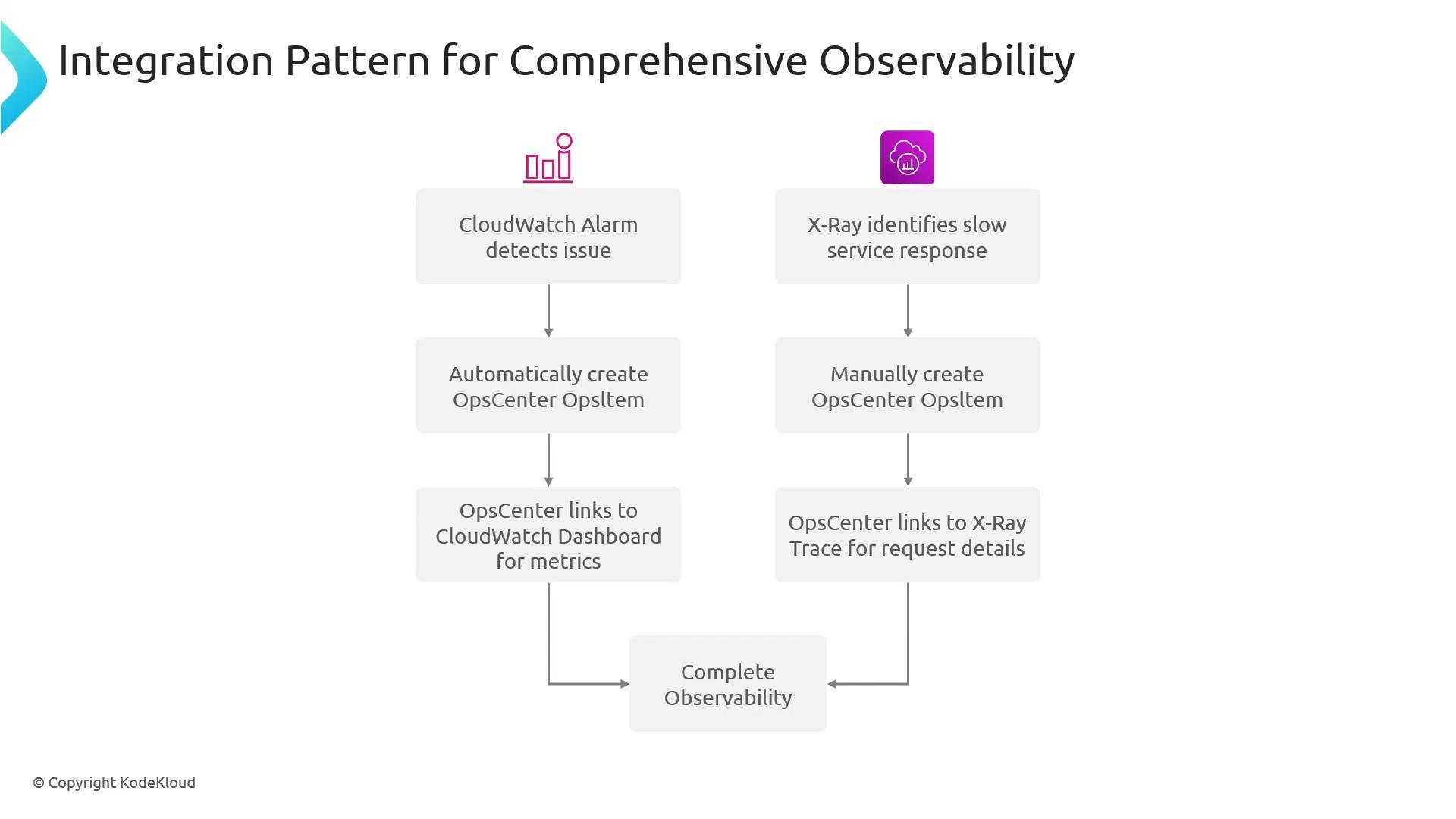
- CloudWatch alarm detects a metric anomaly → EventBridge creates an OpsItem linked to CloudWatch dashboards/logs.
- X‑Ray identifies a slow trace → OpsItem created and linked to the X‑Ray trace for troubleshooting. Combining these links provides end-to-end observability across metrics, logs, traces, and incident records.
Best practices for production OpsCenter
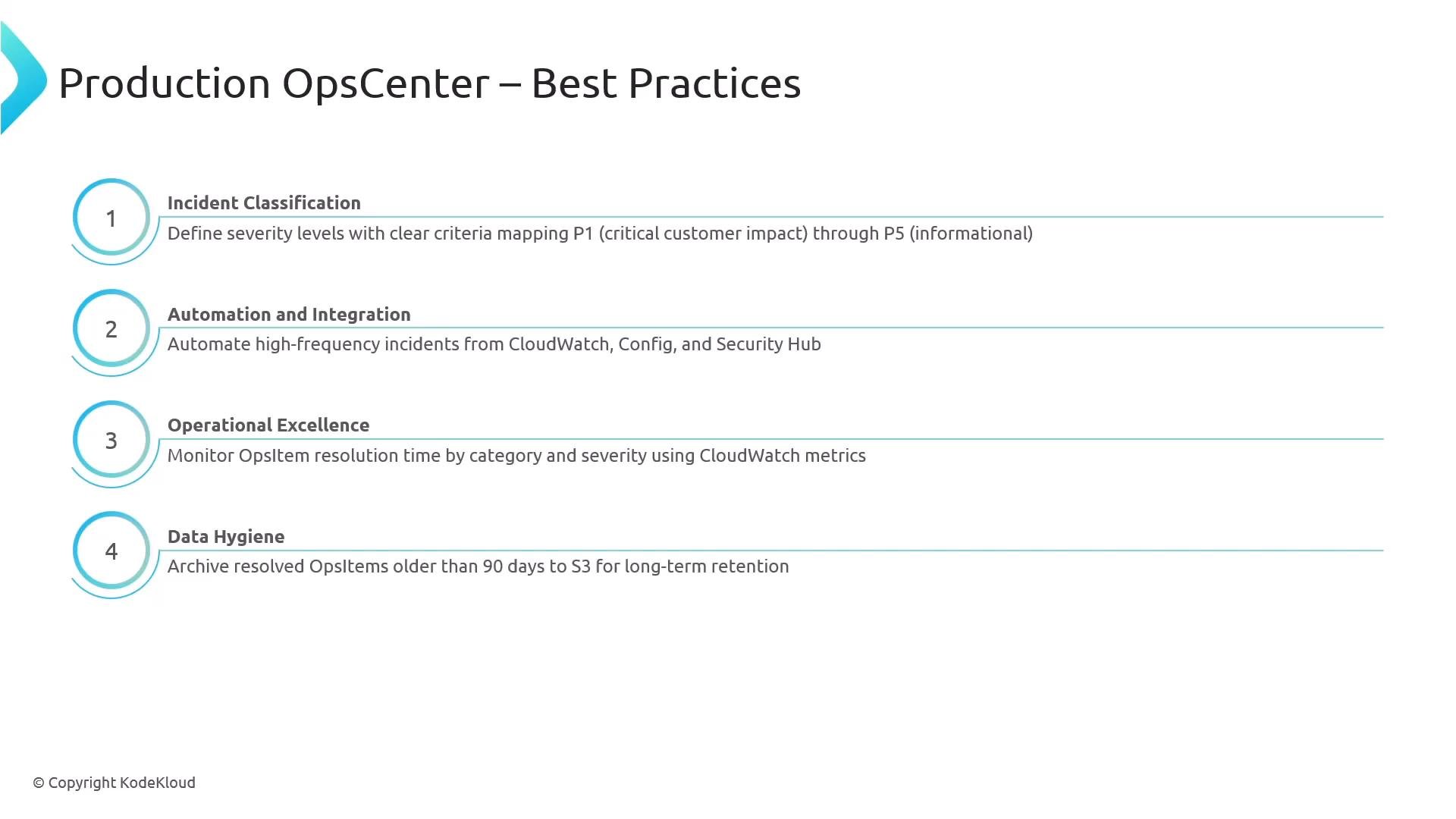
- Incident classification: Define severity tiers (Critical, High, Medium, Low, Informational) and standardize how alerts map to these tiers.
- Automation and integration: Automate high-frequency incidents (CloudWatch, AWS Config, Security Hub) to reduce manual handling and MTTR.
- Operational excellence: Track resolution metrics by category and severity with CloudWatch dashboards; iterate on runbooks and processes.
- Data hygiene and retention: Archive resolved OpsItems older than your retention window (for example, >90 days) to S3 for compliance and cost control.
- Auditing: Enable CloudTrail for all accounts to retain API activity and execution history for OpsItems and Automation runs.
Takeaways
- AWS Systems Manager OpsCenter centralizes incident management and tracks incident lifecycles using OpsItems.
- EventBridge is the standard integration pattern for automatic OpsItem creation from CloudWatch, AWS Config, and Security Hub.
- OpsItems combine metadata, operational data, related resources, and runbook links to enable triage and automated remediation.
- Use OpsCenter for incident workflow and tracking, CloudWatch for metric/log detection, and X‑Ray for distributed tracing; integrate them for full observability.
- OpsItem storage is included, but automation and frequent API operations can generate API request costs — monitor usage in high-volume environments.
- AWS Systems Manager OpsCenter: https://docs.aws.amazon.com/systems-manager/latest/userguide/opscenter.html
- Amazon EventBridge: https://docs.aws.amazon.com/eventbridge/latest/userguide/what-is-amazon-eventbridge.html
- AWS CloudWatch: https://docs.aws.amazon.com/cloudwatch/
- AWS X‑Ray: https://docs.aws.amazon.com/xray/