

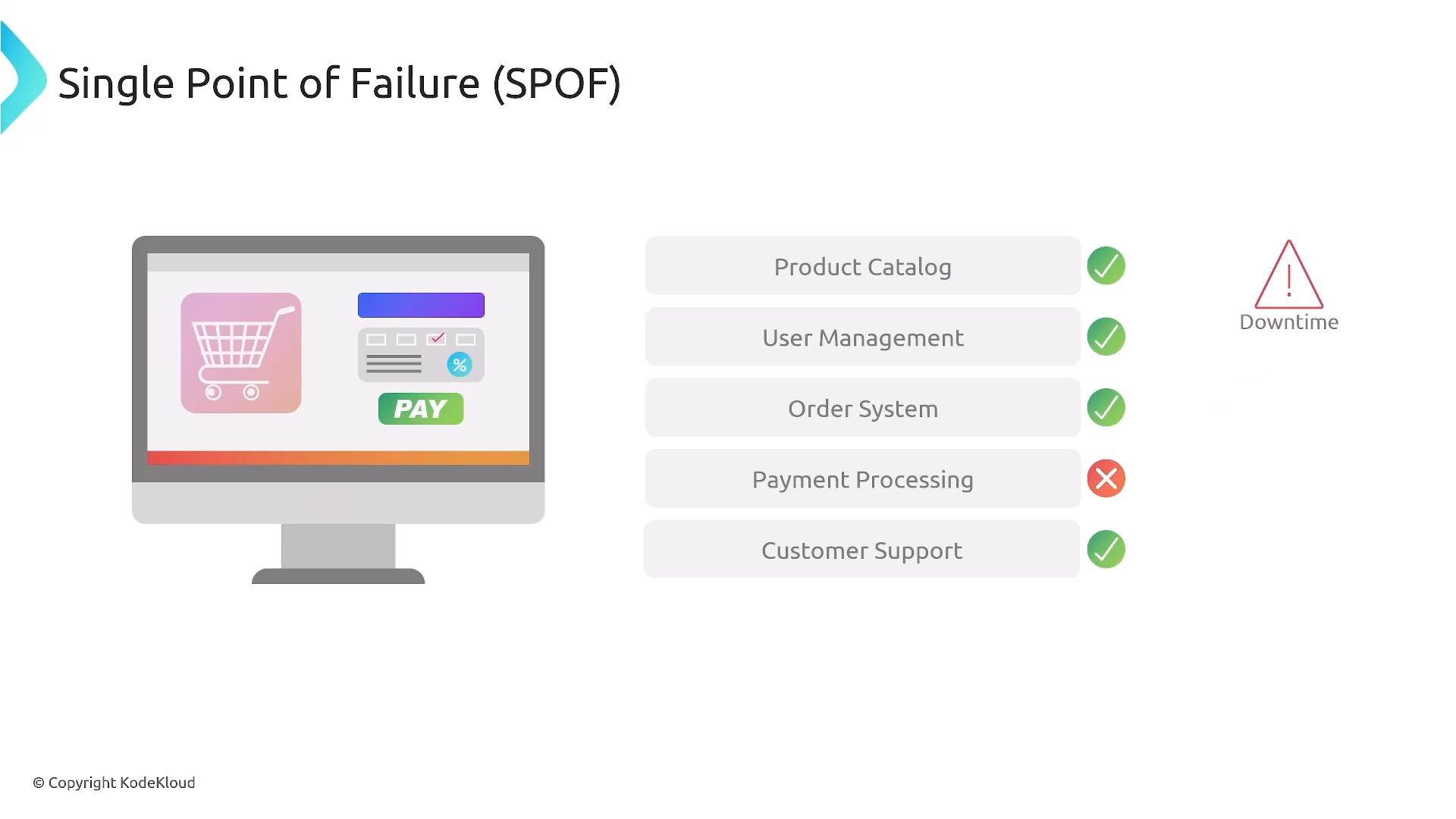
- Identify true SPOFs: components with no redundancy (single instance, single-AZ RDS, etc.).
- Recognize provider-managed redundancy: some AWS services are already distributed and not single-device SPOFs.
- Specify the failure scope: component-level, Availability Zone (AZ)-level, or Region-level. A design may be highly available within a Region but still vulnerable to a Region outage.
When identifying SPOFs, always specify the failure scope: component, AZ, or Region. High availability within one Region does not guarantee resilience across Regions.
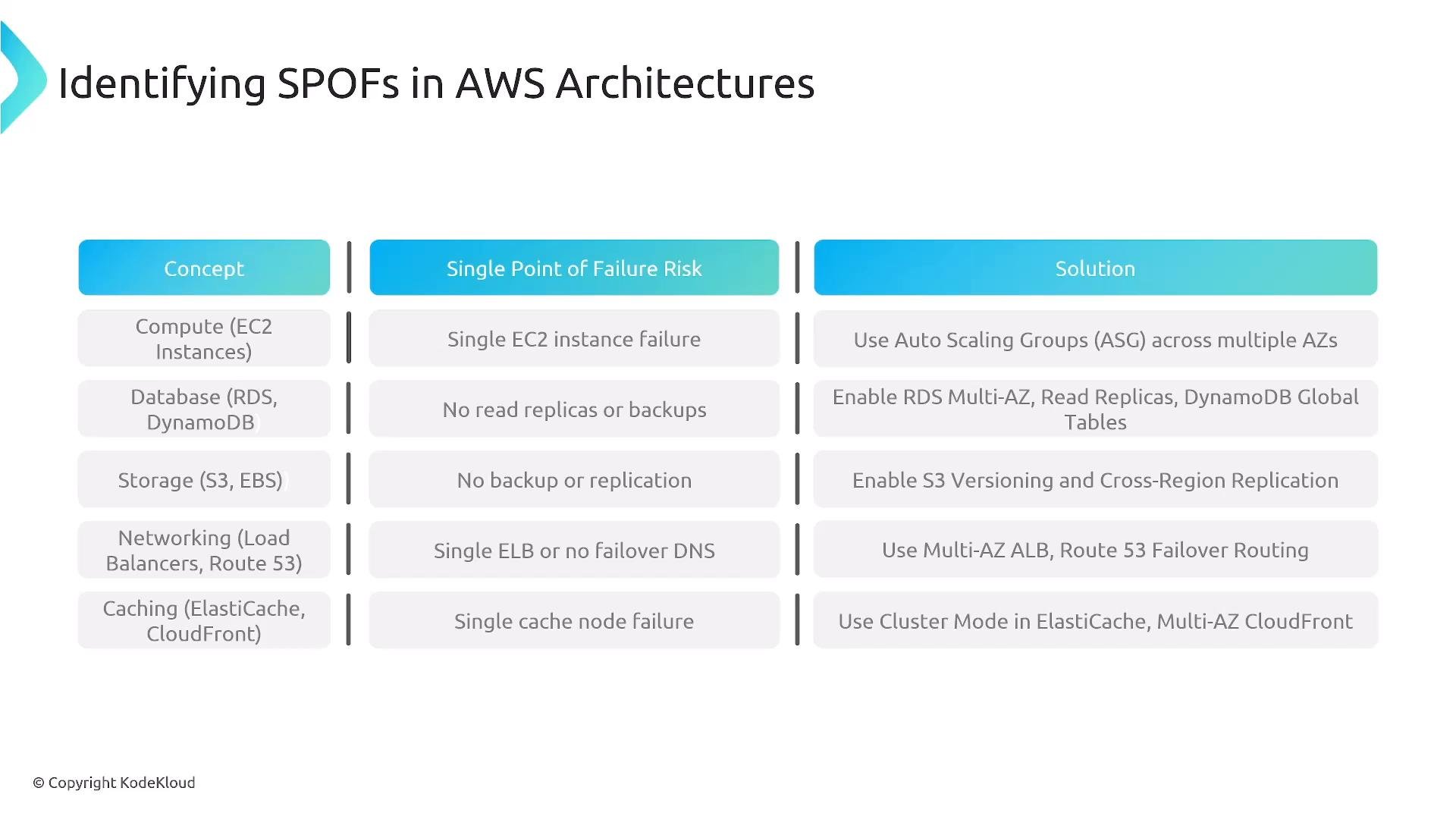
- Single EC2 instance (no load balancer, no Auto Scaling Group): a classic SPOF. Fix: deploy multiple instances across AZs and put them behind an Application Load Balancer (ALB) with an Auto Scaling Group (ASG).
- Single RDS instance (single-AZ): a SPOF. Fix: use RDS Multi-AZ for high availability and read replicas or cross-region replicas for scale and disaster recovery.
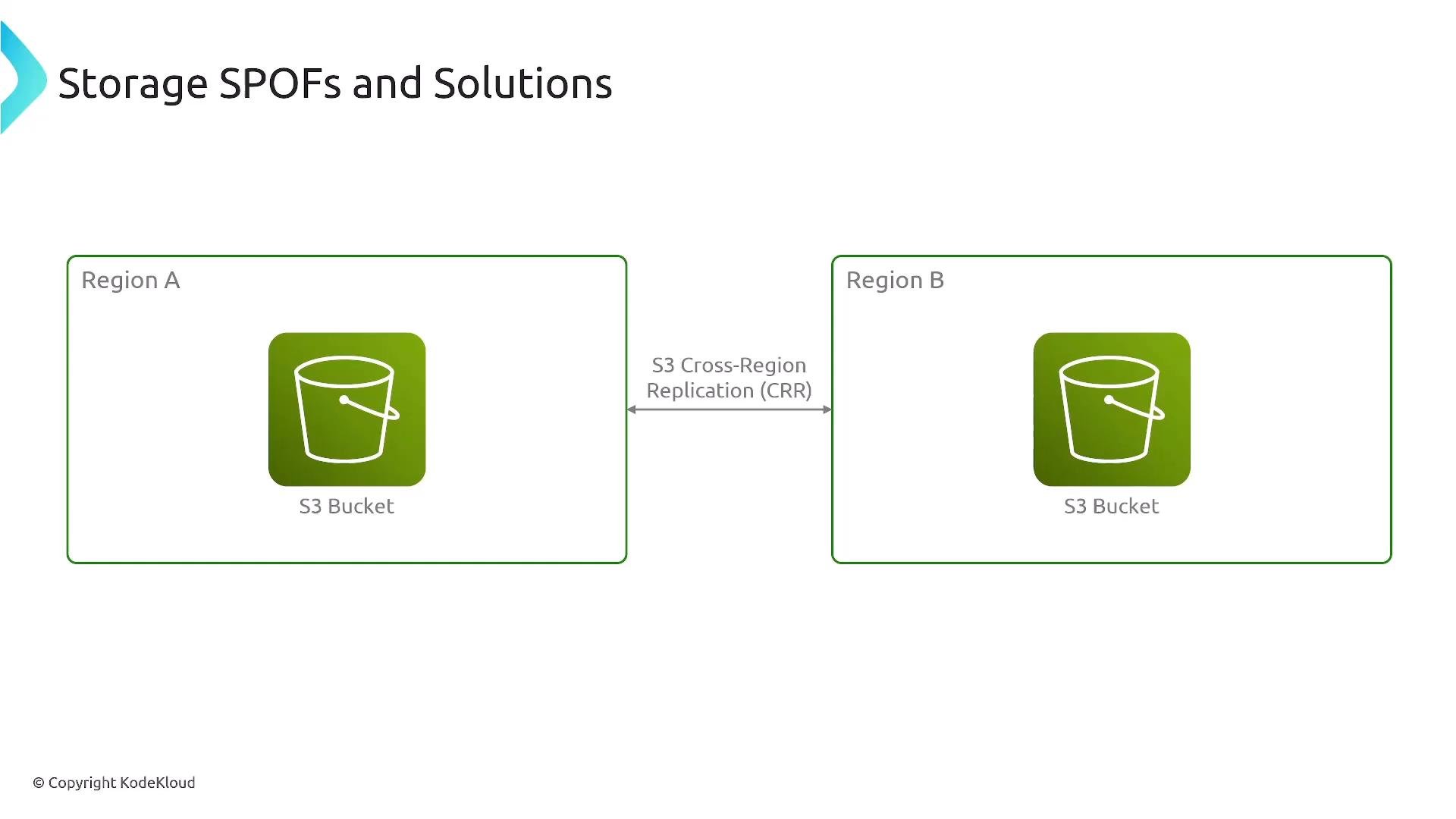
- S3 buckets: durable within a Region (11 9s durability) but Region-scoped. Fix: enable Cross-Region Replication (CRR) for multi-Region durability.
- Amazon Aurora: maintains multiple copies (typically six copies across three AZs) and is resilient by design for intra-Region failures.
- Elastic Load Balancers (ALB/NLB) present a single endpoint but run across many infrastructure devices and AZs.
- CloudFront is a globally distributed CDN.
- Route 53 provides DNS health checks and DNS failover (and advanced routing like latency- or geo-based policies).
- DynamoDB supports Global Tables for active-active multi-Region replication.
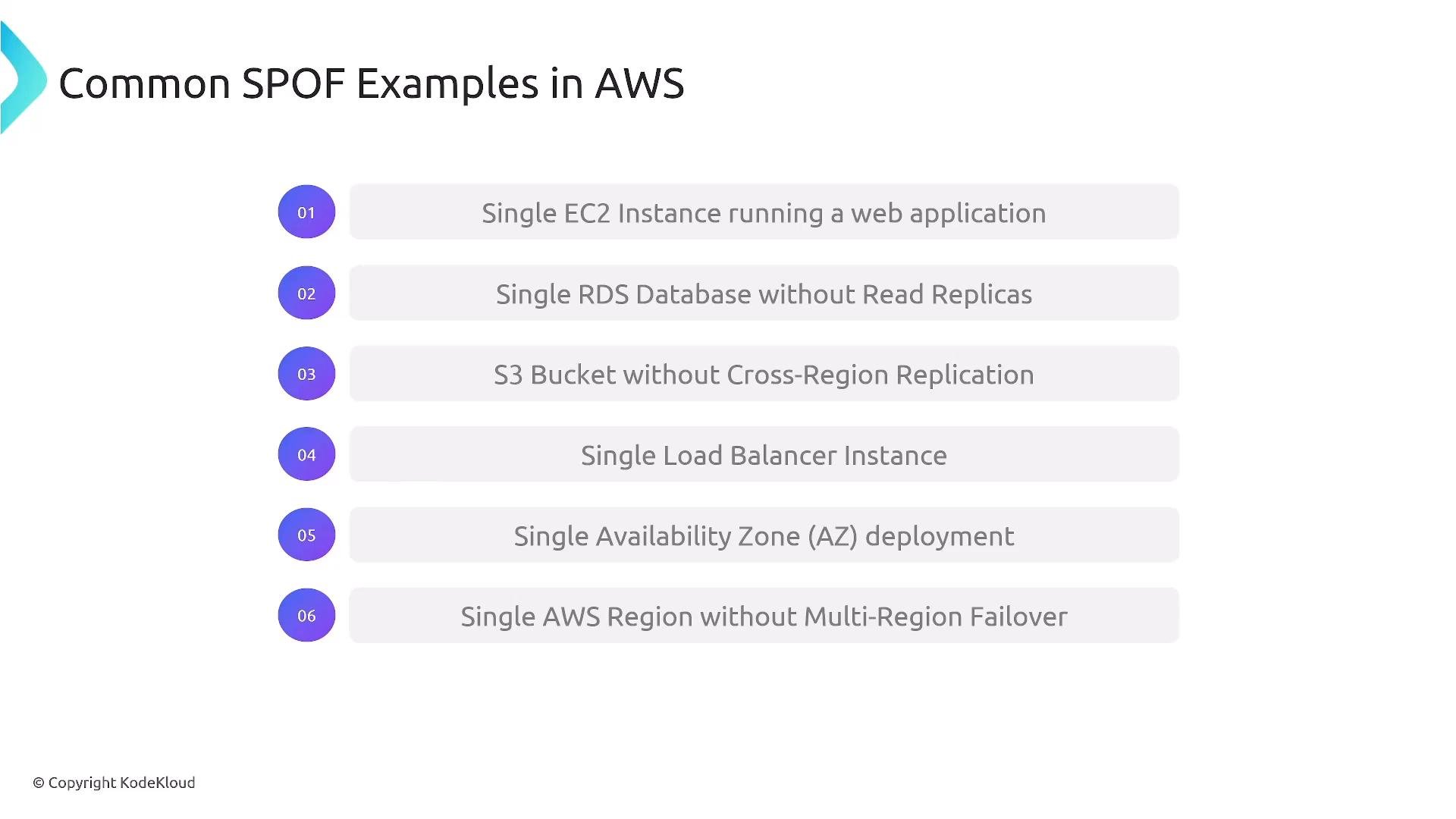
- Component-level SPOFs: always a risk (e.g., single EC2 instance without redundancy).
- AZ-level SPOFs: matter if you require Multi-AZ availability; single-AZ deployments are vulnerable to AZ outages.
- Region-level SPOFs: matter for disaster recovery; a single-Region architecture is vulnerable unless you implement multi-Region failover.
- Compute: replace single instances with
Auto Scaling Group+ALBacross multiple AZs. - Databases: use
RDS Multi-AZfor HA,Read Replicasfor read scale, andAurora Global DatabaseorDynamoDB Global Tablesfor multi-Region replication. - Storage: use
S3(regional durability) and enableCross-Region Replicationif you need multi-Region copies. For EBS, take snapshots and copy them across Regions for DR. - Networking: use managed services (
ELB,Route 53,Global Accelerator) and configure health checks, Multi-AZ targets, and appropriate routing policies. - Caching: for ElastiCache (Redis) enable
cluster modeandMulti-AZ with automatic failover(use replicas and clustering to avoid SPOFs).
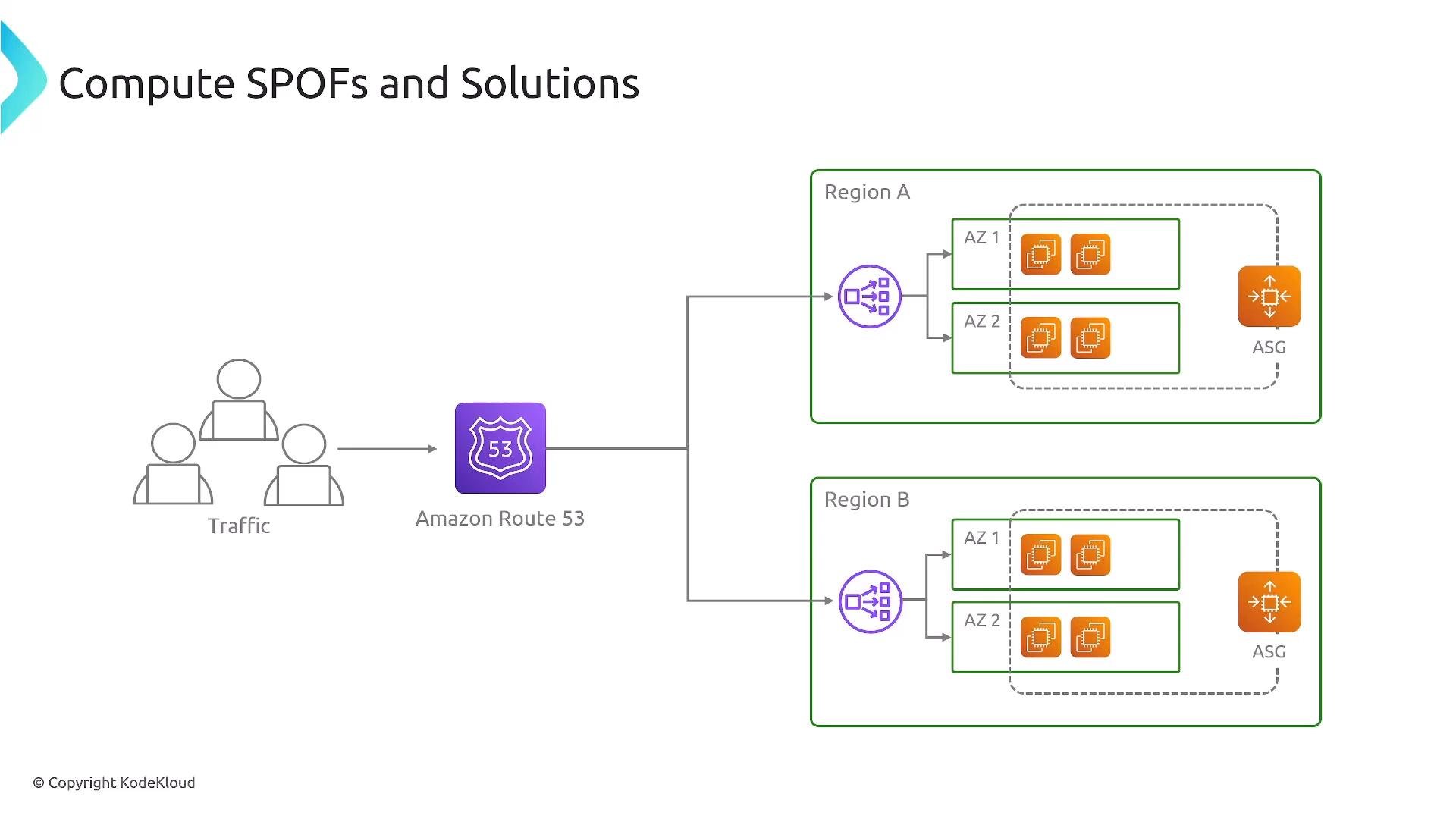
- Route 53 performs global DNS routing (health checks, latency-based routing, or failover).
- Each Region runs an
ALB+Auto Scaling Groupthat spans multiple AZs with stateless application servers. - Storage and databases are replicated or backed up appropriately (for example,
S3 CRR,RDS replicas, orAurora Global Database).
S3is regionally durable and replicated across multiple facilities within a Region. To survive Region failures, enableCross-Region Replicationor copy objects to another Region.EBSvolumes are AZ-scoped; there is no native synchronous multi-Region EBS replication. Use snapshots or AMIs and copy them across Regions for disaster recovery.
EBS volumes are tied to a single AZ. For cross-Region recovery, rely on snapshots/AMIs and automation to recreate volumes in another Region—there is no native synchronous multi-Region EBS replication.
- Use
Route 53health checks with failover or latency-based routing. - Configure load balancers with Multi-AZ target groups.
- Consider
AWS Global Acceleratorfor deterministic global failover and anycast IPs. - For caches, use cluster mode and replicas (ElastiCache Redis with Multi-AZ and automatic failover).
- Recognize true SPOFs: single instances and single-AZ resources without redundancy.
- Understand managed-service behaviors: what AWS replicates or protects for you.
- Choose features to match the failure scope:
Multi-AZ,Multi-Region,CRR,Global Tables,Global Accelerator,Route 53failover, and so on.
- AWS Well-Architected Framework – Reliability pillar: https://aws.amazon.com/architecture/well-architected/reliability/
- Amazon RDS Multi-AZ: https://docs.aws.amazon.com/AmazonRDS/latest/UserGuide/Concepts.MultiAZ.html
- S3 Cross-Region Replication: https://docs.aws.amazon.com/AmazonS3/latest/userguide/replication.html
- Route 53 Failover and Routing Policies: https://docs.aws.amazon.com/Route53/latest/DeveloperGuide/routing-policy.html
- AWS Global Accelerator: https://aws.amazon.com/global-accelerator/