

- Detection: find events and signals that indicate something happened.
- Processing: transform, buffer, or run logic in response to events.
- Notification: route information to people and systems.
- Remediation: automatically resolve or mitigate issues.
- Investigation: analyze and explore incidents and their causes.
Key building blocks
- AWS Health — service and account-relevant health events.
- Amazon EventBridge — central event bus with rules, routing, and transformations.
- AWS CloudTrail — records management and optional data-plane API activity.
- Amazon CloudWatch — metrics, logs, and traces (the observability stack).
Detection layer
The detection layer includes global service status and account-level signals:- Global service status → AWS Health.
- Account and resource events → EventBridge rules and custom event buses.
- API activity → CloudTrail (management and optional data events).
- Metrics, logs, and traces → CloudWatch Alarms, Logs, and X‑Ray traces.
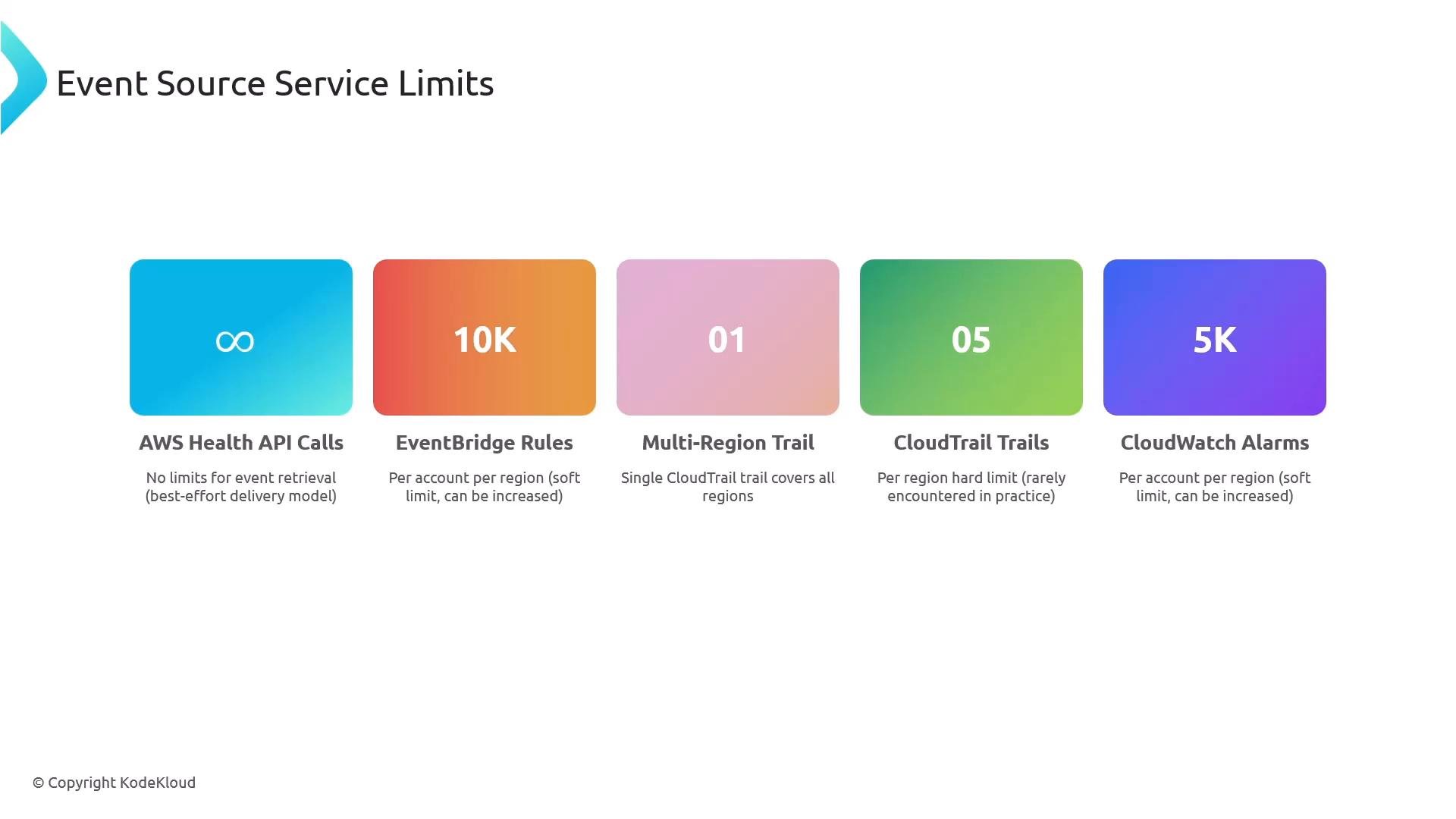
Detection design tip: evaluate signal latency and regional scope for each source. Use EventBridge for low-latency routing and streaming services (Kinesis) for real-time processing. For non-real-time forensic data, rely on CloudTrail + S3.
- CloudTrail-to-S3 is typically eventual — expect a ~5–15 minute delivery window; not suitable for sub-minute automation.
- For near-real-time or sub-second responses, rely on EventBridge or streaming (Kinesis).
Event processing services
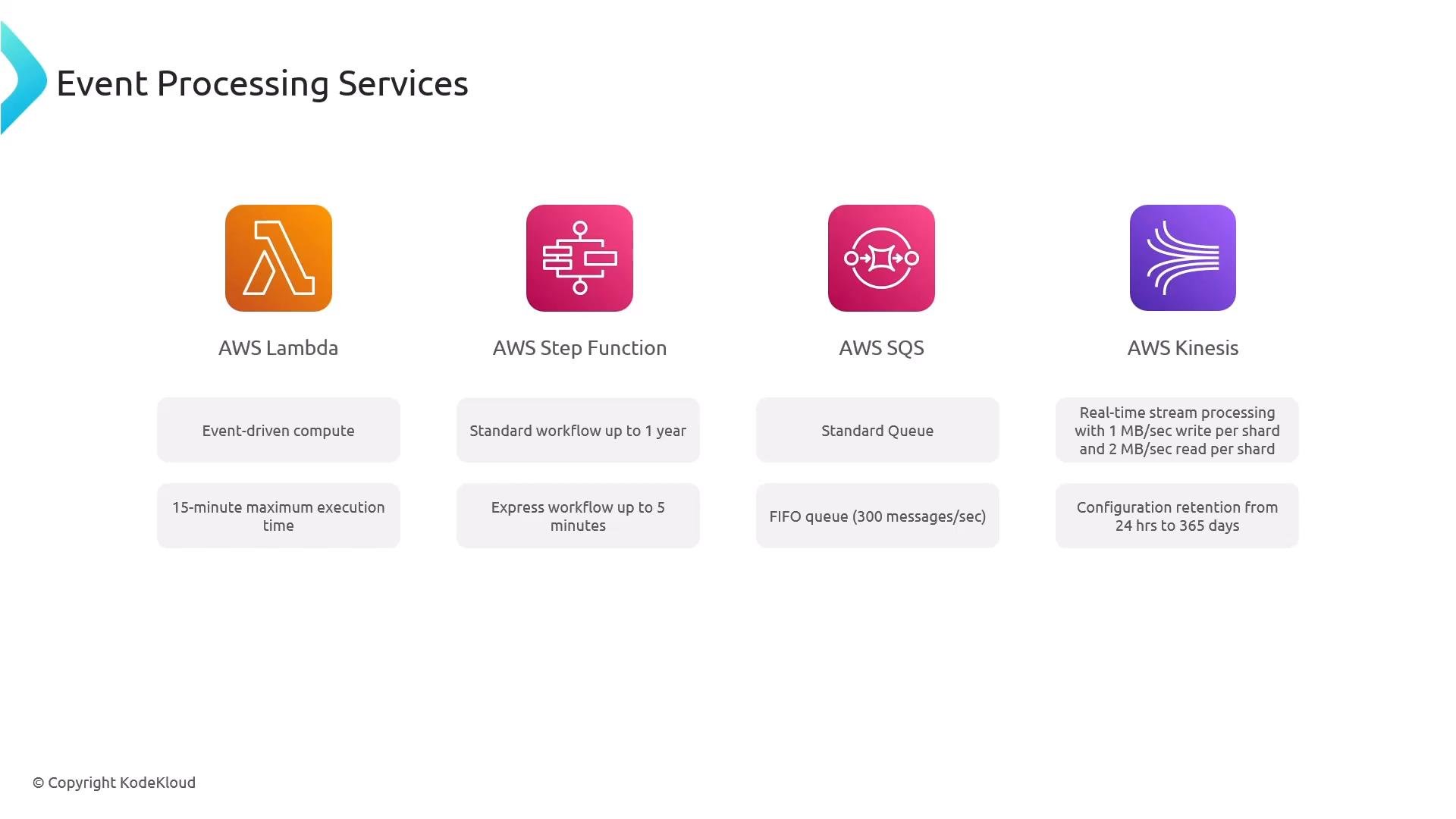
Event processing provides compute, orchestration, buffering, and streaming:- AWS Lambda — event-driven compute for short-lived tasks (max 15 minutes).
- AWS Step Functions — orchestrated workflows; Standard Workflows support long-running executions (up to 1 year), Express Workflows are optimized for high-volume, short-duration workloads (up to 5 minutes).
- Amazon SQS — durable queueing (Standard or FIFO) for decoupling and buffering asynchronous workloads.
- Amazon Kinesis Data Streams — high-throughput, low-latency streaming for real-time processing.
Notification services
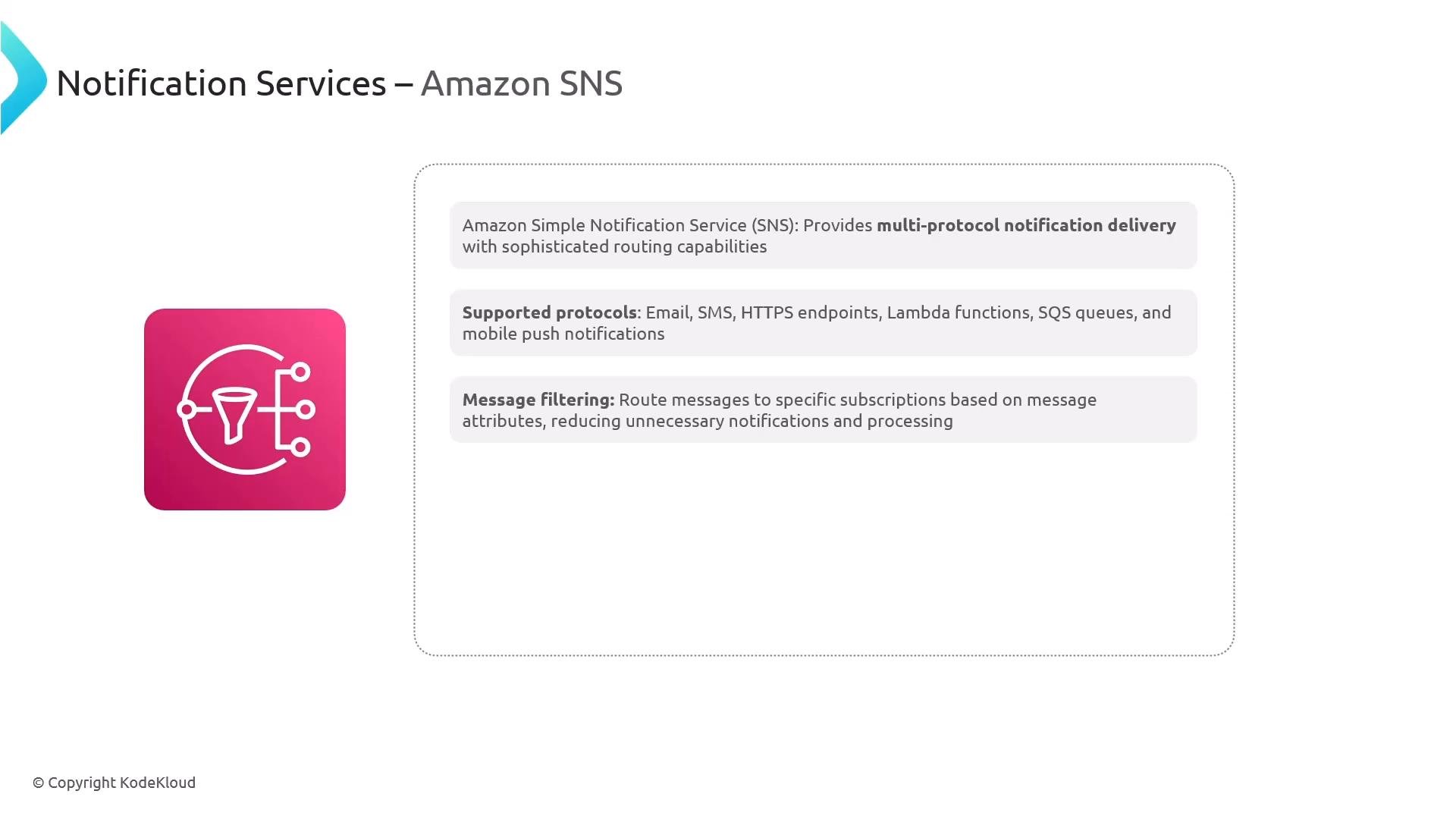
Notification services distribute alerts and findings to humans and systems:- Amazon SNS — multi-protocol fan-out (Email, SMS, HTTP/S, Lambda, SQS, mobile push) with subscription filtering.
- EventBridge targets — sophisticated routing and transformation to many targets; preferred when complex routing or transformations are required.
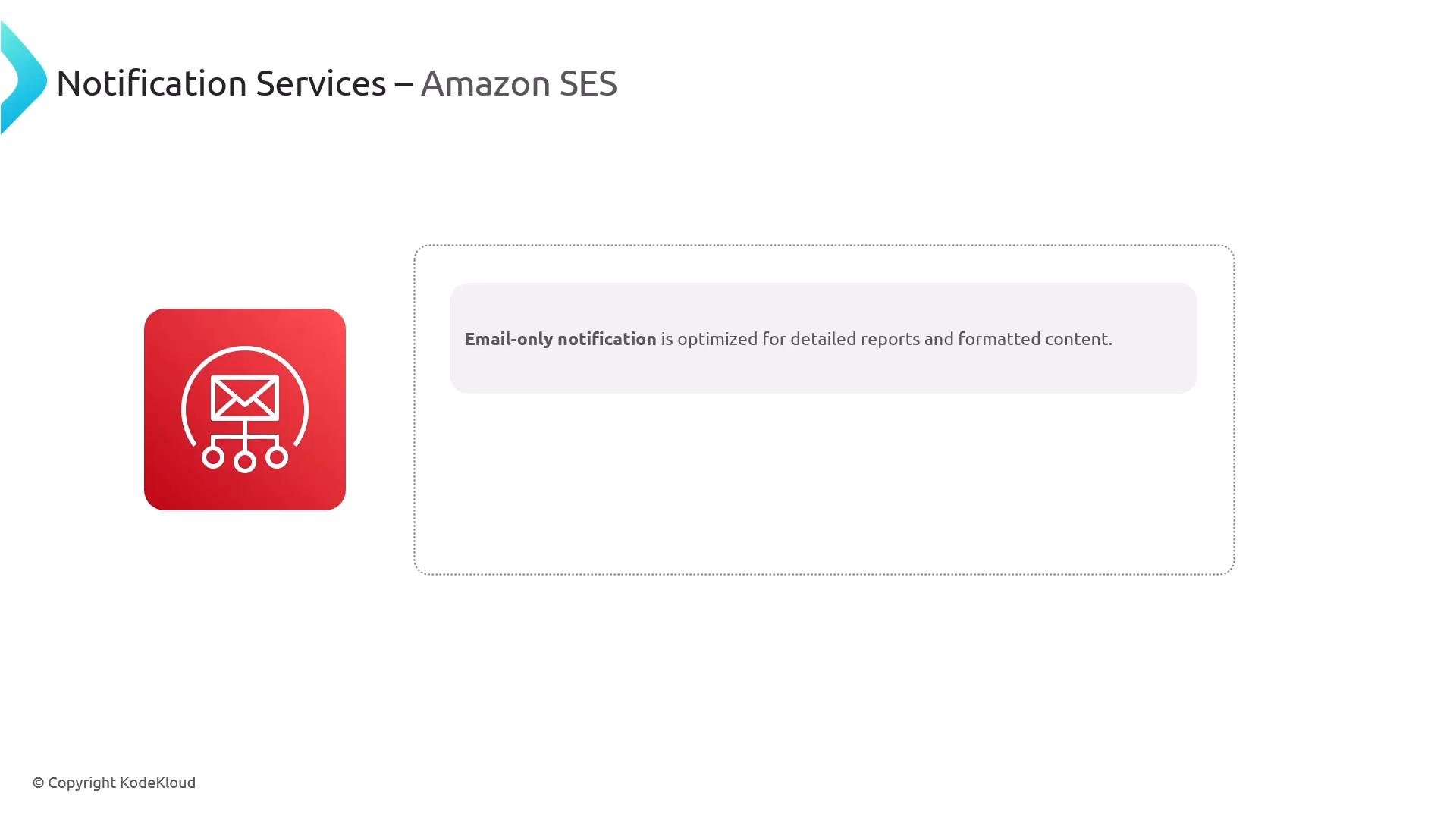
- Amazon SES — optimized for formatted or high-volume email with templates and reputation management.
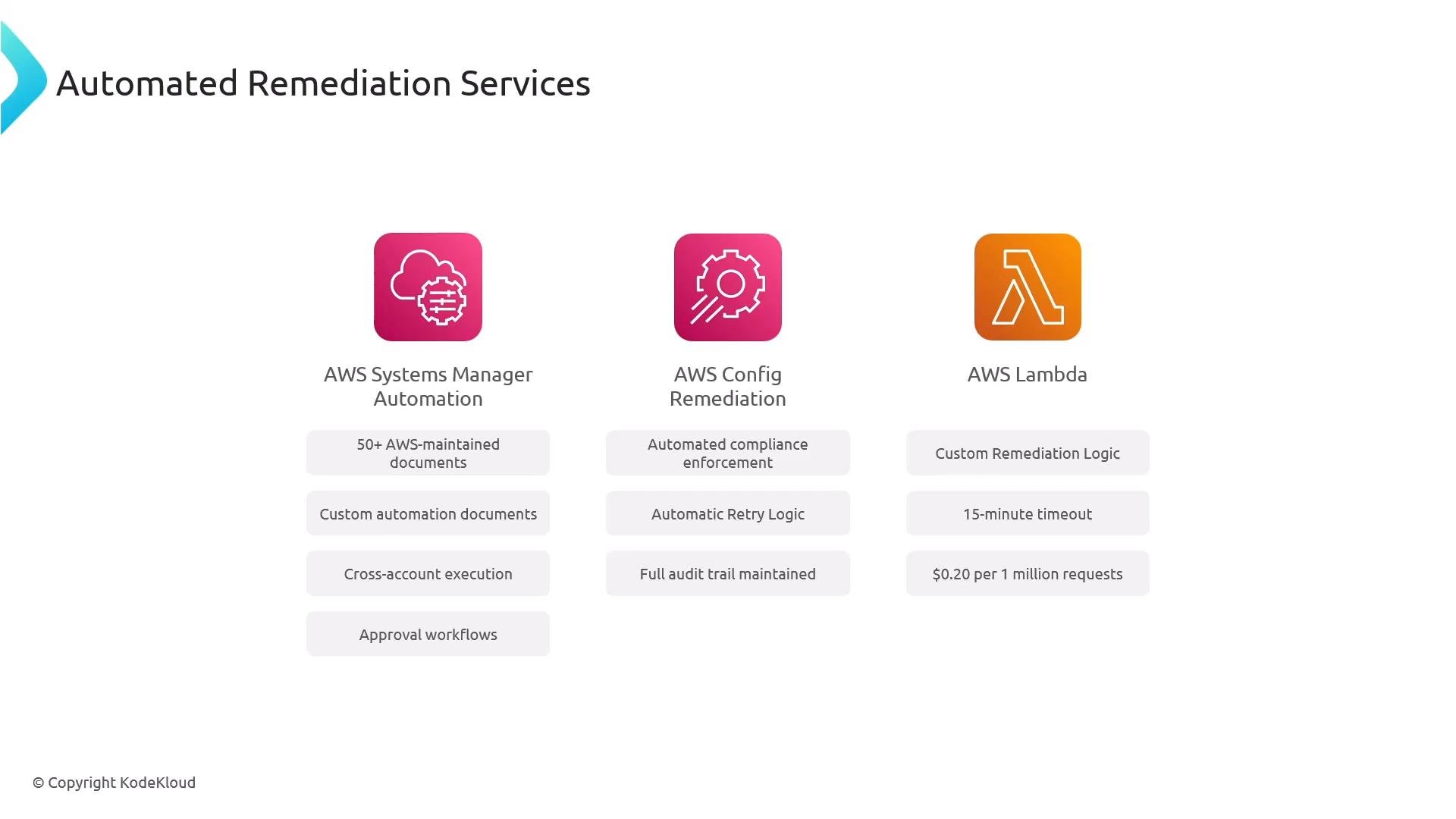
Automated remediation
Remediation combines orchestration, compute, and systems management:- AWS Lambda — ad-hoc/custom remediation actions (subject to the 15-minute runtime limit).
- AWS Systems Manager Automation — runbooks and operational automations for standardized tasks.
- AWS Config Remediation — automatic remediation for compliance-driven rules.
- AWS Step Functions — coordinate multi-step or approval-based remediation workflows.
Lambda functions are limited to a 15-minute maximum execution time. For long-running or durable stateful workflows, prefer Step Functions Standard or Systems Manager Automation.
Investigation and analysis
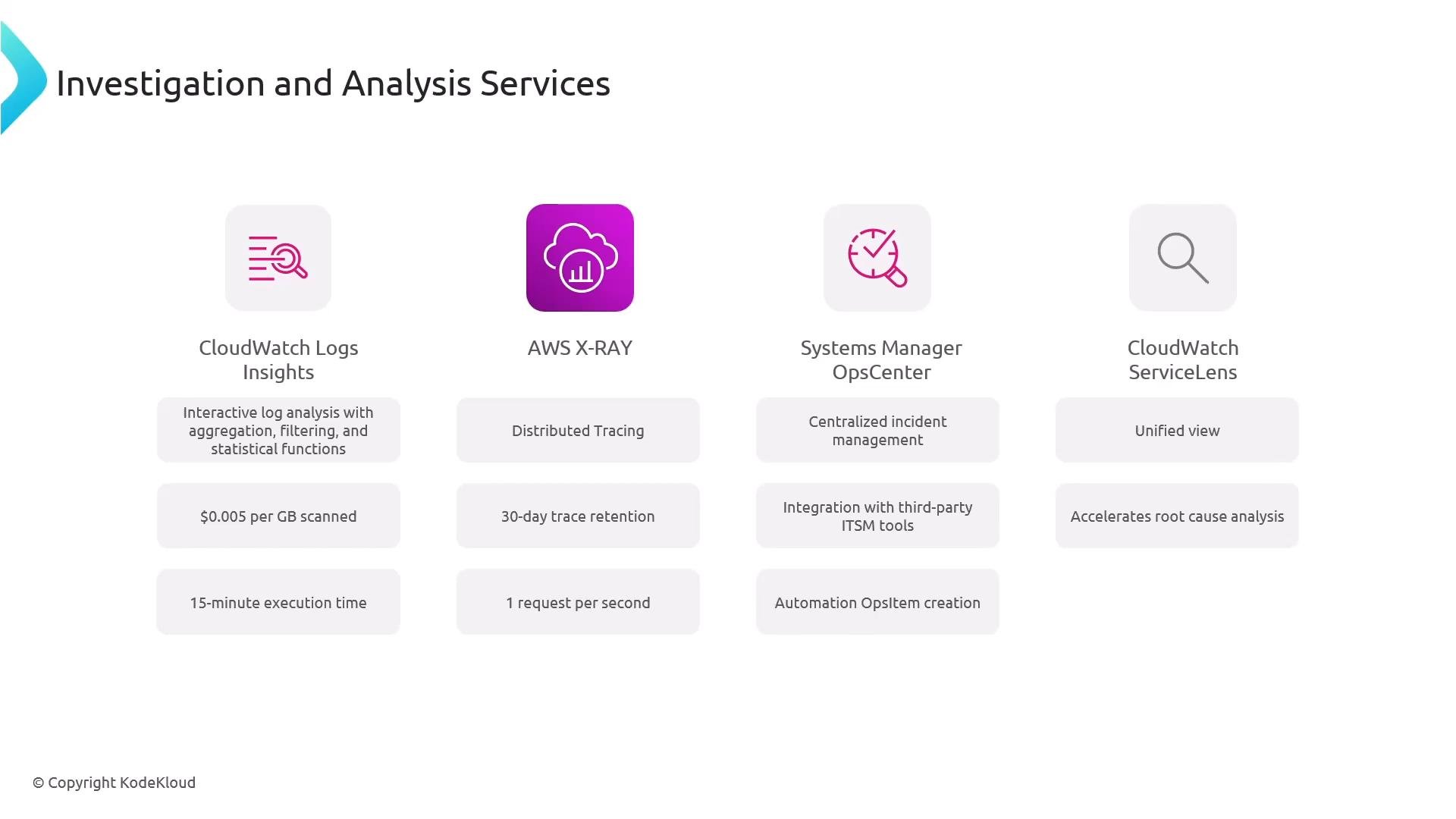
Use observability and management tools to investigate incidents and perform root-cause analysis:- CloudWatch Logs Insights — interactive log queries and ad-hoc investigation.
- AWS X‑Ray — distributed tracing and latency analysis for microservices.
- Systems Manager OpsCenter — aggregated operational items and remediation tracking.
- CloudWatch ServiceLens — visualize service health, metrics, and traces together.
- OpenSearch — powerful log analytics and dashboards for complex queries.
Common service integration patterns
Below are common architectural patterns and how AWS services typically chain together:-
Event-driven remediation
- Source (e.g., AWS Config) → EventBridge → Systems Manager Automation → CloudWatch Logs (results) → OpsCenter (lifecycle tracking)
-
Fan-out / multi-destination notification
- Alarm → SNS topic → PagerDuty / Lambda / SQS / Email / SMS
-
Approval-based automation (human-in-the-loop)
- EventBridge → Step Functions (approval via SNS/console/API) → on approval, trigger Systems Manager Automation or Lambda
-
Cross-account invocation
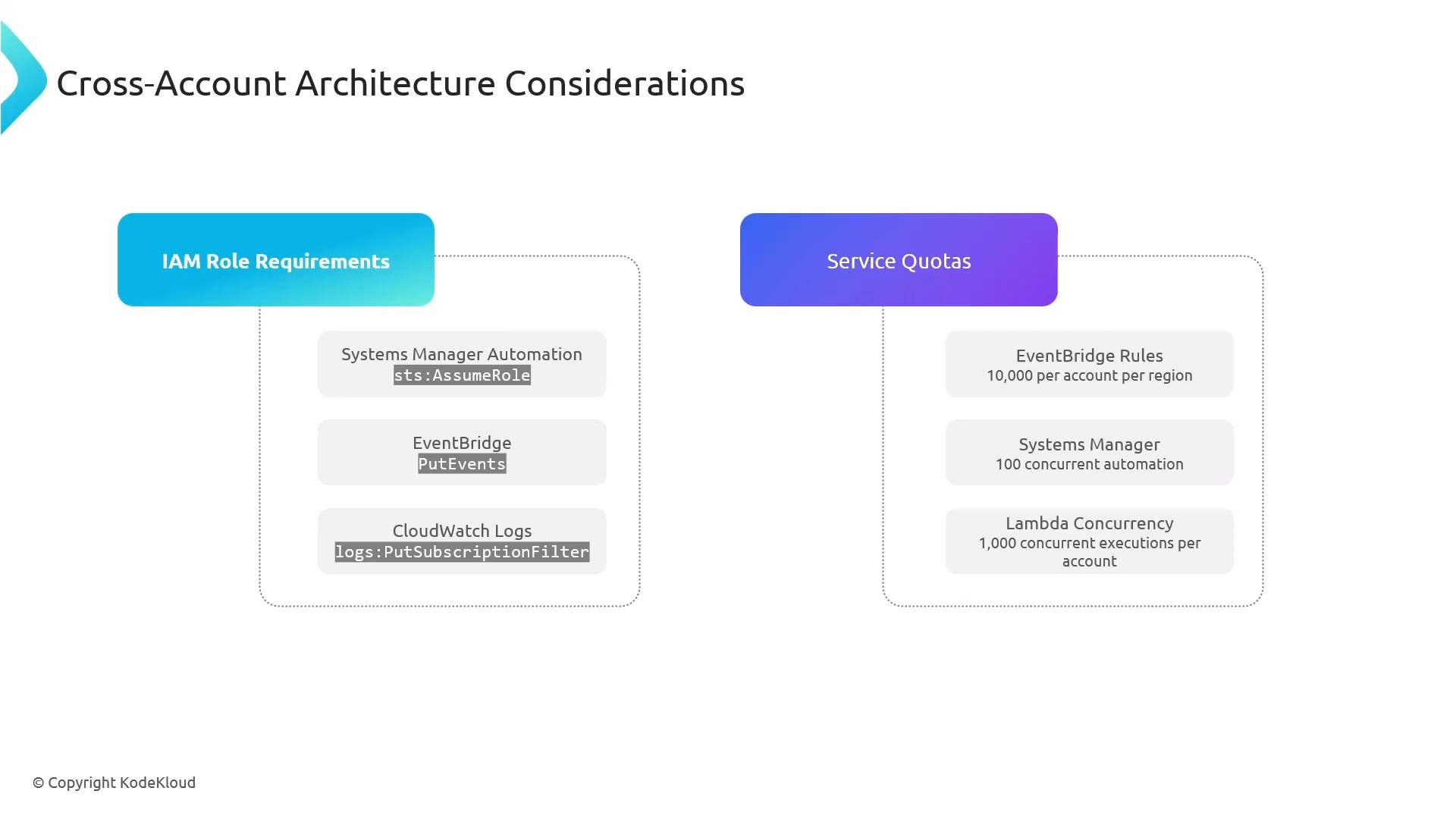
- Use EventBridge cross-account event buses or assume-role patterns (sts:AssumeRole) and resource-based policies to invoke Systems Manager runbooks across accounts. Test IAM roles and policies thoroughly.
-
High-volume processing
- CloudTrail or events → EventBridge → Kinesis Data Streams → Lambda consumers or processing apps → DynamoDB or other stores → CloudWatch dashboards
Cost optimization and operational concerns
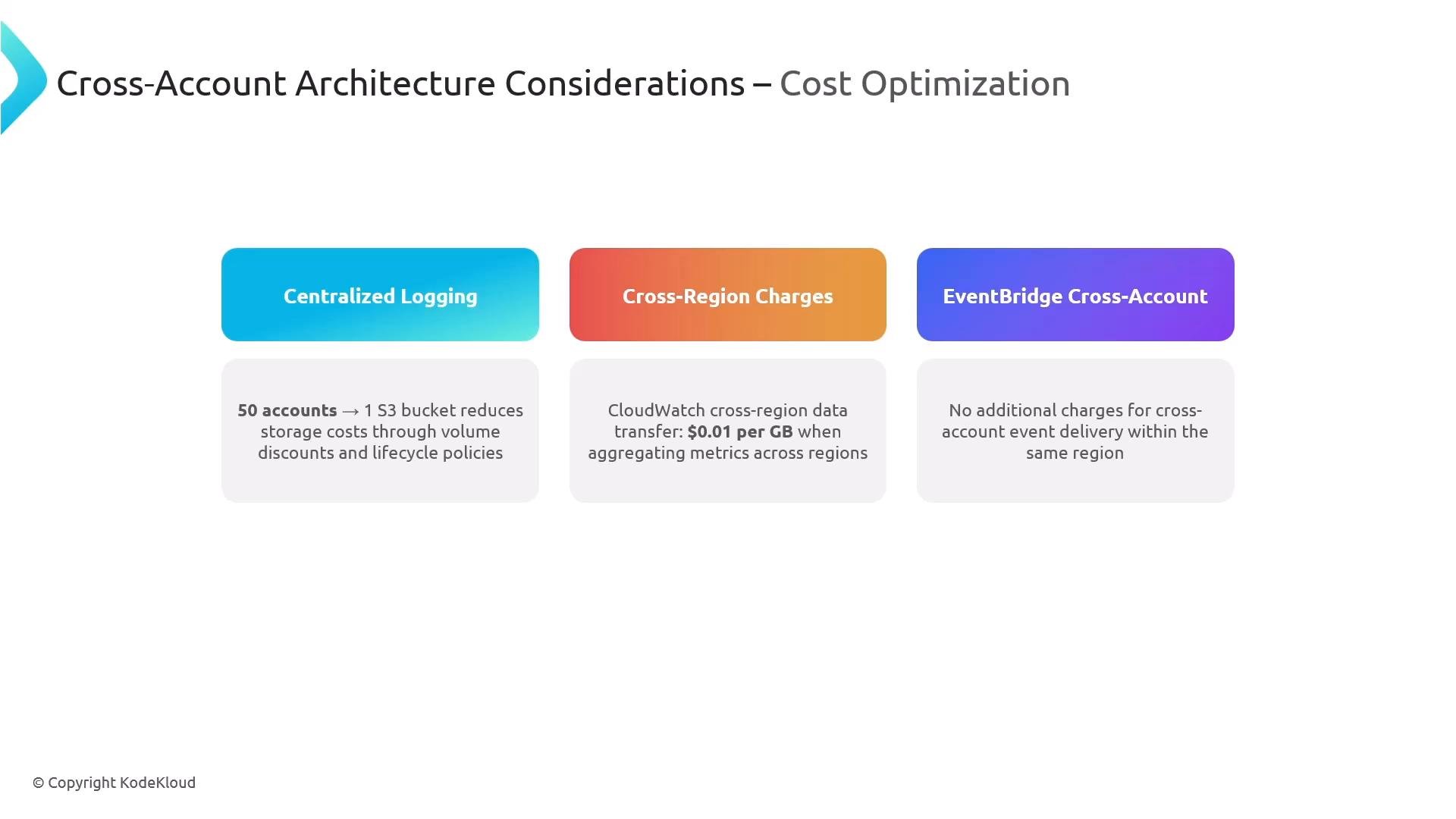
Keep these cost and operational best practices in mind:- Centralize logging to simplify retention policies and cost management.
- Minimize cross-region data transfer to reduce network egress costs.
- EventBridge is commonly used as a cross-account aggregation backbone; cross-account EventBridge routing does not itself add an extra cross-account charge.
- Tier CloudWatch log retention (hot → warm → cold) and archive older data to lower-cost storage (S3 Glacier) when appropriate.
- Understand default quotas (e.g., Lambda concurrency, Step Functions limits, SQS FIFO TPS without batching, Systems Manager automation concurrency) and request quota increases early.
Service selection decision tree (summary)
When choosing services, evaluate these core questions:-
Detection: what is the signal type?
- Infrastructure events → AWS Health
- Service state changes → EventBridge
- API calls → CloudTrail (management or data events)
- Metrics, logs, traces → CloudWatch
-
Processing: runtime, scale, and durability requirements?
- Custom logic under 15 minutes → Lambda
- Multi-step serverless workflows → Step Functions
- High-volume, real-time stream processing → Kinesis Data Streams
- Simple asynchronous buffering → SQS
-
Remediation:
- Standard operational runbooks → Systems Manager Automation
- Complex or custom remediation → Lambda or Step Functions
- Compliance-driven enforcement → AWS Config Remediation + Automation
-
Investigation & analysis:
- Log analytics → CloudWatch Logs Insights or OpenSearch
- Distributed tracing → AWS X‑Ray
- Aggregated operational items → Systems Manager OpsCenter
- Security findings → Security Hub (security-focused detections)
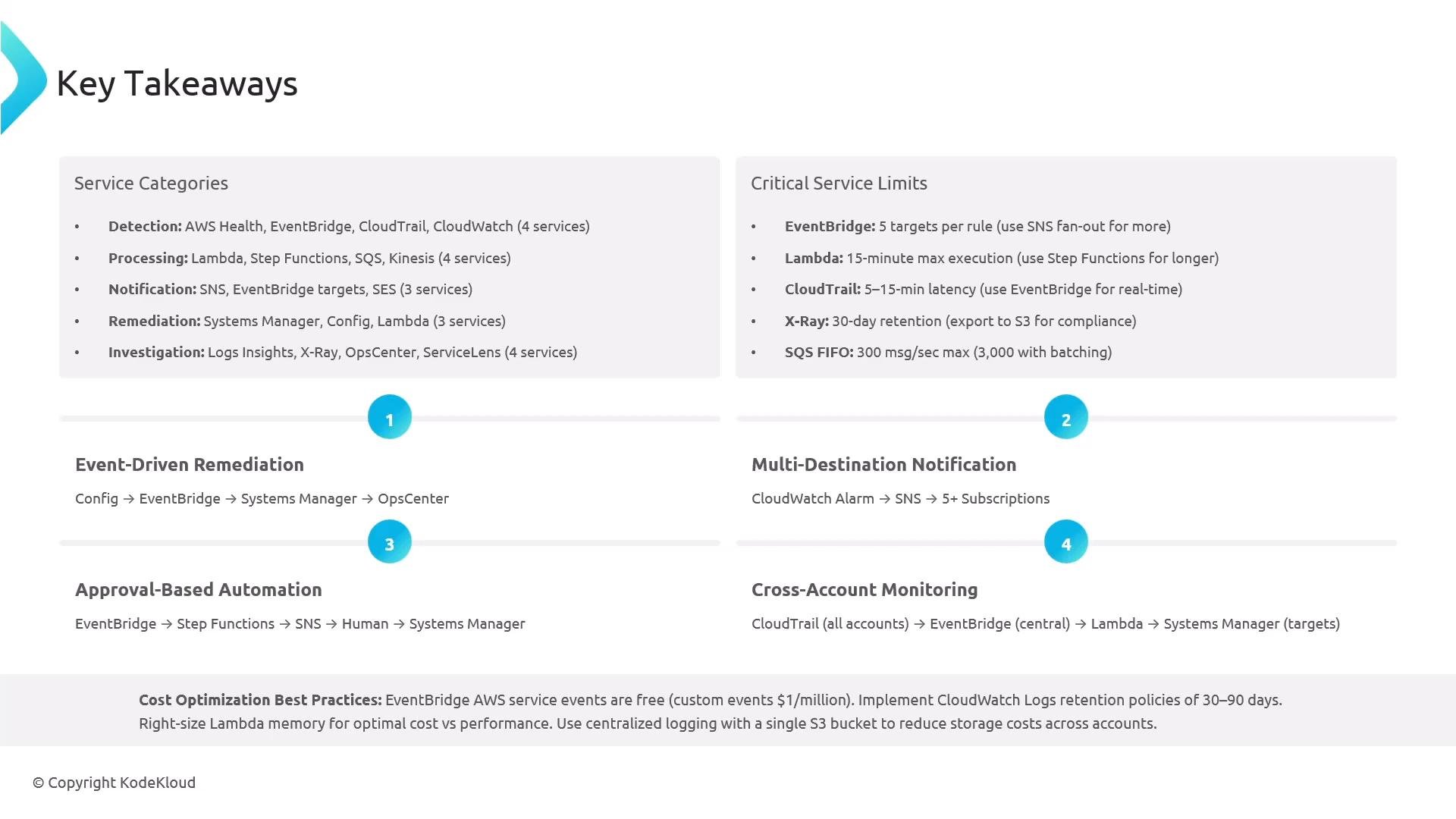
Key takeaways
- Core service categories: detection, processing, notification, remediation, and investigation.
- Watch critical limits and latencies (e.g., Lambda 15-minute execution limit; CloudTrail→S3 delivery ~5–15 minutes).
- Common patterns to design for: event-driven remediation, multi-destination notifications (fan-out), approval-based automation, and cross-account monitoring.
- Cost and operations: centralize logging, tier retention, optimize compute runtimes, and consider EventBridge for cross-account aggregation.
- Always validate IAM roles and service quotas early when building cross-account or high-scale solutions.
Links and references
- AWS EventBridge: https://docs.aws.amazon.com/eventbridge/latest/userguide/what-is-amazon-eventbridge.html
- AWS CloudTrail: https://docs.aws.amazon.com/cloudtrail/index.html
- Amazon CloudWatch: https://docs.aws.amazon.com/cloudwatch/index.html
- AWS Systems Manager Automation: https://docs.aws.amazon.com/systems-manager/latest/userguide/systems-manager-automation.html
- Amazon Kinesis Data Streams: https://docs.aws.amazon.com/streams/latest/dev/introduction.html
- Amazon SNS: https://docs.aws.amazon.com/sns/latest/dg/welcome.html
- Amazon SES: https://docs.aws.amazon.com/ses/latest/DeveloperGuide/Welcome.html
- AWS X‑Ray: https://docs.aws.amazon.com/xray/latest/devguide/aws-xray.html