

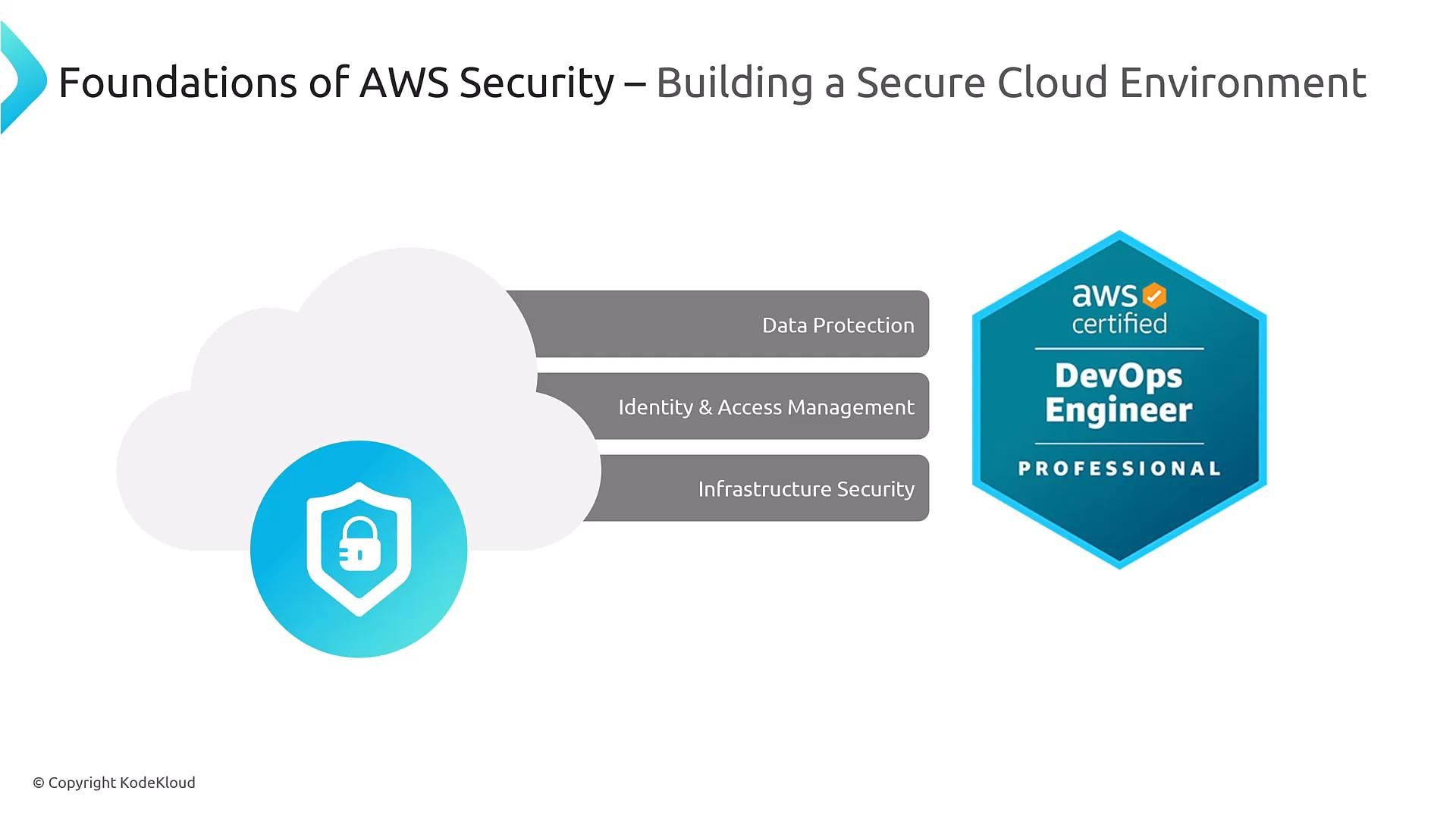
- Data protection (encryption, backups, retention)
- Identity & Access Management (authentication, authorization, least privilege)
- Infrastructure security (networking, compute hardening, edge protection)
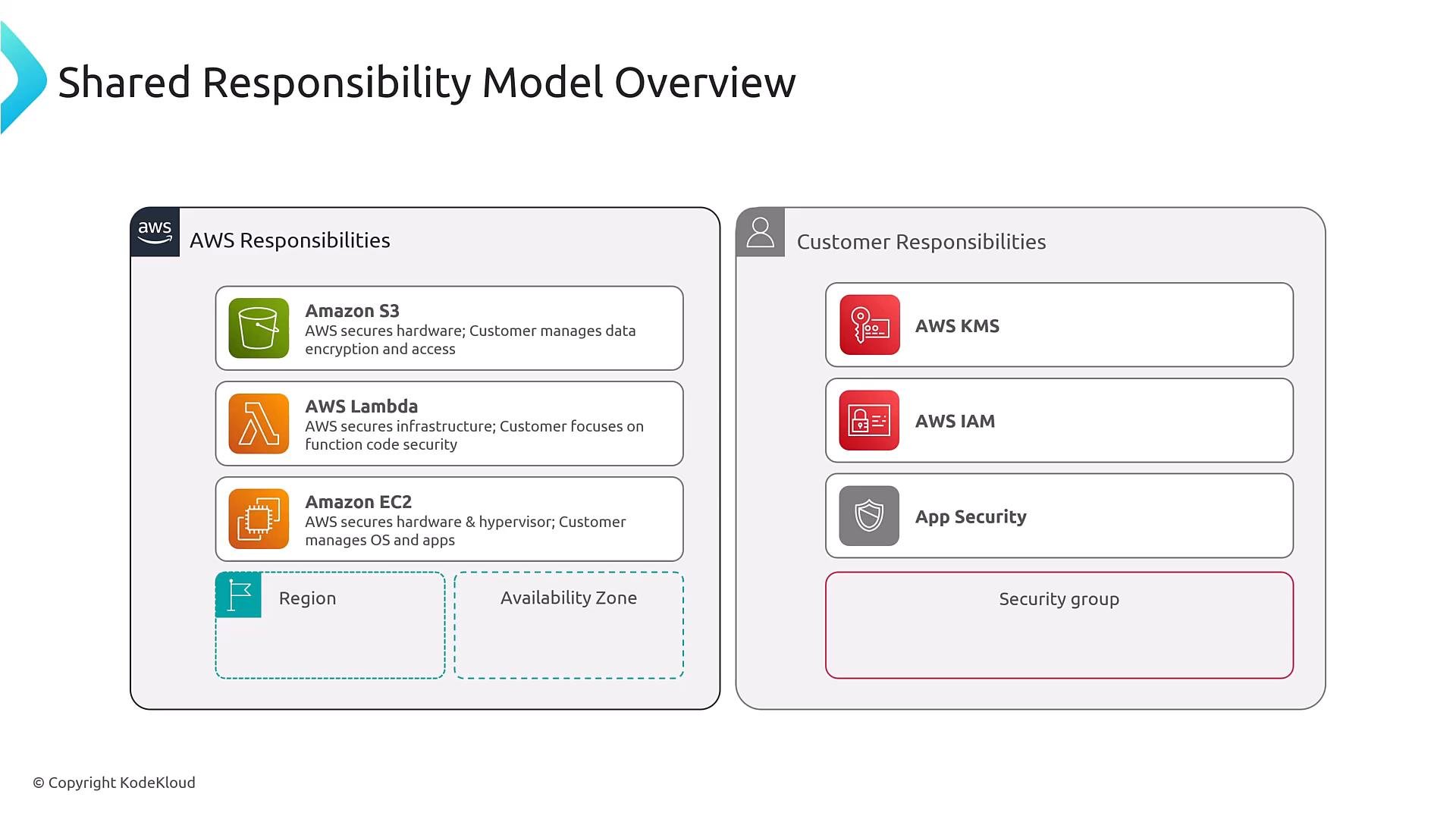
Shared responsibility model — who does what?
Shared responsibility is central to designing secure systems on AWS. Understand the distinction between AWS-managed controls (“of” the cloud) and customer-managed controls (“in” the cloud):- AWS is responsible for the security of the cloud: physical facilities, hardware, network, hypervisor, and foundational managed services.
- Customers are responsible for security in the cloud: data, identity & access configuration, operating system and application patching, application-level controls, and correct configuration of managed services.
- Running an EC2 instance: you manage the OS, patches, installed software, and access control.
- Using a fully managed database (RDS): AWS manages the underlying infrastructure and database engine patching (depending on the engine & configuration), but you must configure encryption, network access, and user permissions correctly.
How responsibility shifts by service model
Responsibility boundaries vary with IaaS, PaaS, and SaaS. Below is a quick reference for common AWS services: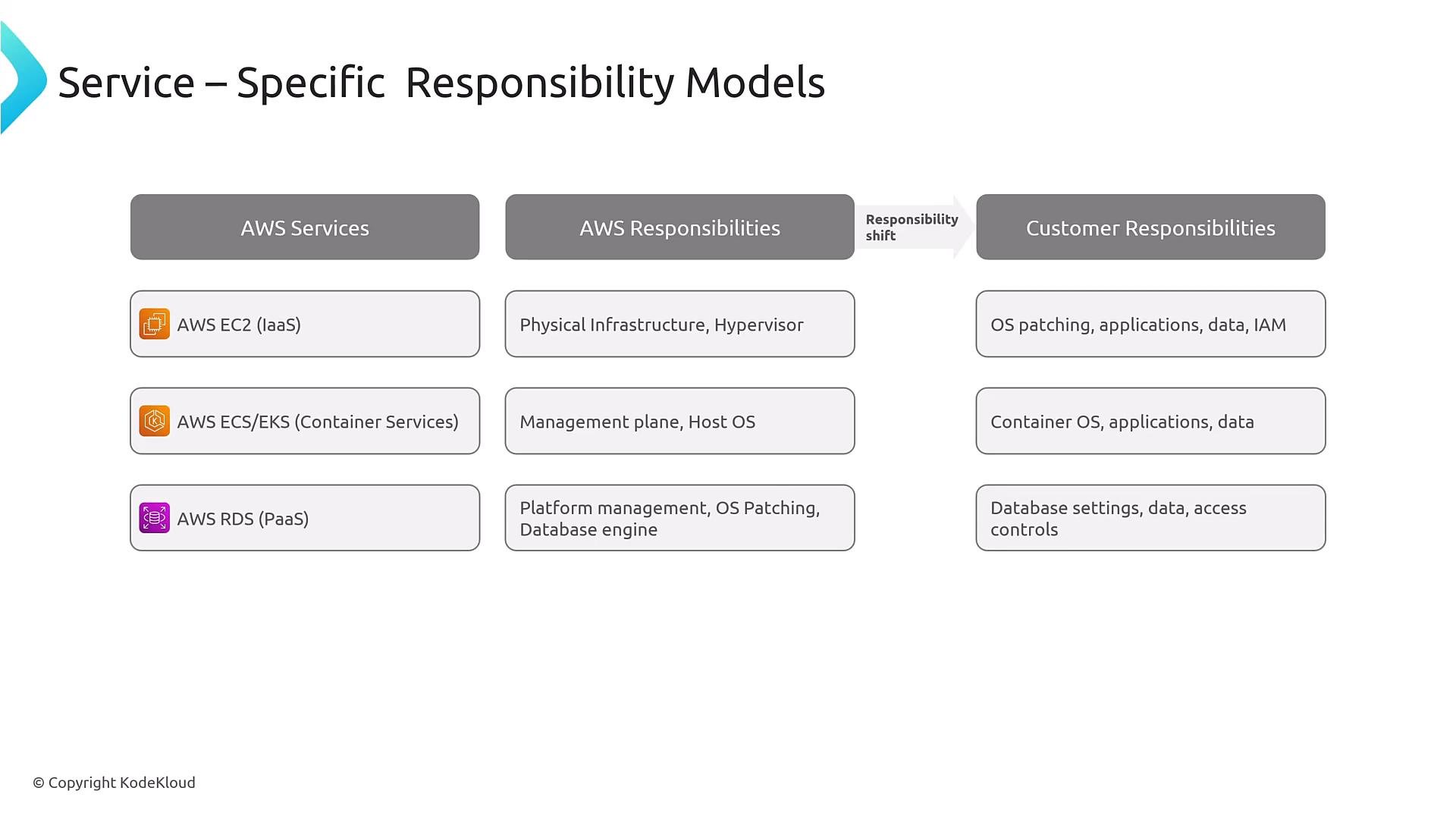
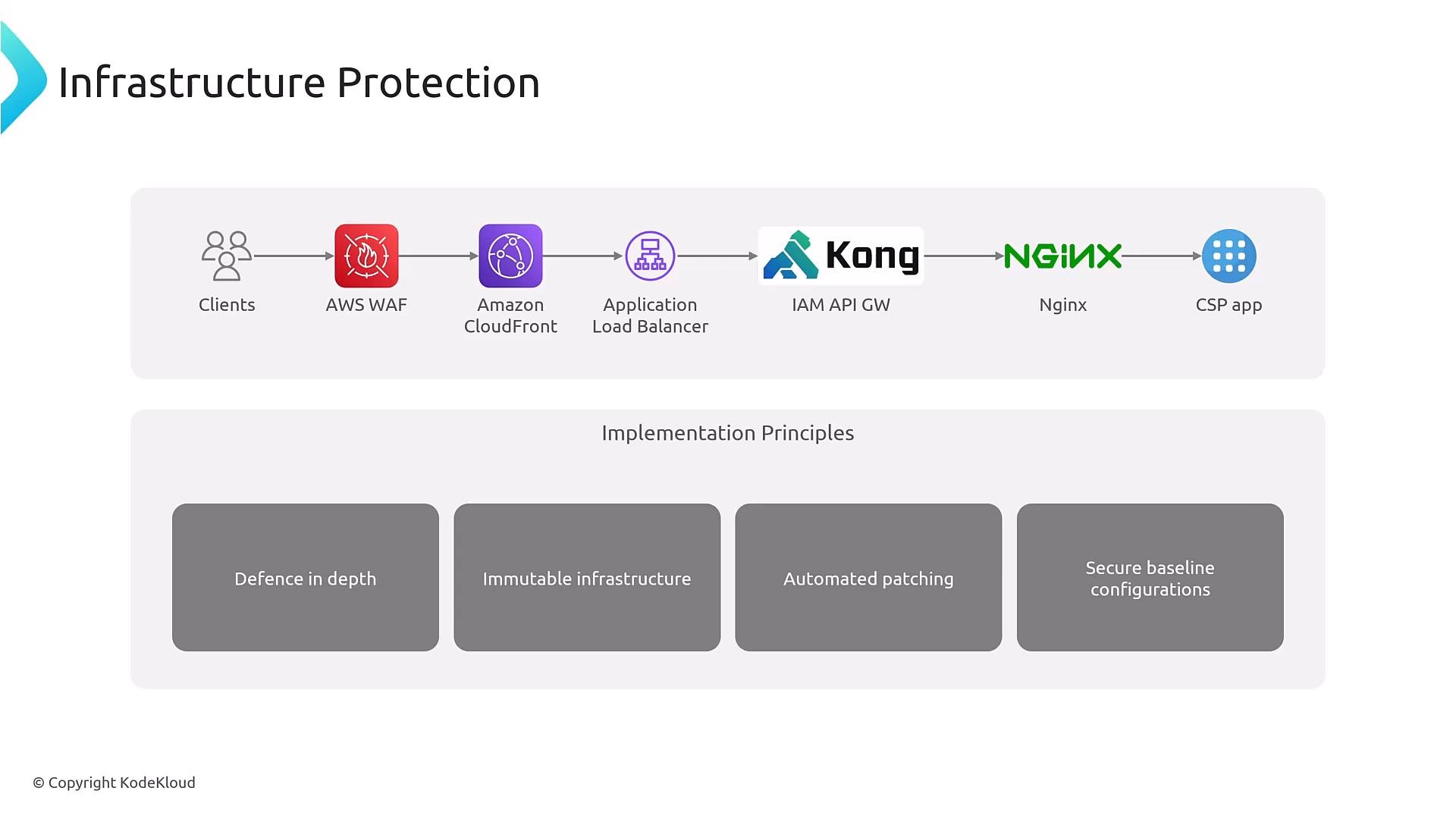
- AWS: VPC networking infrastructure, hypervisor, and physical network design/operation.
- You: VPC subnets, routing, security groups, NACLs, WAF rules, ALB listener rules, API gateway configuration, and application-level protections.
- Managed services like CloudFront and WAF still require customer configuration (cache behavior, rule sets, origins, and access restrictions).
Public exposure of resources (for example, S3 buckets or databases) is one of the most common misconfigurations. Always enable public access blocks, encryption, logging, and versioning where appropriate, and validate policies with policy-as-code tests before deployment.
Example: secure S3 bucket via CloudFormation
Below is a basic CloudFormation snippet demonstrating customer-side controls you must enable: server-side encryption, access logging, public access blocks, and versioning. These are configuration-level responsibilities.Security automation — prevention, detection, remediation
Automation is essential to scale security controls consistently. Cover prevention, detection, and remediation across the entire CI/CD and infrastructure lifecycle:- Shift-left security: run scans and policy checks during pre-commit, build, and test stages.
- Enforce gates: block deployments with failing security checks (vulnerable images, policy violations).
- Remediation workflows: automate incident responses and configuration fixes (Lambda, Step Functions, Systems Manager).
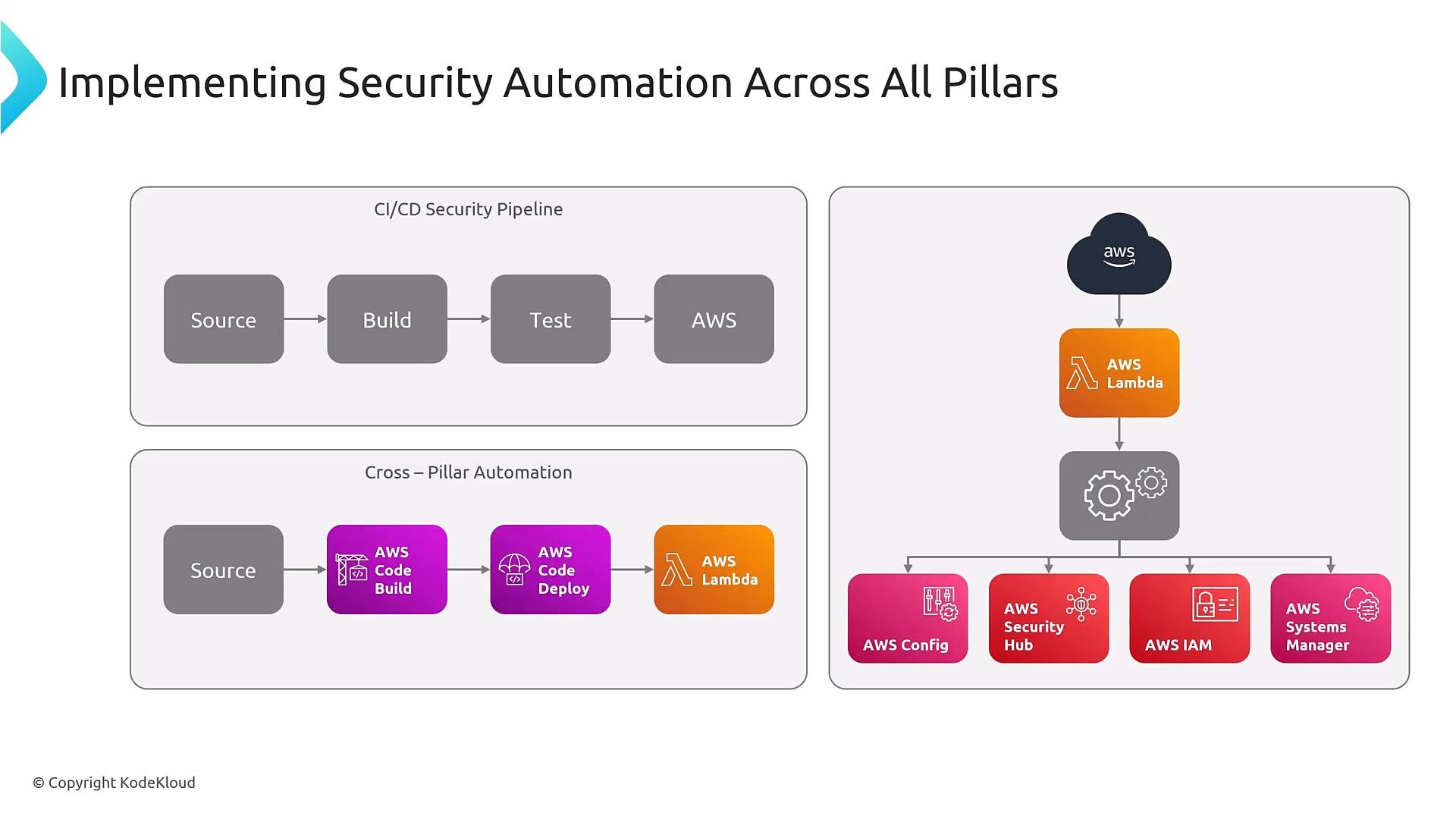
- Infrastructure as Code: CloudFormation, CDK, Terraform/OpenTofu to produce reproducible, auditable deployments.
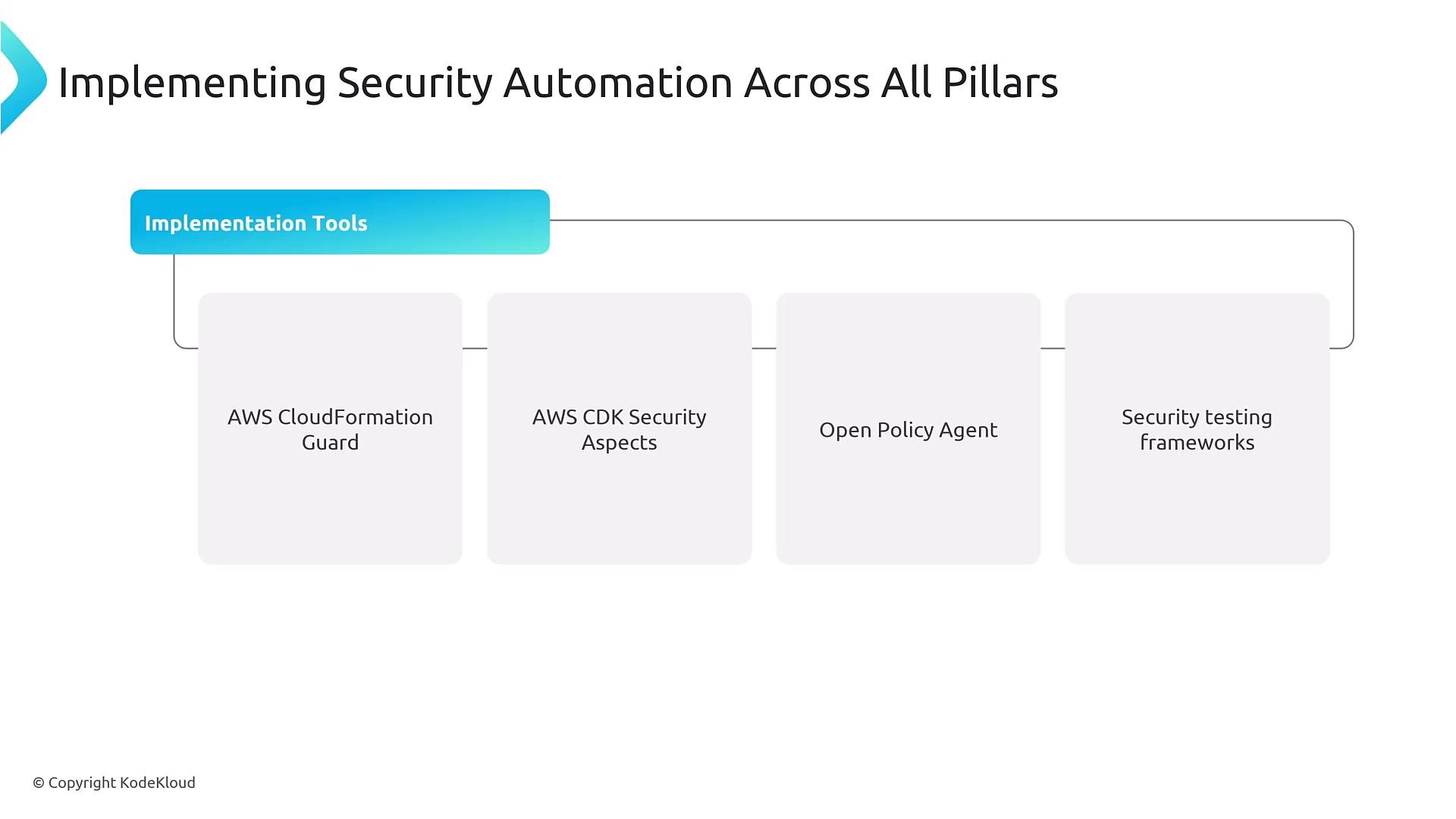
- Policy-as-code: CloudFormation Guard, CDK security aspects, Open Policy Agent (OPA) to enforce guardrails pre-deploy.
- Security testing: static analysis and vulnerability scanners (Trivy, Checkov) integrated into pipelines.
- Automated remediation: AWS Lambda, Systems Manager Automation, and Step Functions to orchestrate responses.
Multi-account strategies and centralized guardrails
Large organizations should standardize using AWS Organizations and multi-account patterns:- Centralized logging and monitoring (central account for CloudTrail, Config aggregator).
- Shared services accounts for DNS, IAM provisioning, and tooling.
- Service Control Policies (SCPs) to enforce organization-level guardrails (e.g., deny S3 bucket deletion, restrict region usage).
- Centralized detection (GuardDuty, Security Hub, Security Lake) and incident response pipelines.
For the exam, prioritize AWS-native services and how they integrate. Third-party tools may be valid integrations, but most questions expect knowledge of AWS-provided controls and patterns.
Measuring security posture
A security posture dashboard tracks consistency and coverage metrics: control consistency, encryption coverage, logging coverage, incident response time, and open gaps (e.g., unencrypted buckets, missing CloudTrail). These metrics drive prioritization for remediation and compliance reporting.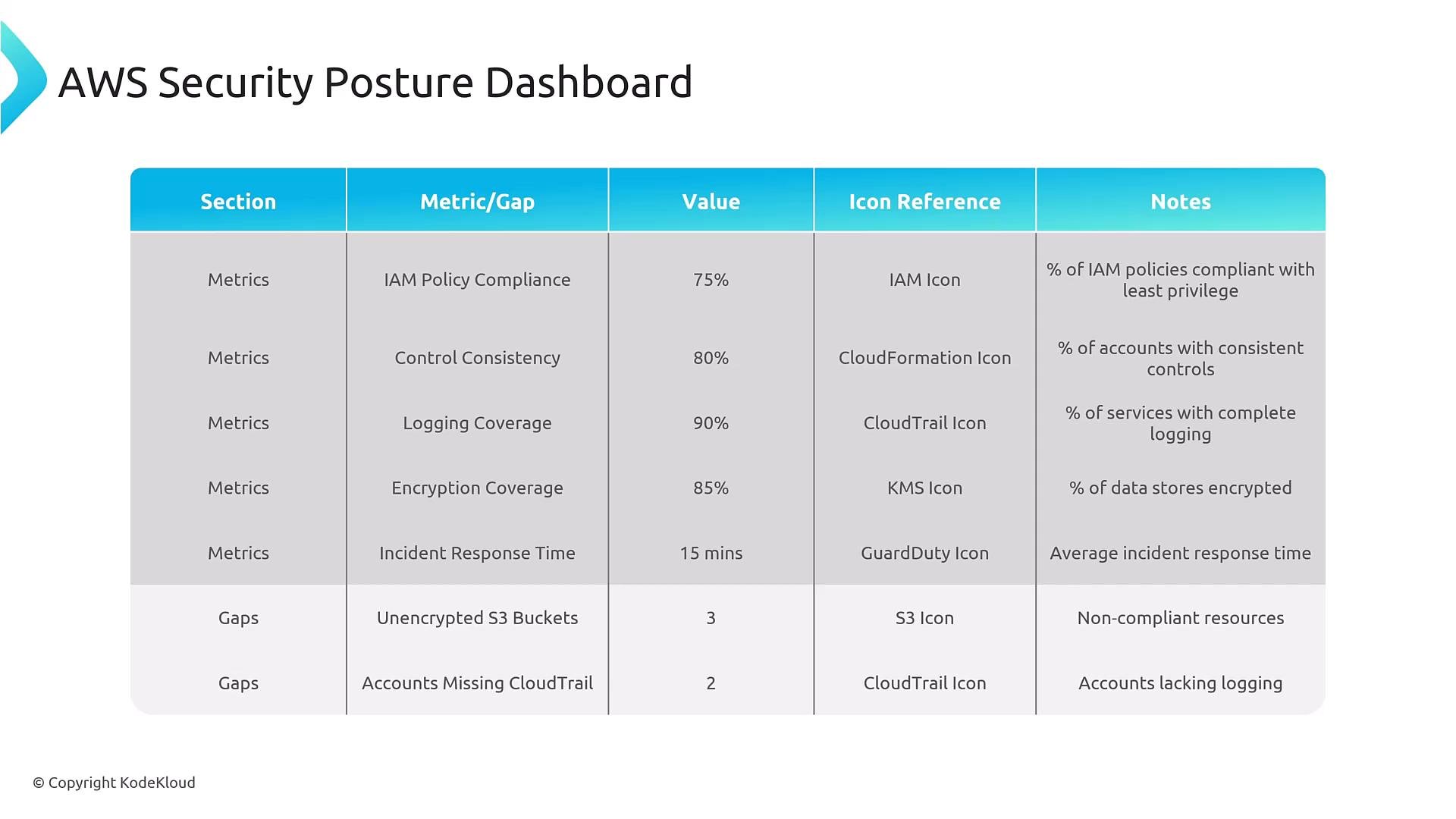
Quick summary
- Shared responsibility: AWS secures the cloud platform; you secure resources and data in the cloud.
- Focus on three pillars: Data protection, Identity & Access Management, and Infrastructure security.
- Automate prevention, detection, and remediation across pipelines and accounts using IaC, policy-as-code, and security testing.
- Use AWS-native centralized services (Organizations, SCPs, CloudTrail, Config, GuardDuty, Security Hub) for guardrails and monitoring.
- Measure posture with dashboards and metrics and continuously close gaps.
Links and references
- AWS Documentation — Shared Responsibility Model
- CloudFormation, CDK, Terraform/OpenTofu, CloudFormation Guard, OPA, Trivy, Checkov (see respective project pages for docs)
- AWS services: AWS Organizations, AWS Config, AWS CloudTrail, AWS Security Hub, Amazon GuardDuty, AWS Systems Manager